Fake Crypto Customer Service Scam (2026): How to Deduct the Loss

Written by Garrett Taylor, CPA #133092
Reviewed by Leanne Grant, EA #00167954-EA
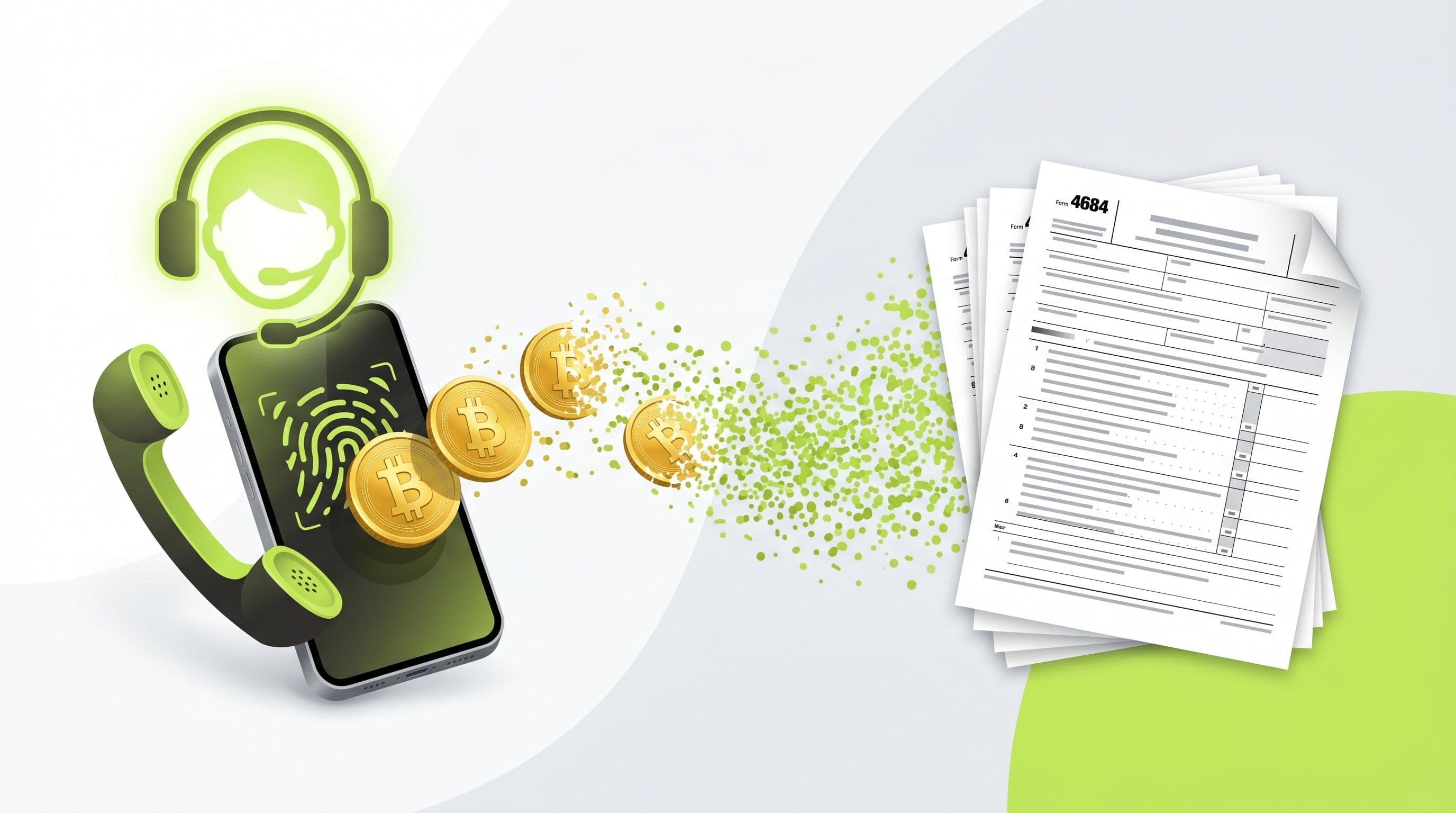
Key Takeaways
- ✓✓A fake crypto customer service scam, where a phony rep gets you to move funds to a 'secure' wallet, is theft. The investment crypto loss is usually deductible under §165(c)(2).
- ✓Scammers spoof real exchange phone numbers and use fake support tickets and urgency to push you into transferring assets before you verify.
- ✓The deduction equals your cost basis in the crypto transferred, claimed in the year of discovery, reported on Form 4684 Section B, then carried to Schedule A.
- ✓✓IRS Chief Counsel Memo 202511015 (Q1 2025) supports the theft-loss position, and these losses fall under §165(c)(2), which the TCJA never suspended.
- ✓A real exchange will never call you to ask for your password, 2FA code, seed phrase, or to move funds to a new wallet. Treat any such request as a scam.
“The cruelest version of this scam tells you that you are about to be robbed, then has you hand over the funds yourself to prevent it.”
A fake crypto customer service scam weaponizes your own caution. A 'representative' from your exchange calls or messages, warns that your account is under attack, and urges you to move your crypto to a new secure wallet right now. The wallet belongs to the scammer. Once you transfer, the funds are gone.
Victims usually assume there is no remedy. There often is one on the tax side. If the crypto you moved was held for investment, the loss can qualify as a deductible theft loss. This guide covers how the scam works and how the deduction works. For the broader framework, start with our crypto scam tax deduction guide.
What Is a Fake Crypto Customer Service Scam?
A fake crypto customer service scam is an impersonation fraud. The scammer poses as support from an exchange or wallet you actually use, claims your account is compromised, and directs you to transfer your assets to a wallet they control, framed as a safety measure. It is sometimes called a compromised account crypto scam because the entire pretext is a fake account breach.
The Coinbase support impersonation version is the most common one I see, simply because so many people hold funds there, but the same script runs against every major platform. The brand changes. The mechanics do not.
How the Scam Unfolds
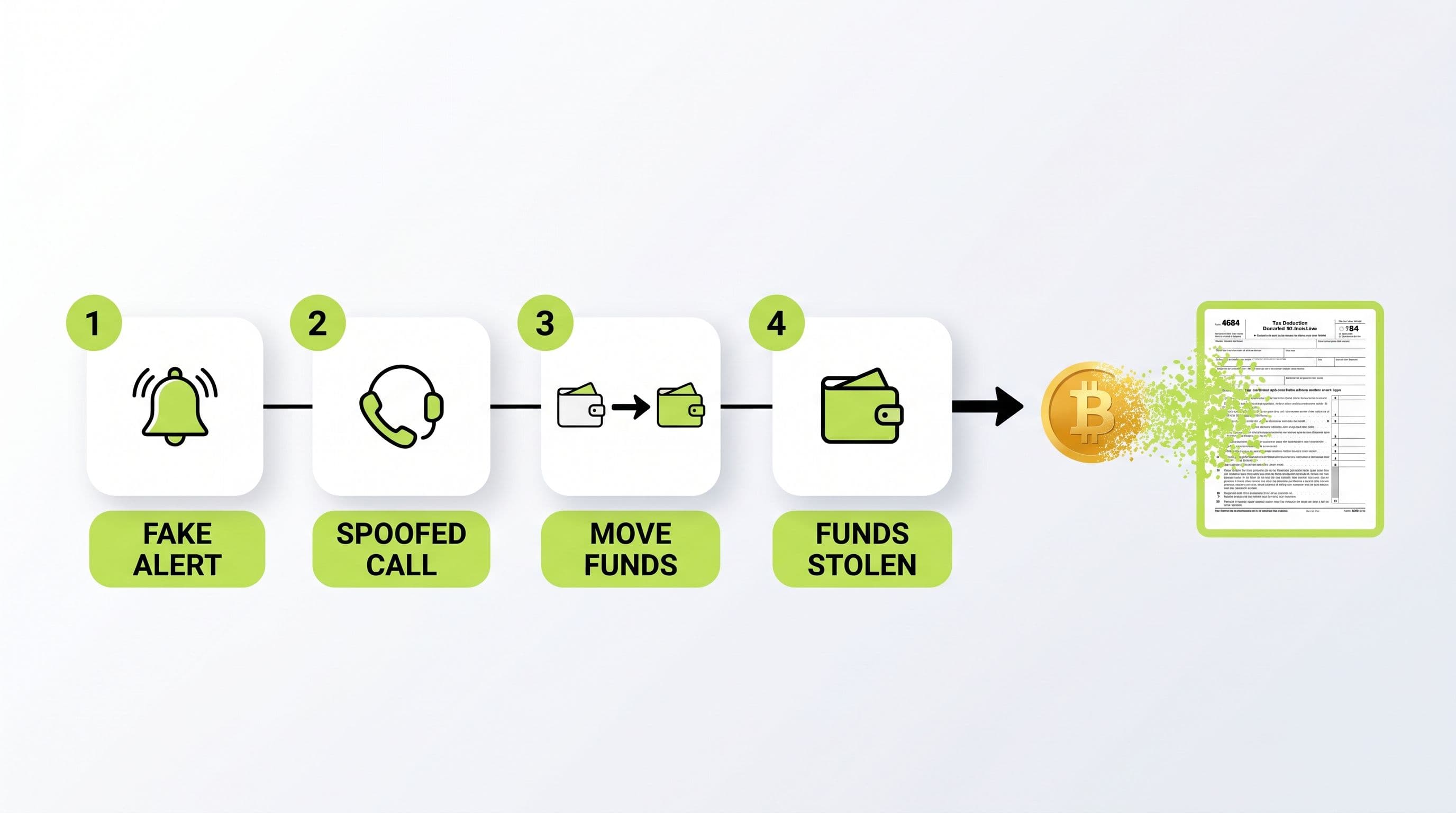
It often starts with a fake security alert by text or email, or an unsolicited call from a spoofed number that matches the real support line. The 'rep' confirms a few details to sound legitimate, then escalates: there is unauthorized activity, your funds are at risk, and the only way to protect them is to move them to a new wallet immediately. They may stay on the phone walking you through each step. The urgency is the weapon. You comply before you verify.
0
Number of times a legitimate exchange will call to ask you to move funds to a new wallet. It does not happen.
Why the Fake Support Scam Is So Convincing
A fake crypto customer service scam works because it arrives dressed as help, not as a threat. You did not seek out a stranger promising riches. Someone reached out to protect you, and protection lowers your defenses far more than a sales pitch ever could. The scammer also controls the tempo. They create a crisis, then position themselves as the only fast way out of it.
The technical props are convincing too. Spoofed caller ID shows the real support number. Fake ticket numbers and case references sound official. Some scammers even read back real recent transactions, scraped from a prior data breach, to prove they are inside your account. None of it is real authority. All of it is theater designed to get you to move your funds.
This is also why a compromised account crypto scam loss is so hard to recover. By the time the panic clears, the funds have moved through wallets you cannot trace and the rep has gone silent. Recovery odds are low, which is exactly why the tax deduction is the most realistic relief available.
Red Flags of a Fake Support Scam
- An unsolicited call, text, or email claiming your crypto account was compromised.
- A caller ID that matches the real support number. Spoofing is trivial and proves nothing.
- Any instruction to move or transfer your funds to a new wallet for safekeeping.
- Requests for your password, 2FA code, or seed phrase, which real support never needs.
- High pressure and a countdown, designed to stop you from hanging up and verifying independently.
Pro Tip
**Hang up and go direct.** If you get a security alert, do not use any number or link from the message. Open the exchange app or type the official URL yourself and contact support through the in-app channel. A spoofed number looking real is the oldest trick in this scam.
Is a Fake Customer Service Scam Loss Tax Deductible?
In most cases, yes. When a scammer deceives you into transferring crypto you held as an investment, the resulting loss is a theft loss under §165(c)(2). IRS Chief Counsel Memo 202511015, released in Q1 2025, supports treating crypto scam losses this way. Because the crypto was an investment holding, the profit-motive requirement is generally satisfied.
This matters because the loss sits under §165(c)(2), the profit-transaction provision, not the personal casualty and theft rules under §165(c)(3) that the Tax Cuts and Jobs Act suspended from 2018 through 2025. The carve-out is what keeps the deduction alive.
The Three Tests, Applied to This Scam
Test 1: Theft Under State Law
Impersonating support to trick you into surrendering property is fraud and false pretenses, which qualifies as theft under any state's criminal law. This test is easily met.
Test 2: Profit Motive
The transferred crypto must have been held for investment. For a compromised account crypto scam this is almost always the case, because you were holding the assets as an investment before the scammer moved them out. The profit motive attaches to the crypto you already held.
Test 3: Year of Discovery
You claim the loss in the year you discovered it with no reasonable prospect of recovery. Once funds hit an anonymous wallet and the 'rep' vanishes, recovery is effectively zero, so the discovery year is usually the year the deduction belongs in.
How Much Can You Deduct?
Your deduction is your cost basis in the crypto the scammer caused you to transfer, reduced by anything you later recover. If you moved 1 BTC that you had bought for $30,000, your loss is $30,000 even if BTC was worth more at the time of the transfer. The deductible figure tracks what you paid, not the market value on the day it was stolen.
Measuring the deductible loss
| Fact | Effect on deduction |
|---|---|
| You transferred 1 BTC bought for $30,000 | $30,000 deductible at cost basis |
| BTC was worth $45,000 the day it was stolen | Still $30,000, basis controls the loss |
| You later recovered $5,000 via the exchange | Loss reduced to $25,000 |
| The crypto was in a retirement-style holding for investment | Profit-motive test satisfied |
How to Report the Loss on Form 4684 Section B
- Document your cost basis in the transferred crypto from purchase and exchange records.
- Report the theft on Form 4684 Section B: property stolen, basis, fair market value after the theft of zero, and any recovery.
- Carry the loss to Schedule A as an itemized deduction, which reduces AGI on Form 1040.
- If the loss is larger than your income, track the §172 net operating loss carryforward for future years.
The full step-by-step reporting flow in the pillar guide applies to this scam without modification.
Documentation You Need
- Call logs, voicemails, texts, and emails from the fake support contact.
- The wallet address you were told to send to and every transaction hash.
- Exchange records showing the outbound transfer and your original cost basis.
- Screenshots of the fake security alert or support ticket.
- An IC3 report and a police report filed promptly after you realized the deception.
Pro Tip
**Report it to the real exchange too.** Filing a support ticket with the actual platform does two things: it opens any slim chance of recovery, and it creates a timestamped record of when you discovered the theft, which fixes the deduction year.
A Worked Example
Imagine you hold 0.8 BTC bought for $24,000. You get a call from a number that matches your exchange. The rep says your account is under attack and walks you through moving the BTC to a 'secure recovery wallet.' You transfer it. The wallet is the scammer's, and the funds are gone within the hour. BTC happened to be worth $40,000 that day, but your theft-loss deduction is your $24,000 cost basis. You report it on Form 4684 Section B in the year of discovery. If you recover nothing, that is the year you claim the full $24,000.
Had you kept those funds and they simply fell in value, you would have no deduction until you sold. Because they were stolen through fraud, the theft-loss path under §165(c)(2) is available now.
How This Differs From Related Scams
A fake customer service scam relies on impersonating support and manufactured urgency. If you instead entered credentials or signed a transaction on a fake site, that is closer to a crypto phishing wallet attack. If you were lured onto a fake platform and watched fake gains before you could not withdraw, see the fake crypto investment platform scam. The tax framework is the same across all three, but the facts you document differ.
Tricked by Fake Crypto Support? Let's Talk.
If a fake crypto customer service scam moved your investment funds in 2024, 2025, or 2026, you may have a deductible theft loss under §165(c)(2) and IRS Chief Counsel Memo 202511015. I can review the facts and build a defensible position memo. Bring me the details and I will tell you straight whether the deduction works.
Talk to GarrettFree 15 minute call. No commitment.
Frequently Asked Questions
Frequently Asked Questions
Is stolen crypto from a fake support scam tax deductible?
In most cases, yes. If you held the crypto for investment and a fake support rep deceived you into transferring it, the loss is a theft loss under §165(c)(2), reported on Form 4684 Section B. IRS Chief Counsel Memo 202511015 supports the position.
Can scammers really spoof a real exchange phone number?
Yes. Caller ID spoofing is easy and common, so a number that matches official support proves nothing. Always hang up and contact the exchange through its official app or website.
Will a real crypto exchange ask me to move funds to a new wallet?
Never. No legitimate exchange will call you and instruct you to transfer your crypto to a new wallet, or ask for your password, 2FA code, or seed phrase. Any such request is a scam.
How much can I deduct after this scam?
You deduct your cost basis in the crypto you were tricked into transferring, reduced by any amount you recover. The market value on the day of the theft does not set the deduction, your basis does.
What year do I claim the loss?
You claim it in the year you discovered the theft with no reasonable prospect of recovery, which is usually the year the funds left and the fake rep disappeared.

About the author
Garrett Taylor, CPA
Former Big Four CPA. CPA #133092. Garrett answers his phone. Led by expertise. Powered by precision.
Related Articles

Crypto Scam Tax Deduction (2026): A CPA's Guide to Writing It Off
If you lost crypto to a pig butchering scam, phishing attack, or rug pull, you probably have a deductible loss. IRS Chief Counsel Memo 202511015 made the rules clear in 2025. Most CPAs still won't file it. Here's the framework that works.

Crypto Phishing Scam (2026): Claiming the Wallet-Drain Loss on Your Taxes
A crypto phishing scam can empty a wallet in one signature. If the drained crypto was held for investment, that loss is often deductible. Here is how the theft-loss rules apply and how to claim it.

Fake Crypto Investment Platform Scam (2026): Deducting the Loss
A fake crypto investment platform shows you climbing profits you can never withdraw. If you invested for profit, that loss is often deductible. Here is how the theft-loss rules apply.