Fake Crypto Investment Platform Scam (2026): Deducting the Loss

Written by Garrett Taylor, CPA #133092
Reviewed by Leanne Grant, EA #00167954-EA

Key Takeaways
- ✓✓A fake crypto investment platform loss is usually a deductible theft loss under §165(c)(2) because you transferred funds with a profit motive. IRS Chief Counsel Memo 202511015 supports it.
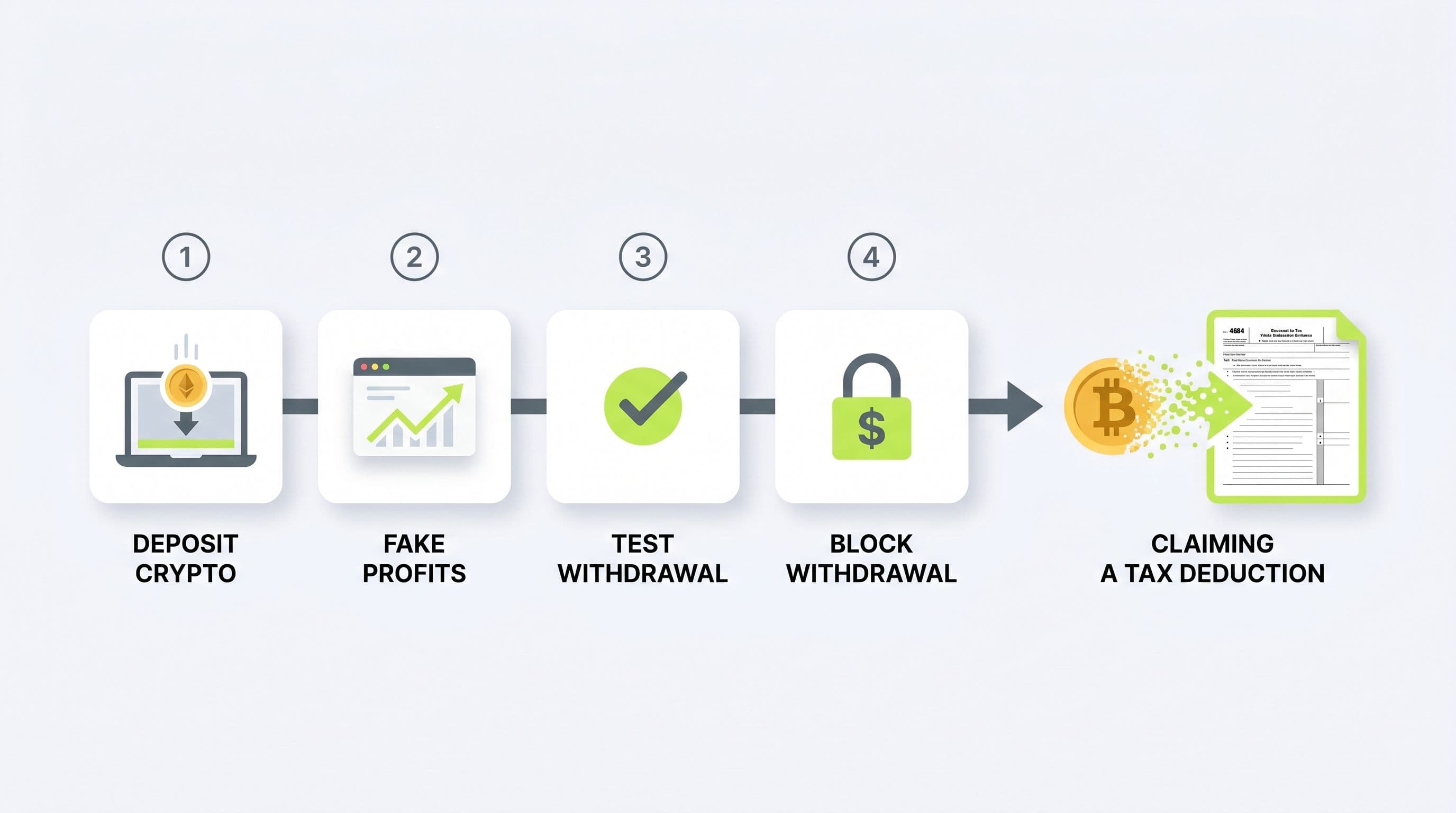
- ✓These platforms show fake climbing balances, allow a small test withdrawal, then block real withdrawals behind endless fees and taxes before vanishing.
- ✓The deductible amount is your cost basis in the crypto you sent, not the inflated on-screen profit. Claim it in the year of discovery on Form 4684 Section B.
- ✓✓The profit-motive test is the dividing line. An investment loss qualifies, but funds sent purely as a romantic gift do not. Mixed cases need careful fact development.
- ✓Document the platform, the deposits, the failed withdrawals, and file an IC3 report. The same records prove the theft and anchor the deduction year.
“The platform looked institutional, the dashboard updated in real time, and the balance only went up. None of it was real except the crypto the victim sent out.”
A fake crypto investment platform is built to look exactly like the real thing. Sleek dashboard, live charts, a support chat, even regulatory badges. You deposit, the balance climbs, and for a while everything works. Then the withdrawals stop, the fees appear, and the platform disappears with your money.
Victims often believe a bad investment is simply a bad investment, with no tax relief. That is wrong when the platform was a fraud. A fake crypto investment platform loss is generally a theft loss, and theft losses on profit-motivated holdings are deductible. This guide explains how the scam works, how the deduction works, and the one test that decides whether you qualify. For the complete framework, see our crypto scam tax deduction guide.
What Is a Fake Crypto Investment Platform Scam?
A fake crypto investment platform scam uses a fraudulent trading or staking site to take your deposits while showing you fabricated profits. The site is a facade. Behind the dashboard there is no real trading, no real custody, and no real money managed on your behalf. There is only a record of what you sent in and a screen designed to keep you sending more.
It overlaps heavily with the pig butchering scam, which often funnels victims onto exactly this kind of fake platform after a grooming period. The difference is mainly the entry point. Pig butchering leads with a relationship. A fake platform scam can also reach you through a slick ad, a fake exchange listing, or a referral, with no romance involved at all.
The Anatomy of the Fraud
First you are pointed to the platform and open an account. You deposit a modest amount and watch it grow. You request a small withdrawal and it succeeds, which removes your doubt. Encouraged, you deposit far more. The balance shows large gains. When you try to withdraw a serious sum, the platform demands a withdrawal fee, then a tax, then a liquidity deposit. Each payment unlocks another demand. Eventually the site goes dark.
Pro Tip
**A platform that taxes withdrawals is a scam.** No legitimate exchange requires you to prepay income tax or a 'liquidity fee' to release funds you already hold. The moment a withdrawal triggers a new payment demand, stop sending money and start documenting.
Why People Trust a Fake Crypto Investment Platform
A fake crypto investment platform is a confidence trick built on production value. The interface is polished, the charts move in real time, and the early returns are real enough to feel safe. The scammers spend real money on design precisely because a believable dashboard is the cheapest way to unlock large deposits. When the numbers on screen keep climbing, your brain reads it as proof, not as a prop.
The small successful withdrawal is the master stroke. By letting you pull out a little early, the platform converts a skeptic into an evangelist. You stop testing and start trusting, and trust is what they monetize. Many victims even recruit friends and family, which is how a single fake platform scam spreads across a network of people who all lose together.
Once you understand that the entire platform exists to take deposits, the red flags become obvious in hindsight. The goal is to see them before you send, not after.
Red Flags of a Fake Investment Platform
- Guaranteed or unusually high returns with little or no risk.
- A platform you were steered to privately rather than one you researched independently.
- A small early withdrawal that works, followed by pressure to deposit much more.
- Withdrawal requests blocked behind fees, taxes, or minimum-balance requirements.
- Vague company details, no verifiable registration, and support that only exists in chat.
Is a Fake Investment Platform Loss Tax Deductible?
In most cases, yes. When you send crypto to what you believe is a legitimate investment platform and it turns out to be a fraud, the loss is a theft loss under §165(c)(2). You acted with a profit motive, you were deceived by criminal fraud, and the property was unlawfully taken. IRS Chief Counsel Memo 202511015, released in Q1 2025, supports treating these scam losses as deductible.
The loss falls under §165(c)(2), the provision for transactions entered into for profit, not the personal casualty and theft rules the Tax Cuts and Jobs Act suspended through 2025. That distinction is the entire reason the deduction survives.
The Profit-Motive Test: The Line That Decides Everything
For a fake investment platform scam, the decisive test is profit motive. You must have transferred the crypto intending to grow or maintain an investment. When the whole point was investing through a platform, this is straightforward.
The test fails when the transfer was personal. If you sent crypto as a gift to a romantic interest, to pay a ransom, or to help someone, there is no profit motive and no §165(c)(2) deduction. Romance scams are the painful example. Victims feel they were investing through the relationship, but courts treat romance-driven transfers as personal.
Does the profit-motive test pass?
| What you intended | Deductible under §165(c)(2)? |
|---|---|
| Invest through what you believed was a real platform | Yes, profit motive present |
| Stake or trade for yield on a fake exchange | Yes, profit motive present |
| Send crypto as a gift to a romantic partner | No, personal transfer |
| Mix of relationship plus a 'platform' they introduced | Depends, facts must show investment intent |
If your situation blends a relationship with a platform, do not assume the answer either way. Get the facts reviewed before you file, because this is exactly where a clean deduction or a denied one is decided.
How Much Can You Deduct?
Your deduction is your cost basis in the crypto you actually sent to the platform, plus any additional crypto you paid in fake fees or taxes, reduced by anything you recovered. The inflated profit the dashboard displayed is fiction and is never part of the deduction.
If you sent crypto that originally cost you $50,000, paid another $6,000 of crypto in fake withdrawal taxes, and saw a $300,000 balance before the site vanished, your deductible loss is $56,000, not $300,000. The phantom gain was never yours.
A Worked Example
You move crypto worth $120,000 onto a fake crypto investment platform over several months. The crypto originally cost you $70,000. The dashboard eventually shows a balance of $480,000. When you try to withdraw, the platform demands a 15% 'withdrawal tax,' so you send another $18,000 of crypto, which had cost you $11,000. Then the site goes dark. Your deductible theft loss is your cost basis in everything you sent, which is $70,000 plus $11,000, for $81,000. The $480,000 was never real. Neither was the gain you were taxed nothing on because it never existed.
If $81,000 exceeds your taxable income in the year of discovery, the excess carries forward under §172 and keeps reducing your taxes in future years until it is used up.
Theft Loss vs. Capital Loss on a Fake Platform
Some taxpayers try to force a fake platform loss onto Schedule D as a capital loss. That is usually the wrong form. A capital loss requires a sale or disposition of an asset you owned. In a fake platform scam there was no real asset and no real sale, only a fraudulent taking. That is a theft loss under §165(c)(2), reported on Form 4684 Section B, which is generally more favorable because it is an ordinary deduction.
How to Report the Loss
- Total your cost basis in all crypto sent to the platform, including fake fees and taxes paid in crypto.
- Report the theft on Form 4684 Section B, with basis in, fair market value after the theft of zero, and any recovery.
- Carry the loss to Schedule A as an itemized deduction, reducing AGI on Form 1040.
- If the loss exceeds your income, track the §172 carryforward, which can offset up to 80% of taxable income in future years.
The detailed reporting walkthrough in the pillar guide applies directly here.
Documentation That Substantiates the Loss
- The platform URL, account screenshots, and your balance history.
- Every deposit, with transaction hashes and the receiving wallet addresses.
- All withdrawal attempts and the fee, tax, or liquidity demands that blocked them.
- Communications with the platform, any 'account manager,' and the referral source.
- An IC3 report and police report filed soon after discovery to fix the theft and the year.
Pro Tip
**Capture the site before it disappears.** Fake platforms go offline without warning. Save full-page screenshots, the URL, and your transaction records now, while they exist. That evidence is what turns a defensible deduction into an easy one.
Lost Funds on a Fake Crypto Platform? Let's Talk.
If a fake crypto investment platform took your funds in 2024, 2025, or 2026, you may have a deductible theft loss under §165(c)(2) and IRS Chief Counsel Memo 202511015. I can test the profit-motive facts and build a defensible position memo. Bring me your details and I will tell you straight whether the deduction works.
Talk to GarrettFree 15 minute call. No commitment.
Frequently Asked Questions
Frequently Asked Questions
Is a fake crypto investment platform loss tax deductible?
In most cases, yes. If you sent crypto intending to invest and the platform was a fraud, the loss is a theft loss under §165(c)(2), reported on Form 4684 Section B. IRS Chief Counsel Memo 202511015 supports the position. The deductible amount is your cost basis in the crypto you sent.
Why can't I withdraw my profits from the platform?
Because the profits are fabricated. A fake platform shows a rising balance to keep you depositing, then blocks withdrawals behind fees, taxes, or liquidity demands that never end. The only real money is what you sent in.
What is the difference between a theft loss and a capital loss here?
A capital loss requires selling a real asset you owned. A fake platform scam involves no real asset and no real sale, just a fraudulent taking, so it is a theft loss on Form 4684 Section B, not a capital loss on Schedule D.
Does a fake platform loss qualify if a romantic partner introduced it?
It depends on the facts. If you can show you transferred the crypto to invest for profit, it can qualify. If the transfers were really personal gifts to a partner, the profit-motive test fails. Mixed cases should be reviewed before filing.
What form do I use to report the loss?
Form 4684 Section B for the theft loss, which flows to Schedule A and then to Form 1040. Any excess over income carries forward as a net operating loss under §172.

About the author
Garrett Taylor, CPA
Former Big Four CPA. CPA #133092. Garrett answers his phone. Led by expertise. Powered by precision.
Related Articles

Crypto Scam Tax Deduction (2026): A CPA's Guide to Writing It Off
If you lost crypto to a pig butchering scam, phishing attack, or rug pull, you probably have a deductible loss. IRS Chief Counsel Memo 202511015 made the rules clear in 2025. Most CPAs still won't file it. Here's the framework that works.

Pig Butchering Scam (2026): How to Write Off the Loss on Your Taxes
A pig butchering scam can wipe out a life savings. The lesser-known part: that loss is often deductible. Here is how the §165(c)(2) theft-loss rules apply to pig butchering, and how to actually claim it.

Fake Crypto Customer Service Scam (2026): How to Deduct the Loss
A fake crypto customer service rep convinces you to move your funds to a 'safe' wallet, then takes them. That loss is often a deductible theft loss. Here is how the tax rules apply.