Pig Butchering Scam (2026): How to Write Off the Loss on Your Taxes

Written by Garrett Taylor, CPA #133092
Reviewed by Leanne Grant, EA #00167954-EA

Key Takeaways
- ✓✓A pig butchering scam loss is usually a deductible theft loss under §165(c)(2), not a dead loss you simply eat. IRS Chief Counsel Memo 202511015 (Q1 2025) supports the position.
- ✓The deduction works when three tests are met: the loss is theft under your state law, the transfer was profit-motivated, and you claim it in the year you discovered there was no reasonable prospect of recovery.
- ✓Your deduction is your cost basis, the crypto you actually sent. The big balance the fake platform showed you on screen is fiction and is irrelevant for tax.
- ✓✓The loss goes on Form 4684 Section B, flows to Schedule A, and reduces your AGI dollar for dollar. A large loss can carry forward under §172.
- ✓Documentation wins or loses the case. Save the withdrawal denials, the chat logs, the wallet addresses, and file an IC3 report to anchor your discovery date.
“Pig butchering is the single most common crypto scam I see, and it is also the one where victims most often leave a legitimate tax deduction on the table.”
Of every crypto scam that walks through my door, pig butchering is the most common by a wide margin. The losses are large, the stories are devastating, and the victims usually arrive convinced that the money is simply gone. The money is gone. The deduction does not have to be.
This guide explains what a pig butchering scam is, how it actually works, and the part almost no one talks about: when and how that loss becomes a deductible theft loss on your tax return. If you want the full multi-scam framework, start with our pillar guide on the crypto scam tax deduction. This article is the deep dive on pig butchering specifically.
What Is a Pig Butchering Scam?
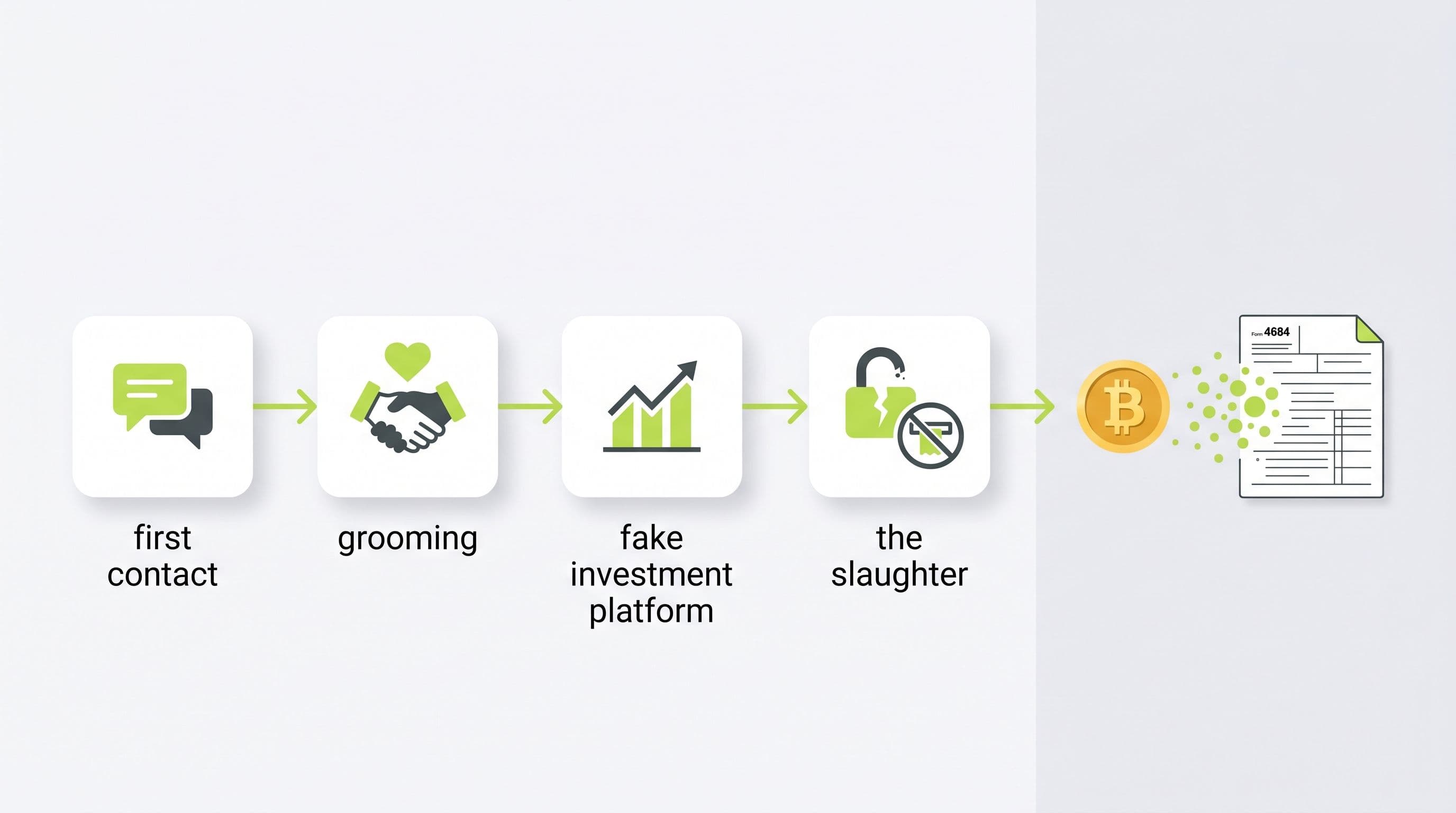
A pig butchering scam is a long-game crypto investment fraud where the scammer builds a relationship with you, points you to a fake trading platform, lets you watch fake profits grow, and then takes everything when you try to withdraw. The name is a translation of the Chinese term sha zhu pan, which describes fattening a pig before slaughter. You are the pig. The fattening is the fake gains. The slaughter is the moment the platform goes dark.
It is a hybrid. Part romance baiting, part cryptocurrency investment fraud, part patient social engineering. The scammer is rarely in a rush, and that patience is exactly what makes a pig butchering scam so effective and so expensive.
$4B+
Estimated annual losses tied to pig butchering and related crypto investment scams, per blockchain forensics reporting.
How a Pig Butchering Scam Works, Step by Step
Almost every pig butchering scam I review follows the same four-phase playbook. Recognizing the structure matters, because the tax treatment turns on the facts of each phase.
Phase 1: First Contact
It starts with a wrong-number text, a friendly LinkedIn message, a dating-app match, or a new follower who slides into your DMs. The opener feels accidental and harmless. There is no pitch yet. The only goal is to start a conversation.
Phase 2: Grooming
Over days or weeks, the contact becomes a friend, a mentor, or a romantic interest. They share photos, life updates, and eventually a story about how well they are doing trading crypto. The trust is real even though the person is not. This grooming phase is what separates a pig butchering scam from a quick hit.
Phase 3: The Investment Pitch
Now comes the fake crypto trading platform. It looks polished. It shows live charts, a real-looking dashboard, and a balance that climbs after every deposit. You start small, see a gain, withdraw a little to test it, and the withdrawal works. That small successful withdrawal is the hook. You send more. The number on the screen grows.
Phase 4: The Slaughter
When you try to withdraw a meaningful amount, it fails. Suddenly there are withdrawal fees, taxes, or liquidity requirements you must pay first. You pay them. More demands follow. Eventually the platform stops responding, the login breaks, and your mentor disappears. The on-screen balance was always fabricated. The only real money was the crypto you sent out.
Pro Tip
**The successful test withdrawal is bait, not proof.** Scammers return a small amount early precisely so you trust the platform with a much larger deposit. A real exchange does not require you to pay a fee or a tax to release funds you already hold.
Why Pig Butchering Scams Work So Well
A pig butchering scam is not a single lie. It is a sequence of small, believable steps, each one reasonable on its own. That is why intelligent, careful people fall for it. The scammer never asks for everything at once. They ask for a little, deliver a small win, and let your own optimism do the rest. By the time the demands turn aggressive, you have already invested weeks of trust and a growing balance you do not want to abandon.
The scale is staggering. These operations are often run from industrial scam compounds in Southeast Asia, frequently staffed by trafficking victims who are themselves coerced into running the scripts. The result is a professionalized, around-the-clock fraud machine. That industrial scale is also why a pig butchering scam loss is so rarely recovered, and why the tax deduction matters so much to victims.
No one is immune. I have worked with retirees, software engineers, physicians, and finance professionals who all fell for the same playbook. The common thread is not gullibility. It is the patient manufacture of trust paired with a platform engineered to look exactly like a legitimate investment.
Red Flags of a Pig Butchering Scam
- An unsolicited contact that pivots from friendly chat to crypto investing.
- A trading platform you were introduced to privately, not one you found and vetted yourself.
- Screenshots of huge returns and pressure to deposit more before an opportunity closes.
- Withdrawals that suddenly require fees, taxes, or a minimum balance before release.
- A partner or mentor who avoids live video, or whose story keeps shifting.
The Part No One Tells You: Your Pig Butchering Loss May Be Tax Deductible
Here is the development that most security blogs and even most CPAs miss. In Q1 2025, the IRS Office of Chief Counsel released Memorandum 202511015. It supports treating crypto scam losses as deductible theft losses under Internal Revenue Code §165(c)(2), the provision for losses from a transaction entered into for profit.
This matters because from 2018 through 2025 the Tax Cuts and Jobs Act suspended most personal casualty and theft losses under §165(c)(3). Many preparers assumed a pig butchering scam loss fell into that suspended bucket and was therefore not deductible. The memo points the other way. A profit-motivated investment loss lives under §165(c)(2), which was never suspended, and gets reported on Form 4684 Section B.
Chief Counsel Memoranda are advisory, not binding regulation. But they reflect the official IRS position and courts give them weight. For a clean pig butchering fact pattern, that is usually enough to support a defensible deduction.
The Three Tests Your Pig Butchering Loss Must Pass
Test 1: Theft Under State Law
The loss must qualify as theft under your state's criminal law, which covers fraud, false pretenses, swindling, and larceny by trick. A pig butchering scam clears this easily. You were deceived into transferring property by someone with criminal intent. That is textbook theft in every state.
Test 2: Profit Motive
You must have sent the crypto intending to grow or maintain an investment. With pig butchering, you believed you were investing in a real trading platform, so the profit motive is usually clear. The danger zone is the romance overlay. If a court concludes you sent crypto as a gift to a romantic partner rather than as an investment, the profit-motive test can fail. The facts have to show investment intent, which is why your chat logs and platform screenshots matter so much.
Test 3: Year of Discovery, No Reasonable Prospect of Recovery
You claim the loss in the year you discovered the scam with no reasonable prospect of recovery, not the year you first sent funds. If you deposited across 2024 and 2025 and only realized in 2025 that withdrawal was impossible, the whole loss is generally a 2025 loss. If law enforcement is actively pursuing seized funds with a real chance of return, you may need to wait.
How Much Can You Deduct? Cost Basis, Not the Fake Balance
This is the number one error I correct. Your deduction is your cost basis in the crypto you actually sent to the scam, not the inflated balance the fake platform displayed.
What you can deduct vs. what you cannot
| Scenario | Deductible amount |
|---|---|
| You bought 2 ETH for $4,000 and sent it to the fake platform | $4,000 (your cost basis) |
| The fake platform showed your balance had grown to $80,000 | $0 of the phantom gain is deductible |
| You paid an extra $1,500 in fake 'withdrawal taxes' from new crypto | $1,500 added to basis of crypto sent |
| You recovered $1,000 through law enforcement | Loss is reduced by the $1,000 recovered |
The fabricated screen balance never existed, so it is never deductible. The discipline of sticking to real cost basis is what keeps the position defensible if the IRS asks.
How to Report a Pig Butchering Loss on Form 4684 Section B
- Complete Form 4684, Section B, the part for income-producing and profit-motivated property. Report the crypto sent, its cost basis, fair market value before (basis) and after (zero), and any recovery.
- Carry the resulting loss to Schedule A as an itemized deduction. You must itemize to use it.
- The Schedule A total flows to Form 1040 and reduces your adjusted gross income dollar for dollar.
- If the loss exceeds your income, the excess becomes a net operating loss under §172 and carries forward indefinitely, offsetting up to 80% of taxable income in future years.
For the complete reporting flow that applies across every scam type, see the crypto scam tax deduction pillar guide. The mechanics there apply directly to pig butchering.
Documentation That Makes the Deduction Hold Up
- Screenshots of the fake platform, your balance, and every failed withdrawal attempt.
- The full chat history with the scammer, especially anything showing investment intent.
- Wallet addresses and transaction hashes for every transfer you made.
- Bank or exchange records showing the crypto you purchased and sent.
- An IC3 report (ic3.gov) and a local police report filed soon after discovery, which anchor your discovery date.
Pro Tip
**File the IC3 report within days of discovery.** It is not strictly required by the IRS, but a contemporaneous report is strong evidence of both the theft and the date you realized recovery was hopeless, which is the year your deduction belongs in.
Pig Butchering vs. Romance Scams: The Tax Line
A pure romance scam, where you send crypto as a gift or to help a partner, generally fails the profit-motive test and is not deductible under §165(c)(2). A pig butchering scam, where you believed you were investing through a platform, generally passes. Many real cases sit in the middle. If your situation blends a relationship with an investment platform, the facts need to be developed carefully before you claim anything. If your loss came through a slick fake platform rather than a person, our guide on the fake crypto investment platform scam covers that variant in detail.
Lost Crypto to a Pig Butchering Scam? Let's Talk.
If you lost crypto to a pig butchering scam in 2024, 2025, or 2026, you may have a significant deduction under §165(c)(2) and IRS Chief Counsel Memo 202511015. I have filed dozens of these returns and can build a defensible position memo. Bring me your facts and I will tell you straight whether the deduction works.
Talk to GarrettFree 15 minute call. No commitment.
Frequently Asked Questions
Frequently Asked Questions
Is a pig butchering scam loss tax deductible?
In most cases, yes. A pig butchering scam loss generally qualifies as a theft loss under §165(c)(2) because it involves criminal fraud and you transferred the crypto with a profit motive. IRS Chief Counsel Memo 202511015 supports the position. You report it on Form 4684 Section B in the year you discovered the loss with no reasonable prospect of recovery.
How much of my pig butchering loss can I deduct?
You deduct your cost basis in the crypto you actually sent, reduced by any amount you recover. The inflated balance the fake platform showed you is fabricated and is never deductible.
What year do I claim a pig butchering loss?
You claim it in the year you discovered the scam with no reasonable prospect of recovery, which is usually the year withdrawals permanently failed and the platform went dark, not the year you first deposited.
How is pig butchering different from a romance scam for taxes?
Pig butchering is treated as a profit-motivated investment loss, which is deductible under §165(c)(2). A pure romance scam, where you sent crypto as a gift, generally fails the profit-motive test and is not deductible. Mixed cases need careful fact development.
Do I need a police report to deduct a pig butchering loss?
It is not strictly required, but an IC3 report and a police report filed soon after discovery strongly support both the theft element and your discovery-year timing. File something within days of realizing the loss.

About the author
Garrett Taylor, CPA
Former Big Four CPA. CPA #133092. Garrett answers his phone. Led by expertise. Powered by precision.
Related Articles

Crypto Scam Tax Deduction (2026): A CPA's Guide to Writing It Off
If you lost crypto to a pig butchering scam, phishing attack, or rug pull, you probably have a deductible loss. IRS Chief Counsel Memo 202511015 made the rules clear in 2025. Most CPAs still won't file it. Here's the framework that works.

Fake Crypto Investment Platform Scam (2026): Deducting the Loss
A fake crypto investment platform shows you climbing profits you can never withdraw. If you invested for profit, that loss is often deductible. Here is how the theft-loss rules apply.

Crypto Phishing Scam (2026): Claiming the Wallet-Drain Loss on Your Taxes
A crypto phishing scam can empty a wallet in one signature. If the drained crypto was held for investment, that loss is often deductible. Here is how the theft-loss rules apply and how to claim it.