How to Choose a Crypto Tax CPA in 2026 (From a CPA Who Files 500+ Crypto Returns a Year)

Written by Garrett Taylor, CPA #133092
Reviewed by Leanne Grant, EA #00167954-EA

Key Takeaways
- ✓✓Not all CPAs are qualified to handle crypto taxes. Most have never filed a single tax return containing crypto transactions.
- ✓A crypto tax CPA should hold an active license, have 100+ crypto returns filed, and understand DeFi and staking.
- ✓✓Expect to pay $800-$2,500 for standard returns and $2,500-$10,000+ for complex portfolios.
- ✓✓The biggest red flag: a CPA who defaults to FIFO without modeling alternatives or doesn't intricately understand Form 8949.
- ✓For portfolios over $100K, a specialized crypto CPA typically saves 3-5x their fee in tax optimization.
“This guide has been reviewed for accuracy by Leanne Grant, Enrolled Agent, specializing in cryptocurrency tax compliance and IRS representation.”
Choosing the wrong crypto tax CPA can cost you more than not hiring one at all.
That's not an exaggeration.
We've cleaned up returns from CPAs who didn't know the difference between FIFO and specific identification. We've seen "crypto-savvy" accountants who reported staking rewards as capital gains instead of ordinary income. We've fixed returns where a CPA forgot to file Form 8949 correctly, triggering a $47,000 IRS notice.
Here's the uncomfortable truth: most CPAs don't know crypto. The ones who claim to often know just enough to be dangerous.
In this guide, I'll show you exactly how to find a CPA who actually knows what they're doing with crypto taxes. The 10 questions to ask. The red flags to watch for. What it should cost. And when you need a CPA vs. an EA vs. a tax attorney.
Why You Can't Use "Any" CPA for Crypto Taxes
Let's start with what makes crypto tax different from everything else a CPA handles.
Traditional taxes involve W-2s, 1099s, standard deductions, maybe some rental income. Your neighborhood CPA has been filing these for 30 years. They're good at it.
Crypto taxes involve:
- Hundreds or thousands of individual transactions, each a potential taxable event
- Multiple cost basis methods (FIFO, LIFO, HIFO, specific identification) that can swing your tax bill by tens of thousands of dollars
- DeFi protocols that generate transactions your CPA has never seen before (liquidity pools, yield farming, wrapping, bridging)
- Staking rewards that the IRS treats as ordinary income (but that many CPAs misclassify)
- Cross-chain transactions that don't show up on any single exchange statement
- New reporting requirements like Form 1099-DA that went live for 2025 tax year
- Active IRS enforcement (Operation Hidden Treasure, John Doe summonses to exchanges)
A generalist CPA is as qualified to handle your crypto taxes as a family doctor is to perform heart surgery. Same license. Very different skill set.
93%
of IRS crypto notices we handle result in a reduced assessment when properly represented by a crypto-specialized CPA.
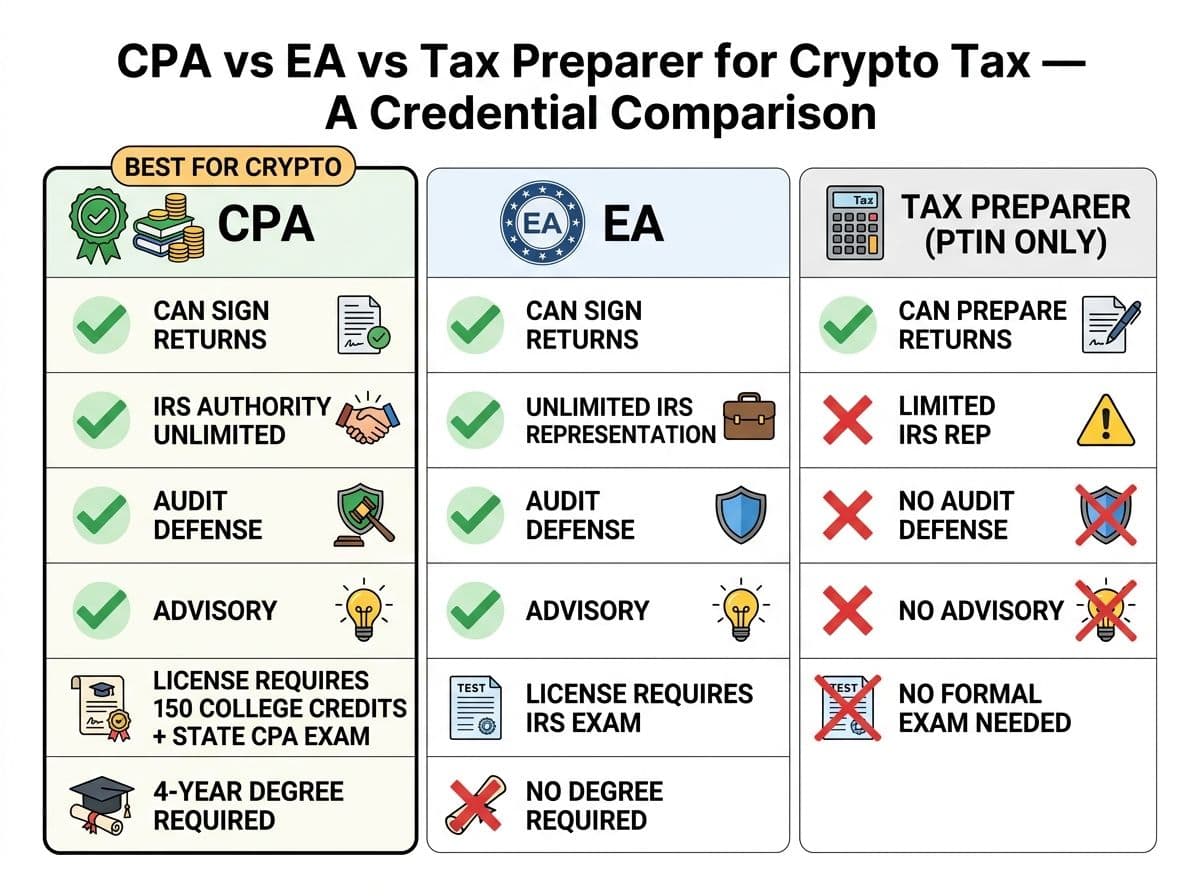
CPA vs. EA vs. Tax Attorney: Who Do You Actually Need?
Before you start searching, understand the three types of tax professionals and what each brings to the table.
CPA vs EA vs Tax Attorney for Crypto Taxes
| Credential | What It Means | Best For | Can Represent You Before IRS? | Typical Crypto Tax Fee |
|---|---|---|---|---|
| CPA (Certified Public Accountant) | State-licensed accountant, passed the CPA exam, meets continuing education requirements | Tax preparation, planning, advisory, financial statement review | Yes (unlimited) | $800-$5,000+ per return |
| EA (Enrolled Agent) | Federally licensed tax practitioner, passed IRS Special Enrollment Exam or former IRS employee | Tax preparation, IRS representation, controversy | Yes (unlimited) | $300-$3,000 per return |
| Tax Attorney | Law degree + bar admission, specializes in tax law | Tax litigation, criminal defense, complex entity structuring, offshore issues | Yes (unlimited) | $400-$800/hour |
Here's the decision framework we use with our own clients:
You need a CPA if:
- You want comprehensive tax preparation and filing
- You need tax planning advice (entity structuring, cost basis optimization, estimated payments)
- You have a straightforward to moderately complex crypto portfolio
- You want someone who files the return AND advises on strategy
You need an EA if:
- Your primary need is IRS representation (you got a notice or are being audited)
- You want a tax-focused specialist without the broader accounting scope
- Budget is a factor (EAs typically charge 20-40% less than CPAs for the same work)
You need a tax attorney if:
- You have potential criminal exposure (willful non-reporting, large unreported amounts)
- You're involved in a token launch or ICO with securities implications
You might need both a CPA and an attorney if:
- You have an IRS criminal investigation pending
- Your portfolio exceeds $10M with complex entity structures
- You're a crypto business founder with payroll, treasury, and token economics
Pro Tip
For 80% of individual crypto investors, a crypto-specialized CPA is the right call. You get tax preparation, planning, and IRS representation in one relationship. An EA is a strong alternative if you're primarily dealing with an IRS notice. A tax attorney is overkill for most individual situations but essential for business-level complexity or criminal exposure.
The 10 Questions to Ask Before Hiring a Crypto Tax CPA
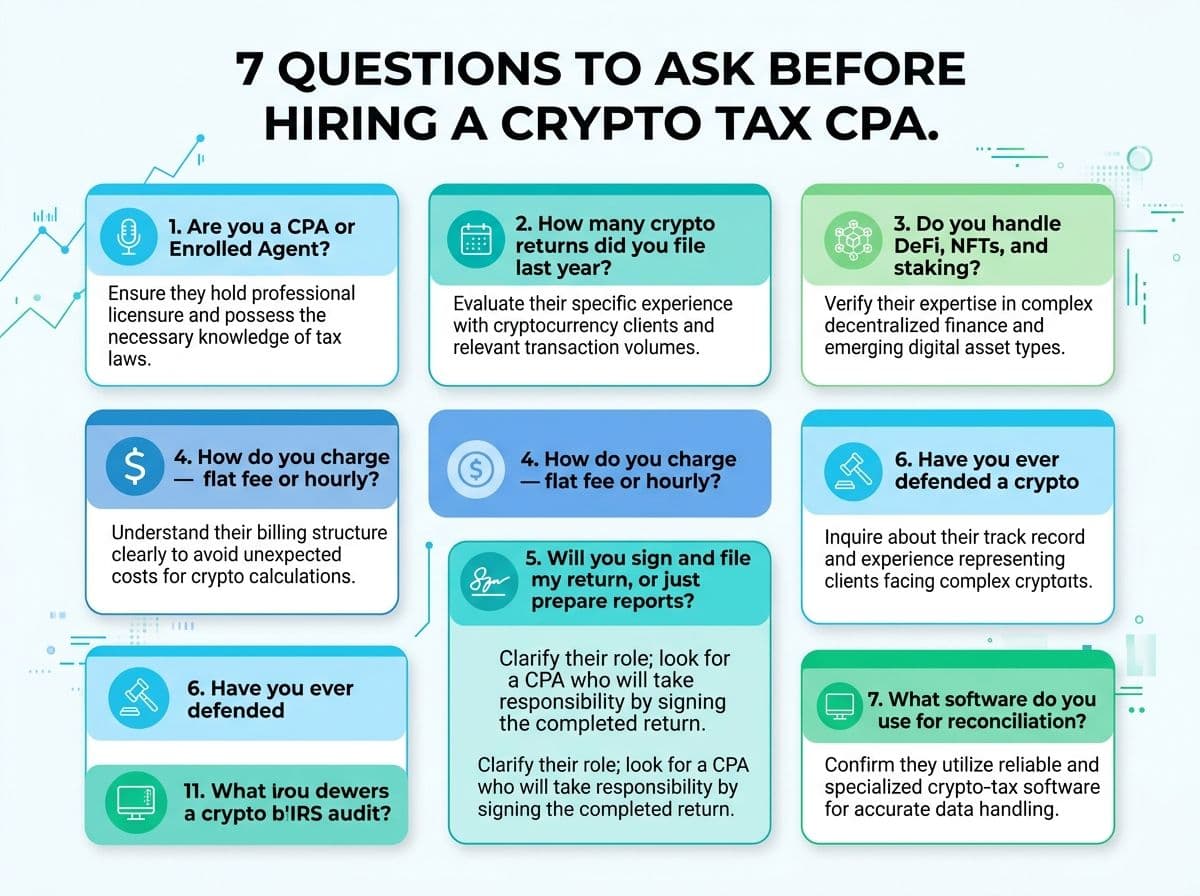
These are the exact questions we'd want a prospective client to ask us. If any CPA can't answer them clearly, keep looking.
1. "How many tax returns did you file last year with crypto transactions?"
Good answer: A specific number. "About 200" or "over 500." They should be able to tell you without thinking about it.
Red flag: "We handle some crypto clients" or "I've been getting into that space." This means single digits. Maybe zero.
2. "What crypto tax software do you use for reconciliation?"
Good answer: They name specific platforms (CoinTracker, Koinly, CoinTracking, CoinLedger) and explain their workflow. Bonus if they mention using multiple tools for different client profiles.
Red flag: "The client provides their own numbers" or "we use Excel." Run!
3. "How do you handle DeFi transactions?"
Good answer: They describe a specific process: importing on-chain data, categorizing LP entries/exits, handling yield farming income, recategorizing wrapped tokens. They know the difference between a swap and a send-to-pool.
Red flag: "DeFi is... what exactly?" or "We treat everything as capital gains." Disaster.
4. "What cost basis method do you recommend, and why?"
Good answer: "It depends on your situation. HIFO usually minimizes current-year tax, but specific identification gives us the most control. We model multiple methods and show you the comparison before we file."
Red flag: "We use FIFO for everyone." This is lazy. FIFO is the IRS default, but it's almost never the optimal choice.
5. "How do you handle staking and mining income?"
Good answer: "Staking rewards are ordinary income at FMV on the date received, per IRS guidance. We track the Jarrett v. US case and advise clients on whether to take the position that staking is taxable at disposition. Mining income goes on Schedule C if it's a trade or business, Schedule 1 if it's a hobby."
Red flag: "We report staking as capital gains when you sell." Wrong. This misses the income event entirely.
6. "What's your experience with IRS crypto notices?"
Good answer: They share specific stats or examples (anonymized). "We handled 40 CP2000s last year with an average 85% reduction." They know what a CP2000 is without you explaining it.
Red flag: "We haven't dealt with those yet." If the IRS comes knocking, you want a CPA who's been through it before.
7. "How do you charge, and what's included?"
Good answer: Clear pricing structure. "Flat fee of $X for up to Y transactions, with Z for additional complexity. Includes data reconciliation, tax prep, filing, and one round of amendments."
Red flag: Open-ended hourly billing with no estimate, or a suspiciously low flat fee (under $300 for a complex crypto return means corners will be cut).
8. "What happens if I get audited after you file my return?"
Good answer: "We stand behind our work. Audit defense is included for returns we prepare, or we offer it as an add-on for $X. We'll represent you before the IRS and handle all correspondence."
Red flag: "That would be a separate engagement" with no further explanation of what support they provide.
9. "Are you available year-round, or only during tax season?"
Good answer: "We work with crypto clients year-round. Tax planning, estimated payments, mid-year portfolio reviews, and year-end loss harvesting are all part of the service."
Red flag: "Call us in February." Crypto tax is a year-round discipline. A seasonal CPA will miss planning opportunities.
10. "Can I see your CPA license number and verify it?"
Good answer: They give it to you immediately. You can verify it on your state's Board of Accountancy website.
Red flag: Hesitation or "I'm not sure where to find that." Also watch for people calling themselves "crypto tax advisors" or "crypto tax experts" who aren't actually CPAs or EAs. The title "tax advisor" is unregulated. Anyone can use it.
What a Crypto Tax CPA Should Actually Cost
Nobody talks about pricing transparently. Let's fix that.
Crypto Tax CPA Pricing Guide (2026)
| Scenario | Transaction Count | Complexity | Typical Fee Range | What's Included |
|---|---|---|---|---|
| Simple holder | <100 | Low (buy/sell on 1-2 exchanges) | $800-$1,000 | Data reconciliation, Form 8949, Schedule D, filing |
| Active trader | 100-1,000 | Medium (3+ exchanges, some staking) | $1,000-$2,500 | Above + cost basis optimization, staking income reporting |
| DeFi user | 500-5,000 | High (DeFi, NFTs, multiple chains) | $2,500-$5,000 | Above + DeFi categorization, NFT reporting, multi-chain reconciliation |
| High-net-worth | 1,000-10,000+ | Very high (entities, international, planning) | $5,000-$15,000+ | Above + entity structuring, estimated payments, FBAR, tax planning |
| IRS notice response | Any | $1,500-$5,000 | Notice review, response drafting, IRS representation, amended returns |
What drives the cost up:
- More exchanges and wallets (each source adds reconciliation time)
- DeFi activity (every LP, bridge, and yield farm needs manual review)
- Prior-year amendments (fixing previous returns costs more than doing it right the first time)
- Entity structures (S-corps, LLCs, trusts)
- IRS correspondence (notices, audits, penalty abatement)
What's a rip-off:
- Charging per transaction (this incentivizes NOT finding all your transactions)
- Separate charges for "technology fees" or "software access" (this should be baked into the flat fee)
- Quoting before seeing your data (no honest CPA can quote accurately without reviewing your portfolio scope)
Pro Tip
Flat fee or bracketed cost estimate based on complexity tier, quoted after a free 15-minute portfolio review. No hourly surprises. No per-transaction charges. The fee covers data reconciliation, cost basis optimization, tax preparation, filing, and one round of amendments.
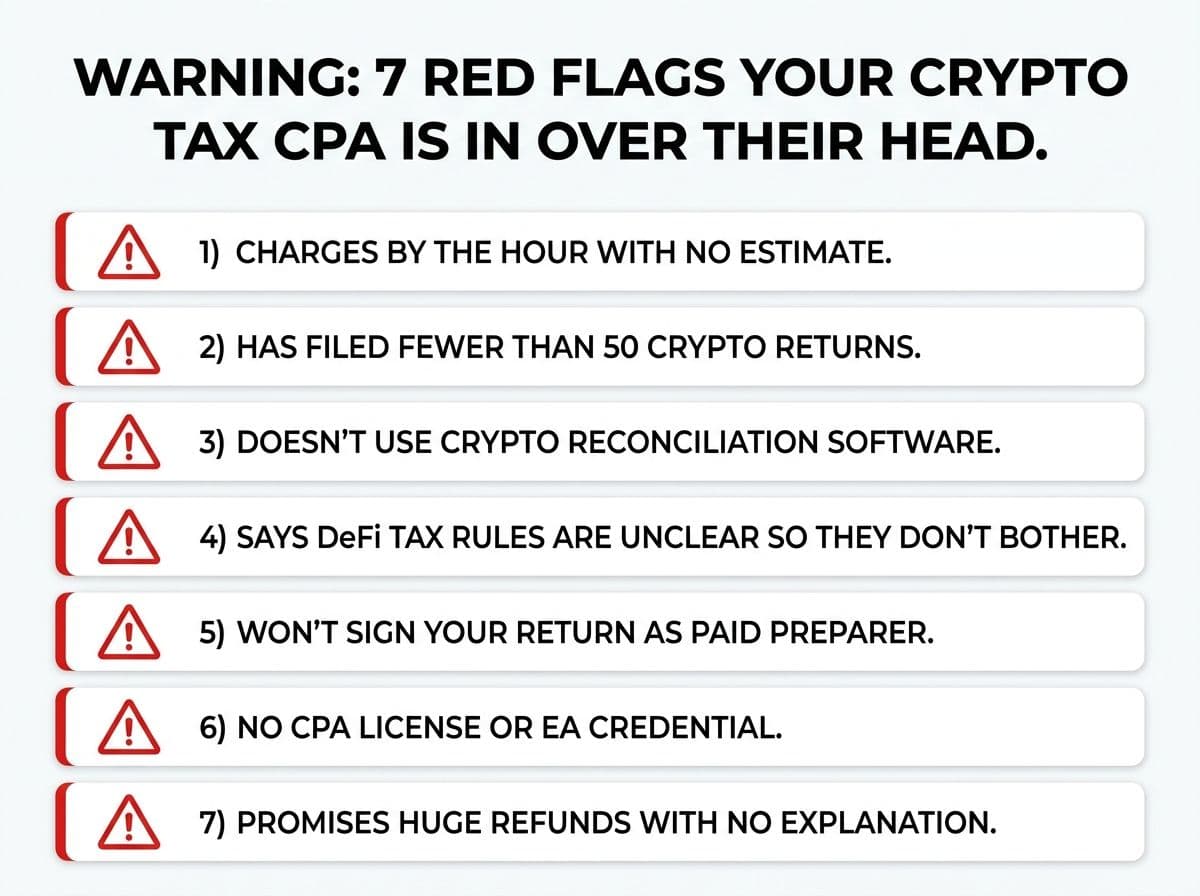
Red Flags: Signs Your Crypto Tax CPA Is in Over Their Head
I've seen all of these. Some of them cost our clients thousands before they came to us.
1. They file Schedule D without Form 8949.
Form 8949 is where every individual crypto transaction gets reported. Schedule D is the summary. Filing Schedule D without the underlying 8949 detail is like submitting a book report without reading the book. The IRS will notice.
2. They report all crypto income as capital gains.
Staking rewards, mining income, airdrops, and payment for services received in crypto are all ordinary income, not capital gains. A CPA who lumps everything into Schedule D is underreporting your income and miscalculating your taxes in both directions.
3. They don't ask about your DeFi activity.
If your CPA never asks "Do you use any DeFi protocols?" they're not looking for the complexity that triggers the biggest errors. DeFi is where the most common and expensive mistakes happen.
4. They use your exchange statements as-is without reconciliation.
Exchange statements are notoriously incomplete. They don't capture DeFi transactions, cross-chain bridges, or wallet-to-wallet transfers. A CPA who relies solely on exchange data is filing an incomplete return.
5. They can't explain the difference between FIFO and HIFO.
If your CPA defaults to FIFO without explaining alternatives, they're leaving money on the table. A specialized crypto CPA should model multiple methods and recommend the one that minimizes your liability.
6. They've never heard of a CP2000 or Form 1099-DA.
CP2000 is the IRS notice you get when their records don't match your return. 1099-DA is the new crypto broker reporting form. If your CPA doesn't know these terms, they're not current on crypto tax enforcement.
Pro Tip
A client came to us after their previous CPA filed 3 years of crypto returns without ever filing Form 8949. The IRS sent a $47,000 proposed assessment. After our review and response, the actual liability was $3,200. The client paid us $2,800 for the representation. Their previous CPA charged $900/year for the incorrect returns. Cheap isn't cheap.
| Varies | |||
What Documents to Prepare Before Meeting Your CPA
Save yourself money and your CPA time by gathering this before your first meeting:
Exchange data:
- API access or CSV exports from every exchange you've used (Coinbase, Kraken, Binance, Gemini, etc.)
- Year-end statements from each exchange
- 1099-DA forms (new for 2026)
- Any 1099-MISC or 1099-K forms from exchanges
Wallet data:
- Public addresses for all self-custody wallets (hardware wallets, MetaMask, Phantom, etc.)
- Records of any wallet-to-wallet transfers
DeFi activity:
- List of DeFi protocols you've used (Uniswap, Aave, Compound, Lido, etc.)
- Records of LP entries/exits, staking deposits/withdrawals, yield farming claims
Income events:
- Records of crypto received as payment for goods or services
- Mining income records (pool payouts, block rewards)
- Airdrop records with dates and amounts
Prior returns:
- Copies of your last 3 years of tax returns
- Any previous crypto-specific forms (Form 8949, Schedule D from prior years)
- Any IRS notices or correspondence
Personal info:
- Filing status, dependents, other income sources
- State of residence (some states have specific crypto rules)
Pro Tip
Don't spend hours organizing CSV files yourself. A good crypto CPA will pull your data via API or blockchain sync through their software. Your job is to give them the access. Their job is to reconcile and organize it.
Action Steps: Finding Your Crypto Tax CPA This Week
Here's your game plan:
Step 1: Determine your complexity level.
Use the pricing table above. Are you a simple holder, active trader, DeFi user, or high-net-worth? This determines the type of CPA you need and the budget to expect.
Step 2: Search with the right terms.
Search "crypto tax CPA [your state]" or "cryptocurrency tax accountant [your city]." Check LinkedIn for CPAs with crypto-specific experience. Ask in crypto communities (Reddit r/CryptoTax, Discord servers, Twitter).
Step 3: Interview 2-3 candidates.
Use the 10 questions above. Most crypto CPAs offer a free 15-30 minute consultation. Take advantage of it.
Step 4: Verify credentials.
Look up their CPA license on your state Board of Accountancy website. Check for any disciplinary actions. Google their name + "reviews" or "complaints."
Step 5: Start the engagement early.
Don't wait until April. The best crypto CPAs fill up by February. Reach out in Q4 for the current tax year or Q1 at the latest.
Need a recommendation? We're biased, but we built COS Elite specifically for crypto holders who want a CPA who answers the phone, files actual returns, and has the Big 4 background to handle anything the IRS throws at you.
Frequently Asked Questions
Do I really need a specialized crypto CPA?
If you have DeFi transactions, staking income, multiple exchanges, or more than $50K in crypto, a specialized CPA will catch errors and optimize strategies that a generalist will miss.
When during the year should I hire a crypto tax CPA?
Ideally in Q4 of the tax year for tax planning, or by January for tax preparation. Top crypto CPAs fill up by February.
Can a crypto tax CPA help with unfiled prior years?
Yes. A crypto CPA can prepare amended returns, calculate back taxes, apply for penalty abatement, and negotiate voluntary disclosure with the IRS.
How do I verify a CPA is licensed?
Check your state's Board of Accountancy online license lookup tool. Ask for their license number and verify it.
Should I use tax software AND a CPA?
Yes. Use crypto tax software for data aggregation and your CPA for review, optimization, and filing. Most crypto CPAs use these tools in their workflow.
What happens if my CPA makes a mistake?
A reputable CPA should offer error resolution and amendment filing at no additional cost for their mistakes. Ask about their error resolution policy before engaging.
Is a Big 4 firm worth it for crypto taxes?
For most individuals, no. Boutique crypto CPA firms offer deeper specialization, direct senior CPA access, and 1/3 to 1/5 the cost. Big 4 makes sense for $10M+ portfolios or crypto businesses.

About the author
Garrett Taylor, CPA
Former Big Four CPA. CPA #133092. Garrett answers his phone. Led by expertise. Powered by precision.
Related Articles

The Ultimate Guide to Crypto Tax (2026 Edition)
The most comprehensive crypto tax guide online, written by a CPA who files 500+ crypto returns a year. Every taxable event, form, strategy, and 2026 update.

Best Crypto Tax Software 2026: A CPA's Honest Review of Every Major Platform
A CPA who files 500+ crypto returns reviews Koinly, CoinTracker, CoinLedger, CoinTracking, ZenLedger, and Summ. No affiliate links. Just honest verdicts.
Koinly Guide: A Crypto Tax CPA's Complete Walkthrough (2026)
A CPA's step-by-step Koinly walkthrough. Learn how to set up Koinly, avoid the 7 most common errors, and know when DIY is enough vs. when you need a pro.