Koinly vs CoinLedger (2026): A CPA's Honest Comparison

Written by Garrett Taylor, CPA #133092
Reviewed by Leanne Grant, EA #00167954-EA

Key Takeaways
- ✓Koinly wins for DeFi-heavy portfolios, advanced cost basis methods (including Specific Identification), and sheer integration count (800+ vs 400+)
- ✓CoinLedger wins for TurboTax users with simple portfolios who want the fastest possible filing experience
- ✓✓Koinly's free tier lets you import up to 10,000 transactions; CoinLedger's free tier supports unlimited transaction imports.
- ✓For portfolios with LP positions or cross-chain DeFi, Koinly's accuracy advantage is significant and measurable
- ✓Neither tool replaces a CPA review for portfolios over $100K or 1,000+ transactions
“This comparison has been reviewed for accuracy by Leanne Grant, Enrolled Agent, specializing in cryptocurrency tax compliance.”
You're stuck between Koinly and CoinLedger. You've read the affiliate reviews. You've scanned the Reddit threads. And you still have no idea which one is right for your portfolio.
Here's the problem:
Most "Koinly vs CoinLedger" comparisons are written by content marketers who've never filed a crypto tax return.
In this comparison, I'll show you exactly where each tool shines, where each one breaks, and which one offers the best value for your situation.
Let's get into it.
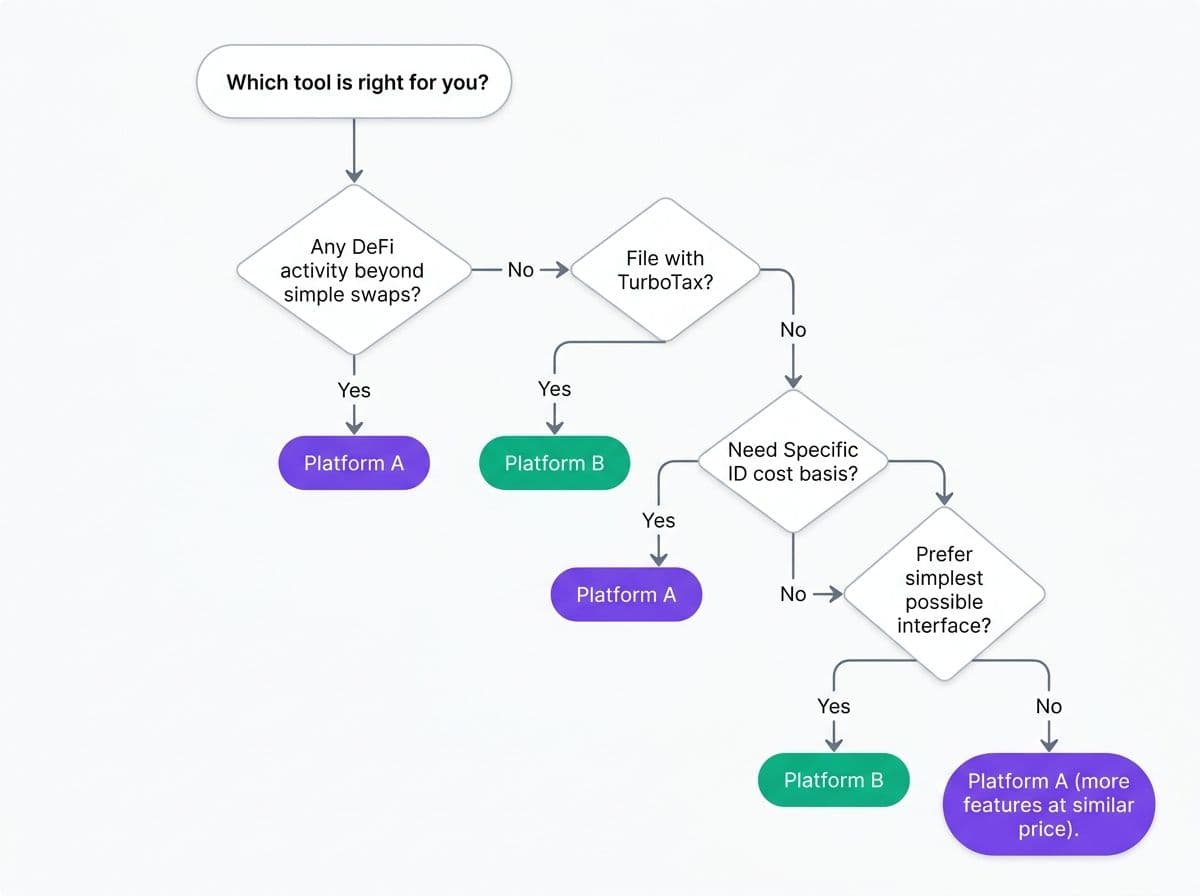
The Quick Verdict: Pick Koinly If... Pick CoinLedger If...
Before we go deep, here's the short version.
Pick Koinly if:
- You use more than 3 exchanges or wallets
- You have any DeFi exposure (LPs, yield farming, bridges, wrapping)
- You want Specific Identification for cost basis (the most tax-efficient method)
- You need to support international tax forms alongside US returns
- Your transaction count exceeds 1,000 per year
Pick CoinLedger if:
- You file with TurboTax and want the smoothest possible integration
- Your portfolio is straightforward (buy on Coinbase, sell on Coinbase)
- You want the simplest interface with the lowest learning curve
- You're a first-time crypto filer and don't want to be overwhelmed
- You have fewer than 3,000 transactions and no DeFi exposure
The honest truth? The breakdown usually comes down to one question: do you have DeFi transactions?
If yes, Koinly. If no, either one works.
Now let's prove it.
Quick Spec Comparison
Koinly vs CoinLedger: 2026 Feature Comparison
| Feature | ||
|---|---|---|
| **Pricing (per year)** | $49 / $99 / $199 / $299 | $49 / $99 / $199+ |
| **Free tier** | 10,000 transactionimports, preview tax summary | unlimited transaction imports, no downloads |
| **Exchange integrations** | 1,000+ | 500+ |
| **DeFi support** | Strong (auto-detects LPs, wraps, bridges) | Basic (simple swaps only) |
| **NFT support** | Yes (minting, selling, royalties) | Yes (basic buy/sell) |
| **Cost basis methods** | FIFO, LIFO, HIFO, ACB, Share Pool, Spec ID | FIFO, LIFO, HIFO |
| **TurboTax export** | Yes | Yes (best-in-class integration) |
| **TaxAct export** | Yes | Yes |
| **Form 8949** | Yes | Yes |
| **Schedule D** | Yes | Yes |
| **International forms** | Yes (UK, Canada, Australia, 20+ countries) | Limited |
| **CPA collaboration** | Tax professional reports, client sharing | Basic CSV export |
| **1099-DA reconciliation** | Manual matching tools | Basic import |
| **Audit trail** | Full transaction-level audit log | Basic summary |
| **Mobile app** | No | No |
| **Tax-loss harvesting** | Yes (unrealized gains dashboard) | Yes |
Pricing: Who Gives You More for Your Money?
Let's talk dollars.
Koinly's tiers (per tax year):
- Free: 10,000 transaction imports, portfolio tracking, tax report preview. No downloads.
- Newbie ($49): Up to 100 transactions. Full reports.
- Hodler ($99): Up to 1,000 transactions.
- Trader ($199): Up to 3,000 transactions. Priority support.
- Pro ($299): 10,000+ transactions. Priority everything.
CoinLedger's tiers (per tax year):
- Free Portfolio Tracking ($0): Unlimited transactions. Preview only. No downloads.
- Hobbyist ($49): Up to 100 transactions. TurboTax export, DeFi, NFTs.
- Investor ($99): Up to 1,000 transactions. Margins, futures, international, priority support.
Pro ($199+): 3,000+ transactions.
Here's what jumps out immediately:
CoinLedger is cheaper at the top end. If you have 5,000 transactions, CoinLedger Pro costs $199. Koinly Pro costs $299. That's a $100 difference.
But Koinly's free tier is dramatically more useful. You can import your entire portfolio, see your full tax summary, and decide if the numbers look right before paying a dime.
Pro Tip
Start with Koinly's free tier. Import everything. Review the tax summary. If the numbers make sense and you don't have complex DeFi, compare them against CoinLedger Hobbyist ($49). You might save $30-$50 by going with CoinLedger for a simple portfolio. If you have DeFi, don't bother with CoinLedger -- the cleanup time will cost you more than Koinly's higher price.
Winner: Tie. Koinly has the better free tier and more granular pricing. CoinLedger has the lower price ceiling. Your wallet depends on your transaction volume.
Exchange and Wallet Integrations
This is where the numbers speak for themselves.
Koinly: 1,000+ integrations. Every major exchange. Every major blockchain. Most DeFi protocols. If you've used it, Koinly probably connects to it.
CoinLedger: 500+ integrations. The major exchanges are covered (Coinbase, Kraken, Binance, Gemini). But you'll hit gaps faster with smaller exchanges, DEXs, and Layer 2 chains.
In practice, here's what this means:
If you've only used Coinbase and Kraken, both tools connect seamlessly. No difference.
If you've used Phantom wallet for Solana DeFi, traded on dYdX, or bridged assets through Arbitrum, Koinly has native support. CoinLedger will require manual CSV imports for some of these, and manual CSV imports are where errors happen.
One important caveat: Both tools have sync issues with certain exchanges. Binance API connections break periodically for both platforms. KuCoin CSV formats have changed multiple times. These aren't Koinly or CoinLedger problems specifically -- they're industry-wide headaches.
Winner: Koinly. 1,000+ vs 500+ isn't close. The integration gap matters most for DeFi users and anyone with assets spread across 5+ platforms.
DeFi and NFT Handling
This is where the comparison stops being close.
Koinly's DeFi support is significantly better than CoinLedger's. Full stop. Let me show you why with a specific example.
The Uniswap LP Test
Say you provide liquidity to the ETH/USDC pool on Uniswap V3. Here's the transaction chain:
- You deposit 2 ETH ($3,600 each = $7,200) and 7,200 USDC into the pool
- You receive an LP position (NFT in Uniswap V3)
- Over 3 months, you earn $840 in trading fees
- You withdraw: 2.3 ETH + 6,400 USDC + $840 in accrued fees
- The ETH price has risen to $4,100 by withdrawal
How Koinly handles it:
Koinly auto-detects the LP entry and exit. It recognizes the liquidity provision as a non-taxable transfer into the pool. It calculates the impermanent loss. It separates the fee income ($840, taxed as ordinary income) from the capital gain on the ETH position. It tracks the cost basis correctly through the entire lifecycle.
Is it perfect? No. We usually need to manually verify the fee classification and double-check the impermanent loss calculation. But the foundation is solid.
How CoinLedger handles it:
CoinLedger sees a series of token swaps. The deposit? It looks like you sold 2 ETH and 7,200 USDC. The withdrawal? It looks like you bought 2.3 ETH and 6,400 USDC from nowhere.
The result: phantom gains, missing cost basis, and a tax bill that's potentially thousands of dollars off.
NFT Handling
Both platforms handle basic NFT buy-and-sell transactions. You bought an NFT for 0.5 ETH and sold it for 1.2 ETH? Both get the capital gain right.
But Koinly handles edge cases better:
- Minting costs (gas fees added to cost basis)
- Royalty income (taxed as ordinary income, not capital gains)
- NFT-to-NFT trades (treated as like-kind? No, they are treated astaxable dispositions under IRS Notice 2014-21)
- Failed transactions (gas fees are still deductible as investment expenses)
CoinLedger handles the basic cases but often misses gas fee attribution and royalty classification.
Winner: Koinly. For DeFi and NFTs, this isn't close. If you have any DeFi exposure beyond simple token swaps, Koinly is the only responsible choice between these two.
Cost Basis Methods
This section matters more than most people realize.
The cost basis method you choose determines which specific coins you're "selling" when you dispose of crypto. Different methods produce wildly different tax bills on the exact same transactions.
Koinly offers: FIFO, LIFO, HIFO, Average Cost Basis (ACB), Share Pooling, and Specific Identification (Spec ID).
CoinLedger offers: FIFO, LIFO, HIFO.
The big gap: Specific Identification.
Spec ID lets you choose exactly which lot you're selling on each transaction. Under IRS Publication 550, taxpayers can use specific identification for investment assets as long as they adequately identify the lots at the time of sale.
Here's a worked example of why this matters:
You bought ETH three times:
- Lot 1: 1 ETH at $1,200 (January 2024)
- Lot 2: 1 ETH at $3,800 (November 2024)
- Lot 3: 1 ETH at $2,400 (March 2025)
You sell 1 ETH at $3,600 in December 2025.
| Method | Lot Sold | Cost Basis | Gain | Tax (24% bracket) |
|---|---|---|---|---|
| FIFO | Lot 1 ($1,200) | $1,200 | $2,400 | $576 (long-term at 15%) = **$360** |
| LIFO | Lot 3 ($2,400) | $2,400 | $1,200 | $1,200 x 24% = **$288** |
| HIFO | Lot 2 ($3,800) | $3,800 | -$200 | **$0** (loss) |
| Spec ID | Lot 2 ($3,800) | $3,800 | -$200 | **$0** + harvest the loss |
In this example, HIFO and Spec ID produce the same result. But across a complex portfolio with hundreds of lots, Spec ID lets a CPA optimize each individual sale.
Pro Tip
If you use Specific Identification, you must be able to identify each lot at the time of sale and maintain adequate records. Koinly's Spec ID implementation lets you tag lots, but your CPA should verify the lot selection defensibility before filing. The IRS has been scrutinizing cost basis methods more closely since the 2024 broker reporting rules under the Infrastructure Investment and Jobs Act.
Winner: Koinly. Specific Identification alone makes Koinly the better choice for anyone trying to minimize their tax liability. CoinLedger's HIFO gets you most of the way there, but Spec ID is the professional-grade tool.
IRS Audit Trail and 1099-DA Reconciliation
Under the Infrastructure Investment and Jobs Act, exchanges now issue 1099-DA forms reporting gross proceeds to the IRS. If your return doesn't match, you get a CP2000 notice.
Koinly lets you import 1099-DA data and match it transaction-by-transaction. The audit trail is detailed: every transaction shows source data, classification, manual edits, and tax treatment. When the IRS questions a disposition, you can pull the exact evidence chain.
CoinLedger supports 1099-DA import with summary-level reconciliation. The audit trail is lighter and drilling into individual mismatches requires more manual work.
Winner: Koinly. The audit trail depth matters if you're ever questioned.
CPA Collaboration and Export Quality
Koinly offers tax professional reports, client-sharing (your CPA views your account directly), multiple export formats (CSV, PDF, TXF, Form 8949), and API access for automated workflows.
CoinLedger has the smoothest TurboTax integration in the business. One-click export populates Form 8949 inside TurboTax automatically. Also exports TaxAct, CSV, and Form 8949 PDF.
If youuse TurboTax, CoinLedger wins. If your CPA uses professional software (UltraTax, Lacerte, Drake), that advantage disappears and Koinly's detailed reporting gives more to work with.
Winner: Tie. Depends on your tax preparer's software.
Interface, UX, and Support
CoinLedger is simpler. Clean dashboard, linear workflow, fewer decisions. First-time users get from signup to tax report with minimal friction. But when something's miscategorized, the editing tools are limited.
Koinly is more powerful. More data on the dashboard, more filters, more manual overrides. Overwhelming at first, but when something goes wrong you have the tools to fix it.
Support: Both offer email support and knowledge bases. Neither offers phone support. Tax season response times stretch to 3-4 days for both. Neither platform helps with "is this taxable?" That's what a CPA is for.
Winner: CoinLedger for simplicity, Koinly for control.
Who Should Pick Koinly
Based on the portfolios we see in our practice, Koinly is the better choice for:
1. The DeFi Power User. If you've provided liquidity, used lending protocols, bridged assets across chains, or interacted with smart contracts, Koinly's DeFi detection is materially better. Not perfect, but better.
2. The Multi-Exchange Trader. If you're spread across 5+ exchanges and wallets, Koinly's 1,000+ integrations mean fewer manual imports and fewer errors.
3. The Tax Optimizer. If you want Specific Identification to surgically minimize your tax bill lot by lot, Koinly is the only option between these two.
4. The International Filer. If you have tax obligations in multiple countries or need reports for non-US jurisdictions, Koinly supports 20+ countries natively.
Read our full Koinly walkthrough for setup tips and CPA-tested configuration advice.
Who Should Pick CoinLedger
CoinLedger earns its place in the market for:
1. The TurboTax Filer. If you file your own taxes with TurboTax, CoinLedger's integration is the smoothest path from crypto data to filed return. Period.
2. The Simple Portfolio Holder. If you bought crypto on Coinbase, maybe traded a few times, and now need to report it, CoinLedger handles this use case perfectly at a fair price.
3. The Crypto Beginner. First time filing crypto taxes? CoinLedger's interface is less intimidating. You'll understand what's happening without reading documentation.
4. The Budget-Conscious Filer. If you have 5,000+ transactions with no DeFi, CoinLedger Pro at $199 is significantly cheaper than Koinly Pro at $299.
5. The Set-It-And-Forget-It Filer. If you want to connect your exchange, click three buttons, and get a tax report without making decisions about lot selection or cost basis optimization, CoinLedger's streamlined workflow is your match.
See our detailed CoinLedger review for a deep dive on the platform's strengths and weaknesses.
| Koinly | CoinLedger | |
|---|---|---|
The 1099-DA Factor
Here's something most comparisons miss entirely.
The Infrastructure Investment and Jobs Act requires centralized exchanges to issue 1099-DA forms starting with the 2025 tax year. This means the IRS now receives gross proceeds data directly from Coinbase, Kraken, and other major exchanges.
What does this mean for Koinly vs CoinLedger?
Both tools need to reconcile your calculated gains with what the IRS already knows from 1099-DA filings. If there's a mismatch, you'll get a CP2000 notice.
Koinly's reconciliation tools let you import 1099-DA data and flag discrepancies at the transaction level. CoinLedger offers summary-level reconciliation.
For simple portfolios: Both handle 1099-DA fine.
For complex portfolios: Koinly's transaction-level matching catches discrepancies that summary-level tools miss.
Final Verdict
Koinly is the better tool for most crypto investors in 2026. Its integration count, DeFi handling, cost basis flexibility, and audit trail depth make it the more capable platform.
CoinLedger is the better tool for simple TurboTax filers. If your portfolio is straightforward and you value ease-of-use, CoinLedger gets the job done at a lower price point.
But here's what matters most:
Neither tool is a substitute for professional review. We see errors in output from both platforms.
The smartest move? Pick the tool that fits your portfolio, import your data, and have a crypto-specialized CPA review the output before you file.
Your software does the math. Your CPA makes sure the math is right.
Frequently Asked Questions
Which is cheaper, Koinly or CoinLedger?
CoinLedger has a lower price ceiling ($199vs Koinly's $299). For high-volume traders without DeFi, CoinLedger saves money on software cost. Factor in CPA cleanup time and the total cost picture often favors Koinly.
Does CoinLedger support Specific Identification (Spec ID)?
No. CoinLedger supports FIFO, LIFO, and HIFO but not Specific Identification. Koinly supports all four methods plus Average Cost Basis and Share Pooling. Spec ID can save significant money for investors with multiple lots purchased at different prices.
Which tool has better TurboTax integration?
CoinLedger has the better TurboTax integration. The one-click export is the smoothest crypto-to-TurboTax workflow available. Koinly also exports to TurboTax but the process is slightly less streamlined.
Can I use Koinly and CoinLedger together?
Yes. They use Koinly's free tier to preview and verify their data, then use CoinLedger Premium for the TurboTax export if their portfolio is simple enough.
How do Koinly and CoinLedger handle 1099-DA forms?
Both platforms support 1099-DA import and reconciliation. Koinly offers transaction-level matching to flag discrepancies. CoinLedger provides summary-level reconciliation. For complex portfolios, Koinly's granular approach catches more issues.
Which tool is better for DeFi users?
Koinly is significantly better for DeFi. It auto-detects LP positions, bridges, wrapping, and staking transactions. CoinLedger handles simple swaps but often misclassifies complex DeFi activity, generating phantom gains that require manual correction.
Is Koinly free? Is CoinLedger free?
Both have free tiers. Koinly's free tier lets you import 10,000 transactions and preview tax summaries without paying. CoinLedger's free tier offers unlimited transaction imports but offers no report downloads.
Which crypto tax tool do CPAs prefer?
Most crypto-specialized CPAs lean toward Koinly or CoinTracker for complex portfolios. Koinly produces more detailed tax professional reports and better audit documentation. CoinLedger's TurboTax export is preferred for simple individual returns.
Should I use crypto tax software or just hire a CPA?
Both. Crypto tax software aggregates your data and calculates your gains. A CPA reviews the output, catches errors, optimizes your cost basis method, and ensures IRS compliance. For portfolios over $100K or 1,000+ transactions, the CPA review typically pays for itself.
How do Koinly and CoinLedger handle staking rewards?
Both platforms can import staking rewards. Koinly auto-detects most staking income and lets you configure whether rewards are taxed at receipt or disposition. CoinLedger imports staking rewards but offers less flexibility in tax treatment configuration.
Can my CPA access my Koinly or CoinLedger account?
Koinly offers a client-sharing feature that lets your CPA view your account and generate reports directly. CoinLedger doesn't offer direct CPA account access but provides downloadable reports and CSV exports your CPA can work with.

About the author
Garrett Taylor, CPA
Former Big Four CPA. CPA #133092. Garrett answers his phone. Led by expertise. Powered by precision.
Related Articles

Koinly Guide: A Crypto Tax CPA's Complete Walkthrough (2026)
A CPA's step-by-step Koinly walkthrough. Learn how to set up Koinly, avoid the 7 most common errors, and know when DIY is enough vs. when you need a pro.

CoinLedger Review 2026: A Crypto Tax CPA's Honest Walkthrough
A CPA's honest CoinLedger review for 2026. Free vs paid breakdown, TurboTax export workflow, DeFi limitations, common errors, and how it compares to Koinly.

Best Crypto Tax Software 2026: A CPA's Honest Review of Every Major Platform
A CPA who files 500+ crypto returns reviews Koinly, CoinTracker, CoinLedger, CoinTracking, ZenLedger, and Summ. No affiliate links. Just honest verdicts.