“This comparison has been reviewed for accuracy by Leanne Grant, Enrolled Agent, specializing in cryptocurrency tax compliance.”
If you've been going back and forth between CoinTracker and CoinLedger, you're not alone.
This is the most common question we get from new clients during tax season. Both tools promise accurate crypto tax reports. Both have slick marketing. And most "comparison" articles you'll find online are written by one of the two companies.
Here's what's different about this comparison:
We've filed returns using both CoinTracker and CoinLedger. We don't care which one you pick. We care that your tax return is accurate.
So, let's break down what actually matters.
The Quick Verdict
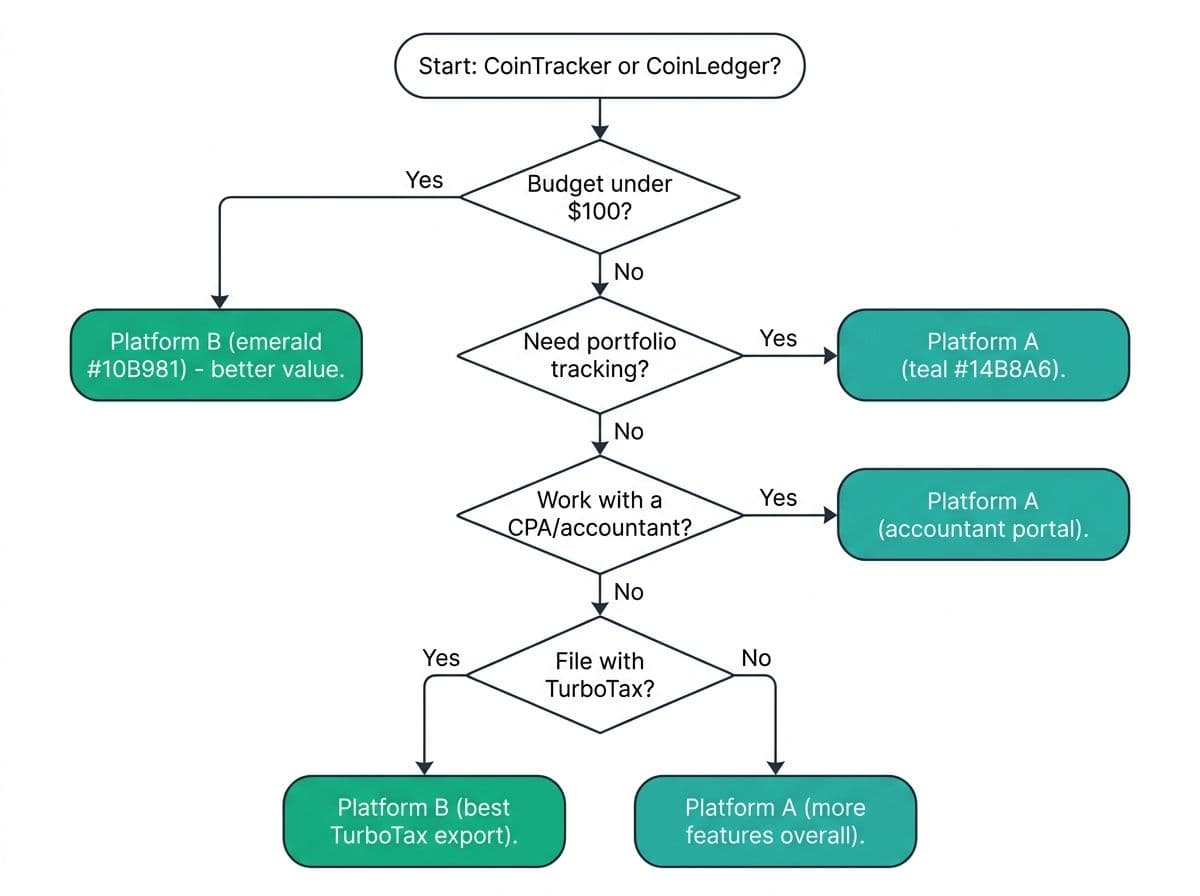
Pick CoinTracker if:
- You trade on 3+ exchanges and need broad integration coverage
- You want a built-in portfolio tracker alongside your tax reports
- You work with a CPA who needs direct account access
- You have DeFi activity on Ethereum Mainnet
- You want the strongest 1099-DA reconciliation workflow
Pick CoinLedger if:
- You file with TurboTax and want the smoothest possible export
- Your portfolio is straightforward (buy, hold, sell on 1-2 exchanges)
- You're price-sensitive and want full tax reports under $50
- You're filing crypto taxes for the first time and want the simplest interface
- You don't need advanced CPA collaboration features
The honest truth? For portfolios under 500 transactions on centralized exchanges only, both tools will give you the same result. The differences only start to matter when things get complex.
Head-to-Head Spec Comparison
CoinTracker vs CoinLedger (2026)
| Feature | CoinTracker | CoinLedger |
|---|---|---|
| Exchange integrations | 500+ | 400+ |
| Starting price (paid) | $59/year (100 txns) | $49.99/year (3,000 txns) |
| Top-tier price | $499-$599/year (10,000+ txns) | $99.99/year (100,000 txns) |
| Cost basis methods | FIFO, LIFO, HIFO, Spec ID | FIFO, LIFO, HIFO |
| TurboTax export | Good | Best-in-class |
| Accountant portal | Full access (Premium+) | Email export only |
| Portfolio tracking | Built-in, real-time | None |
| DeFi support | Good (Ethereum), Fair (L2s) | Basic |
| NFT handling | Good | Basic |
| 1099-DA reconciliation | Advanced | Basic |
| Free tier limit | 25 transactions | 25 transactions |
| Audit defense add-on | No | Yes ($49/year) |
| Interface complexity | Moderate | Simple |
| Best for | Multi-exchange, CPA-managed | TurboTax filers, simple portfolios |
Now let's go deeper on each category that actually affects your tax return.
Pricing: Who Gives You More for Less?
This is where CoinLedger has a clear structural advantage.
CoinLedger's pricing is simpler and cheaper at every tier:
- Premium ($49.99/year): 3,000 transactions, full reports, TurboTax export, DeFi and NFT support
- Pro ($99.99/year): 100,000 transactions, margin/futures, international forms, priority support
CoinTracker's pricing scales with transaction count:
- Base ($59/year): 100 transactions, basic reports
- Prime ($149/year): 1,000 transactions, DeFi support
- Premium ($299/year): 3,000 transactions, CPA portal
- Ultra ($499-$599/year): 10,000+ transactions, full features
Here's the math that matters. If you have 500 transactions:
- CoinLedger: $49.99 (Premium plan, well within the 3,000 cap)
- CoinTracker: $149 (Prime plan, since Base only covers 100)
That's a 3x price difference for the same transaction volume.
But wait. There's a catch.
CoinTracker includes portfolio tracking, which CoinLedger doesn't. If you're currently paying $50-$100/year for a separate portfolio tracker (Delta, CoinStats, etc.), CoinTracker's higher price starts to make sense.
Pro Tip
If you only need tax reports and file with TurboTax, CoinLedger at $49.99 is hard to beat. If you want a combined tax + portfolio tracking tool and work with a CPA, CoinTracker's Premium at $299 bundles both needs. Do the math on what you're already paying across separate tools.
Winner: CoinLedger. CoinLedger gives you more transactions at a lower price. CoinTracker justifies its premium cost only if you use its additional features.
Integrations: Which Connects to More?
CoinTracker claims 500+ integrations. CoinLedger claims 400+.
But what matters is whether your specific exchanges sync cleanly.
Where they're equal:
- Coinbase, Kraken, Gemini, Binance.US: Both platforms handle these well
- MetaMask, Ledger, Trezor wallet imports: Comparable quality
- Ethereum Mainnet public address tracking: Both solid
Where CoinTracker has the edge:
- Broader DEX coverage across EVM chains
- Better auto-detection of transaction types on imports
- More frequent API update cadence (we notice fewer "stale sync" issues)
Where CoinLedger has the edge:
- Binance International CSV imports are more forgiving of format changes
- Phantom/Solana wallet sync has slightly better SPL token recognition
- Simpler manual CSV upload workflow when APIs fail
Winner: CoinTracker. The broader coverage and better auto-detection give it a slight edge, especially for multi-exchange portfolios.
DeFi and NFT Support
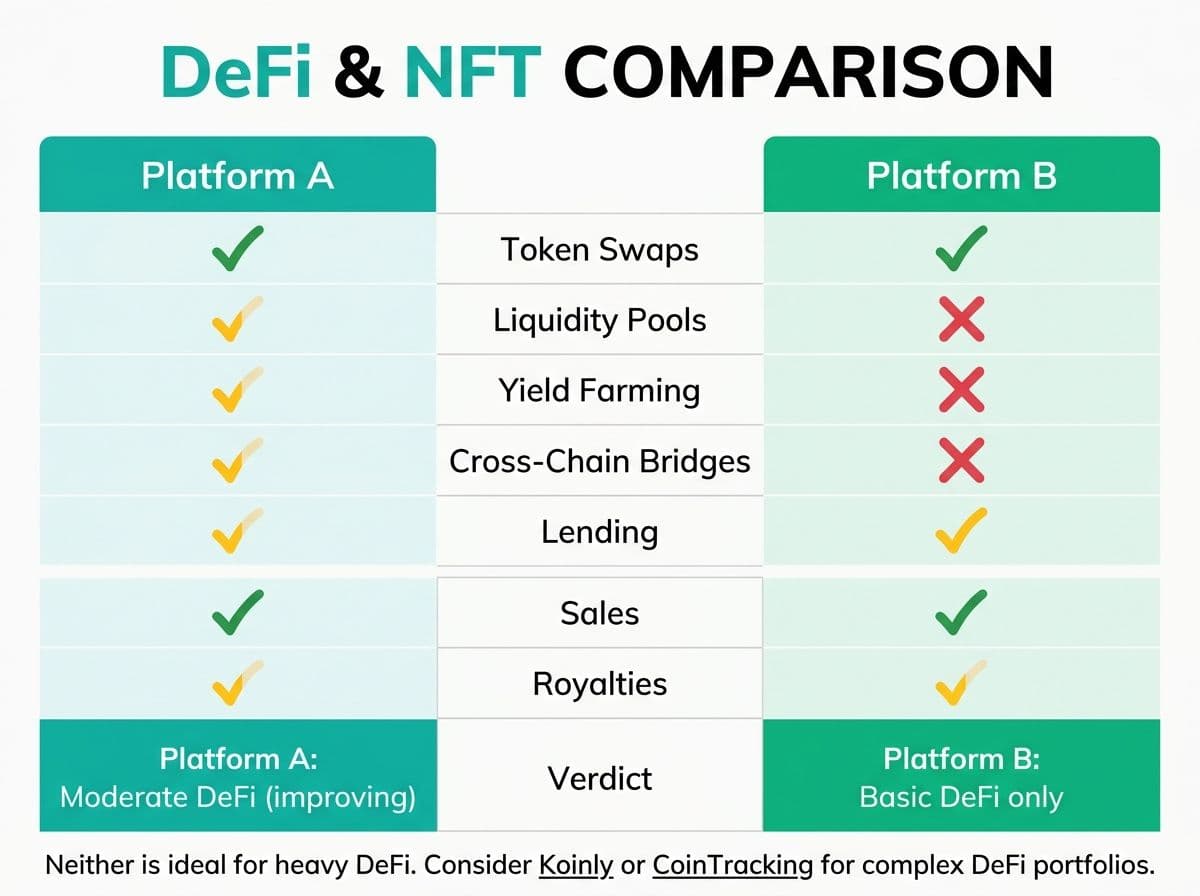
This is where both platforms show their limitations. And where the comparison gets honest.
CoinTracker's DeFi handling:
- Ethereum Mainnet swaps: Good
- Staking (Lido, Rocket Pool): Good
- LP deposits/withdrawals: Fair (often needs manual recategorization)
- L2 chains (Arbitrum, Optimism, Base): Fair and improving
- Solana DeFi: Poor
- Cross-chain bridges: Poor (phantom gains from unmatched transfers)
CoinLedger's DeFi handling:
- Ethereum Mainnet swaps: Adequate
- Staking: Basic (sometimes miscategorized as trades)
- LP deposits/withdrawals: Poor
- L2 chains: Poor
- Solana DeFi: Poor
- Cross-chain bridges: Poor
The NFT gap: CoinTracker tracks NFT buys, sells, and gas fees across Ethereum and several EVM chains with reasonable accuracy. CoinLedger covers basic NFT transactions but struggles with minting events, creator royalties, and low-liquidity valuations.
Neither platform handles the open IRS question about NFTs potentially being taxed at the 28% collectibles rate under IRS Notice 2023-27. Both calculate gains at standard capital gains rates.
Pro Tip
If you have serious DeFi activity (LPs, yield farming, bridges, lending), neither CoinTracker nor CoinLedger will get you to a filing-ready return without manual cleanup. This isn't a knock on either platform. It's the state of the industry. Plan for 1-3 hours of manual review per 100 DeFi transactions, regardless of which tool you use.
Winner: CoinTracker. It handles more DeFi scenarios correctly out of the box. But "better" doesn't necessarily mean good enough to file without review.
Cost Basis Methods
This is a quiet but important difference between the two platforms.
CoinTracker supports:
- FIFO (First In, First Out)
- LIFO (Last In, First Out)
- HIFO (Highest In, First Out)
- Specific Identification
CoinLedger supports:
- FIFO
- LIFO
- HIFO
The missing piece? CoinLedger doesn't offer Specific Identification (Spec ID).
For most investors, HIFO is sufficient. It automatically sells your highest-cost lots first, minimizing current-year gains. But Spec ID gives you granular control that can save thousands on large trades.
Worked example:
You hold three ETH lots:
- Lot A: 1 ETH bought at $1,200 (January 2024, long-term)
- Lot B: 1 ETH bought at $3,400 (March 2025, short-term)
- Lot C: 1 ETH bought at $2,800 (August 2024, long-term)
You sell 1 ETH at $3,600.
| Method | Lot Sold | Gain | Holding Period | Tax Rate (est.) | Tax Owed |
|---|---|---|---|---|---|
| FIFO | Lot A ($1,200) | $2,400 | Long-term | 15% | $360 |
| HIFO | Lot B ($3,400) | $200 | Short-term | 24% | $48 |
| Spec ID | Lot C ($2,800) | $800 | Long-term | 15% | $120 |
HIFO picks the $3,400 lot and gives you the lowest nominal gain. But it's short-term, taxed at your ordinary rate. Spec ID lets you choose the $2,800 long-term lot instead: slightly higher gain, but at a lower rate.
In this case, HIFO actually wins ($48 vs $120). But flip the numbers slightly, add a state tax layer, or scale to larger trades, and Spec ID's flexibility becomes material.
The IRS requires "adequate identification" under Treasury Regulation 1.1012-1 for Spec ID. CoinTracker documents your lot selection automatically, which satisfies this requirement. CoinLedger can't do this because it doesn't support Spec ID at all.
Winner: CoinTracker. The Spec ID option gives advanced investors meaningful tax optimization that CoinLedger simply can't offer.
1099-DA Reconciliation
Starting with the 2025 tax year, exchanges issue Form 1099-DA which reports your crypto dispositions directly to the IRS. If your return doesn't match, expect an automated CP2000 notice. This makes 1099-DA reconciliation one of the most important features in any crypto tax tool this year.
CoinTracker's approach:
- Import 1099-DA via upload or API (where supported)
- Automated cross-reference against your full transaction history
- Color-coded dashboard: green (match), yellow (minor difference), red (mismatch)
- Identify the exact transaction causing each discrepancy
- Handles gross vs. net proceeds differences intelligently
CoinLedger's approach:
- Manual 1099-DA upload (added January 2026)
- Basic comparison against imported data
- Flags major discrepancies (different proceeds amounts, missing transactions)
- Provides less detail about what is causing mismatches
The difference is meaningful. CoinTracker's reconciliation tool is better at recognizing nuances such as fee-adjusted proceeds, partial fills, and rounding differences. CoinLedger is more likely to flag these situations as errors.
Winner: CoinTracker. The 1099-DA reconciliation is one of CoinTracker's strongest features and a clear gap between the two platforms.
CPA Collaboration
If you work with a tax professional, this category might be the most important one.
CoinTracker's CPA tools (Premium plan and above):
- Full accountant portal with independent login
- Your CPA sees your transactions, categorizations, and reports without touching your settings
- CPA can flag issues and leave notes inside the platform
- Shared reconciliation dashboard for 1099-DA review
- Export options for professional tax software (Drake, Lacerte, UltraTax)
CoinLedger's CPA workflow:
- Generate PDF and CSV reports
- Email them to your CPA
- No direct account access
- No in-platform collaboration
- Export to TurboTax, TaxAct, H&R Block
Here's the thing. If your CPA is reviewing your crypto data anyway (and they should be), CoinTracker's portal saves significant back-and-forth. Instead of you exporting a report, emailing it, your CPA finding issues, emailing you back, you making changes, re-exporting... your CPA just logs in and sees everything.
Winner: CoinTracker. If CPA collaboration matters to you, CoinTracker is the only real option between the two.
Interface and User Experience
CoinLedger is designed for people who've never filed crypto taxes before. CoinTracker is designed for people who want to do it well.
CoinLedger's UX strengths:
- Clean, minimal dashboard with zero learning curve
- Step-by-step guided workflow from import to export
- Clear explanations of every tax concept
- TurboTax export is simple and takes just three clicks
- No overwhelming feature menus
CoinTracker's UX strengths:
- More powerful transaction editor with bulk actions
- Portfolio tracking dashboard alongside tax data
- Better search and filter tools for finding specific transactions
- More detailed error warnings with suggested fixes
- 1099-DA reconciliation built into the main workflow
The trade-off is real. CoinLedger's simplicity means fewer features. CoinTracker's depth means a steeper learning curve. If you've never used crypto tax software before, CoinLedger will feel friendlier. If you've been through a tax season and know what to look for, CoinTracker gives you more control.
Winner: Tie. This is purely a preference call. CoinLedger wins on simplicity. CoinTracker wins on power. Neither is objectively better.
Support
CoinTracker support:
- Email and chat support on all paid plans
- Priority support on Ultra plan
- Help center with detailed articles
- Active community forum
- Response time: typically 24-48 hours on paid plans
CoinLedger support:
- Email support on all paid plans
- Priority support on Pro plan
- Help center with tutorials
- Response time: typically 24-48 hours
Neither platform offers phone support. Neither has CPA-level tax advice in their support team (nor should they).
In our experience, CoinTracker's support team gives more technically detailed responses, especially for DeFi categorization questions. CoinLedger's team is faster to respond but sometimes redirects to generic help articles rather than addressing the specific issue.
Winner: CoinTracker by a slim margin, based on technical depth of responses.
Who Should Pick CoinTracker
Based on what we see in our practice, CoinTracker is the better choice for:
- Multi-exchange investors trading on 3+ platforms who need broad integration coverage and auto-matched transfers
- Investors who work with a CPA or EA and want their tax professional to have direct account access through the accountant portal
- DeFi users on Ethereum Mainnet who want the best available auto-categorization (while accepting that manual cleanup is still needed)
- Portfolio trackers who want a single dashboard for both tax reporting and real-time portfolio value across all accounts
- Investors focused on 1099-DA compliance who want the most thorough reconciliation workflow available
Who Should Pick CoinLedger
CoinLedger is the better choice for:
- TurboTax filers with simple portfolios who want a simple export
- Budget-conscious investors who want full tax reports for under $50 without paying for features they won't use
- First-time crypto tax filers who value simplicity and clear, non-technical guidance
- Straightforward buy-and-sell investors on 1-2 exchanges with no DeFi, NFTs, or complex staking activity
- Self-filers who don't work with a CPA and just need a clean Form 8949 and Schedule D
The Verdict Nobody Else Will Give You
Both CoinTracker and CoinLedger will get a straightforward crypto portfolio to a correct tax return. The differences show up at the edges.
CoinTracker is the more capable platform. More integrations, better DeFi handling, Specific ID cost basis, accountant portal, portfolio tracking, stronger 1099-DA reconciliation. It costs more because it does more.
CoinLedger is the more accessible platform. Lower price, simpler interface, best-in-class TurboTax export. It does fewer things, but does them cleanly.
What neither platform does: Replace a CPA for complex portfolios. Every single comparison point in this article is about getting you 80-90% of the way to an accurate return. The last 10-20% is where categorization judgment, cost basis optimization, and IRS compliance expertise come in.
Read our full CoinTracker review | Read our full CoinLedger review
Frequently Asked Questions
Is CoinTracker better than CoinLedger?
CoinTracker is the more capable platform with 500+ integrations, Specific ID cost basis, a full accountant portal, and stronger DeFi and 1099-DA support. CoinLedger is simpler and cheaper, with the best TurboTax export workflow. For simple buy/sell portfolios, CoinLedger is fine. For multi-exchange, DeFi, or CPA-managed portfolios, CoinTracker has the edge.
Which is cheaper, CoinTracker or CoinLedger?
CoinLedger is significantly cheaper. Its Premium plan covers 3,000 transactions for $49.99/year. CoinTracker's equivalent 3,000-transaction tier costs $299/year. CoinLedger's Pro plan handles 100,000 transactions for $99.99, while CoinTracker's Ultra plan starts at $499-$599 for 10,000+.
Does CoinLedger support Specific Identification cost basis?
No. CoinLedger supports FIFO, LIFO, and HIFO, but not Specific Identification. CoinTracker supports all four methods including Spec ID, which lets you choose exactly which tax lot to sell for optimal tax treatment. For most investors HIFO is sufficient, but Spec ID can save thousands on large trades.
Which crypto tax tool has better TurboTax integration?
CoinLedger has the best TurboTax integration in the industry. The TXF export imports cleanly into TurboTax and populates Form 8949 and Schedule D automatically. CoinTracker also supports TurboTax export, but CoinLedger's workflow is smoother and more reliable for simple portfolios.
Can my CPA access CoinTracker and CoinLedger?
CoinTracker offers a full accountant portal on Premium plans and above, giving your CPA direct login access to your transactions, reports, and reconciliation data. CoinLedger has no CPA portal. You'd need to export PDF and CSV reports and email them to your accountant.
Which handles DeFi better, CoinTracker or CoinLedger?
CoinTracker handles DeFi better overall, especially on Ethereum mainnet. It auto-categorizes more DeFi transaction types correctly and has better L2 chain coverage. CoinLedger's DeFi support is basic and more often requires manual recategorization. Neither platform handles complex DeFi (LPs, bridges, yield farming) without manual cleanup.
How do CoinTracker and CoinLedger handle 1099-DA reconciliation?
CoinTracker has a more advanced 1099-DA reconciliation tool with color-coded dashboards, drill-down to specific transactions, and intelligent handling of fee-adjusted proceeds. CoinLedger added basic 1099-DA upload in January 2026, but it flags more false positives and offers less granularity on mismatch sources.
Do CoinTracker and CoinLedger give the same tax results?
For straightforward buy/sell portfolios using the same cost basis method, yes. Both platforms produce identical Form 8949 output once data is correctly categorized. The difference is how much manual cleanup each requires to get there. CoinTracker typically needs less manual intervention.
Which crypto tax software is best for beginners?
CoinLedger is better for beginners. It has a simpler interface, plain-language explanations, and a guided step-by-step workflow from import to TurboTax export. CoinTracker has more features but a steeper learning curve.
Can I switch from CoinLedger to CoinTracker mid-year?
Yes. Both platforms import from the same exchanges, so you can set up a new account on either tool at any time. You'll need to import your full transaction history from your first crypto purchase to ensure accurate cost basis. The platforms don't transfer data between each other directly.