Crypto Airdrops and Hard Forks: Tax Treatment

By Garrett Taylor, CPA #133092
Reviewed by Leanne Grant, EA #00167954-EA

Key Takeaways
- ✓✓Airdrops and hard fork tokens are taxed as ordinary income at fair market value (FMV) the moment you gain "dominion and control" over them (Rev. Rul. 2019-24).
- ✓Your cost basis in airdropped or forked tokens equals the FMV you reported as income.
- ✓✓Unsolicited airdrops you never claim are generally not taxable until you actually claim or access them.
- ✓Dust tokens and worthless airdrops still create a reporting obligation if you claimed them -- but strategies exist to minimize the headache.
- ✓✓Hard forks without an airdrop (where you receive nothing) create no taxable event.
You woke up one morning and found 400 UNI tokens in your wallet. You didn't buy them. You didn't ask for them. They just... appeared.
Now you have a question that 2.3 million crypto holders asked the IRS last year: Do I owe taxes on an airdrop I never requested?
Short answer: almost certainly yes.
In this guide, I'll break down exactly how the IRS taxes crypto airdrops and hard fork tokens -- including the specific revenue ruling that governs them, how to calculate your income, what your cost basis becomes, and what to do about worthless dust tokens cluttering your wallet.
Before we get into tax treatment, let's make sure we're talking about the same things.
An airdrop is a distribution of tokens -- usually by a protocol or project -- directly to wallet addresses. Sometimes it rewards early users (like the famous Uniswap UNI airdrop). Sometimes it promotes a new token. You might need to claim it, or it might just land in your wallet.
A hard fork is a permanent divergence in a blockchain's protocol. When a hard fork occurs, the original chain splits into two. If you held tokens on the original chain, you now hold tokens on both chains. The most famous examples: Bitcoin Cash (BCH) forking from Bitcoin in August 2017, and Ethereum Classic (ETC) persisting after the Ethereum DAO fork in 2016.
The IRS treats these events similarly but not identically. The critical question for both is the same: when did you gain dominion and control over the new tokens?
| Factor | Airdrop | Hard Fork |
|---|---|---|
| **How tokens arrive** | Distributed by a project/protocol to your wallet | Created automatically when a blockchain splits |
| **Your action required** | Sometimes must claim; sometimes auto-deposited | Usually none -- tokens exist on new chain by default |
| **IRS governing guidance** | Rev. Rul. 2019-24 | Rev. Rul. 2019-24 |
| **Taxable event trigger** | Dominion and control (ability to transfer, sell, or exchange) | Dominion and control (exchange/wallet supports the new chain) |
| **Income type** | Ordinary income at FMV | Ordinary income at FMV |
| **Cost basis** | FMV at time of receipt | FMV at time of receipt |
| **Common examples** | UNI, ARB, ENS, OP, DYDX | BCH (from BTC), ETC (from ETH), BSV (from BCH) |
In October 2019, the IRS issued Revenue Ruling 2019-24 -- the single most important piece of guidance on airdrop and hard fork taxation. It addresses two specific situations:
Situation 1: A taxpayer receives new cryptocurrency from an airdrop following a hard fork, and the taxpayer has the ability to dispose of (sell, exchange, or transfer) the new cryptocurrency.
Ruling: The taxpayer has ordinary income equal to the FMV of the new cryptocurrency at the time it is received -- meaning the date and time the taxpayer gains dominion and control.
Situation 2: A hard fork occurs, but the taxpayer does NOT receive any new cryptocurrency (for example, the exchange they use doesn't support the new chain).
Ruling: No taxable event. No income. Nothing to report.
This ruling builds on the foundation laid by Notice 2014-21, which first established that virtual currency is treated as property for federal tax purposes. The IRS has also published a comprehensive FAQ on virtual currency transactions that reinforces these principles. Together, these documents form the backbone of crypto tax law in the United States.
““This guide has been reviewed for accuracy by Leanne Grant, Enrolled Agent, specializing in cryptocurrency tax compliance and IRS representation.” (move this section towards the top of the blog)”
"When you receive cryptocurrency from an airdrop following a hard fork, you have ordinary income equal to the fair market value of the new cryptocurrency when it is received." -- IRS Revenue Ruling 2019-24
This is where it gets nuanced -- and where most crypto holders make mistakes.
You don't owe taxes the instant a hard fork happens or the second someone initiates an airdrop. You owe taxes when you gain dominion and control over the new tokens.
Dominion and control means the ability to transfer, sell, or exchange the cryptocurrency. Here's what that looks like in practice:
You HAVE dominion and control when:
- The airdrop tokens appear in your self-custody wallet and you can send or swap them
- Your exchange credits the forked tokens to your account and enables trading
- You successfully claim an airdrop through a protocol's claim page
- The new chain is live and your wallet software supports it
You do NOT yet have dominion and control when:
- A fork occurs but your exchange hasn't credited or supported the new token
- An airdrop is announced but you haven't claimed it yet (and must take action to claim)
- Tokens are sent to your wallet on a chain your wallet doesn't support
- A smart contract holds the tokens in a vesting schedule you can't accelerate
This distinction matters enormously for timing. The FMV at the moment of dominion and control is what determines your income -- and crypto prices can move dramatically between a fork announcement and when an exchange actually supports the new token.
Pro Tip
Document the exact date and time you gained access to airdropped or forked tokens. Screenshot your wallet balance, the exchange notification, or the claim transaction. If the IRS questions the FMV you reported, this timestamp is your strongest evidence.
Let's address the question every crypto holder asks: "What about airdrops I never asked for and never claimed?"
Claimed airdrops: Taxable the moment you claim them. If you connected your wallet to Arbitrum's claim page and received ARB tokens, that's a taxable event. Your income equals the FMV of the ARB tokens at the moment the claim transaction confirmed on-chain.
Unclaimed airdrops (action required): If an airdrop requires you to take a specific action -- connect a wallet, sign a transaction, visit a claim page -- and you haven't done it, you generally don't have dominion and control yet. No dominion and control, no taxable event.
Unsolicited airdrops (auto-deposited): This is the gray area. If someone sends tokens directly to your wallet and you can immediately transfer or sell them, the IRS position is that you have dominion and control. That means income, even though you never asked for it.
However, there's a practical argument for certain unsolicited airdrops: if the tokens have no liquidity, no market, and no exchange listing, you arguably don't have true dominion and control because you cannot dispose of them. This is a facts-and-circumstances analysis, and you should work with a qualified crypto CPA if you're in this situation.
Let's walk through two of the most significant hard forks in crypto history.
Bitcoin Cash (BCH) -- August 1, 2017
On August 1, 2017, the Bitcoin blockchain split. Everyone holding BTC received an equal number of BCH on the new chain. If you held 2 BTC, you received 2 BCH.
Tax treatment: Your BCH was taxed as ordinary income at the FMV on the date you gained dominion and control. If your exchange didn't support BCH until January 2018, your taxable event occurred in January 2018 (at January 2018 prices), not August 2017.
This timing distinction resulted in dramatically different tax outcomes. BCH traded around $300 at the fork but surged above $3,000 by late December 2017. Taxpayers whose exchanges enabled BCH access later may have owed significantly more in taxes.
Ethereum Classic (ETC) -- July 20, 2016
After the DAO hack, the Ethereum community hard-forked to reverse the exploit. The original chain continued as Ethereum Classic. ETH holders received an equal number of ETC.
Tax treatment: Identical framework -- ordinary income at FMV when you gained dominion and control. If you held ETH in a self-custody wallet and your software supported ETC immediately, that was your taxable moment. If you relied on an exchange that took weeks to support ETC, the taxable event was delayed accordingly.
Important note about your original tokens: A hard fork does NOT change the cost basis of your original tokens. Your BTC basis stayed the same after the BCH fork. Your ETH basis stayed the same after the ETC fork. You simply gained a new asset with its own separate basis.
The formula is straightforward:
Ordinary Income = Number of Tokens Received x FMV per Token at Time of Dominion and Control
Where it gets complicated is determining the FMV. For major tokens with active trading markets, use the price on a reputable exchange at the time of receipt. For newer or illiquid tokens, you may need to use:
- The price on a decentralized exchange (DEX) at the time of your claim transaction
- The price reported by a data aggregator like CoinGecko or CoinMarketCap
- A reasonable good-faith estimate if no reliable market exists
This income is reported on your tax return as "Other Income" (Schedule 1, Line 8z for individuals). It's taxed at your ordinary income tax rates -- not the preferential capital gains rates. For high-income taxpayers in 2026, that could mean a federal rate of 37%.
For a complete breakdown of how cryptocurrency income fits into your overall tax picture, see our comprehensive crypto tax guide.
Here's the good news embedded in all this taxation: the FMV you report as ordinary income becomes your cost basis.
This matters enormously when you eventually sell. Your cost basis offsets your sale proceeds, reducing your capital gain (or increasing your capital loss).
If you received 500 ARB tokens at a FMV of $1.20 each:
- Ordinary income reported: $600
- Cost basis per ARB: $1.20
- Total cost basis: $600
Later, if you sell all 500 ARB at $2.50 each:
- Proceeds: $1,250
- Cost basis: $600
- Capital gain: $650
Your holding period starts on the date you received the tokens. If you hold for more than one year before selling, you qualify for long-term capital gains rates. This interacts directly with your cost basis method -- FIFO, LIFO, or specific identification -- so make sure your records are airtight.
Your wallet probably contains dozens of random tokens you never asked for. Scam airdrops. Dead project tokens. Tokens worth fractions of a penny. This is "dust."
The practical reality: If dust tokens appeared in your wallet unsolicited and have zero or negligible market value, most tax professionals take the position that:
- The FMV at receipt was effectively $0, so ordinary income = $0
- The cost basis is $0
- If you can't sell them (no liquidity, no exchange listing), you arguably never had dominion and control
The compliance risk: The IRS hasn't issued specific guidance on dust tokens. In theory, even a token worth $0.001 creates a reporting obligation. But in practice, the de minimis nature of these amounts means enforcement is essentially zero.
Our recommendation: Don't lose sleep over legitimate dust. Focus your compliance efforts on airdrops and forks involving tokens with real market value. If you have a wallet full of dust tokens complicating your digital asset reconciliation, a crypto-specialized CPA can help you sort the signal from the noise.
Governance token airdrops deserve special attention because they've generated the largest tax bills for everyday DeFi users.
The Uniswap UNI Airdrop (September 2020)
Uniswap airdropped 400 UNI to every wallet that had used the protocol before September 1, 2020. At the time of claim, UNI was trading around $3.00. That's $1,200 in ordinary income per claimant.
But here's the twist: UNI later surged above $40. If you claimed at $3.00, your cost basis was $3.00. Selling at $40 meant a capital gain of $37 per token -- $14,800 on those 400 tokens alone.
Timing your claim mattered. Some users claimed immediately at $3. Others waited and claimed at $8 or $12 -- paying higher ordinary income tax but establishing a higher cost basis.
The Arbitrum ARB Airdrop (March 2023)
Arbitrum distributed ARB based on usage metrics. Heavy users received thousands of tokens. At claim-time FMV around $1.20-$1.40, some users had $10,000+ in ordinary income from a single claim transaction.
The Lesson
Governance token airdrops are not "free money." They are pre-tax income. Before you claim, calculate the tax hit. In some cases, it may be strategically beneficial to delay claiming (if the option exists) until a lower-price moment -- though this involves market timing risk.
For a deeper look at how DeFi activity creates tax obligations beyond airdrops, read our DeFi tax guide.
Let's walk through a complete scenario with actual numbers.
The Setup: Emma held 10 ETH in a self-custody wallet when the Ethereum/Ethereum Classic hard fork occurred in July 2016. Her wallet software supported both chains immediately.
Step 1: Determine the Taxable Event Emma gained dominion and control over 10 ETC as soon as the fork completed and her wallet recognized the ETC chain. At that moment, ETC was trading at $12.50 per token.
Step 2: Calculate Ordinary Income 10 ETC x $12.50 = $125 ordinary income, reported on her tax return for the year she gained dominion and control.
Step 3: Establish Cost Basis Emma's cost basis in her 10 ETC is $12.50 per token ($125 total). Her holding period begins on the date she received them.
Step 4: Her Original ETH Emma's 10 ETH cost basis remains unchanged. The fork did not affect her ETH position at all.
Step 5: Later Disposition Two years later, Emma sold all 10 ETC at $28.00 each.
- Proceeds: 10 x $28.00 = $280
- Cost basis: 10 x $12.50 = $125
- Long-term capital gain: $155 (held for more than one year)
Emma's total tax impact from the ETC fork:
- $125 ordinary income (taxed at her marginal rate, say 24% = $30)
- $155 long-term capital gain (taxed at 15% = $23.25)
- Total taxes paid: approximately $53.25
This example also illustrates why accurate record-keeping matters. If Emma couldn't prove her $12.50 basis, the IRS could argue her basis was $0 -- turning that $280 sale into a $280 capital gain instead of $155. That's nearly double the tax.
Understanding how crypto-to-crypto trades are taxed will also help you track subsequent dispositions of forked or airdropped tokens.
Here's where the rubber meets the road.
Ordinary income from airdrops/forks:
- Report on Schedule 1, Line 8z ("Other income") with a description like "Cryptocurrency airdrop income"
- This flows to Form 1040, Line 8
Later sale of airdropped/forked tokens:
- Report on Form 8949 and Schedule D, just like any other crypto disposition
- Use the FMV at receipt as your cost basis
- Classify as short-term or long-term based on your holding period
The checkbox: Don't forget the digital asset question on page 1 of Form 1040. If you received airdrops or fork tokens during the tax year, the answer is "Yes."
For most crypto holders, the complexity isn't the tax rules themselves -- it's reconstructing the data. If you used multiple wallets, multiple chains, and multiple exchanges during the year, pulling together accurate FMV data at the moment of each airdrop claim can be a real challenge. This is where professional tax return preparation pays for itself.
One common mistake: lumping staking rewards and airdrops together. While both create ordinary income at FMV, they arise from different activities and may have different reporting nuances.
Staking rewards are compensation for validating transactions -- more analogous to earning interest or mining income. Airdrops are distributions -- more analogous to receiving property. The tax result is similar (ordinary income), but the classification matters for certain state tax rules and for proper Schedule categorization.
For a complete breakdown of staking taxation, see our crypto staking tax guide.
Navigating airdrop and hard fork taxes gets complicated fast -- especially when you're dealing with multiple chains, wallets, and tax years. At COS Elite, we specialize exclusively in crypto tax for digital asset investors and DeFi participants. Schedule a consultation with Garrett Taylor, CPA, and get your airdrop income reported correctly the first time.
Frequently Asked Questions
Do I owe taxes on an airdrop I never claimed?
Generally, no. If the airdrop requires you to take action (connect wallet, sign transaction) and you haven't done so, you likely don't have dominion and control. However, if tokens were auto-deposited and you can freely transfer them, the IRS considers that taxable.
What if my exchange didn't support a hard fork token?
No taxable event occurs until your exchange (or wallet) supports the forked token and you can trade or withdraw it. Rev. Rul. 2019-24, Situation 2 addresses this directly.
Is the airdrop income taxed at capital gains rates?
No. Airdrop income is ordinary income, taxed at your marginal income tax rate (up to 37% federal in 2026). Only the subsequent *sale* of airdropped tokens may qualify for capital gains rates.
What is my cost basis for airdropped tokens?
Your cost basis equals the FMV of the tokens at the time you gained dominion and control -- the same amount you reported as ordinary income.
Do I report each airdrop separately on my tax return?
The ordinary income from all airdrops can be combined on Schedule 1, Line 8z. However, each subsequent sale must be reported individually on Form 8949 with its own cost basis and holding period.
Can I claim a loss on worthless airdrop tokens?
Potentially. If you received tokens, reported them as income, and they later became worthless, you may be able to claim a capital loss. You would need to establish that the tokens are truly worthless -- meaning zero trading volume and no reasonable expectation of recovery. Consult a crypto tax professional for this analysis.
Are airdrops from foreign protocols taxable in the US?
Yes. US taxpayers owe tax on worldwide income regardless of where the airdrop originates. A token distributed by a protocol based in the Cayman Islands is taxed identically to one from a US-based project.
What about NFT airdrops?
Same rules apply. An NFT received via airdrop is taxable at FMV when you gain dominion and control. The challenge is determining FMV for NFTs without active trading markets -- floor price of the collection is a commonly used (though imperfect) proxy.
I received an airdrop in 2023 but forgot to report it. What should I do?
File an amended return (Form 1040-X) for that tax year. The IRS is increasingly matching on-chain data to tax returns. Voluntary correction is always better than an IRS notice. We can help with amended returns and back filing,
How does the IRS know about my airdrops?
Exchanges file Form 1099 reporting. The IRS has also issued John Doe summonses to major exchanges and has invested in blockchain analytics tools. On-chain transactions are public and permanent. Assume the IRS can see everything.
Are DAO governance airdrops different from promotional airdrops?
Tax treatment is the same: ordinary income at FMV. The distinction matters more for securities law analysis than tax law. From the IRS perspective, tokens received without purchase consideration are income regardless of the distributor's intent.
What records should I keep for airdrop and fork tokens?
At minimum: the date and time of receipt, the number of tokens, the FMV per token at receipt (with source), the transaction hash, and the wallet address. Screenshots and CSV exports from your wallet or exchange are ideal. Keep these records for at least 6 years.

About the author
Garrett Taylor, CPA
Former Big Four CPA. CPA #133092. Garrett answers his phone. Led by expertise. Powered by precision.
Related Articles

The Ultimate Guide to Crypto Tax (2026 Edition)
The most comprehensive crypto tax guide online, written by a CPA who files 500+ crypto returns a year. Every taxable event, form, strategy, and 2026 update.

How Crypto Staking Is Taxed (2026 Complete Guide)
Staking rewards are taxed as ordinary income at fair market value when received, plus capital gains when sold. This guide covers IRS rulings, liquid staking, restaking, validator deductions, and worked examples for 2026.
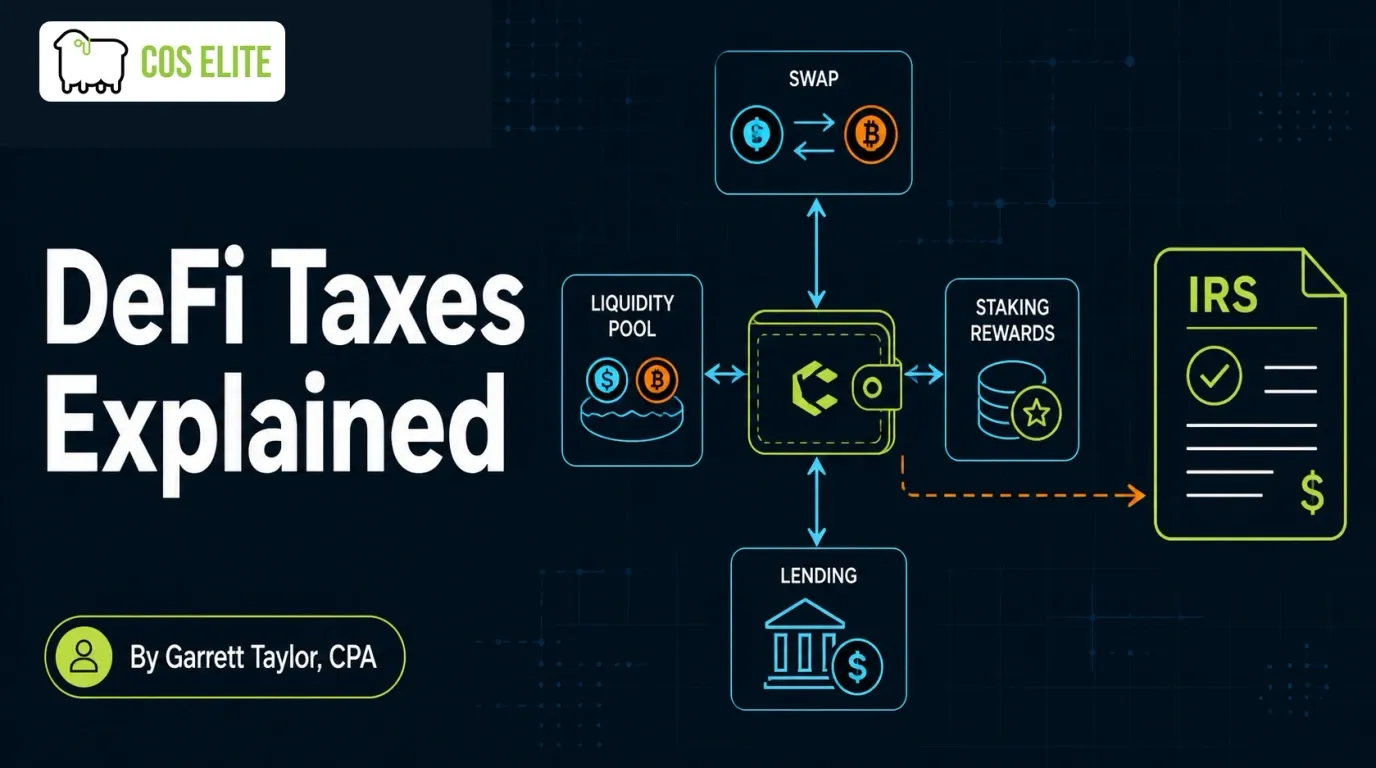
DeFi Taxes in the US: A Complete Guide
How DeFi is taxed in the US: staking, liquidity pools, yield farming, lending, and airdrops. Complex DeFi history? Our crypto CPAs handle it.