Crypto-to-Crypto Trades: Tax Treatment Explained

By Garrett Taylor, CPA #133092
Reviewed by Leanne Grant, EA #00167954-EA
Key Takeaways
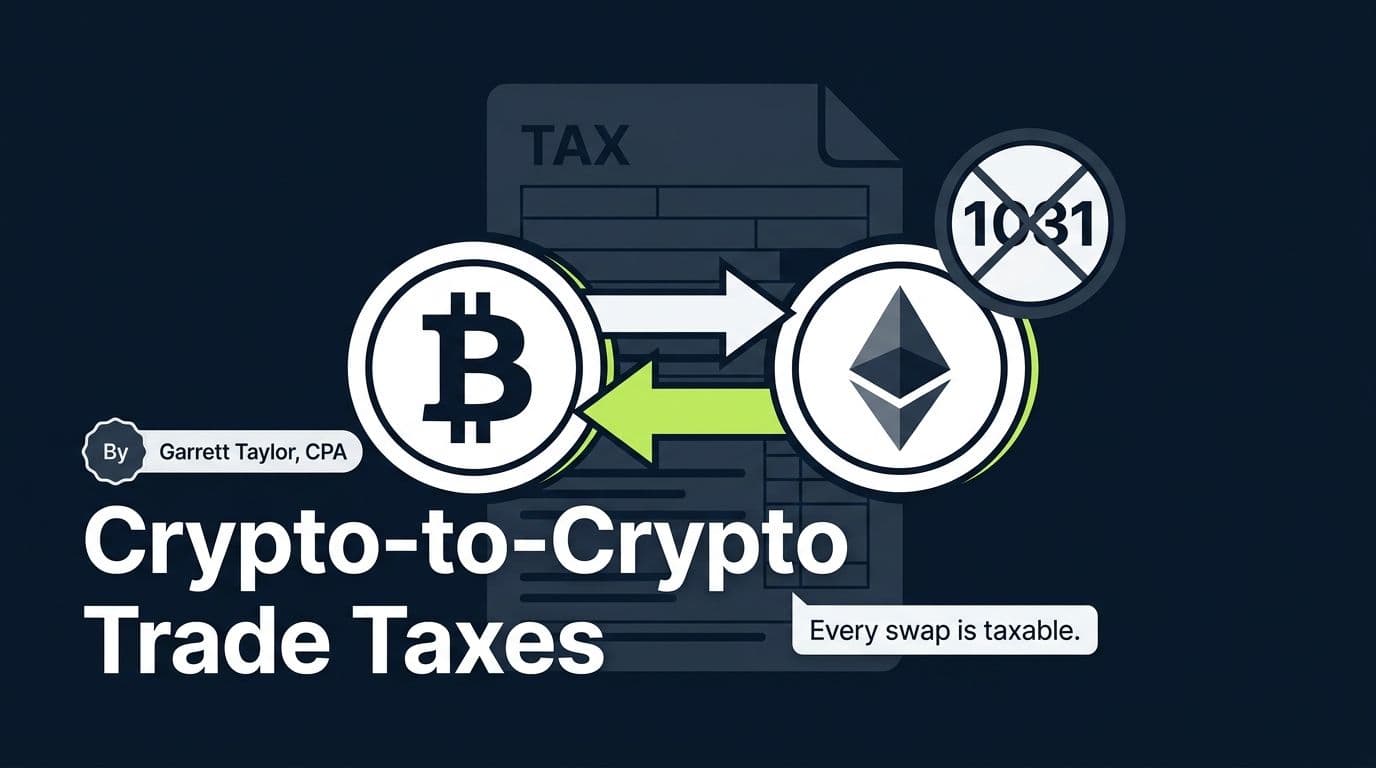
- ✓Every crypto-to-crypto swap (BTC to ETH, ETH to USDC, token to token) is a taxable disposition that triggers capital gains or losses.
- ✓Section 1031 like-kind exchanges have NOT applied to crypto since the Tax Cuts and Jobs Act took effect on January 1, 2018.
- ✓Wrapped token swaps (ETH to WETH) occupy a regulatory grey area, but the conservative position is to treat them as taxable.
- ✓Your new asset's cost basis equals the fair market value at the time of the swap.
- ✓Stablecoin-to-stablecoin swaps (USDC to DAI) are also taxable, even though the dollar value barely changes.
Here's a scenario that trips up almost every crypto investor I work with:
You swap your BTC for ETH on Uniswap. No dollars changed hands. Nothing hit your bank account. So it's not a taxable event... right?
Wrong.
Every single crypto-to-crypto trade is a taxable disposition under U.S. tax law. And the IRS has been crystal clear about this since Notice 2014-21.
In this guide, I'll walk you through exactly how crypto-to-crypto trades are taxed, why Section 1031 like-kind exchanges don't apply anymore, how to calculate your gain or loss on each swap, and the grey areas that still trip up experienced traders.
Why Every Crypto Swap Is a Taxable Event
The IRS treats cryptocurrency as property, not currency. This classification comes directly from Notice 2014-21, Q&A-1, and it has massive implications for how swaps are taxed.
When you exchange one piece of property for another piece of property, you've "disposed" of the first asset. That disposition triggers a capital gain or capital loss, calculated as the difference between your cost basis in the asset you gave up and the fair market value of what you received.
Think of it this way: if you traded a rental property for a sports car, nobody would argue that wasn't a taxable event. The IRS views a BTC-to-ETH swap the exact same way.
No ambiguity. No loopholes. Every swap triggers tax.
“”
This applies whether you're trading on Coinbase, swapping on Uniswap, using a DEX aggregator like 1inch, or executing an atomic swap. The venue doesn't matter. The tax consequence is identical.
For a complete overview of how all crypto transactions are taxed, see our Crypto Tax Guide for 2026.
Section 1031 and Crypto: Why Like-Kind Doesn't Apply
Before the Tax Cuts and Jobs Act (TCJA), some crypto investors argued that swapping one cryptocurrency for another qualified as a Section 1031 like-kind exchange. Under Section 1031, you can defer capital gains when you exchange one piece of "like-kind" property for another, as long as both qualify.
The argument went like this: Bitcoin and Ethereum are both "digital assets" or "virtual currencies," so they're like-kind to each other. Therefore, swapping BTC for ETH should be tax-deferred.
That argument had problems even before 2018. The IRS never issued guidance confirming crypto-to-crypto swaps qualified under Section 1031. And plenty of tax professionals argued that Bitcoin and Ethereum have fundamentally different use cases, consensus mechanisms, and economic characteristics, making them arguably not "like-kind" at all.
But the debate became moot on January 1, 2018.
Section 13303 of the TCJA amended Section 1031 to limit like-kind exchanges exclusively to real property. The amended text reads:
"No gain or loss shall be recognized on the exchange of real property held for productive use in a trade or business or for investment if such real property is exchanged solely for real property of like kind..."
Cryptocurrency is not real property. Period. So from 2018 forward, Section 1031 does not apply to any crypto-to-crypto swap. Not BTC to ETH. Not USDC to USDT. Not any token-to-token exchange.
Pro Tip
CPA Note: Some aggressive preparers still try to apply Section 1031 to post-2017 crypto swaps. This is not a defensible position. The statute is unambiguous. If your current tax preparer is doing this, get a second opinion, preferably from a firm that specializes in digital asset reconciliation.
How to Calculate Gain/Loss on a Crypto-to-Crypto Trade
The math on a crypto-to-crypto swap is straightforward once you understand the framework. Here's the formula:
Capital Gain (or Loss) = Fair Market Value of Asset Received - Cost Basis of Asset Disposed
Let's break that down:
- Fair Market Value (FMV) of Asset Received: The dollar value of the crypto you received at the exact time of the swap.
- Cost Basis of Asset Disposed: What you originally paid (in dollar terms) for the crypto you gave up, plus any transaction fees.
The FMV of what you received also becomes the cost basis of your new asset. This is critical for calculating gains on future dispositions.
Your choice of cost basis accounting method, FIFO, LIFO, Specific Identification, or HIFO, directly impacts which cost basis gets used when you dispose of partial holdings. We cover this in depth in our guide on crypto cost basis methods.
Stablecoin Swaps: Still Taxable
This one catches people off guard constantly.
"I swapped USDC for DAI. They're both worth $1. There's no gain. So it's not taxable, right?"
Technically, it IS a taxable event. You disposed of one asset (USDC) and acquired another (DAI). The fact that the gain is $0 (or close to it) doesn't mean you can skip reporting it.
Here's why this matters beyond just compliance:
- Stablecoins can deviate from their peg. If you acquired USDC at $0.98 during the March 2023 depeg and later swapped it for DAI at $1.00, you have a $0.02 per-unit gain. On a large position, that adds up.
- The IRS expects reporting. Even zero-gain dispositions should appear on Form 8949. Omitting them creates discrepancies if the IRS cross-references exchange data.
- Your cost basis resets. Your new DAI's cost basis is the FMV at the time of the swap, not your original USDC cost basis.
The same logic applies to swapping between any stablecoins: USDC to USDT, DAI to FRAX, BUSD to TUSD. All taxable dispositions.
Wrapped Tokens: The Grey Area
Here's where things get genuinely murky.
When you wrap ETH into WETH (Wrapped Ether), are you "disposing" of one asset and "acquiring" another? Or are you simply changing the technical wrapper around the same underlying asset?
The IRS has not issued specific guidance on wrapped tokens as of May 2026. That leaves us in a grey area.
The conservative position: treat wrapping and unwrapping as taxable events. WETH and ETH trade on different smart contracts, have different token addresses, and function differently within DeFi protocols. Under the property framework of Notice 2014-21, these distinctions arguably make them separate assets.
The aggressive position: wrapping is merely a technical transformation, not a substantive exchange. ETH and WETH are economically identical and freely interchangeable 1:1. This is closer to exchanging a $100 bill for five $20s, a change in form, not substance.
If you take the aggressive position, document your reasoning thoroughly. And understand that if the IRS later rules that wrapping IS a taxable event, you could face penalties on unreported gains.
For DeFi traders who wrap and unwrap tokens frequently, the tax implications can be significant. Our DeFi tax guide covers this and other protocol-specific scenarios in detail.
| Trade Type | Taxable? | Notes |
|---|---|---|
| BTC to ETH | Yes | Standard crypto-to-crypto disposition |
| ETH to USDC | Yes | Crypto-to-stablecoin is still crypto-to-crypto |
| USDC to DAI | Yes | Stablecoin-to-stablecoin swap; gain is usually near $0 |
| ETH to WETH | Grey area | No IRS guidance; conservative = taxable |
| BTC to BTC (same chain) | No | No disposition; same asset |
| Token airdrop claim + immediate swap | Yes (twice) | Income on receipt + capital gain/loss on swap |
| LP token deposit/withdrawal | Likely yes | Treated as exchange of underlying for LP token |
| Cross-chain bridge (e.g., ETH to ETH on Arbitrum) | Grey area | Arguably same asset, different network representation |
DEX Swaps vs CEX Trades: Same Tax Rules
Whether you execute a trade on Coinbase (centralized exchange) or Uniswap (decentralized exchange), the tax treatment is identical. The IRS does not distinguish between venues.
However, there are practical differences that affect your tax compliance:
CEX trades generate transaction histories and, increasingly, 1099 forms. The IRS receives copies. This creates an automatic paper trail.
DEX trades do not generate 1099s. The transactions exist only on-chain. This does NOT mean they're invisible to the IRS, blockchain analytics firms like Chainalysis work directly with the agency. But it does mean the burden of record-keeping falls entirely on you.
If you're actively trading across multiple DEXs, keeping accurate records is essential. A missed swap can cascade into incorrect cost basis calculations for every subsequent trade. Our tax return preparation service includes full on-chain reconciliation for exactly this reason.
Pre-2018 Trades: The Like-Kind Argument
If you made crypto-to-crypto trades before January 1, 2018, the Section 1031 question is more nuanced.
Before the TCJA, Section 1031 applied to all property, not just real property. Some tax professionals filed crypto-to-crypto swaps as like-kind exchanges during this period. The IRS has not retroactively invalidated these filings.
That said, the like-kind argument for pre-2018 crypto trades was always aggressive:
- Like-kind requires similar nature and character. Bitcoin (a payment network) and Ethereum (a smart contract platform) arguably have different natures. The IRS applies a "nature and character" test, not merely a "same asset class" test.
- Like-kind exchange rules require strict compliance. Section 1031 has holding period requirements and documentation standards that most crypto traders never followed.
- No IRS ruling ever confirmed it. Unlike real estate 1031 exchanges, which have decades of case law and IRS rulings, crypto had zero authoritative guidance supporting like-kind treatment.
If you filed pre-2018 trades as like-kind exchanges and the IRS challenges them, the burden of proof falls on you. Make sure your documentation is airtight.
For a broader view of how wash sale rules interact with crypto trading strategies, see our wash sale rules guide.
Worked Example: Chain of Trades
Let's walk through a realistic scenario with actual numbers. Meet Lisa.
“This example illustrates how cost basis flows through a chain of crypto-to-crypto swaps. Every trade creates a new taxable event and a new cost basis.”
Trade 1: Lisa buys Bitcoin.
- January 15, 2025: Lisa buys 1 BTC for $30,000 on Coinbase.
- Cost basis: $30,000 for 1 BTC ($30,000 per BTC).
Trade 2: Lisa swaps half her BTC for ETH.
- June 10, 2025: BTC price = $62,000. ETH price = $6,200.
- Lisa swaps 0.5 BTC for 5 ETH on Uniswap.
- Disposition: 0.5 BTC with cost basis of $15,000 (half of her $30,000 total).
- Proceeds (FMV received): 5 ETH x $6,200 = $31,000.
- Capital gain: $31,000 - $15,000 = $16,000 (short-term, held < 1 year).
- New cost basis for ETH: $6,200 per ETH.
Trade 3: Lisa swaps some ETH for USDC.
- October 3, 2025: ETH price = $7,400.
- Lisa swaps 2 ETH for 14,800 USDC.
- Disposition: 2 ETH with cost basis of $12,400 (2 x $6,200).
- Proceeds (FMV received): 14,800 USDC x $1.00 = $14,800.
- Capital gain: $14,800 - $12,400 = $2,400 (short-term).
- New cost basis for USDC: $1.00 per USDC (14,800 units).
Trade 4: Lisa swaps USDC for a new altcoin.
- December 20, 2025: Lisa swaps 10,000 USDC for 5,000 ALTCOIN at $2.00 each.
- Disposition: 10,000 USDC with cost basis of $10,000.
- Proceeds (FMV received): 5,000 x $2.00 = $10,000.
- Capital gain: $10,000 - $10,000 = $0.
- New cost basis for ALTCOIN: $2.00 per token.
Lisa's 2025 tax summary from these trades:
| Trade | Asset Sold | Gain/Loss | Term |
|---|---|---|---|
| BTC to ETH | 0.5 BTC | +$16,000 | Short-term |
| ETH to USDC | 2 ETH | +$2,400 | Short-term |
| USDC to ALTCOIN | 10,000 USDC | $0 | Short-term |
| Total | +$18,400 |
Lisa owes tax on $18,400 in short-term capital gains, taxed at her ordinary income rate. She still holds 0.5 BTC (basis: $15,000), 3 ETH (basis: $18,600), 4,800 USDC (basis: $4,800), and 5,000 ALTCOIN (basis: $10,000).
Notice how each trade resets the cost basis for the received asset. This chain effect is exactly why accurate tracking matters. One wrong cost basis early in the chain throws off every subsequent calculation. For guidance on staking rewards that get swapped into other tokens, see our staking taxes guide.
Tracking Your Trades for Tax Purposes
If you're making more than a handful of crypto-to-crypto trades per year, manual spreadsheet tracking becomes error-prone fast. Here's what I recommend to clients:
1. Export transaction histories from every exchange and wallet.
Pull CSV exports from each CEX. For DEX trades, you'll need on-chain data from block explorers or indexing services.
2. Reconcile on-chain and off-chain records.
Transfers between your own wallets are NOT taxable events. But they look identical to trades in raw transaction data. Misclassifying a wallet-to-wallet transfer as a sale inflates your reported gains. Our digital asset reconciliation service handles this systematically.
3. Choose a cost basis method and apply it consistently.
FIFO (First-In, First-Out) is the default if you don't elect otherwise. But HIFO (Highest-In, First-Out) or Specific Identification can reduce your tax liability if applied correctly. Read our cost basis methods breakdown before choosing.
4. Document everything.
Save screenshots of trade confirmations. Export your full transaction history at year-end. Keep records for at least 3 years from the filing date (6 years if you underreport income by more than 25%).
5. Reconcile before filing.
Don't wait until April. Start reconciling in January. Give yourself (or your CPA) time to track down missing transactions, resolve discrepancies, and make strategic decisions about cost basis methods.
Need help reconciling your crypto-to-crypto trades?
COS Elite specializes in digital asset tax preparation for active traders and DeFi users. Book a free consultation and let's make sure every swap is accounted for.
Book a Free ConsultationFree 15 minute call. No commitment.
Frequently Asked Questions
How do I calculate my gain on a crypto-to-crypto trade?
Subtract your cost basis in the crypto you gave up from the fair market value of the crypto you received at the time of the swap. The result is your capital gain (if positive) or capital loss (if negative).
Are stablecoin swaps taxable?
Yes. Swapping USDC for DAI, USDT for USDC, or any stablecoin-to-stablecoin trade is a taxable disposition. The gain is typically near zero, but the event must still be reported on Form 8949.
What about wrapping ETH into WETH -- is that taxable?
The IRS has not issued specific guidance on wrapped tokens. The conservative position is to treat wrapping as a taxable event. The aggressive position treats it as a non-event since the economic value doesn't change. Document your position either way.
Do DEX swaps get reported to the IRS?
DEXs do not currently issue 1099 forms. However, all on-chain transactions are permanently recorded on public blockchains. The IRS uses blockchain analytics tools and can trace DEX activity. You are required to report all DEX trades regardless of whether you receive a tax form.
What cost basis method should I use for crypto-to-crypto trades?
FIFO (First-In, First-Out) is the IRS default. However, Specific Identification or HIFO (Highest-In, First-Out) may reduce your tax bill. You must elect your method before the disposition and apply it consistently. Consult a crypto-specialized CPA before switching methods.
What if I made crypto-to-crypto trades before 2018 and claimed like-kind treatment?
The IRS has not retroactively ruled on pre-2018 like-kind claims for crypto. Some tax professionals took this position. If challenged, you'll need to demonstrate that the assets were "like-kind" under the pre-TCJA standard and that you followed all Section 1031 procedural requirements.
Are cross-chain bridge transfers taxable?
This is another grey area. Bridging ETH from Ethereum Mainnet to Arbitrum arguably doesn't change the underlying asset. But the IRS hasn't ruled on it. The conservative approach is to document these transfers and be prepared to report them if guidance changes.
Do I owe taxes if I swap crypto at a loss?
You still have a taxable event, but you can use the capital loss to offset other capital gains. If your net capital losses exceed your gains, you can deduct up to $3,000 per year against ordinary income, carrying forward any excess to future years.
How are gas fees treated on crypto-to-crypto swaps?
Gas fees paid to execute a swap can generally be added to your cost basis (reducing your gain) or treated as a separate disposition of the token used to pay gas (e.g., spending ETH on gas is itself a taxable event). The IRS hasn't issued definitive guidance, but most practitioners add gas fees to the transaction cost basis.
What happens if I don't report my crypto-to-crypto trades?
Failure to report taxable dispositions can result in accuracy-related penalties (20% of the underpayment under IRC Section 6662), failure-to-file penalties, and interest on unpaid tax. In egregious cases, willful failure to report can lead to fraud penalties or criminal prosecution.

About the author
Garrett Taylor, CPA
Former Big Four CPA. CPA #133092. Garrett answers his phone. Led by expertise. Powered by precision.
Related Articles

The Ultimate Guide to Crypto Tax (2026 Edition)
The most comprehensive crypto tax guide online, written by a CPA who files 500+ crypto returns a year. Every taxable event, form, strategy, and 2026 update.
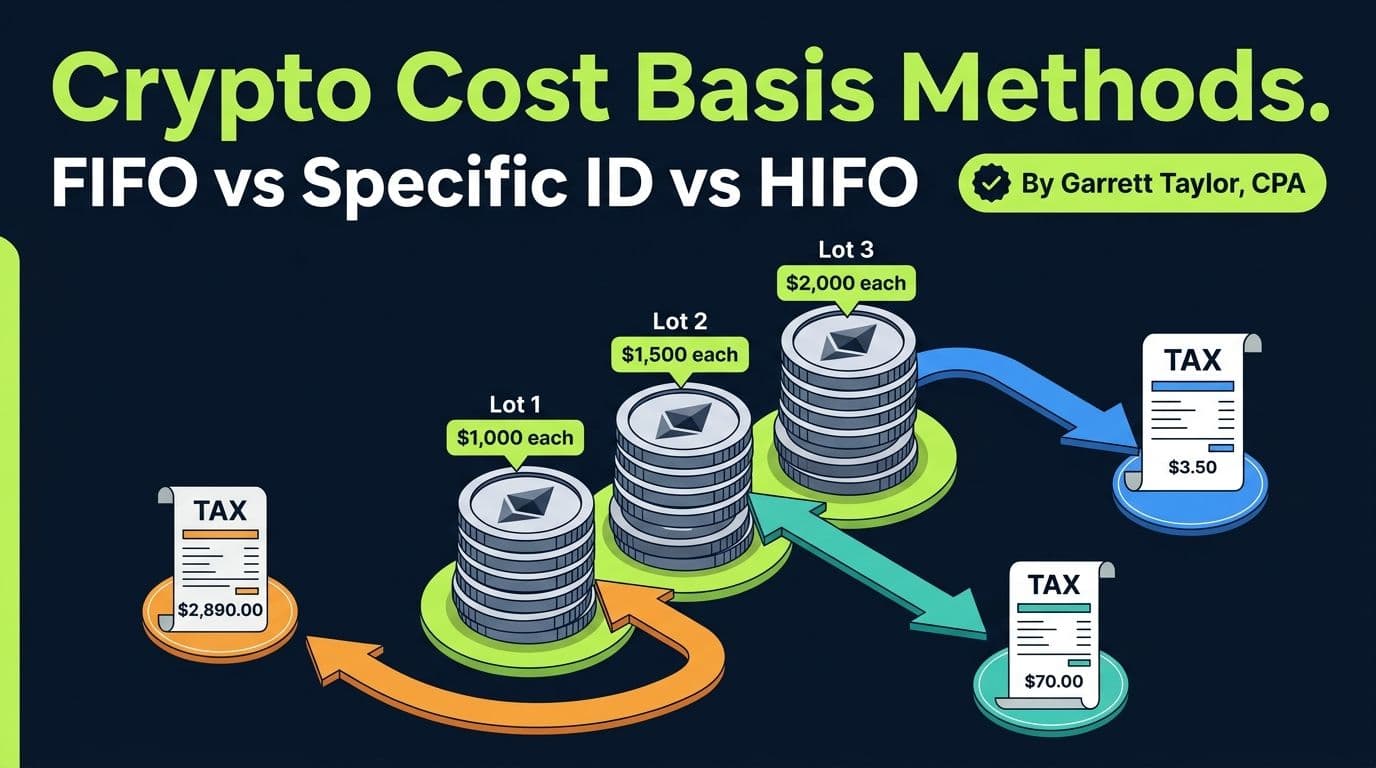
Crypto Cost Basis Methods: FIFO vs Specific ID vs HIFO
Compare FIFO, LIFO, HIFO, and Specific ID for crypto taxes. Worked example shows how the same sale produces 4 different tax bills. Updated for Rev. Proc. 2024-28, Notice 2026-20, and 1099-DA.
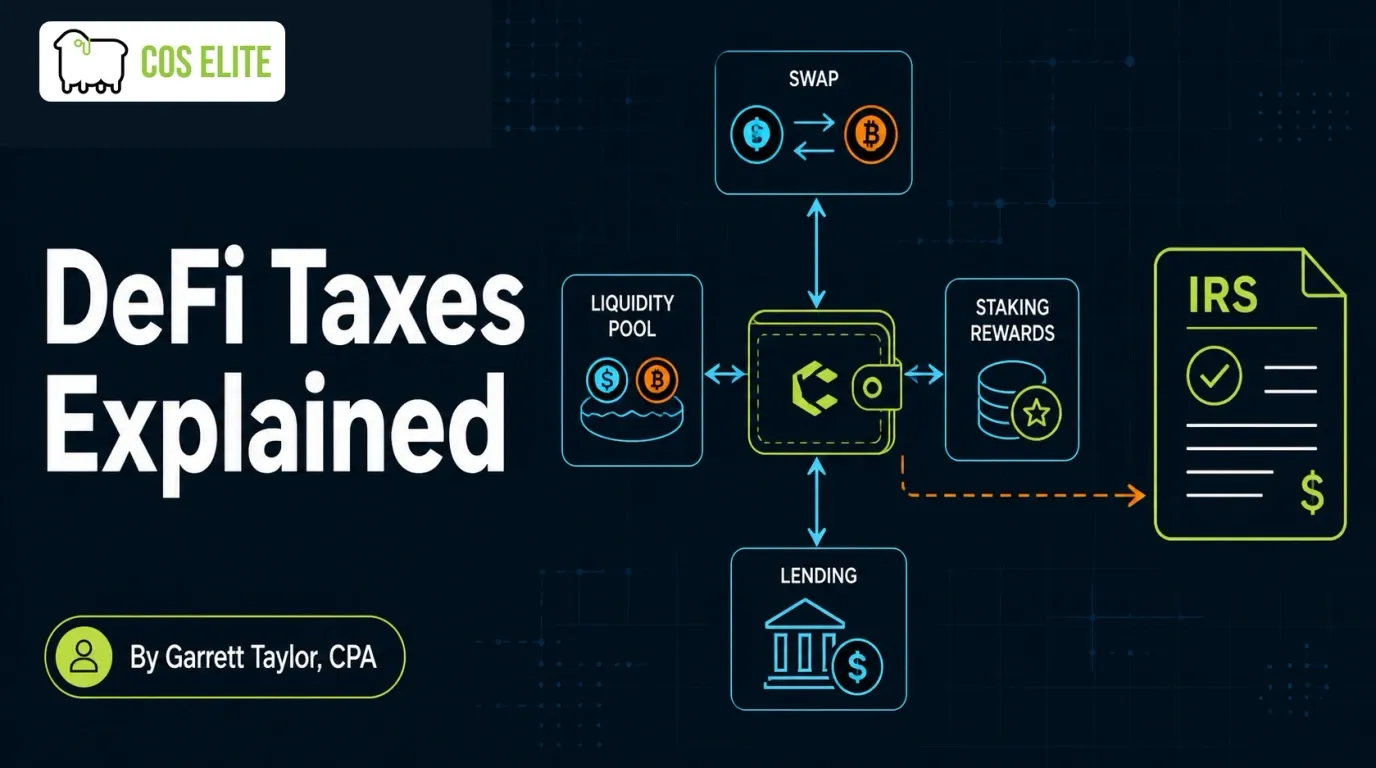
DeFi Taxes in the US: A Complete Guide
How DeFi is taxed in the US: staking, liquidity pools, yield farming, lending, and airdrops. Complex DeFi history? Our crypto CPAs handle it.