Wash Sale Rules and Crypto: The Loophole That Won't Last

By Garrett Taylor, CPA #133092
Reviewed by Leanne Grant, EA #00167954-EA
Key Takeaways
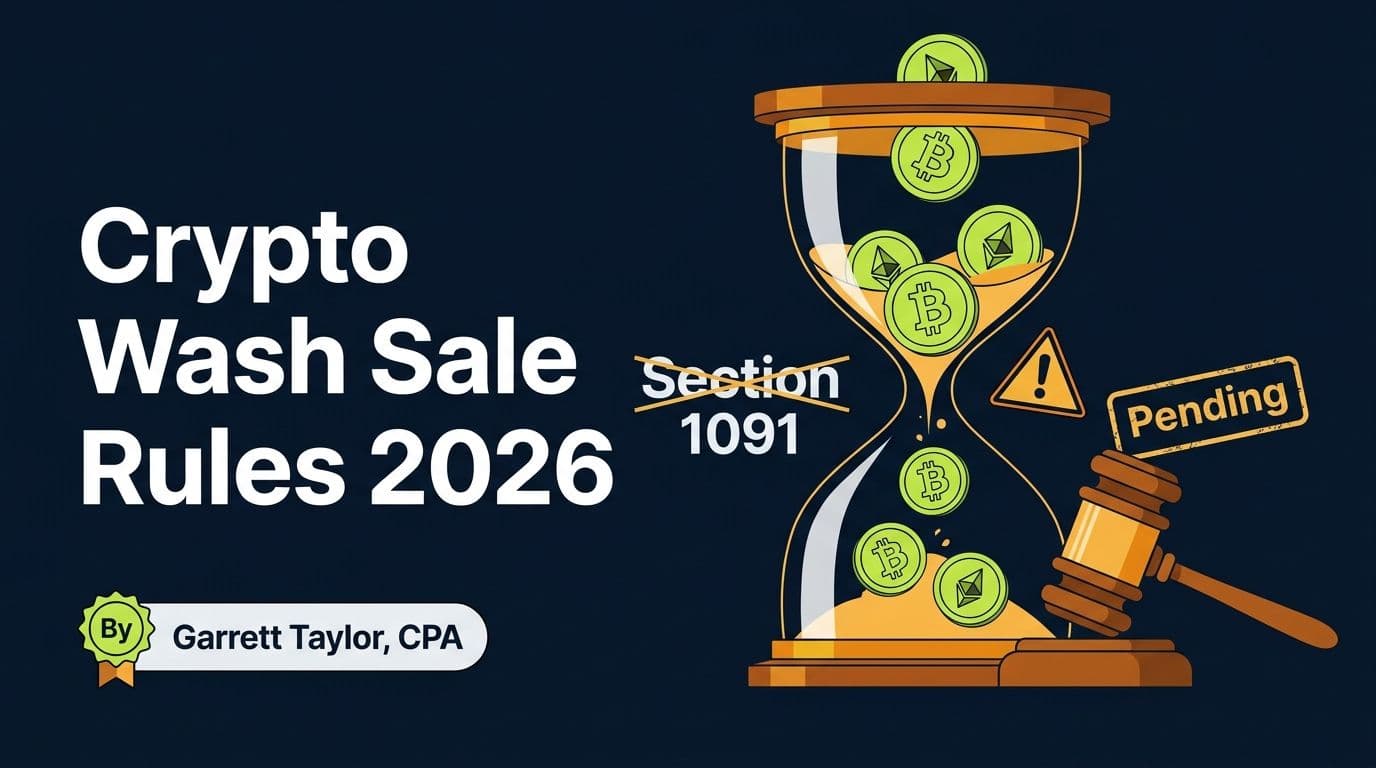
- ✓The wash sale rule (Section 1091) applies to stocks and securities but not to cryptocurrency, as of May 2026.
- ✓Crypto is classified as "property" under IRS Notice 2014-21, placing it outside the scope of Section 1091.
- ✓This means you can sell crypto at a loss and immediately repurchase the same asset, claiming the full capital loss.
- ✓Multiple legislative proposals (including the Build Back Better Act) have attempted to extend wash sale rules to digital assets.
- ✓This exemption could disappear with any new legislation. Proactive tax planning now is critical.
“This guide has been reviewed for accuracy by Leanne Grant, Enrolled Agent, specializing in cryptocurrency tax compliance and IRS representation.”
, Reviewed by Leanne Grant, EA
If you trade stocks, you already know the frustration of the wash sale rule: sell at a loss, buy back too soon, and the IRS disallows your deduction. But as of May 2026, cryptocurrency operates under a different set of rules, and that difference creates a significant, time-limited tax planning opportunity.
This guide explains exactly how the wash sale rule works, why it does not currently apply to crypto transactions, and what you should be doing right now before Congress closes the gap.
What Is the Wash Sale Rule? (Section 1091 Basics)
The wash sale rule is codified in Section 1091 of the Internal Revenue Code. It was designed to prevent taxpayers from manufacturing artificial tax losses while maintaining their economic position in an investment.
Here is how it works in practice:
- You sell a stock or security at a loss.
- Within 30 days before or after the sale, you purchase a "substantially identical" stock or security.
- The IRS disallows the loss deduction.
The disallowed loss is not permanently gone, it gets added to the cost basis of the replacement shares. But the immediate tax benefit disappears.
The 30-day window is strict. It applies 30 days before the sale and 30 days after, creating a 61-day total window. If you buy back within that period, the wash sale rule triggers automatically.
“The wash sale rule creates a 61-day blackout window around any stock loss. For crypto, that window does not exist, yet.”
, Garrett Taylor, CPA
Why Wash Sales Don't Apply to Crypto (Yet)
This is the critical distinction that creates the current opportunity: cryptocurrency is not a security under federal tax law.
In Notice 2014-21, the IRS established that virtual currency is treated as "property" for federal tax purposes. This classification has far-reaching consequences, but one of the most significant is that it places crypto outside the reach of Section 1091.
Section 1091 specifically applies to "stock or securities." The statutory language does not mention property broadly, and it does not include digital assets. Because the IRS treats Bitcoin, Ethereum, and other cryptocurrencies as property, similar to real estate, collectibles, or precious metals, the wash sale rule simply does not apply.
As of May 2026, this remains the law. You can sell crypto at a loss and repurchase the exact same asset one second later without triggering any wash sale disallowance.
Pro Tip
This exemption could end with any new legislation. Multiple bills have proposed extending wash sale rules to digital assets. Plan your tax-loss harvesting strategy accordingly, and consult with a qualified crypto tax professional before executing large transactions. What is legal today may not be legal next tax year.
The "Property vs Securities" Distinction
Understanding why this loophole exists requires understanding the fundamental classification difference between stocks and crypto under the tax code.
| Classification | Examples | Wash Sale Rule Applies? |
|---|---|---|
| Securities | Stocks, bonds, options, ETFs, mutual funds | Yes (Section 1091) |
| Property | Real estate, collectibles, art, crypto | No |
| Commodities | Gold, oil, agricultural futures | Generally no |
Crypto sits in the "property" bucket alongside real estate and collectibles. You would not trigger a wash sale by selling an investment property at a loss and immediately purchasing another property. The same logic applies to crypto.
However, and this is the key caveat, this classification is a policy choice, not an immutable law of nature. Congress can change it at any time. The SEC has separately argued that certain tokens may qualify as securities under the Howey test for regulatory purposes, but that securities law classification has not yet altered the tax treatment under Section 1091.
| Factor | Stocks & Securities | Cryptocurrency |
|---|---|---|
| Tax classification | Securities | Property (Notice 2014-21) |
| Wash sale rule applies | Yes, Section 1091 | No, not currently covered |
| 30-day repurchase restriction | Yes | No |
| Loss disallowance on quick repurchase | Yes | No |
| Tax-loss harvesting | Must wait 31 days or buy "not substantially identical" asset | Can sell and immediately repurchase the same asset |
| Cost basis on repurchase | Adjusted (disallowed loss added) | New cost basis at repurchase price |
| Reporting form | Form 8949 / Schedule D | Form 8949 / Schedule D |
| Legislative risk | Established, stable rules | Exemption could change any session |
Crypto Tax-Loss Harvesting: How It Works
Tax-loss harvesting is the practice of strategically selling investments at a loss to offset capital gains or reduce taxable income. With stocks, the wash sale rule severely limits this strategy. With crypto, the absence of wash sale restrictions makes it dramatically more powerful.
Here is the basic concept:
- You hold a crypto asset that has declined in value below your cost basis.
- You sell the asset, realizing the capital loss.
- You immediately repurchase the same asset if you want to maintain your position.
- You claim the capital loss on your tax return.
The loss can offset capital gains dollar-for-dollar. If your capital losses exceed your capital gains for the year, you can deduct up to $3,000 of excess losses against ordinary income ($1,500 if married filing separately). Remaining losses carry forward to future tax years indefinitely.
This strategy works with any crypto asset, Bitcoin, Ethereum, altcoins, stablecoins that have lost their peg, even staking rewards that have declined in value.
Pro Tip
COS Elite Pro Tip: Tax-loss harvesting is most effective when you have significant realized capital gains to offset. Review your crypto-to-crypto trades, every swap is a taxable event that may have generated gains you can now offset with harvested losses.
Step-by-Step Tax-Loss Harvesting Strategy
Here is a practical framework for executing crypto tax-loss harvesting while the wash sale exemption remains in effect:
Step 1: Identify Unrealized Losses
Review your entire crypto portfolio and identify positions trading below your cost basis. Pay special attention to your cost basis method, whether you use FIFO, LIFO, HIFO, or specific identification will significantly affect which lots show losses. Our digital asset reconciliation service can help you map this out precisely.
Step 2: Calculate the Tax Impact
Before selling, calculate the expected tax benefit. Consider your marginal tax rate, existing capital gains for the year, and whether the losses would offset short-term gains (taxed at ordinary income rates, up to 37%) or long-term gains (taxed at 0%, 15%, or 20%).
Step 3: Execute the Sale
Sell the depreciated crypto asset on your exchange. Document the transaction: date, amount, sale price, and cost basis of the specific lot sold.
Step 4: Repurchase (If Desired)
Because the wash sale rule does not apply, you can repurchase immediately. Your new cost basis will be the repurchase price, there is no basis adjustment like there would be with securities.
Step 5: Document Everything
Maintain records of both the sale and repurchase. While the IRS does not currently require wash sale tracking for crypto, thorough documentation protects you if rules change retroactively or if your return is audited.
Legislative Proposals to Close the Loophole
Congress has made multiple attempts to extend wash sale rules to digital assets. While none have passed as of May 2026, the trajectory is clear: this loophole is living on borrowed time.
Build Back Better Act (2021)
The most significant legislative attempt came in the Build Back Better Act, which passed the House in November 2021 but stalled in the Senate. Section 138153 of the bill would have amended Section 1091 to include "digital assets" alongside stocks and securities. The provision would have applied to transactions after December 31, 2021.
The bill's failure did not represent Congressional endorsement of the crypto wash sale exemption, it failed for unrelated political reasons. The wash sale extension had bipartisan support.
Subsequent Proposals
Multiple subsequent bills and budget proposals have included similar provisions. The Tax Foundation and other policy organizations have analyzed these proposals, and the consensus is that extending wash sale rules to crypto is a matter of "when," not "if."
The Joint Committee on Taxation estimated that closing this loophole would generate approximately $16.8 billion in revenue over ten years, a figure that makes it an attractive revenue offset for future legislation.
What This Means for You
Every year that passes without legislation is another year you can harvest crypto losses without wash sale restrictions. But planning as if the exemption is permanent would be a mistake.
What Changes If Wash Sales Are Extended to Crypto
If Congress does extend Section 1091 to digital assets, here is what would change:
- 30-day restriction applies. You could no longer sell and immediately repurchase the same crypto. You would need to wait at least 31 days.
- "Substantially identical" test applies. Buying a wrapped version of the same token (e.g., selling ETH and buying WETH) would likely trigger the wash sale rule.
- Loss disallowance. Losses on wash sales would be disallowed and added to the cost basis of replacement assets.
- Cross-account tracking required. Wash sales would apply across all your wallets and exchanges, not just within a single account.
- Spousal transactions included. Purchases by your spouse within the 30-day window would also trigger the rule.
The strategic landscape would shift dramatically. Crypto tax-loss harvesting would still work, but you would need to either wait 31 days (accepting price risk) or swap into a "not substantially identical" asset, such as selling BTC and buying ETH to harvest the BTC loss while maintaining general crypto market exposure.
A CPA who specializes in digital assets can help you identify tax-loss harvesting opportunities, calculate the potential tax impact, ensure proper reporting, and stay informed about legislative developments. At COS Elite, crypto tax planning, including tax-loss harvesting strategies, is a core part of our tax services.
If you have experienced lost or stolen crypto, that situation involves different rules entirely and would likely remain unaffected by wash sale changes.
Worked Example: "$50,000 in Tax Savings Through Crypto TLH"
Let's walk through a realistic scenario that illustrates the power of crypto tax-loss harvesting under current rules.
Meet Rachel
Rachel is a high-income professional in the 37% federal tax bracket. She holds 10 ETH purchased at $4,000 each, for a total cost basis of $40,000.
The Market Drops
ETH declines to $2,500. Rachel's 10 ETH are now worth $25,000, an unrealized loss of $15,000.
Rachel's Tax-Loss Harvest
- Rachel sells all 10 ETH for $25,000, realizing a $15,000 capital loss.
- She immediately repurchases 10 ETH at $2,500 each.
- Her new cost basis is $2,500 per ETH ($25,000 total).
If This Were Stocks (Wash Sale Applies)
The $15,000 loss would be completely disallowed under Section 1091. The disallowed loss would be added to the basis of her replacement shares, and Rachel would receive no current-year tax benefit.
Because This Is Crypto (No Wash Sale)
Rachel claims the full $15,000 capital loss on her tax return. She still holds 10 ETH and has the same market exposure she started with.
The Tax Savings
Rachel has $60,000 in short-term capital gains from other crypto-to-crypto trades this year. The $15,000 loss offsets those gains directly:
- $15,000 loss x 37% marginal rate = $5,550 in federal tax savings
- Plus state tax savings (varies by state)
- Rachel's net taxable crypto gains drop from $60,000 to $45,000
Now multiply this across multiple assets and multiple market dips throughout the year. Sophisticated investors who harvest losses on every significant dip, in BTC, ETH, SOL, and other holdings, can generate tens of thousands in tax savings annually.
“Rachel saved $5,550 in federal taxes by harvesting a single crypto loss, and she never gave up her ETH position. With stocks, that deduction would have been disallowed entirely.”
, Worked Example Result
Risks and Limitations of Crypto Tax-Loss Harvesting
Tax-loss harvesting in crypto is powerful, but it is not without risks. Consider these factors before implementing the strategy:
1. Transaction Costs
Every sale and repurchase incurs exchange fees, network gas fees, and potential spread costs. These costs reduce the net tax benefit. For smaller positions, the costs may outweigh the savings.
2. Price Movement Risk
Even though you can repurchase immediately, prices can move in the seconds between your sale and repurchase. In volatile markets, you could sell at $2,500 and repurchase at $2,550. For large positions, consider using limit orders or executing on exchanges with deep liquidity.
3. Tracking Complexity
Every harvest event creates a new tax lot with a new cost basis and a new holding period. If you harvest frequently, your cost basis records become complex. Working with a firm that specializes in digital asset reconciliation prevents errors that could cost more than the harvesting saves.
4. Legislative Risk
If wash sale rules are extended to crypto retroactively (unlikely but possible), previously harvested losses could be challenged. Most practitioners consider retroactive application improbable, but it is worth noting as a tail risk.
5. The $3,000 Cap
If you do not have capital gains to offset, your usable loss deduction is limited to $3,000 per year against ordinary income. Excess losses carry forward, but the immediate benefit is capped. This makes the strategy most valuable when you have realized gains to offset.
6. Wash Sale Rules May Apply to Certain Tokens
If a specific token is deemed a "security", either through SEC action or judicial ruling, the wash sale rule could apply to that token even without new legislation. This is an evolving area of law. The safe assumption is that Bitcoin and Ethereum are property, but less established tokens carry more classification risk.
Ready to Maximize Your Crypto Tax Savings?
COS Elite specializes in crypto tax planning for investors who want to take advantage of every legal strategy available, including tax-loss harvesting. to build a personalized harvesting plan before the rules change.
Schedule a consultationFree 15 minute call. No commitment.
Frequently Asked Questions
Can you tax-loss harvest crypto in 2026?
Yes. As of May 2026, the wash sale rule does not apply to cryptocurrency. You can sell crypto at a loss and immediately repurchase the same asset, claiming the full loss on your tax return. This is because the IRS classifies crypto as "property" under Notice 2014-21, not as a "security" under Section 1091.
What is the wash sale rule?
The wash sale rule (Section 1091) prevents taxpayers from claiming a tax loss on a stock or security if they purchase a "substantially identical" asset within 30 days before or after the sale. The loss is disallowed and added to the cost basis of the replacement asset.
Does the wash sale rule apply to Bitcoin?
No, not as of May 2026. Bitcoin is classified as property for federal tax purposes, and the wash sale rule only applies to stocks and securities. However, legislation to extend the rule to digital assets has been proposed multiple times and could pass in the future.
What is the 30-day rule for crypto?
There is no 30-day rule for crypto, that is the point. The 30-day wash sale window applies only to stocks and securities. Because crypto is classified as property, you can sell and repurchase instantly without any waiting period and still claim the loss.
Did the Build Back Better Act extend wash sales to crypto?
The Build Back Better Act (H.R. 5376) included a provision to extend wash sale rules to digital assets, but the bill did not pass the Senate. As a result, the wash sale exemption for crypto remains intact. Future legislation may include similar provisions.
Can I sell Bitcoin at a loss and buy Ethereum to harvest the loss?
Yes, and this would qualify as tax-loss harvesting regardless of whether wash sale rules applied. Bitcoin and Ethereum are different assets, so they would never be considered "substantially identical", even under wash sale rules. This is a strategy that would survive any legislative change.
How much can I deduct from crypto losses?
Crypto capital losses first offset capital gains dollar-for-dollar with no limit. If losses exceed gains, you can deduct up to $3,000 per year against ordinary income ($1,500 if married filing separately). Remaining losses carry forward indefinitely to future tax years.
Do I need to report crypto tax-loss harvesting to the IRS?
Yes. All crypto sales must be reported on Form 8949 and Schedule D, including sales executed for tax-loss harvesting purposes. You report the sale and the resulting loss. The repurchase establishes a new cost basis for future reporting.
Is crypto tax-loss harvesting legal?
Absolutely. Tax-loss harvesting is a well-established, IRS-recognized tax planning strategy. The fact that wash sale rules do not apply to crypto makes it even more straightforward for digital assets. There is nothing aggressive or questionable about this approach.
What happens to my cost basis when I harvest a crypto loss?
When you sell crypto at a loss and repurchase, your new cost basis is simply the repurchase price. Unlike stocks (where disallowed wash sale losses are added to the replacement basis), there is no basis adjustment because no wash sale applies. Your holding period also resets to the repurchase date.
Should I harvest crypto losses throughout the year or wait until December?
Harvesting throughout the year is generally superior. Waiting until December means you might miss opportunities during mid-year dips. Market conditions in December may not offer the same unrealized losses. A systematic approach that harvests losses whenever they exceed a meaningful threshold tends to produce better results.
Can my CPA help me with crypto tax-loss harvesting?
A CPA who specializes in digital assets can help you identify harvesting opportunities, calculate the tax impact, ensure proper reporting, and monitor legislative changes. At COS Elite, crypto tax planning, including tax-loss harvesting strategy, is a core part of our [tax return preparation service](/services/tax-return-preparation). , -
Disclaimer: This article is for informational purposes only and does not constitute tax advice. Tax laws are subject to change, and the wash sale exemption for crypto could be modified by future legislation. Consult with a qualified tax professional before implementing any tax strategy. COS Elite provides personalized crypto tax planning, contact us to discuss your specific situation.

About the author
Garrett Taylor, CPA
Former Big Four CPA. CPA #133092. Garrett answers his phone. Led by expertise. Powered by precision.
Related Articles

The Ultimate Guide to Crypto Tax (2026 Edition)
The most comprehensive crypto tax guide online, written by a CPA who files 500+ crypto returns a year. Every taxable event, form, strategy, and 2026 update.
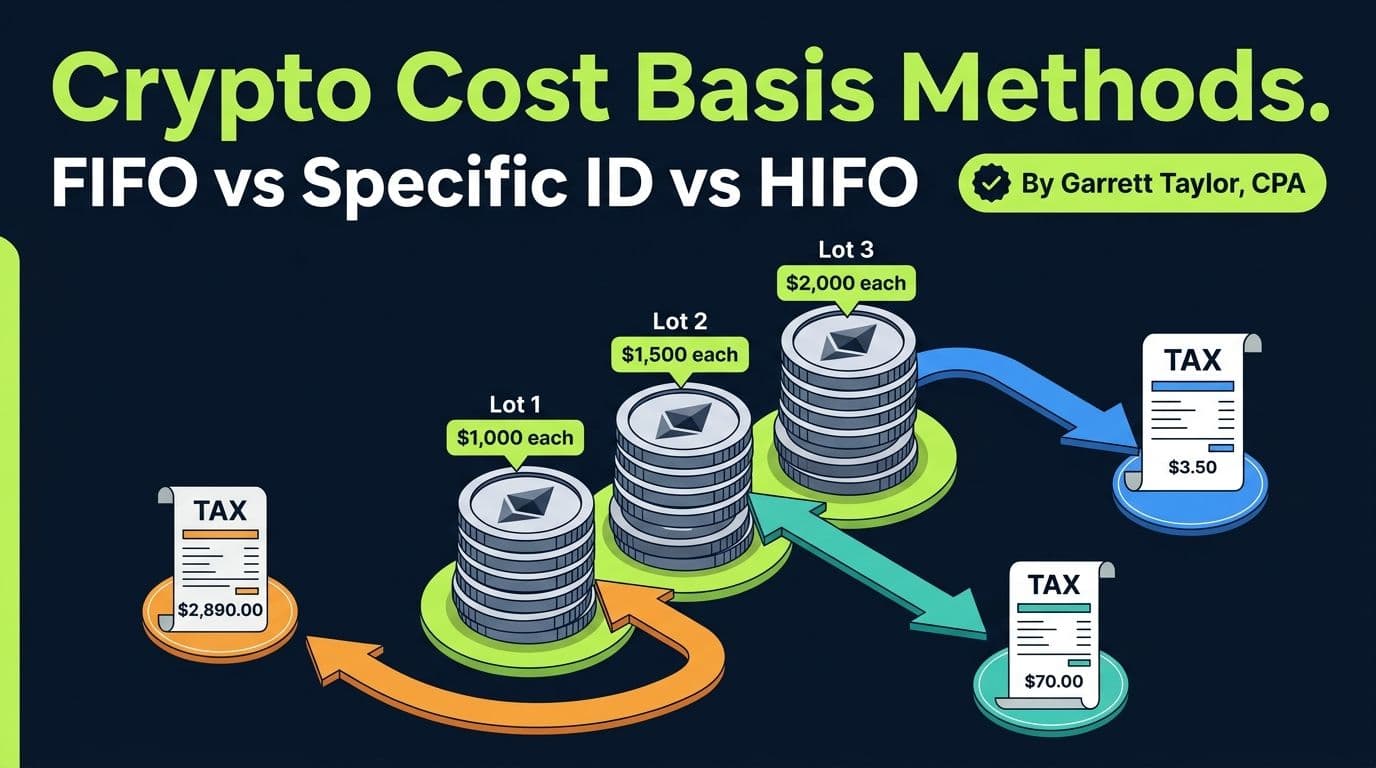
Crypto Cost Basis Methods: FIFO vs Specific ID vs HIFO
Compare FIFO, LIFO, HIFO, and Specific ID for crypto taxes. Worked example shows how the same sale produces 4 different tax bills. Updated for Rev. Proc. 2024-28, Notice 2026-20, and 1099-DA.
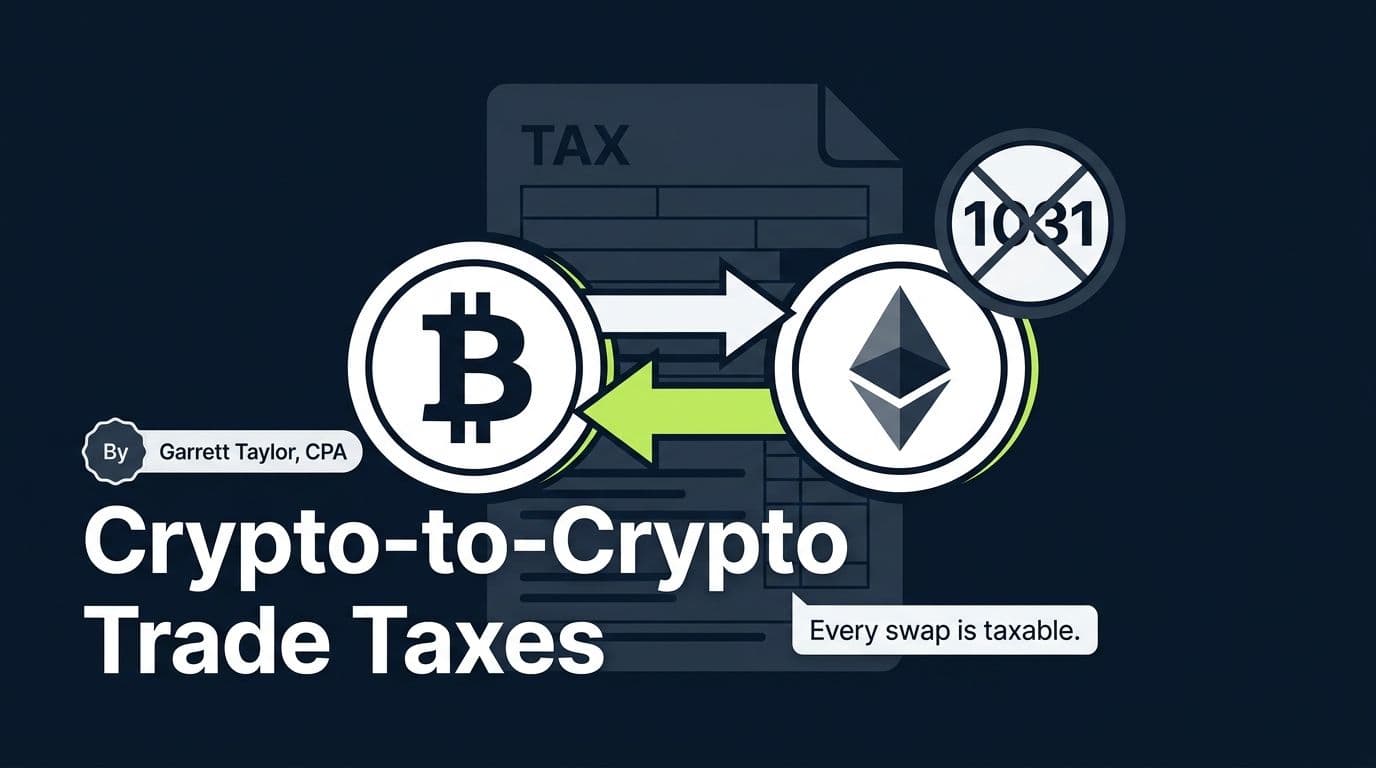
Crypto-to-Crypto Trades: Tax Treatment Explained
Every crypto-to-crypto swap is taxable. Learn how to calculate gain/loss, why Section 1031 doesn't apply, and how to handle stablecoin swaps, wrapped tokens, and DEX trades.