How Crypto Mining Is Taxed (2026 Complete Guide)

By Garrett Taylor, CPA #133092
Reviewed by Leanne Grant, EA #00167954-EA
Key Takeaways
- ✓Mined crypto is taxed as ordinary income at fair market value the moment it hits your wallet.
- ✓The IRS treats mining as either a hobby or a business -- and the tax difference is massive.
- ✓Business miners file Schedule C and can deduct electricity, hardware depreciation, internet, and dedicated space.
- ✓Hobby miners report income on Schedule 1 but cannot deduct any expenses after TCJA.
- ✓Self-employment tax adds 15.3% on top of your income tax rate for business miners.
- ✓Qualified Business Income (QBI) deduction can offset up to 20% of your net mining profit.
- ✓When you sell mined crypto, you trigger a second taxable event -- capital gains on the appreciation since the date mined.
“This guide has been reviewed for accuracy by Leanne Grant, Enrolled Agent, specializing in cryptocurrency tax compliance and IRS representation.”
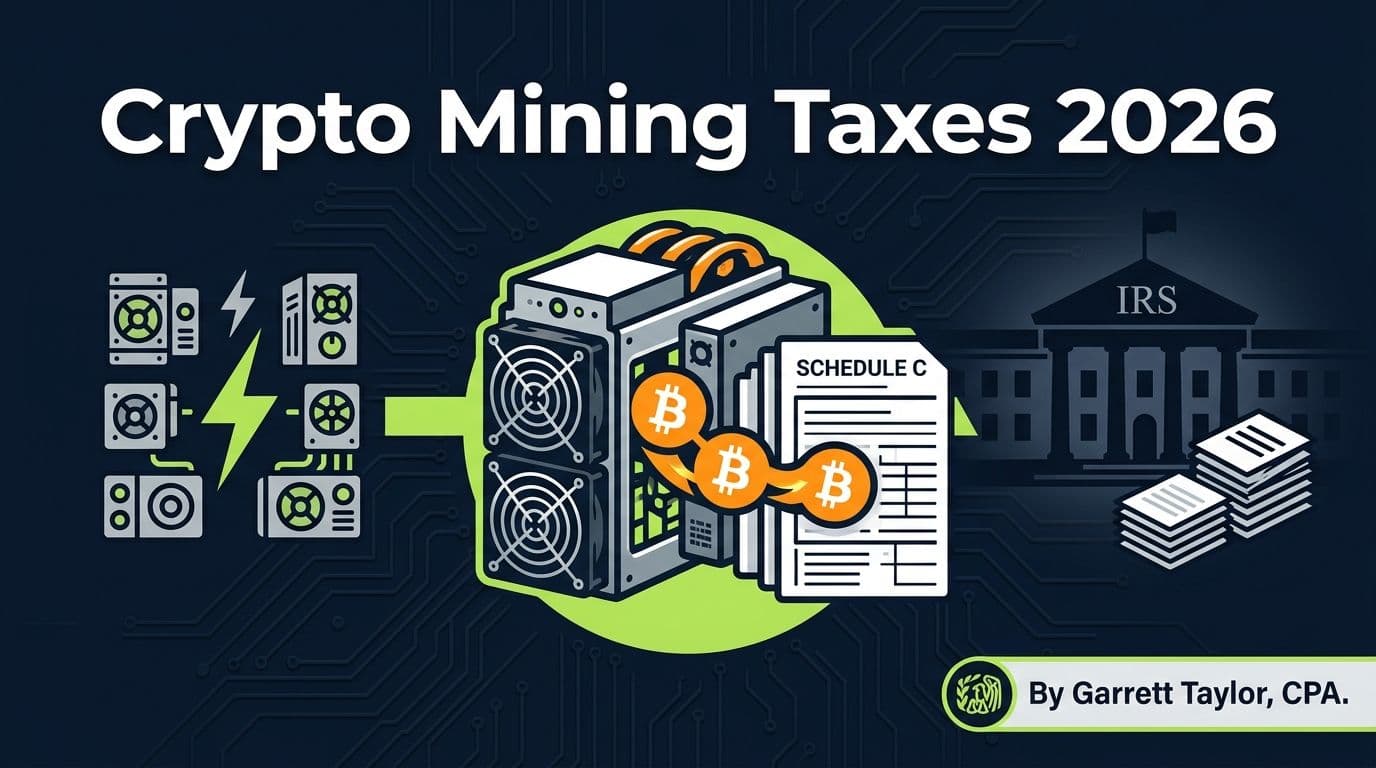
If you mined Bitcoin, Ethereum, or any other cryptocurrency in 2025 or 2026, the IRS wants its cut. Mining rewards are taxable the moment they land in your wallet,not when you sell. The tax is calculated on the fair market value (FMV) at the time of receipt, and it's treated as ordinary income. That means your marginal tax rate applies immediately. This guide breaks down exactly how crypto mining is taxed, what you can deduct, and how to avoid the most expensive mistakes miners make.
How the IRS Classifies Mined Cryptocurrency
The IRS made its position clear in Notice 2014-21: virtual currency received from mining constitutes gross income. Specifically, Q&A #8 states that when a taxpayer successfully mines virtual currency, the fair market value of the currency as of the date of receipt is includible in gross income.
This applies to every type of mining:
- Proof-of-Work mining (Bitcoin, Litecoin, Kaspa)
- Pool mining rewards (your proportional share)
- Cloud mining payouts
- Merge-mined coins (receiving secondary chain rewards)
There is no threshold or exemption. Mine $50 worth of crypto? Taxable. Mine $500,000? Also taxable. The classification is the same regardless of scale.
For a broader overview of how all crypto is taxed, see our complete crypto tax guide for 2026.
Hobby vs. Business: The IRS Test That Changes Everything
This is the single most important distinction for miners. The IRS uses Section 183 (Activities Not Engaged in for Profit) to determine whether your mining operation is a hobby or a business. The classification affects everything: what you can deduct, what forms you file, and how much tax you owe.
The Nine-Factor Profit Motive Test
The IRS evaluates these nine factors (from Treasury Regulation 1.183-2) to determine whether an activity is carried on for profit:
- The manner in which the taxpayer carries on the activity -- Do you keep books, track expenses, and maintain records like a business?
- The expertise of the taxpayer -- Have you studied mining economics, hash rate optimization, or energy costs?
- The time and effort expended -- Do you spend significant, regular time on mining operations?
- The expectation that assets may appreciate -- Is there a reasonable expectation the mined crypto will increase in value?
- The success of the taxpayer in similar activities -- Have you profited from mining or similar ventures before?
- The taxpayer's history of income or losses -- Does the activity show occasional profits, or only losses year after year?
- The amount of occasional profits -- When profitable, are profits substantial relative to investment?
- The financial status of the taxpayer -- Is mining your primary income source, or a side activity subsidized by other income?
- Elements of personal pleasure or recreation -- Is mining primarily for fun, or genuinely for profit?
Safe harbor rule: If your mining operation is profitable in three out of five consecutive years, the IRS presumes it's a business. But profitability alone isn't the only path: you can qualify as a business even with losses if you meet enough of the other factors.
| Factor | Hobby Mining | Business Mining |
|---|---|---|
| **Tax form** | Schedule 1, Line 8 (Other Income) | Schedule C (Profit or Loss) |
| **Expense deductions** | None (post-TCJA through 2025; likely extended) | Full deduction of ordinary and necessary expenses |
| **Self-employment tax** | Not applicable | 15.3% on net profit (Social Security + Medicare) |
| **QBI deduction** | Not eligible | Up to 20% deduction on qualified business income |
| **Loss treatment** | Cannot offset other income | Business losses can offset other income (subject to limits) |
| **Audit risk** | Lower scrutiny | Higher scrutiny but far better tax position |
| **Record-keeping burden** | Minimal | Substantial -- but required for deductions |
Pro Tip
If you're running even two or three ASIC miners and paying dedicated electricity costs, you almost certainly qualify as a business. Document your profit intent from day one: create a business plan, track all expenses, and keep a mining log. The IRS looks at the totality of circumstances, and documentation is your best defense.
Schedule C Deductions: What Business Miners Can Write Off
Business miners file Schedule Cand can deduct ordinary and necessary expenses. These deductions directly reduce your taxable mining income. Here's what qualifies:
Electricity Costs
Electricity is typically the single largest deductible expense for miners. If you have a dedicated meter for your mining operation, deduct 100% of that meter's cost. If mining rigs share a residential circuit, you'll need to calculate the mining portion based on wattage draw and hours of operation.
How to calculate: (Rig wattage x hours running x electricity rate) = deductible amount. Keep utility bills and document your calculation method.
Hardware Depreciation
ASIC miners, GPUs, power supplies, networking equipment, and cooling systems are all depreciable assets. You have two options:
- Section 179 expensing: Deduct the full cost in the year of purchase (up to the annual limit, which is $1,250,000 for 2026).
- MACRS depreciation: Spread the deduction over 5 years (mining equipment falls under asset class 00.12, Information Systems).
Most miners benefit from Section 179 in high-income years, but MACRS can be strategic if you expect higher income in future years.
Internet Costs
If you use your internet connection for mining, you can deduct the business-use percentage. A miner running rigs 24/7 that consume meaningful bandwidth has a strong case for a significant allocation, but you need documentation showing how you determined the percentage.
Dedicated Mining Space (Home Office Deduction)
If you dedicate a specific area of your home exclusively and regularly to mining operations, you qualify for the home office deduction. Two methods:
- Simplified method: $5 per square foot, up to 300 sq ft ($1,500 max).
- Actual expense method: Percentage of rent/mortgage interest, insurance, utilities, and repairs based on square footage.
Given that mining rigs generate significant heat and noise, a dedicated room is common -- and that works in your favor for this deduction.
Other Deductible Expenses
- Cooling systems -- Dedicated fans, HVAC upgrades, or immersion cooling equipment
- Mining pool fees -- Percentage-based fees charged by pools
- Software and monitoring tools -- Mining management software, monitoring dashboards
- Repairs and maintenance -- Replacement fans, thermal paste, power supply repairs
- Professional fees -- Tax preparation costs related to your mining business (hint: our tax return preparation service)
Self-Employment Tax: The 15.3% Bite
Here's the part that catches many miners off guard. If your mining is a business, your net profit is subject to self-employment (SE) tax under Schedule SEThe rate is 15.3%, broken down as:
- 12.4% for Social Security (on income up to $168,600 in 2026)
- 2.9% for Medicare (no income cap)
- 0.9% Additional Medicare Tax on income over $200,000 (single) or $250,000 (married filing jointly)
You do get to deduct 50% of your SE tax as an above-the-line deduction on your 1040. But 15.3% is still a significant hit.
Important caveat: Some tax professionals argue that passive mining income (cloud mining, certain pool arrangements) may not constitute self-employment income. The IRS has not issued definitive guidance on this distinction. If your mining is truly passive with minimal involvement, discuss this with a crypto-specialized CPA before filing. Our take is generally that you can claim the mining is passive, but then you cannot deduct expenses related to the activity.
QBI Deduction: Save Up to 20%
If your mining qualifies as a trade or business (and you meet income thresholds), you may be eligible for the Qualified Business Income (QBI) deduction under Section 199A. This lets you deduct up to 20% of your qualified business income from mining.
For 2026:
- Single filers with taxable income below $191,950: Full 20% deduction available
- Married filing jointly below $383,900: Full 20% deduction available
- Above these thresholds: Phase-out rules apply based on W-2 wages and qualified property
Mining is generally classified as a Specified Service Trade or Business (SSTB) only if you're providing mining services to others. If you're mining for your own account, you should qualify for QBI without SSTB limitations.
This deduction alone can be worth thousands of dollars. It's one of the strongest reasons to classify your mining as a business rather than a hobby.
Pool Mining vs. Solo Mining: Tax Treatment
The tax obligation is the same regardless of whether you mine solo or in a pool. But the mechanics differ slightly.
Solo Mining
You receive the full block reward (plus transaction fees) when you successfully mine a block. Income is recognized at FMV on the date the reward is received. The amounts are large but infrequent, which can make tracking simpler but creates lumpy income.
Pool Mining
You receive proportional rewards based on your contributed hash power. Income is recognized each time a payout hits your wallet. This creates frequent, smaller taxable events -- sometimes daily or even multiple times per day.
Record-keeping tip: Export your pool's payout history regularly. Most major pools (F2Pool, Foundry, Antpool) provide CSV exports. Match each payout to the FMV on that date. If you're mining through a pool and receiving daily payouts, you need 365 valuations per year. This is where digital asset reconciliation services become essential.
For related guidance on how staking rewards are taxed similarly, see our guide on crypto staking taxes in 2026.
When You Sell Mined Crypto: The Double Tax Event
Mining creates a two-layer tax structure that many miners don't fully grasp:
Layer 1 - Ordinary income at receipt: You pay income tax on the FMV when mined. This FMV becomes your cost basis.
Layer 2 - Capital gains at sale: When you eventually sell, swap, or spend the mined crypto, you owe capital gains tax on any appreciation above your cost basis.
Example: You mine 0.1 BTC when Bitcoin is at $62,400. You report $6,240 as ordinary income. That $6,240 is now your cost basis. Six months later, you sell at $78,000 per BTC (receiving $7,800). You owe short-term capital gains tax on $1,560 ($7,800 - $6,240).
If you hold for more than one year before selling, the gain qualifies for long-term capital gains rates (0%, 15%, or 20% depending on income).
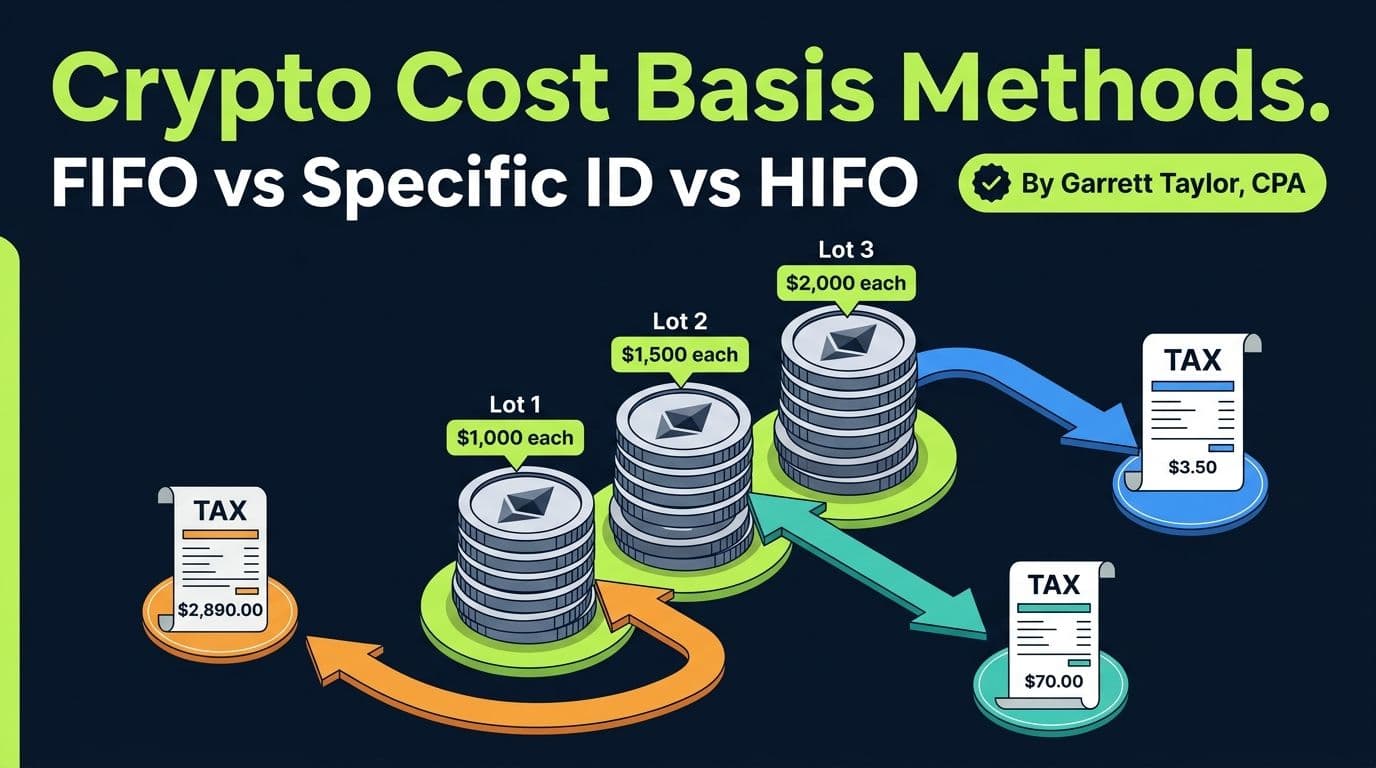
Understanding cost basis methods is critical here. Different methods -- FIFO, LIFO, HIFO, Spec ID -- produce dramatically different tax outcomes. Read our deep dive on crypto cost basis methods to optimize your position.
Also be aware of the crypto wash sale rules taking effect in 2026 if you're harvesting losses on mined crypto.
Worked Example: Mike's 2026 Mining Operation
Let's walk through a complete, realistic scenario.
Mike's setup:
- 3 Bitmain Antminer S21 Pro units (purchased January 2026 for $6,000 each = $18,000 total)
- Located in a dedicated 150 sq ft room in his home
- Mines Bitcoin through Foundry USA Pool
- Receives daily payouts
Mike's 2026 mining income: Over the course of 2026, Mike mines 0.5 BTC. Based on the FMV at the time of each daily payout, his total ordinary income from mining is $31,200.
Mike's Schedule C deductions:
| Expense | Amount | Notes |
|---|---|---|
| Electricity | $4,800 | Dedicated 30A circuit, metered separately |
| Hardware depreciation (Section 179) | $18,000 | Full first-year expensing of 3 ASIC miners |
| Internet (40% business use) | $720 | $150/mo x 12 x 40% |
| Home office (simplified) | $750 | 150 sq ft x $5 |
| Pool fees (2%) | $624 | 2% of gross mining revenue |
| Cooling (dedicated portable AC) | $480 | Unit cost + incremental electricity |
| Mining software | $120 | Foreman monitoring subscription |
| **Total deductions** | **$25,494** |
Mike's tax calculation:
| Line Item | Amount |
|---|---|
| Gross mining income | $31,200 |
| Schedule C deductions | ($25,494) |
| Net Schedule C profit | $5,706 |
| Self-employment tax (15.3%) | $873 |
| SE tax deduction (50%) | ($437) |
| Adjusted mining income for income tax | $5,269 |
| QBI deduction (20% of $5,706) | ($1,141) |
| Taxable mining income | $4,128 |
Without business classification and deductions, Mike would owe income tax on the full $31,200 plus potentially miss the QBI deduction entirely. The difference in tax owed is substantial -- potentially $6,000 to $8,000 depending on his marginal rate.
Note on Section 179: In year one, Mike gets an outsized deduction from expensing his hardware. In subsequent years, without new equipment purchases, his deductions will be lower and his taxable income higher. This is normal and expected, so plan accordingly.
Common Mining Tax Mistakes
These are the errors we see most frequently when reviewing miners' prior returns:
- Not reporting mining income at all. The IRS receives information from exchanges and, increasingly, from mining pools. Failing to report is the fastest path to an audit.
- Using sale price instead of FMV at receipt. Your cost basis is locked in when you mine, not when you sell. Using the wrong figure creates errors in both your ordinary income and your capital gains calculations.
- Claiming hobby deductions post-TCJA. The Tax Cuts and Jobs Act suspended miscellaneous itemized deductions (including hobby expenses) through at least 2025. If this provision is extended (which is likely), hobby miners get zero deductions. Report the income, deduct nothing.
- Ignoring self-employment tax. Many miners calculate income tax but forget SE tax. That 15.3% adds up fast.
- Failing to track FMV on each payout date. If you're pool mining with daily payouts, you need daily FMV records. Using an annual average or a single date is not compliant.
- Not separating personal and mining electricity. Without documentation (a dedicated meter, kill-a-watt readings, or detailed calculations), the IRS can disallow your entire electricity deduction.
- Depreciating equipment already expensed under Section 179. You get one or the other, not both.
- Missing the QBI deduction. Many miners and even some generalist tax preparers overlook Section 199A eligibility for mining businesses.
When You Need a Crypto Tax CPA
DIY tax prep works for simple situations: one exchange, a few trades, maybe some staking rewards. Mining is not simple.
Between daily FMV tracking, Schedule C optimization, depreciation elections, SE tax calculations, QBI eligibility, and the interplay between mining income and capital gains when you sell -- the complexity stacks up fast. A single missed deduction or incorrect classification can cost thousands.
You need specialized help if:
- You run multiple mining rigs as a business
- Your annual mining income exceeds $10,000
- You've never filed Schedule C for mining before
- You're considering an LLC or S-Corp election for your mining operation
- You received an IRS notice related to cryptocurrency
- You have mining income across multiple coins or pools
Our team at COS Elite handles mining tax returns from single-rig hobbyists to industrial-scale operations.
Need Help With Mining Taxes?
Mining taxes are complicated. Between daily FMV tracking, Schedule C deductions, self-employment tax, and QBI eligibility, one mistake can cost you thousands. Let Garrett Taylor, CPA, handle your mining return and maximize every legal deduction.
Talk to GarrettFree 15 minute call. No commitment.
Frequently Asked Questions
Do I have to pay taxes on crypto I mined but haven't sold?
Yes. Mined cryptocurrency is taxed as ordinary income at the fair market value on the date you receive it (IRS Notice 2014-21, Q&A #8). The taxable event is the receipt, not the sale.
What tax form do I use for mining income?
If mining is a business, file Schedule C (Form 1040). If mining is a hobby, report income on Schedule 1, Line 8z (Other Income). Business classification is almost always more favorable.
Can I deduct electricity costs for crypto mining?
Only if your mining is classified as a business. Business miners deduct electricity on Schedule C with proper documentation.
How do I determine fair market value for each mining payout?
Use the price on a major exchange at the date and time of receipt. Be consistent with your pricing source throughout the year.
Is crypto mining subject to self-employment tax?
Yes, if classified as a business. Net mining profit on Schedule C is subject to 15.3% self-employment tax.
Can I use Section 179 to deduct mining equipment in the first year?
Yes. Mining equipment qualifies for Section 179 immediate expensing up to $1,250,000 for 2026.
How are mining pool payouts taxed differently from solo mining?
The tax treatment is identical -- ordinary income at FMV when received. The difference is practical: pool mining generates more frequent payouts requiring more granular record-keeping.
Do I need to pay quarterly estimated taxes on mining income?
If you expect to owe $1,000 or more in tax for the year, you must make quarterly estimated payments using Form 1040-ES.
Can I form an LLC or S-Corp for my mining operation?
Yes. An LLC provides liability protection. An S-Corp election can reduce self-employment tax but typically only makes sense above $40,000 in net mining profit.
What happens if I mine a coin that has no established market value?
You may argue the FMV is zero or nominal at receipt. Document your reasoning. When sold later, entire proceeds would be capital gain with zero cost basis.
Are cloud mining contracts taxable?
Yes. Payouts from cloud mining contracts are taxable as ordinary income at FMV when received. Cloud mining may not constitute self-employment if involvement is purely passive.
What records should I keep for mining taxes?
Maintain daily payout records, FMV documentation, equipment receipts, electricity bills, internet documentation, pool fee records, and a mining log. Keep records for at least 7 years.

About the author
Garrett Taylor, CPA
Former Big Four CPA. CPA #133092. Garrett answers his phone. Led by expertise. Powered by precision.
Related Articles

The Ultimate Guide to Crypto Tax (2026 Edition)
The most comprehensive crypto tax guide online, written by a CPA who files 500+ crypto returns a year. Every taxable event, form, strategy, and 2026 update.
How Crypto Staking Is Taxed (2026 Complete Guide)
Staking rewards are taxed as ordinary income at fair market value when received, plus capital gains when sold. This guide covers IRS rulings, liquid staking, restaking, validator deductions, and worked examples for 2026.
Crypto Cost Basis Methods: FIFO vs Specific ID vs HIFO
Compare FIFO, LIFO, HIFO, and Specific ID for crypto taxes. Worked example shows how the same sale produces 4 different tax bills. Updated for Rev. Proc. 2024-28, Notice 2026-20, and 1099-DA.