Koinly vs CoinTracker (2026): A CPA's Honest Comparison

By Garrett Taylor, CPA #133092
Reviewed by Leanne Grant, EA #00167954-EA
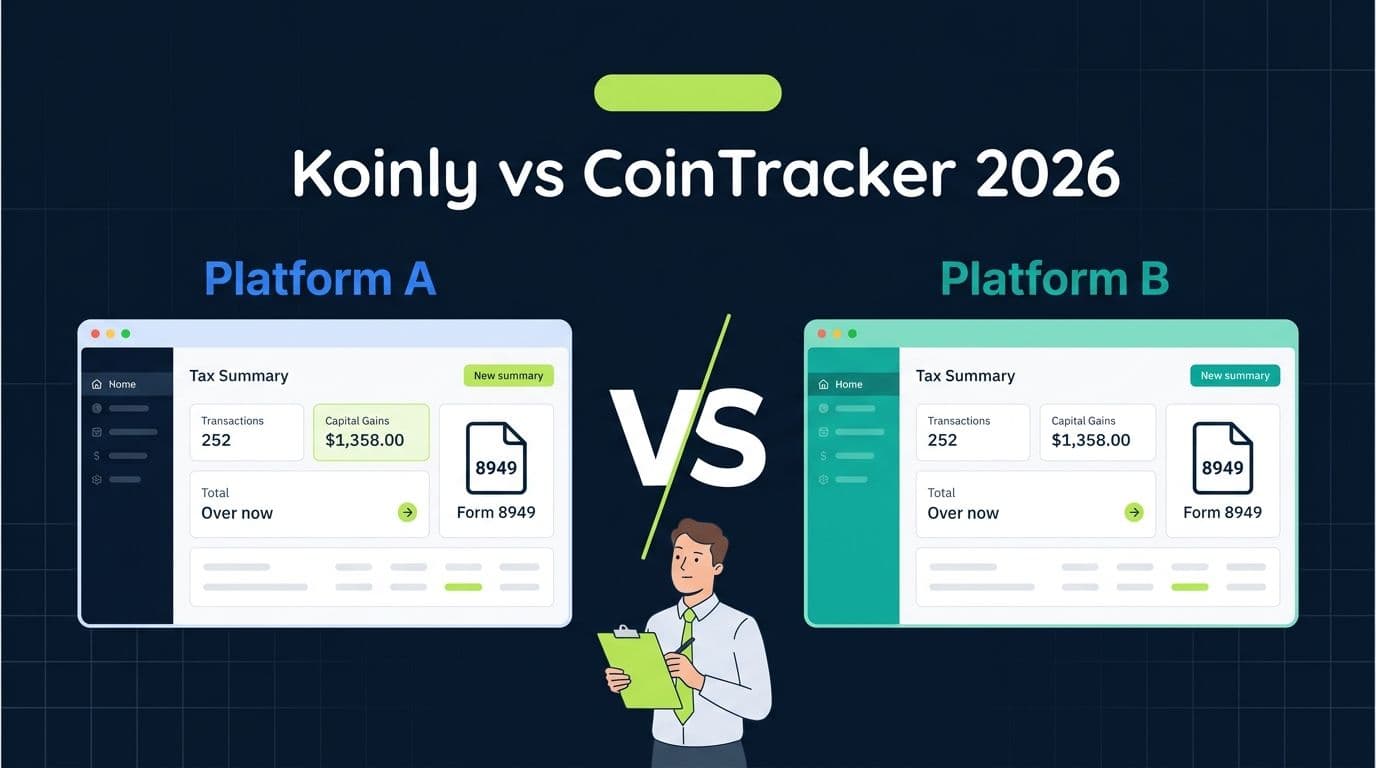
Key Takeaways
- ✓✓Koinly is cheaper at every pricing tier and supports 1,000+ integrations vs CoinTracker's 500+
- ✓Koinly offers Specific Identification for cost basis, which CoinTracker lacks, saving active traders thousands per year
- ✓CoinTracker has a cleaner interface and a stronger accountant portal for CPA collaboration
- ✓Both handle centralized exchange imports well, but Koinly has a meaningful edge on multi-chain DeFi
- ✓For most crypto investors Koinly is the better value; CoinTracker wins if you prioritize UX and the Coinbase ecosystem
“This comparison has been reviewed for accuracy by Leanne Grant, Enrolled Agent, specializing in cryptocurrency tax compliance.”
You're trying to decide between Koinly and CoinTracker. And every "comparison" you've found online was written by one of the two companies.
That's not helpful.
This is the Koinly vs CoinTracker comparison I wish existed when we started building out our crypto tax practice.
Let's get into it.
The Quick Verdict
Before we dive deep, here's the bottom line.
Pick Koinly if:
- You want the lowest cost at every transaction tier
- You trade across 5+ exchanges or wallets
- You're active in DeFi across multiple chains (Ethereum, Arbitrum, Solana, Polygon)
- You want Specific Identification to cherry-pick your most tax-efficient lots
- You have over 1,000 transactions per year
Pick CoinTracker if:
- Most of your activity is on Coinbase
- You value a clean, intuitive interface over raw feature depth
- You want a dedicated accountant portal with full CPA access
- Your portfolio is under 1,000 transactions and relatively straightforward
- You use the platform for portfolio tracking, not just tax season
- You want the best 1099-DA reconciliation workflow currently available
Here's the deal. Neither platform is "bad." But they're built for different users. And picking the wrong one can cost you real money at tax time.
Quick Spec Comparison
Koinly vs CoinTracker: 2026 Feature Comparison
| Feature | ||
|---|---|---|
| **Free Tier** | 10,000 transactions (view only, no reports) | Unlimited transactions (no reports) |
| **Starter Price** | $49/year (100 txns) | $59/year (100 txns) |
| **Mid-Tier Price** | $99/year (1,000 txns) | $199/year (1,000 txns) |
| **Top-Tier Price** | $299/year (10,000+ txns) | $599/year (10,000+ txns) |
| **Exchange/Wallet Integrations** | 1,000+ | 500+ |
| **DeFi Support** | Strong (multi-chain, auto-categorizes most protocols) | Moderate (Ethereum Mainnet solid, L2s developing) |
| **NFT Support** | Yes (auto-detection on ETH, Solana, Polygon) | Yes (ETH-focused, expanding) |
| **Cost Basis Methods** | FIFO, LIFO, HIFO, Specific ID | FIFO, LIFO, HIFO |
| **1099-DA Reconciliation** | Basic matching | Advanced reconciliation tool |
| **TurboTax Export** | Yes (direct integration) | Yes (direct integration) |
| **CPA Collaboration** | Accountant access and professional reports | Full accountant portal |
| **Tax-Loss Harvesting** | Dashboard available (Prime(+) and Ultra (+)) | Dashboard available |
| **IRS Audit Support** | Transaction audit trail export | Transaction audit trail + reconciliation report |
Pricing: Who Gives You More for Less?
Let's talk money. Because this is where the gap is most obvious.
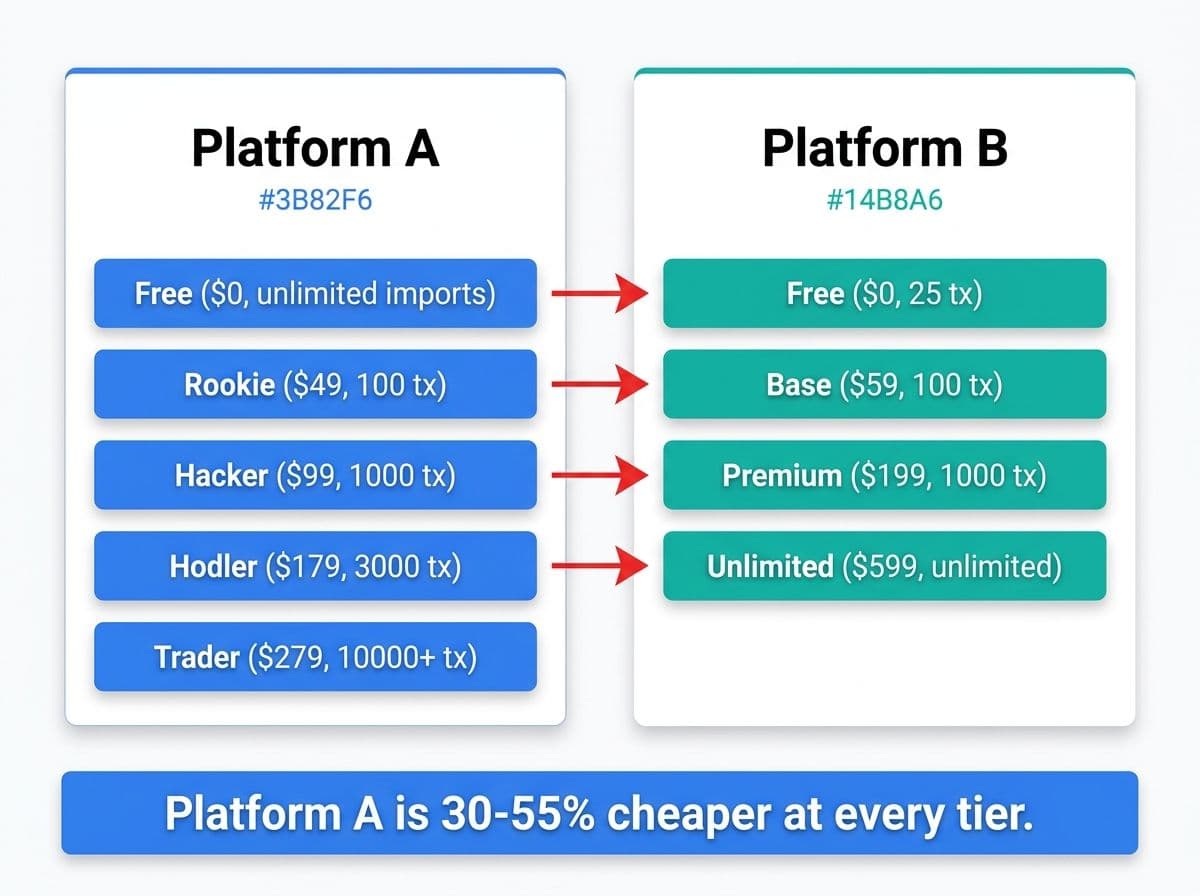
Koinly's pricing is simpler and cheaper at every single tier. Here's what you're actually paying:
- 100 transactions: Koinly $49 vs CoinTracker $59 (save $10)
- 1,000 transactions: Koinly $99 vs CoinTracker $199 (save $100)
- 3,000 transactions: Koinly $199 vs CoinTracker $599 (save $400)
- 10,000+ transactions: Koinly $299 vs CoinTracker $1,999 (save $1,700)
That last number is striking. If you're an active trader with over 10,000 transactions, you're paying significantly more with CoinTracker for what is, frankly, a similar core output: a Form 8949 and a summary.
But here's what the pricing comparison alone doesn't show you. CoinTracker's Prime($199) and Ultra ($599) plans include the accountant portal. If your CPA needs direct access to your data, that's bundled in.
Pro Tip
Both platforms count internal transfers (wallet-to-wallet moves) toward your transaction limit. Before picking a tier, import your data on the free plan and check your actual transaction count. You might be surprised how fast internal transfers inflate the number.
Winner: Koinly. The pricing gap is too large to ignore, especially at higher tiers. CoinTracker would need to deliver dramatically more value to justify its price, and it doesn't.
Exchange and Wallet Integrations
Koinly supports over 1,000exchanges, wallets, and blockchains. CoinTracker supports over 500. That 500-integration gap matters more than it sounds.
Here's why.
The "long tail" of crypto platforms is where most import headaches live. It's not Coinbase or Kraken that causes problems. It's that DeFi protocol on Arbitrum. It's that DEX aggregator. It's that staking platform you used for three months in 2024.
Koinly consistently covers more of these edge-case platforms. When a client comes to us with activity on a lesser-known exchange, Koinly has the integration about 80% of the time. CoinTracker, more like 60%.
Both platforms handle the major exchanges well:
- Coinbase: CoinTracker has a slight edge here with deeper native integration
- Kraken, Gemini, Binance: Both handle these cleanly
- Hardware wallets (Ledger, Trezor): Both support via blockchain address import
- Solana ecosystem: Koinly has better coverage as of early 2026
Pro Tip
If you use Coinbase as your primary exchange and have minimal activity elsewhere, CoinTracker's Coinbase integration is genuinely best-in-class. The API sync is faster and the transaction categorization is more accurate out of the box. But the moment you add a fourth or fifth platform, Koinly's broader integration library becomes the deciding factor. [Internal link: CoinTracker Review → /blog/cointracker-review] (fix link)
Winner: Koinly. Broader integration library, better long-tail coverage, and stronger blockchain-native imports for DeFi chains. CoinTracker gets a nod for Coinbase-specific depth.
DeFi and NFT Handling
This is where we see the biggest real-world differences between the two platforms.
Koinly's DeFi handling:
- Auto-categorizes liquidity pool deposits and withdrawals on Ethereum, Arbitrum, Optimism, Polygon, Solana, and Avalanche
- Recognizes yield farming rewards and maps them to the correct tax treatment (ordinary income)
- Handles cross-chain bridges with reasonable accuracy (still needs manual review on complex routes)
- NFT minting, buying, and selling auto-detected on Ethereum, Solana, and Polygon
CoinTracker's DeFi handling:
- Strong on Ethereum Mainnet with auto-categorization for major protocols (Uniswap, Aave, Compound)
- L2 coverage is improving but still requires more manual cleanup than Koinly
- Bridge transactions remain a common pain point
- NFT support focused on Ethereum with expanding Solana coverage
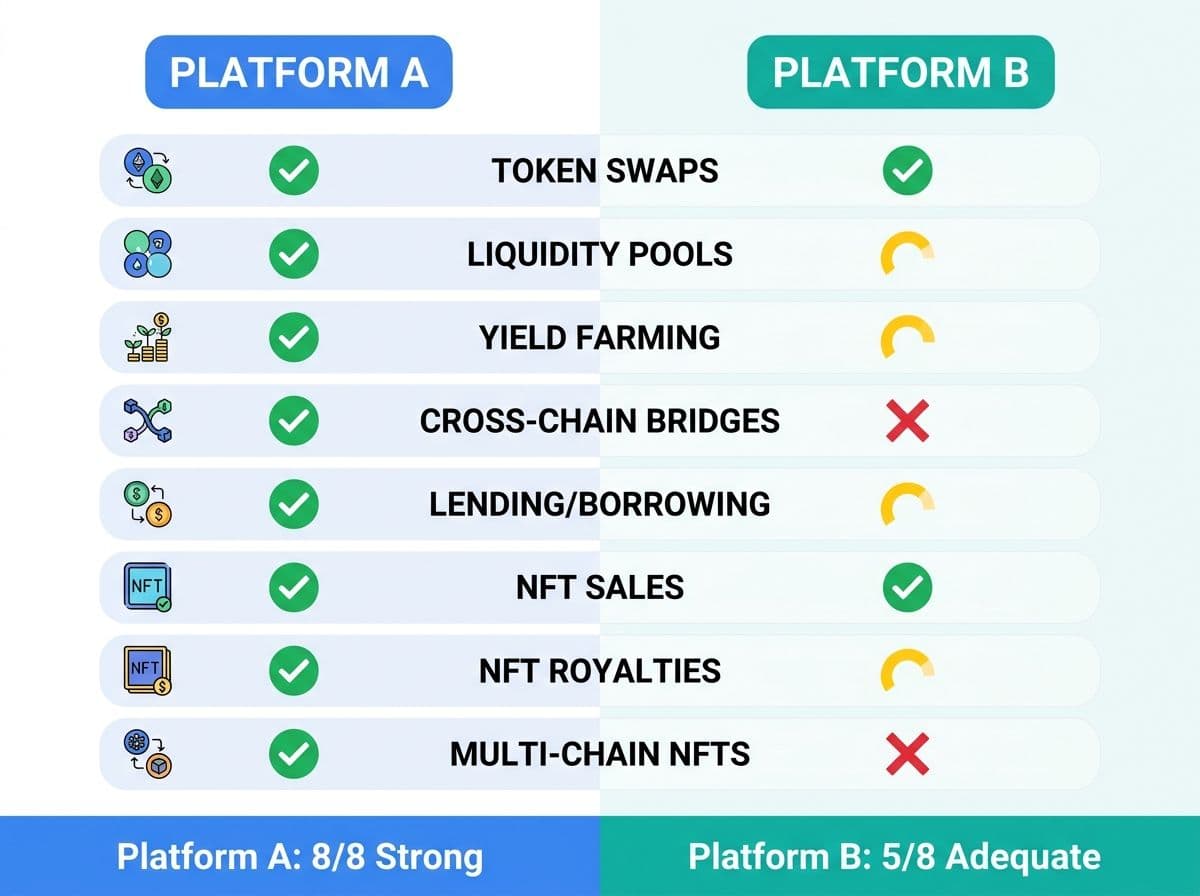
Winner: Koinly. Better multi-chain DeFi coverage, higher auto-categorization accuracy, and fewer manual fixes needed. CoinTracker is catching up, but it's not there yet.
Cost Basis Methods: The $4,000 Difference
This section matters more than any other for your actual tax bill. Pay attention.
Both platforms support FIFO (First In, First Out), LIFO (Last In, First Out), and HIFO (Highest In, First Out).
But Koinly also supports Specific Identification. CoinTracker does not.
Why does this matter?
Specific Identification lets you choose exactly which tax lot to sell against when you dispose of crypto. Instead of the system automatically picking the first, last, or highest-cost lot, you (or your CPA) can select the optimal lot for each transaction.
This is the method professional traders and high-net-worth clients use. It's the method that Treasury Regulation 1.1012-1 allows, and it's the method that can produce the lowest legal tax bill.
Here's the thing. For a simple portfolio with a few buys and sells, the difference between HIFO and Specific ID is negligible. But for an active trader with hundreds of transactions across different price points? The difference can be thousands of dollars.
Winner: Koinly. Specific Identification is a genuine competitive advantage. Until CoinTracker adds this method, Koinly wins this category outright.
IRS Audit Defense and 1099-DA Reconciliation
Starting in 2026, exchanges are issuing Form 1099-DA for digital asset transactions. This changes the game for both platforms.
CoinTracker's 1099-DA reconciliation is one of its strongest features. The tool cross-references exchange-issued 1099-DA data against your imported transaction history, flags mismatches, and generates a reconciliation report you can file with your return. It's well-designed and genuinely useful.
Koinly's 1099-DA support is more basic. It imports 1099-DA data and highlights discrepancies, but the reconciliation workflow isn't as polished as CoinTracker's. You can still catch mismatches, but you'll do more of the comparison manually (or your CPA will).
For audit defense, both platforms export detailed transaction logs. But CoinTracker's reconciliation report gives you a cleaner paper trail if the IRS comes knocking with a 1099-DA mismatch notice.
Pro Tip
Do not file your return based solely on either platform's output without reviewing the 1099-DA reconciliation. We've seen cases where the exchange-reported amounts on 1099-DA differ from the platform's calculated amounts by over $15,000, usually because of transfer-in cost basis the exchange didn't have. If your 1099-DA shows proceeds that don't match your tax software, you need a CPA to resolve the discrepancy before filing.
Winner: CoinTracker. The 1099-DA reconciliation tool is genuinely better. For the 2026 filing year and beyond, this feature alone could be worth the price difference for investors who want a clean audit trail.
CPA Collaboration and Export Quality
If you work with a CPA (and if your portfolio is complex, you should), the collaboration tools matter.
Koinly's approach: Although Koinly does not have a dedicated accountant portal, you can grant your accountant full access to your account, allowing them to review transactions, make corrections, adjust settings, and generate tax reports directly within the platform.
CoinTracker's approach: The accountant portal gives your CPA full access. They can view transactions, run different cost basis scenarios, edit categories, generate reports, and even set up the account configuration. It's designed for professional workflows.
For export quality, both platforms generate clean Form 8949 reports, TurboTax TXF files, and CSV exports. We've filed returns using exports from both without issues.
Winner: Draw. Both platforms give accountants the tools they need to prepare returns effectively. CoinTracker's dedicated accountant portal offers a more professional workflow, while Koinly achieves similar functionality through full account access.
Interface and User Experience
Let's be direct. CoinTracker looks better.
The dashboard is clean, modern, and intuitive. Portfolio tracking is front and center. The tax section feels like an extension of the portfolio view rather than a separate product bolted on. For a first-time user, CoinTracker is less intimidating.
Koinly, by contrast, is more information-dense. The dashboard shows more data at once: unrealized gains, tax summary, recent transactions, warnings, and reconciliation notes. For an experienced user or a CPA, this density is actually useful. For someone importing their first Coinbase CSV, it can feel overwhelming.
A few specific UX differences:
- Onboarding: CoinTracker's setup wizard is smoother. Koinly drops you into the dashboard and expects you to figure it out.
- Transaction review: Koinly shows more detail per transaction (cost basis lot matching, warnings, flags). CoinTracker groups things more cleanly.
- Mobile: CoinTracker has a better mobile experience. Koinly's mobile view is functional but cramped.
- Speed: Both handle under 1,000 transactions without lag. Above 5,000, Koinly's calculation engine is noticeably faster.
Winner: CoinTracker. Cleaner design, better onboarding, superior mobile experience. But power users may prefer Koinly's information density.
Customer Support
Neither platform is known for blazing-fast support. But there are differences.
Koinly offers email support and an extensive knowledge base. Response times average 24-48 hours during non-peak periods, stretching to 3-5 business days during tax season (January through April). They have an active community forum and subreddit where users help each other.
CoinTracker offers email and in-app chat support. Ultra users receive priority support with faster response times, whereas Free users only have access to self-serve support resources. Their knowledge base is well-organized but thinner than Koinly's. During peak season, even priority support can take 48+ hours.
Neither platform offers phone support.
In our experience, both support teams know their platforms well. The difference is that Koinly's community resources (guides, forums, YouTube walkthroughs) often answer your question faster than a support ticket will.
Winner: Draw. Both are adequate. Neither is exceptional. If you're hitting complex issues, you likely need a CPA, not a support ticket.
Who Should Pick Koinly
Here's who we consistently recommend Koinly to:
1. The Active Trader (1,000+ transactions/year) You're buying and selling frequently across multiple exchanges. Koinly's pricing is dramatically cheaper at high transaction volumes, and Specific Identification lets you optimize your tax bill in ways CoinTracker simply can't.
2. The DeFi Power User You're farming yields on Arbitrum, swapping on Solana DEXs, and providing liquidity on Ethereum. Koinly's multi-chain DeFi coverage is stronger, and the higher auto-categorization rate means less manual cleanup.
3. The Multi-Exchange Investor You hold assets on 5+ platforms. Koinly's 1,000+ integrations mean you're more likely to find direct support for every platform you use.
4. The Cost-Conscious Filer You want accurate tax reports at the lowest price. Koinly is cheaper at every tier. For a 1,000-transaction portfolio, you're saving $100/year.
5. The Tax Optimizer You want to minimize your legal tax liability using every method available. Specific Identification is the most powerful tool in the crypto tax optimization toolkit, and only Koinly offers it.
Who Should Pick CoinTracker
And here's who we point toward CoinTracker:
1. The Coinbase-Centric Investor If 80%+ of your activity is on Coinbase, CoinTracker's native integration is the best in the business. Faster sync, better auto-categorization, fewer import errors.
2. The UX-First User You want a tool that looks good and feels intuitive. You don't want to be overwhelmed by data density. CoinTracker's cleaner interface is easier to navigate for non-technical users.
3. The Audit-Conscious Filer You want the strongest possible paper trail for 1099-DA reconciliation. CoinTracker's reconciliation tool generates a clean mismatch report that's useful if the IRS sends a notice.
4. The Portfolio Tracker You want a single dashboard for both portfolio tracking and tax reporting. CoinTracker's real-time portfolio view is more polished than Koinly's, and it doubles as a year-round tracking tool, not just a tax-season product.
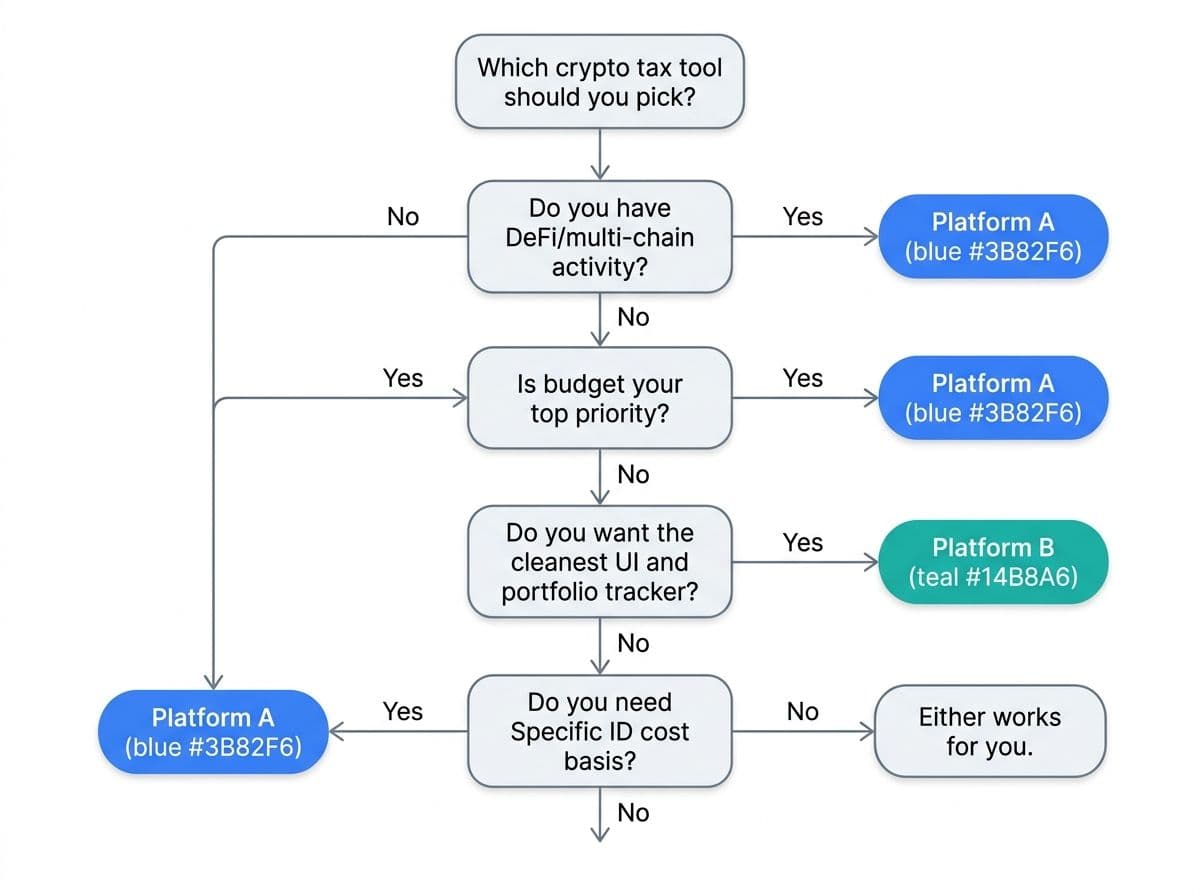
| CoinTracker | |||
| Koinly | |||
Pro Tip
Specific Identification requires adequate records per IRS Publication 550You must identify the specific lot at the time of the sale, not retroactively. Koinly's lot selection interface handles this requirement, but you need to make the selection before filing. If you're switching from CoinTracker to Koinly specifically for Specific ID, do it before your next sale, not after. Your CPA can help you set this up correctly.
The Bottom Line
Here's what it comes down to.
Koinly is the better value for most crypto investors. It's cheaper, supports more platforms, handles DeFi better, and the Specific Identification cost basis method is a genuine advantage that can save active traders thousands per year.
CoinTracker is the better experience for specific use cases. If you're a Coinbase-heavy investor who values clean designand needs the best 1099-DA reconciliation workflow, CoinTracker delivers.
For our practice, we use both. We recommend Koinly as the default for clients with complex, multi-platform portfolios. We recommend CoinTracker for clients with simpler setups who want a polished experience and plan to delegate their tax prep to us through the accountant portal.
The worst choice? Not using either one and trying to do crypto taxes manually. That's how $50,000 errors happen.
Related reading: Best Crypto Tax Software 2026.
Frequently Asked Questions
Is Koinly or CoinTracker better for crypto taxes in 2026?
Koinly is the better value for most crypto investors. It's cheaper at every pricing tier, supports more exchange integrations (1,000+ vs 500+), handles DeFi more accurately across multiple chains, and offers Specific Identification for cost basis. CoinTracker is better for Coinbase-heavy investors who want a cleaner interface and full CPA portal access.
How much does Koinly cost compared to CoinTracker?
Koinly is cheaper at every tier. For 100 transactions: Koinly $49 vs CoinTracker $59. For 1,000 transactions: Koinly $99 vs CoinTracker $199. For 10,000+ transactions: Koinly $299 vs CoinTracker $599. The gap widens significantly at higher transaction volumes.
Does CoinTracker support Specific Identification cost basis?
No. As of 2026, CoinTracker supports FIFO, LIFO, and HIFO but does not offer Specific Identification. Koinly supports all four methods including Specific ID, which allows you to select the most tax-efficient lot for each disposal.
Which is better for DeFi taxes, Koinly or CoinTracker?
Koinly handles DeFi better across more chains. Koinly has stronger support for L2s like Arbitrum and Optimism, while CoinTracker's Ethereum mainnet DeFi coverage is solid but L2 support is still developing.
Which platform handles the 1099-DA form better?
CoinTracker has the edge on 1099-DA reconciliation. Its tool cross-references exchange-issued 1099-DA data against your transaction history, flags mismatches, and generates a reconciliation report. Koinly imports 1099-DA data and highlights discrepancies but the workflow is less automated.
How many exchanges does Koinly support vs CoinTracker?
Koinly supports over 1,000 exchanges, wallets, and blockchains. CoinTracker supports over 500. The gap matters most for lesser-known platforms and newer DeFi protocols where Koinly is more likely to have a direct integration.
Should I use Koinly or CoinTracker with TurboTax?
Both platforms offer direct TurboTax export and integration. The export quality is comparable. Your choice should be based on which platform handles your specific portfolio better, not the TurboTax integration, since both work equally well.
Can I switch from CoinTracker to Koinly mid-year?
Yes, but timing matters. Import your full transaction history into Koinly before your next trade, not after. If you're switching to use Specific Identification, you must identify the specific lot at the time of sale per IRS rules. A CPA can help ensure the transition doesn't create cost basis discrepancies.
Do Koinly and CoinTracker support tax-loss harvesting?
Yes, both platforms include tax-loss harvesting dashboards that show unrealized gains and losses in real time. This helps you identify positions to sell before year-end to offset gains. Note that crypto is not currently subject to wash sale rules, though legislation has been proposed.

About the author
Garrett Taylor, CPA
Former Big Four CPA. CPA #133092. Garrett answers his phone. Led by expertise. Powered by precision.
Related Articles
Koinly Guide: A Crypto Tax CPA's Complete Walkthrough (2026)
A CPA's step-by-step Koinly walkthrough. Learn how to set up Koinly, avoid the 7 most common errors, and know when DIY is enough vs. when you need a pro.
CoinTracker Review 2026: A Crypto Tax CPA's Honest Walkthrough
A CPA's honest CoinTracker review for 2026. Common errors, DeFi import quality, 1099-DA reconciliation, pricing, and when you need professional help.

Best Crypto Tax Software 2026: A CPA's Honest Review of Every Major Platform
A CPA who files 500+ crypto returns reviews Koinly, CoinTracker, CoinLedger, CoinTracking, ZenLedger, and Summ. No affiliate links. Just honest verdicts.