“This comparison has been reviewed for accuracy by Leanne Grant, Enrolled Agent, specializing in cryptocurrency tax compliance.”
Koinly or ZenLedger. You've narrowed it down to two. Now you need a real answer.
A real comparison from someone who has filed hundreds of returns using data from both platforms.
Here's the deal:
We use both Koinly and ZenLedger in our CPA practice. We've seen where each one shines and where each one quietly costs clients money. This comparison is based on that experience, not on a 30-minute free trial.
Let's break it down.

Before we get into the details, here's the bottom line.
Pick Koinly if:
- You use DeFi protocols, liquidity pools, or cross-chain bridges
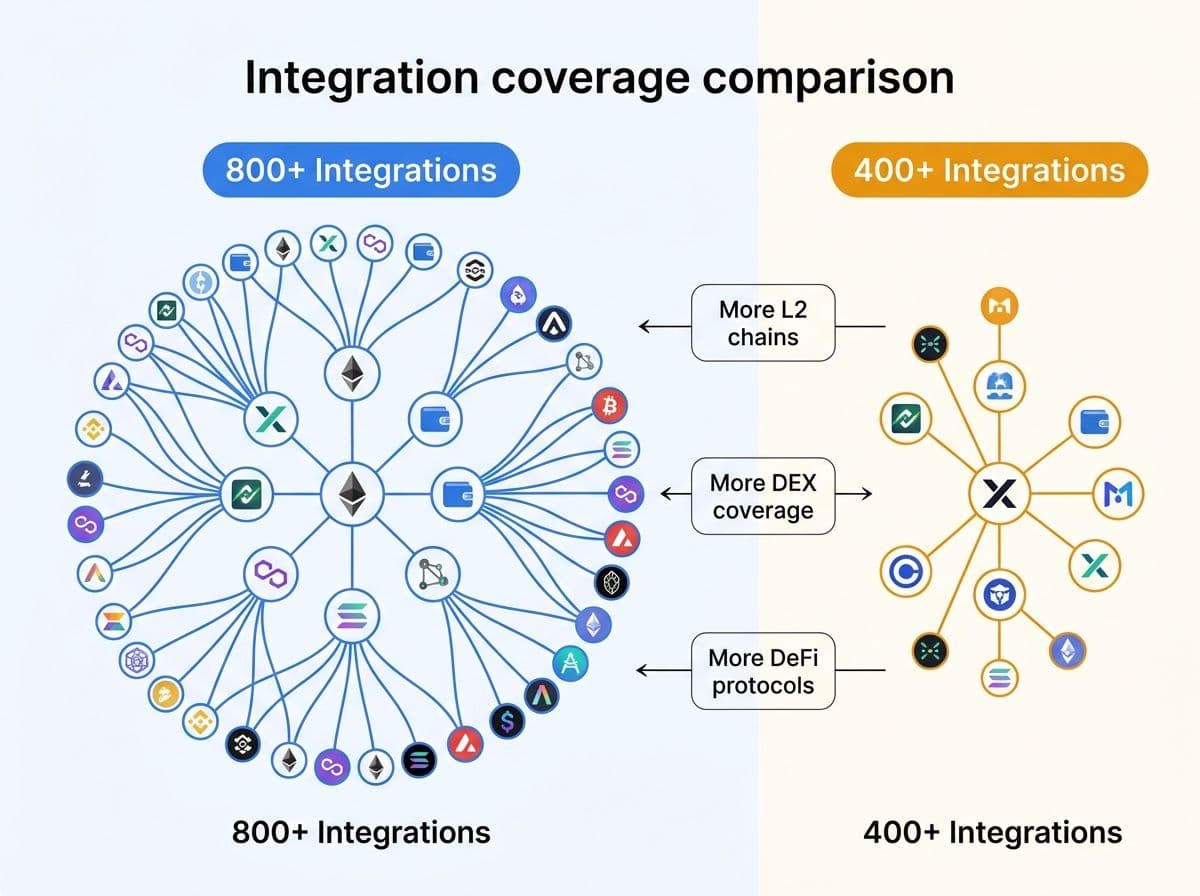
- You want the widest exchange and wallet coverage (800+)
- You want Specific Identification for cost basis optimization
- You need to share read-only access with your CPA
- You want the best value at mid-tier pricing
Pick ZenLedger if:
- You want a built-in IRS audit defense package
- You file with TurboTax and want native export
- You prefer a simpler interface and don't need advanced DeFi support
- You're willing to pay premium for dedicated phone/email support
- Your portfolio is mostly centralized exchange trades (Coinbase, Kraken, Gemini)
Now let's get into the specifics.
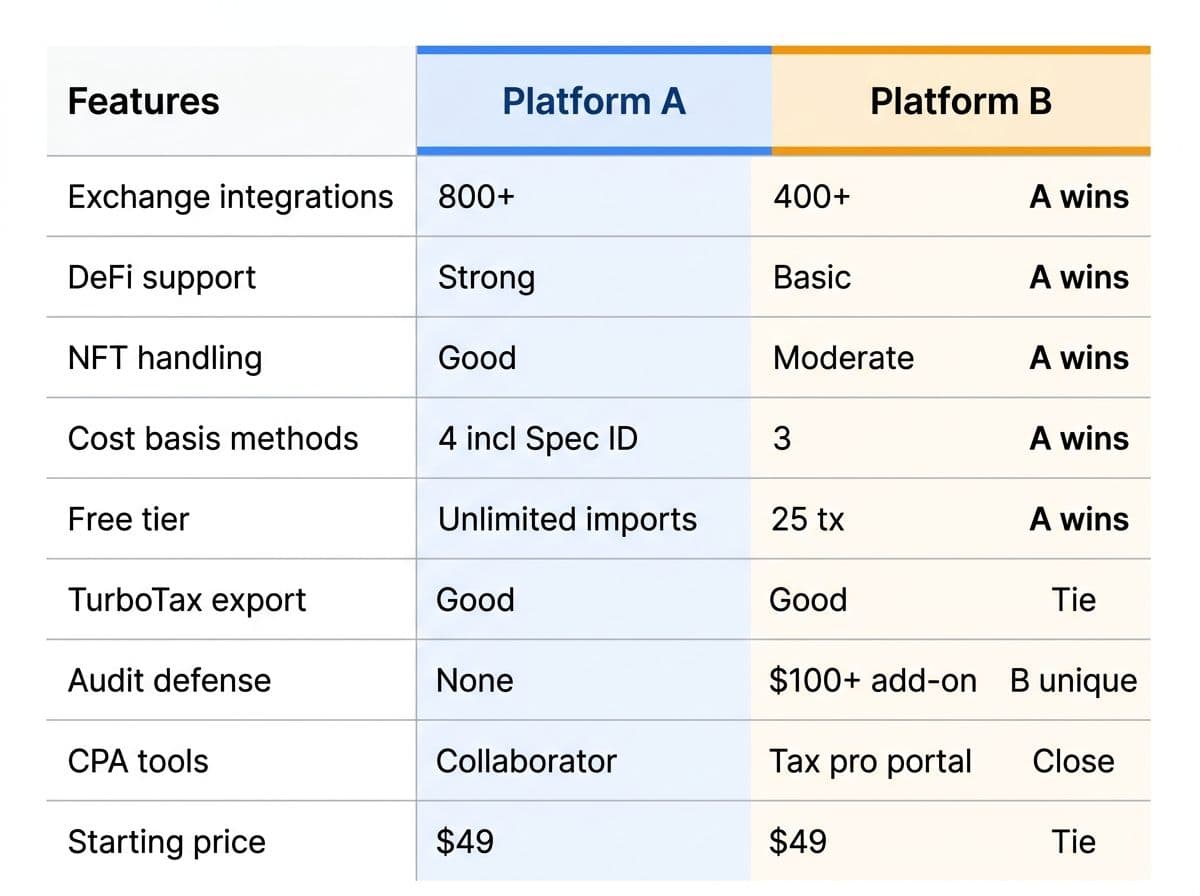
Koinly vs ZenLedger: Feature Comparison
| Feature | ||
|---|---|---|
| Exchanges & Wallets | 800+ | 400+ |
| Pricing (Tax Reports) | $49 / $99 / $179 / $279 | $49 / $149 / $199 / $399 |
| Free Tier | Yes (preview only) | Yes (25 transactions) |
| Cost Basis Methods | FIFO, LIFO, HIFO, Spec ID | FIFO, LIFO, HIFO |
| DeFi Support | Strong (auto-categorization) | Basic (manual tagging) |
| NFT Support | Yes (multi-chain) | Yes (limited chains) |
| 1099-DA Reconciliation | Yes | Yes |
| IRS Audit Defense | No | Yes ($100+ add-on) |
| TurboTax Integration | No (CSV export) | Yes (native) |
| CPA/Accountant Portal | Read-only collaborator | Limited sharing |
| Tax Loss Harvesting | Yes (dashboard) | Yes (dashboard) |
| Support | Email + help center | Email + premium phone tier |
Pricing and Value
Let's talk money first. Because pricing is where these two platforms diverge significantly.
Koinly's pricing is straightforward:
- Newbie: $49/year (up to 100 transactions)
- Hodler: $99/year (up to 1,000 transactions)
- Trader: $179/year (up to 3,000 transactions)
- Pro: $279/year (up to 10,000 transactions)
- Free: $0 (up to 25 transactions — barely useful)
- Starter: $49/year (up to 200 transactions)
- Premium: $149/year (up to 2,500 transactions)
- Executive: $199/year (up to 15,000 transactions)
- Platinum: $399/year (unlimited + audit defense included)
Here's the thing most reviews miss:
At the entry level, they look similar. Both start at $49. But once you pass 200 transactions — which is most active traders by February — ZenLedger jumps to $149 while Koinly's $99 tier handles up to 1,000 transactions.
For a typical client in our practice with 500-1,500 transactions, Koinly costs $99-$179. The equivalent ZenLedger tier runs $149-$199.
Average savings choosing Koinly over ZenLedger
$50-$70/year for mid-tier users (500-2,500 transactions), based on 2026 published pricing
The exception: ZenLedger's $399 Platinum tier includes unlimited transactions AND their audit defense package. If you're a high-volume trader who also wants audit protection, that bundle can actually be a better deal than buying Koinly Pro ($279) plus a separate audit defense service.
Winner: Koinly. Better value at every tier except the ultra-premium bundle.
Exchange and Wallet Integrations
This one isn't even close.
Koinly supports 800+ exchanges and wallets. That includes every major CEX (Coinbase, Kraken, Binance, Gemini, KuCoin), plus direct blockchain sync for Ethereum, Solana, Bitcoin, Arbitrum, Base, Polygon, Avalanche, and dozens more.
ZenLedger supports 400+. The major exchanges are covered, but we've had clients hit gaps with smaller CEXs and newer L2 chains.
In our practice, this matters more than you'd think. Here's why:
Say a client used Bybit for a few months in 2024 before moving to Coinbase. Or they bridged assets to Base through a DEX. With Koinly, we connect and go. With ZenLedger, we're hunting for CSV exports and manually uploading transaction files.
And manual CSV uploads are where errors creep in. Different exchanges use different CSV formats. Date formats vary. Fee columns get misaligned. Every manual upload is a chance for a mistake that turns into a phantom gain on your Form 8949.
Pro Tip
When evaluating any crypto tax software, don't just count integrations. Check whether YOUR specific exchanges and wallets are supported via API (auto-sync). A platform with 400 integrations that covers your 4 exchanges works fine. But if even one exchange requires a manual CSV, budget 30 minutes of cleanup time.
Winner: Koinly. Twice the integrations and better L2/DeFi chain coverage.
DeFi and NFT Handling
This is where the gap gets wide.
Koinly's DeFi support:
- Auto-detects liquidity pool deposits, withdrawals, and LP token swaps
- Handles wrapped tokens and bridging across chains
- Categorizes yield farming rewards as income automatically
- Supports NFT minting, buying, selling, and royalties across Ethereum, Solana, and Polygon
- Still requires manual review for complex multi-step DeFi strategies (we always double-check these)
ZenLedger's DeFi support:
- Imports on-chain transactions but often labels them generically as "trade" or "transfer"
- Limited auto-categorization — most DeFi transactions need manual tagging
- NFT support exists but is limited to Ethereum and a few other chains
- Cross-chain bridges frequently generate errors or missing cost basis warnings
We've run the same client portfolio through both platforms. The Koinly import correctly categorized about 75-80% of DeFi transactions automatically. ZenLedger caught maybe 40-50%, with the rest needing manual reclassification.
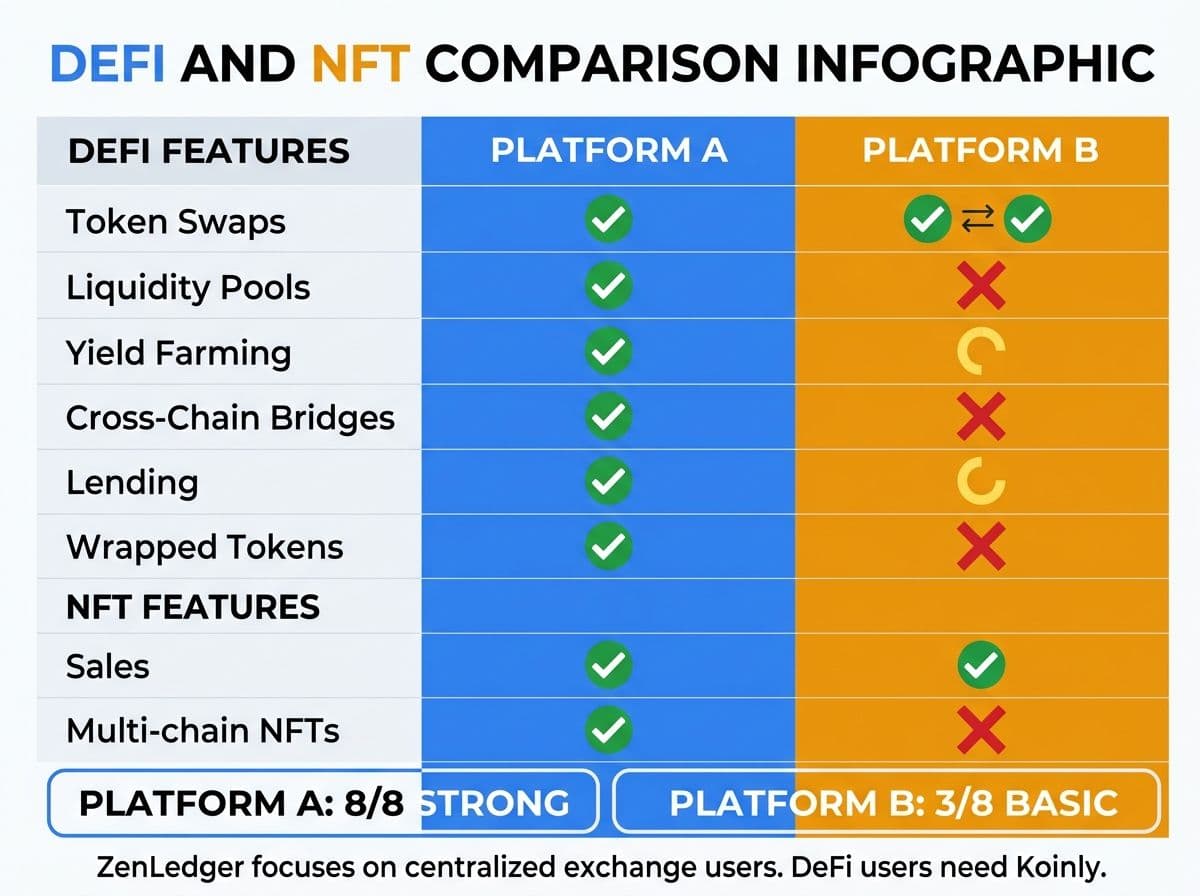
That difference translates directly into time and accuracy. If you have 200 DeFi transactions and ZenLedger miscategorizes half of them, you're looking at hours of manual corrections or, more likely, filing with errors.
Pro Tip
If you use DeFi protocols like Aave, Uniswap, or Curve and don't manually review your ZenLedger categorizations, you could end up with liquidity pool deposits treated as disposals. That triggers a taxable event that shouldn't exist. We've seen this cost clients $5,000-$15,000 in phantom gains.
Winner: Koinly. Significantly better auto-categorization for DeFi and broader NFT chain support.
Cost Basis Methods
This is a critical comparison point that most reviews gloss over.
Koinly offers: FIFO, LIFO, HIFO, and Specific Identification (Spec ID).
ZenLedger offers: FIFO, LIFO, and HIFO.
Why does Specific Identification matter?
With Spec ID, you choose exactly which lot to sell when you dispose of a crypto asset. This gives you maximum control over your tax outcome. In a year where you have both short-term and long-term lots of the same token, Spec ID lets you strategically sell the lot that produces the best tax result.
Here's a quick example:
You bought 1 ETH at $1,200 in January 2024 and another 1 ETH at $3,800 in November 2025. You sell 1 ETH today at $3,600.
- FIFO sells the January 2024 lot: $2,400 long-term gain (taxed at 15%)
- HIFO sells the November 2025 lot: $200 short-term loss (saves you taxes)
- Spec ID lets you choose. Maybe you want the loss this year. Maybe you'd rather book the long-term gain because you have losses elsewhere to offset it.
ZenLedger gives you three good options. Koinly gives you those same three plus the surgical precision of Spec ID.
For clients with large, multi-year portfolios, Spec ID can save thousands per year. For the average investor with a simple portfolio, HIFO alone probably gets you 90% of the way there.
Winner: Koinly. Spec ID is a genuine competitive advantage for tax optimization.
1099-DA Reconciliation
Starting in the 2025 tax year (filed in 2026), centralized exchanges are issuing 1099-DA forms to the IRS and to you. This changes the game.
Both platforms now offer 1099-DA import and reconciliation features. Here's how they compare:
Koinly: Imports your 1099-DA data alongside your API-synced transaction history and highlights discrepancies. If Coinbase reported a sale at $3,500 but your Koinly records show $3,502 (due to slight timing differences), Koinly flags it so you can investigate before filing.
ZenLedger: Similar reconciliation workflow. Imports 1099-DA PDFs or CSVs, cross-references against your transaction data, and generates a discrepancy report.
Both handle this reasonably well. The real advantage here goes to whichever platform has your transactions imported more completely — because you can't reconcile against data you don't have.
Given Koinly's broader integration coverage, it tends to have a more complete picture to reconcile against. But if your portfolio is entirely on Coinbase and Kraken, ZenLedger's reconciliation works just as well.
Pro Tip
The IRS receives your 1099-DA. If your filed return doesn't match what exchanges reported, expect a CP2000 notice. Both Koinly and ZenLedger help you catch mismatches before filing. Don't skip this step.
Winner: Tie. Both handle 1099-DA reconciliation competently. Edge to Koinly only because broader integrations mean fewer gaps.
CPA Collaboration Features
This one matters to us personally. When a client uses tax software, we need access to review their data.
Koinly: Offers a read-only collaborator feature. Your CPA gets their own login with full visibility into your transactions, categorizations, and generated reports. They can see everything but can't modify anything. Clean, secure, and exactly what we want.
ZenLedger: Has a "share" feature, but it's more limited. You can export reports and share them manually. There's no dedicated accountant portal with separate login credentials. For CPA review, we typically ask clients to export their full transaction report and tax forms, then email them to us.
The difference matters for efficiency. With Koinly, we log in, review the dashboard, spot-check flagged transactions, and we're done. With ZenLedger, we're working from static PDFs and CSVs, which means we can't click into a suspicious transaction to investigate.
Winner: Koinly. Purpose-built CPA access vs. manual report sharing.
Interface and User Experience
Let's give credit where it's due.
ZenLedger has a cleaner, more approachable interface. The dashboard is less cluttered. The navigation is more intuitive for first-time users. Everything feels a bit more polished visually.
Koinly's interface is more information-dense. More data on screen, more filters, more options. It can feel overwhelming for beginners, but once you learn it, you move faster.
For DIY investors filing their own taxes for the first time, ZenLedger's UX is friendlier. For power users and CPAs who live in these platforms daily, Koinly's depth is an advantage.
One specific UX win for ZenLedger: its TurboTax integration. If you file with TurboTax, you can push your crypto tax data directly into your return without downloading and re-uploading CSVs. Koinly doesn't have this. You'll need to download your Form 8949, then manually import the CSV into TurboTax.
Winner: ZenLedger. Cleaner UX for beginners and the TurboTax integration is genuinely useful.
Customer Support
ZenLedger offers a premium support tier at the Executive ($199) and Platinum ($399) levels. That includes dedicated email support with faster response times and, at the Platinum tier, phone support. Their standard support (Starter and Premium) is email-only with 24-48 hour response times.
Koinly offers email support and an extensive help center and knowledge base. No phone support at any tier. Response times vary but generally run 24-72 hours during peak tax season.
For what it's worth, both platforms have active community forums and decent documentation. But if you're the type who needs to pick up the phone when something goes wrong, ZenLedger is your only option here.
Winner: ZenLedger. Premium phone support is a real differentiator for users who need it.
IRS Audit Defense
This is ZenLedger's strongest unique feature.
Starting at their Executive tier ($199) and included in Platinum ($399), ZenLedger partners with audit defense providers to offer a package that covers:
- Professional representation if the IRS audits your crypto returns
- Access to a tax attorney or enrolled agent for audit correspondence
- Coverage for audit-related fees (typically up to $1 million in professional fees)
Koinly doesn't offer anything like this. If you get audited, you're on your own (or you call your CPA, which is what you should do anyway).
Here's our honest take: audit defense packages provide peace of mind, and for some investors, that's worth the premium. But the actual audit rate for individual returns is low (about 0.4% according to IRS audit statistics). If you file accurately, which is the whole point of using good software plus a CPA, your audit risk is minimal. Additionally, if you did end up in an IRS audit, you have to ask whether you would trust the representative that ZenLedger assigns to you. I wonder about the qualify and credentials of this person.
That said, if you have a complex crypto portfolio with significant DeFi activity, staking rewards, and large unrealized gains, having audit defense isn't a bad insurance policy.
Winner: ZenLedger. Unique feature with real value for risk-averse investors.
Koinly is the better choice if you are:
- A DeFi user. Liquidity pools, yield farming, cross-chain bridges — Koinly handles these dramatically better than ZenLedger.
- A multi-exchange trader. If you use more than 3 exchanges or trade on smaller platforms, Koinly's 800+ integrations mean fewer manual uploads and fewer errors.
- Working with a CPA. The read-only collaborator access makes your CPA's job easier, faster, and cheaper (which saves you money on professional fees).
- Cost-conscious on mid-tier plans. For 500-3,000 transactions, Koinly is $50-$70 cheaper per year.
- Someone who wants maximum tax optimization. Specific Identification gives you surgical control over which lots to sell and when. (Read our full Koinly guide for setup details.)
ZenLedger is the better choice if you are:
- A TurboTax filer. Native integration saves real time and eliminates CSV import headaches.
- Worried about IRS audits. The built-in audit defense package is a genuine differentiator. No other crypto tax platform offers this natively.
- A beginner who wants a simpler interface. ZenLedger's cleaner UX and more hand-held onboarding process is friendlier for first-time filers.
- Primarily on centralized exchanges. If your portfolio is 100% Coinbase, Kraken, and Gemini, ZenLedger covers those just fine and the DeFi gap doesn't affect you.
- Someone who values phone support. If you want to call a human when things go wrong, ZenLedger's premium tiers deliver that. (See our full ZenLedger review for more details.)
| Koinly | ZenLedger | |
|---|---|---|
For most crypto investors, Koinly is the better choice. It offers more integrations, better DeFi support, a superior cost basis method (Spec ID), and purpose-built CPA collaboration features — all at a lower price point for mid-tier users.
ZenLedger earns its place for TurboTax users, investors who want audit defense baked in, and beginners who value a simpler interface over power features.
The honest truth? Both tools work. The bigger mistake is using either one without reviewing the output. Software calculates. A CPA verifies, optimizes, and defends.
If you're not sure which platform fits your situation — or if you've already generated reports and want a professional to review them — we can help.
Free Crypto Tax Health Check
Upload your Koinly or ZenLedger reports and we'll review them for errors, missed deductions, and cost basis optimization opportunities. No obligation, no sales pitch — just a CPA's honest assessment of where you stand.
Book Your Free ReviewFree 15 minute call. No commitment.
Looking for individual platform deep dives? Read our complete [Koinly guide](https://coselite.io/blog/koinly-guide) and [ZenLedger review](https://coselite.io/blog/zenledger-review) for setup walkthroughs and platform-specific tips.
Frequently Asked Questions
Is Koinly better than ZenLedger?
For most users, yes. Koinly offers broader integrations (800+ vs 400+), better DeFi support, and Specific Identification cost basis that ZenLedger lacks. ZenLedger wins on TurboTax integration and audit defense.
Does Koinly support Specific Identification cost basis?
Yes. Koinly supports FIFO, LIFO, HIFO, and Specific Identification (Spec ID). Spec ID lets you choose exactly which lot to sell, giving you maximum control over your tax outcome. ZenLedger does not offer Spec ID.
Does ZenLedger integrate with TurboTax?
Yes. ZenLedger offers a native TurboTax integration that pushes your crypto tax data directly into your return. Koinly requires you to download a CSV and manually import it into TurboTax.
Which is better for DeFi: Koinly or ZenLedger?
Koinly is significantly better for DeFi. It auto-categorizes about 75-80% of DeFi transactions (liquidity pools, yield farming, bridges) compared to ZenLedger's 40-50%. ZenLedger requires more manual reclassification for DeFi activity.
Does ZenLedger offer IRS audit defense?
Yes. ZenLedger offers an IRS audit defense package starting at the Executive tier ($199/year) and included in the Platinum tier ($399/year). It provides professional representation and coverage for audit-related fees.
Can my CPA access my Koinly account?
Yes. Koinly offers a read-only collaborator feature that gives your CPA their own login with full visibility into your transactions and reports. ZenLedger has more limited sharing options.
How do Koinly and ZenLedger handle 1099-DA forms?
Both platforms import 1099-DA data and reconcile it against your transaction history to flag discrepancies. Koinly has a slight edge because its broader integrations provide a more complete transaction picture to reconcile against.
Which is cheaper: Koinly or ZenLedger?
Koinly is cheaper at mid-tier pricing. For 500-2,500 transactions, Koinly runs $99-$179/year compared to ZenLedger's $149-$199. Entry-level pricing is similar at $49. ZenLedger's Platinum ($399) bundle may be worth it if you need audit defense.
Can I switch from ZenLedger to Koinly?
Yes. You can export your transaction data from ZenLedger as a CSV and import it into Koinly. However, we recommend re-syncing directly from your exchanges via API for the cleanest data. You don't need to keep both subscriptions active.
Do Koinly and ZenLedger support NFT taxes?
Both support NFT transactions, but Koinly has broader chain coverage. Koinly handles NFTs on Ethereum, Solana, Polygon, and other chains. ZenLedger's NFT support is more limited in chain coverage.
Should I use Koinly or ZenLedger with a CPA?
If you work with a CPA, Koinly is the better choice. Its read-only collaborator feature gives your CPA direct access to review your data. With ZenLedger, your CPA has to work from exported PDFs and CSVs, which is slower and less transparent.