NFT Taxes Explained (2026 Complete Guide)

By Garrett Taylor, CPA #133092
Reviewed by Leanne Grant, EA #00167954-EA
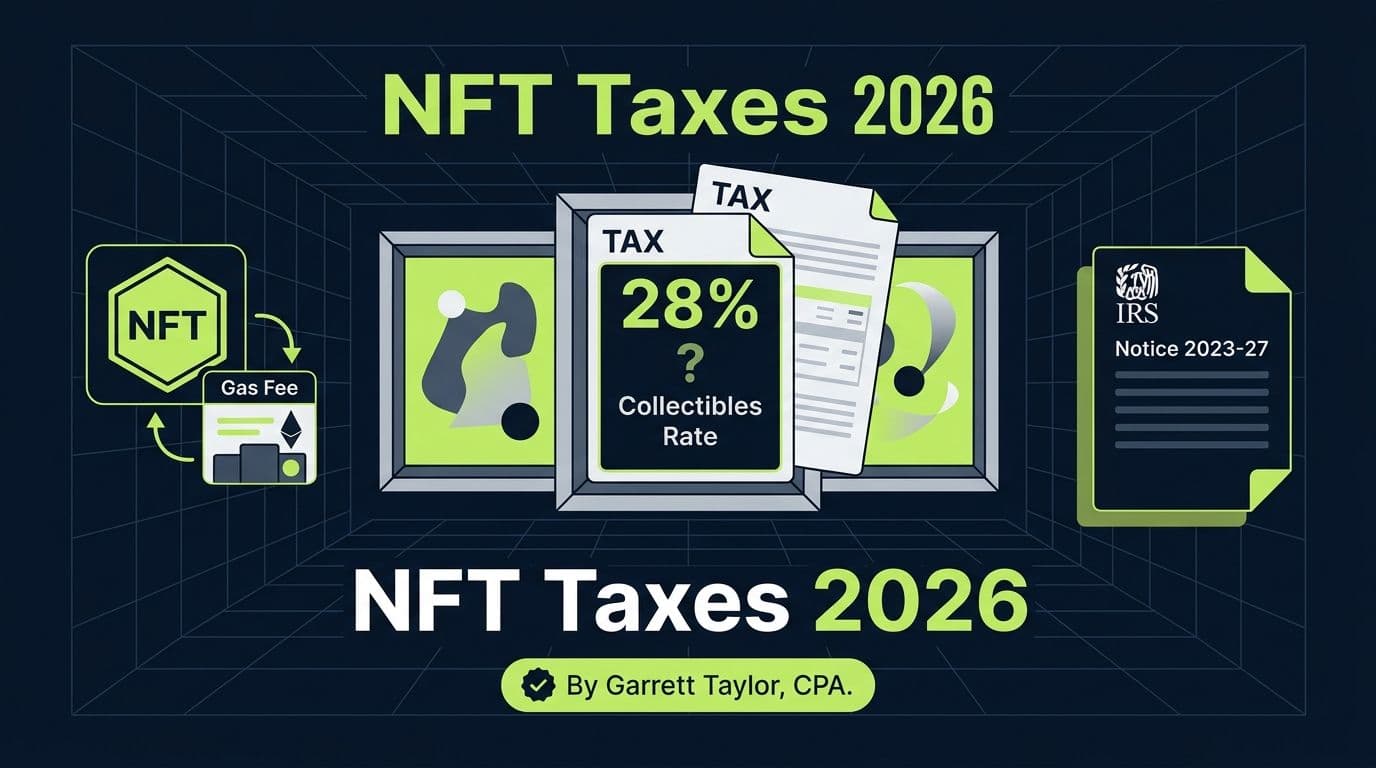
Key Takeaways
- ✓The IRS treats NFTs as property. Every sale, swap, or disposition is a taxable event.
- ✓Under Notice 2023-27, the IRS applies a "look-through" test to determine if your NFT qualifies as a collectible.
- ✓If your NFT is classified as a collectible, long-term capital gains are taxed at up to 28% -- not the standard 20% max rate.
- ✓NFT creators report revenue as ordinary income on Schedule C. This is self-employment income.
- ✓Royalties from secondary sales are also ordinary income for creators.
- ✓Section 1031 like-kind exchanges do NOT apply to NFTs after the Tax Cuts and Jobs Act of 2017 (effective 2018+).
- ✓Gas fees paid during minting or purchasing add to your cost basis.
“NFTs are taxed as property under IRS rules -- and depending on the underlying asset, they may be taxed at the higher 28% collectibles rate. Whether you're a creator or a collector, the tax treatment is different, and the stakes are real.”
, Reviewed by Leanne Grant, EA
Are NFTs taxable? Yes. The IRS classifies NFTs as digital assets, a form of property. That means every time you sell, trade, or otherwise dispose of an NFT, you trigger a taxable event. But the real question isn't whether NFTs are taxed. It's how they're taxed, because the answer depends on whether you're a creator or a collector, what the NFT represents, and how long you held it.
This guide breaks down every scenario: minting, buying, selling, earning royalties, and the collectibles question that could cost you an extra 8% in taxes.
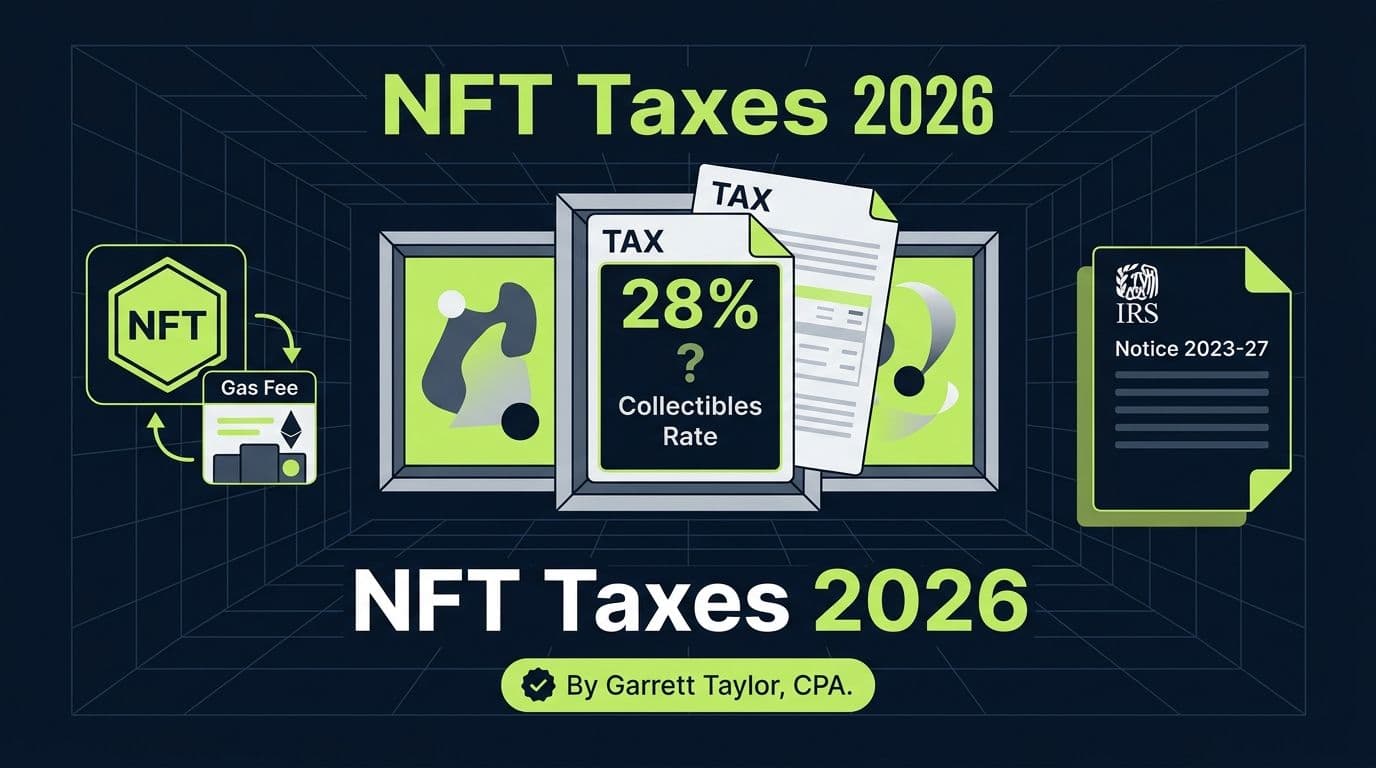
How NFTs Are Classified for Tax Purposes
Under IRS Notice 2014-21, virtual currencies and digital assets are treated as property. NFTs fall squarely into this classification.
That means the same rules that apply to stocks, real estate, and other capital assets apply to NFTs:
- You have a cost basis (what you paid, including gas fees).
- You have a fair market value at the time of disposition.
- The difference is your gain or loss.
- Holding period determines whether the gain is short-term or long-term.
But NFTs have an additional wrinkle that stocks don't: the collectibles question. If the IRS decides your NFT is a collectible, the federal long-term capital gains rate jumps from a maximum of 20% to a maximum of 28%.
This is a significant distinction. And in 2023, the IRS finally gave us some insight on how they plan to make that call.
IRS Notice 2023-27: The Collectibles "Look-Through" Test
IRS Notice 2023-27 introduced the "look-through" analysis for NFTs. The idea is straightforward: the IRS doesn't care about the NFT wrapper. They care about what's inside it.
Here's how it works:
The IRS looks at the underlying asset the NFT represents. If that underlying asset would be classified as a collectible under Section 408(m)(2) of the Internal Revenue Code), then the NFT itself is treated as a collectible.
Section 408(m) defines collectibles as:
- Works of art
- Rugs and antiques
- Metals and gems
- Stamps and coins
- Alcoholic beverages
- Any other tangible personal property specified by the IRS
So if your NFT is essentially a digital artwork, which describes the vast majority of profile-picture (PFP) projects, generative art collections, and 1/1 pieces, it likely qualifies as a collectible under the look-through test.
On the other hand, an NFT that represents a concert ticket, a membership pass, or in-game utility might not be a collectible, because the underlying asset isn't art, antiques, or any other listed category.
Pro Tip
The look-through test means the *format* of the asset doesn't matter. A JPEG on IPFS represented by an NFT is treated the same as a physical painting hanging in a gallery -- if both are "works of art," both are collectibles. Focus on what the NFT actually represents, not the technology.
The 28% Collectibles Tax Rate: When It Applies
If your NFT is classified as a collectible under the look-through test, long-term capital gains are subject to a maximum federal tax rate of 28% instead of the usual 20% maximum.
Here's the breakdown:
- Short-term gains (held 1 year or less): Taxed at your ordinary income rate regardless of collectible status. No difference here.
- Long-term gains on non-collectible NFTs (held more than 1 year): Taxed at 0%, 15%, or 20% depending on your income bracket.
- Long-term gains on collectible NFTs (held more than 1 year): Taxed at your ordinary income rate, but capped at 28%.
For a taxpayer in the 32% or 37% bracket, the 28% cap is actually favorable compared to ordinary rates. But for someone in the 24% bracket or below, the collectibles designation doesn't increase their rate at all -- they'd still pay their regular rate.
The real pain hits taxpayers in the 24%-28% range who would otherwise qualify for the 15% long-term capital gains rate on non-collectible assets. For these taxpayers, the collectibles classification can nearly double their effective tax rate on a long-term NFT gain.
Plus, don't forget the 3.8% Net Investment Income Tax (NIIT) that applies on top for high earners, potentially pushing the federal effective rate to 31.8%.
NFT Creator Tax Treatment
If you create and sell NFTs, the IRS treats you as a business. Your NFT sales revenue is ordinary income, reported on Schedule C (or through your business entity if regarded for tax purposes).
This applies whether you:
- Mint and sell NFTs on a primary marketplace
- Receive royalties from secondary sales
- Earn income from commissions or custom NFT work
As a creator, you're also subject to self-employment tax (15.3% on the first $168,600 of net earnings in 2026, then 2.9% on amounts above that). This is on top of your income tax.
The upside: as a business, you can deduct expenses. Common deductions for NFT creators include:
- Gas fees for minting and deploying contracts
- Platform fees and marketplace commissions
- Software and tools (design software, AI generation tools)
- Hardware (drawing tablets, computers)
- Marketing and promotion costs
- Home office deduction (if applicable)
These deductions offset your ordinary income dollar-for-dollar. If you're serious about NFTs as a business, tracking every expense is critical. A crypto tax CPA can help you maximize these deductions.
NFT Collector and Investor Tax Treatment
If you buy NFTs as an investment or for personal use, you're on the capital gains side of the equation.
When you sell an NFT for more than your cost basis, you realize a capital gain. When you sell for less, it's a capital loss (with some limitations for personal-use assets).
Your tax rate depends on two factors:
- Holding period: Short-term (1 year or less) vs. long-term (more than 1 year)
- Collectible status: Whether the look-through test classifies your NFT as a collectible
| Factor | NFT Creator | NFT Collector/Investor |
|---|---|---|
| **Income type** | Ordinary income (Schedule C) | Capital gains (Schedule D) |
| **Tax rate** | Ordinary income rate + SE tax | ST: ordinary rate / LT: up to 20% (or 28% if collectible) |
| **Self-employment tax** | Yes (15.3%) | No |
| **Expense deductions** | Yes (business expenses) | Limited (investment expenses largely non-deductible post-TCJA) |
| **Royalties** | Ordinary income | N/A |
| **Loss treatment** | Business loss (can offset other income) | Capital loss (limited to $3,000/yr net against ordinary income) |
| **Reporting form** | Schedule C | Schedule D + Form 8949 |
Minting an NFT: Tax Implications
Minting is where the tax confusion starts. Here's the breakdown for each side:
For Creators
The act of minting your own NFT is not a taxable event by itself. You're creating a new asset, not selling or exchanging one. However:
- Gas fees paid to mint are a deductible business expense (or added to your cost basis if you plan to sell the NFT yourself).
- The taxable event occurs when you sell the minted NFT. The full sale price minus your costs is ordinary income.
For Buyers (Minting from a Project)
When you mint an NFT from a project (e.g., minting during a public sale), you're purchasing an asset. This is not a taxable event, butan acquisition.
Your cost basis is:
- The mint price (in USD at the time of the transaction)
- Plus gas fees paid
- Plus any platform fees
Important: If you pay for the mint with ETH or another cryptocurrency, that payment is itself a disposition of the crypto. If your ETH appreciated since you bought it, you realize a gain on the ETH used to pay for the mint. This is a commonly missed taxable event.
For example: You bought 1 ETH at $2,000. ETH is now worth $3,200. You use 0.1 ETH to mint an NFT. You've disposed of 0.1 ETH with a cost basis of $200 and a fair market value of $320. That's a $120 gain on the ETH, separate from any future gain on the NFT itself.
Selling NFTs: Calculating Your Gain
The formula is simple, but getting the numbers right requires diligence.
Gain (or Loss) = Sale Price - Cost Basis - Selling Expenses
Where:
- Sale price = USD value of proceeds at the time of sale (whether paid in ETH, USDC, or fiat)
- Cost basis = What you originally paid (in USD) + gas fees + platform fees at acquisition
- Selling expenses = Gas fees to list/sell + marketplace commission + royalties paid to creator
Your cost basis method matters if you hold multiple units of the same NFT collection (e.g., you own 5 NFTs from the same project and sell 2). FIFO, LIFO, and specific identification could all produce different results.
Worked Example: Creator
Alex creates a generative art NFT collection. Here's the tax math:
- Minting costs: $200 in gas fees to deploy the contract
- Marketplace fees: 2.5% on each sale
- Sales: 100 NFTs at 0.1 ETH each, ETH price = $3,200
- Gross revenue: 10 ETH = $32,000
- Marketplace fees: $32,000 x 2.5% = $800
- Net revenue: $32,000 - $800 - $200 = $31,000
Alex reports $31,000 as ordinary income on Schedule C. Alex owes income tax at their marginal rate plus self-employment tax of approximately $4,743 (15.3% of $31,000).
Worked Example: Collector
Jordan buys an NFT for 2 ETH when ETH = $3,200. Total cost: $6,400 (plus $50 in gas, so cost basis = $6,450).
Eight months later, Jordan sells for 5 ETH when ETH = $3,600. Gross proceeds: $18,000. Marketplace fee: $450 (2.5%).
- Net proceeds: $18,000 - $450 = $17,550
- Cost basis: $6,450
- Gain: $17,550 - $6,450 = $11,100
- Holding period: 8 months = short-term
- Tax treatment: Ordinary income rates (collectible status irrelevant for short-term)
If Jordan had held for over a year and the NFT is digital art (collectible), the gain would be taxed at up to 28% instead of the usual long-term rates.
NFT Royalties and Secondary Sales
NFT royalties create ongoing tax obligations for creators. Every time your NFT sells on the secondary market and you receive a royalty payment, that's ordinary income.
It doesn't matter that you're not actively involved in the transaction. The royalty flows to your wallet automatically, and it's taxable the moment it's received.
Key points on royalty taxation:
- Royalties are reported as self-employment income if you're the creator
- Each royalty payment is valued in USD at the time of receipt
- If you receive royalties in ETH and hold it, you have a new cost basis in that ETH from the date received
- Subsequent appreciation of the ETH royalty is a separate capital gain event when you eventually sell the ETH
This creates a two-layer tax situation: income tax on the royalty when received, then capital gains tax on any ETH appreciation when you convert it.
Track every single royalty payment with the date, amount in crypto, and USD value at receipt. This is where digital asset reconciliation services pay for themselves. Royalties across dozens of marketplaces and chains can be a nightmare to reconstruct at tax time.
Section 1031 Does NOT Apply to NFTs
Before the Tax Cuts and Jobs Act (TCJA) of 2017, Section 1031 allowed like-kind exchanges of certain property types, deferring capital gains tax when you swapped one asset for a similar one.
Some NFT traders have asked: can I swap one NFT for another and defer the gain under Section 1031?
No. Since January 1, 2018, Section 1031 like-kind exchanges are limited exclusively to real property (real estate). Digital assets, cryptocurrency, and NFTs are explicitly excluded.
Common NFT Tax Mistakes
These are the errors we see most often when reviewing NFT portfolios:
- Ignoring the ETH disposition when minting. Paying for a mint with appreciated ETH triggers a gain on the ETH. Most people miss this entirely.
- Not tracking gas fees. Gas fees add to your cost basis (reducing future gains) or are deductible expenses for creators. Leaving them out means overpaying taxes.
- Treating royalties as capital gains. Creator royalties are ordinary income, not capital gains. The tax rate and reporting requirements are different.
- Forgetting about worthless NFTs. If your NFT went to zero, you may be able to claim a capital loss. But you need to burn the NFT or sell it for a nominal amount. Read more about handling lost or worthless crypto assets.
- Assuming all NFTs get the 28% rate. The collectibles rate only applies to long-term gains on NFTs that qualify as collectibles under the look-through test. Short-term gains are always taxed at ordinary rates regardless.
- Missing the NIIT. High earners owe an additional 3.8% Net Investment Income Tax on top of capital gains rates.
- Not reporting NFT-to-NFT swaps. Every swap is a disposition. No exceptions.
Frequently Asked Questions
Are NFTs taxable?
Yes. The IRS classifies NFTs as property (digital assets). Selling, trading, or otherwise disposing of an NFT is a taxable event. Creators owe ordinary income tax on sales and royalties; collectors owe capital gains tax on profits.
What is the tax rate on NFTs?
It depends. Short-term gains are taxed at ordinary income rates (10%-37%). Long-term gains on non-collectible NFTs are taxed at 0%, 15%, or 20%. Long-term gains on collectible NFTs are taxed at up to 28%. Creator income is taxed at ordinary rates plus 15.3% self-employment tax.
How does the IRS determine if my NFT is a collectible?
Under Notice 2023-27, the IRS uses a 'look-through' test. They examine the underlying asset the NFT represents. If that asset falls under Section 408(m)(2) -- art, antiques, gems, etc. -- the NFT is treated as a collectible.
Is minting an NFT a taxable event?
For creators, minting alone is not taxable -- the taxable event is the sale. For buyers minting from a project, the mint itself is an acquisition (not taxable), but paying with appreciated cryptocurrency triggers a gain on the crypto used.
Are NFT royalties taxable?
Yes. Royalties from secondary sales are ordinary income for creators, subject to both income tax and self-employment tax. Each payment is valued in USD at the time it's received.
Can I do a like-kind exchange (Section 1031) with NFTs?
No. Since 2018, Section 1031 is limited to real property. NFT-to-NFT swaps are fully taxable events.
What if my NFT is worthless? Can I claim a loss?
Potentially. You may claim a capital loss if you can demonstrate the NFT has been abandoned, destroyed (burned), or you sell it for a nominal amount. Documentation is key. Personal-use NFTs have additional limitations.
Do I owe taxes if I receive a free NFT airdrop?
Yes. The fair market value of the NFT at the time of receipt is ordinary income. Your cost basis in the NFT going forward is that fair market value.
How do I report NFT transactions on my tax return?
Collectors report on Form 8949 and Schedule D. Creators report business income on Schedule C. All taxpayers must answer the digital asset question on page 1 of Form 1040.
What records should I keep for NFT taxes?
Date and time of every transaction, USD value at the time, gas fees paid, marketplace fees, wallet addresses involved, and blockchain transaction hashes. Screenshots of listings and sales confirmations are also helpful.
Are gas fees tax deductible?
For creators, gas fees related to business activity are deductible expenses. For collectors, gas fees paid during purchase add to cost basis (reducing future gains), and gas fees paid during sale reduce proceeds.
What happens if I trade one NFT for another?
It's a taxable event. You're disposing of the first NFT (realizing a gain or loss based on its fair market value) and acquiring the second NFT at a cost basis equal to its fair market value at the time of the trade.

About the author
Garrett Taylor, CPA
Former Big Four CPA. CPA #133092. Garrett answers his phone. Led by expertise. Powered by precision.
Related Articles
The Ultimate Guide to Crypto Tax (2026 Edition)
The most comprehensive crypto tax guide online, written by a CPA who files 500+ crypto returns a year. Every taxable event, form, strategy, and 2026 update.
DeFi Taxes Explained (2026 Complete Guide)
How are DeFi transactions taxed in 2026? Complete guide covering token swaps, liquidity pools, yield farming, lending, governance airdrops, wrapped tokens, and new broker reporting rules.
Crypto-to-Crypto Trades: Tax Treatment Explained
Every crypto-to-crypto swap is taxable. Learn how to calculate gain/loss, why Section 1031 doesn't apply, and how to handle stablecoin swaps, wrapped tokens, and DEX trades.