How Much Does a Crypto Tax CPA Cost in 2026? (Real Numbers from a Real CPA)

By Garrett Taylor, CPA #133092
Reviewed by Leanne Grant, EA #00167954-EA
Key Takeaways
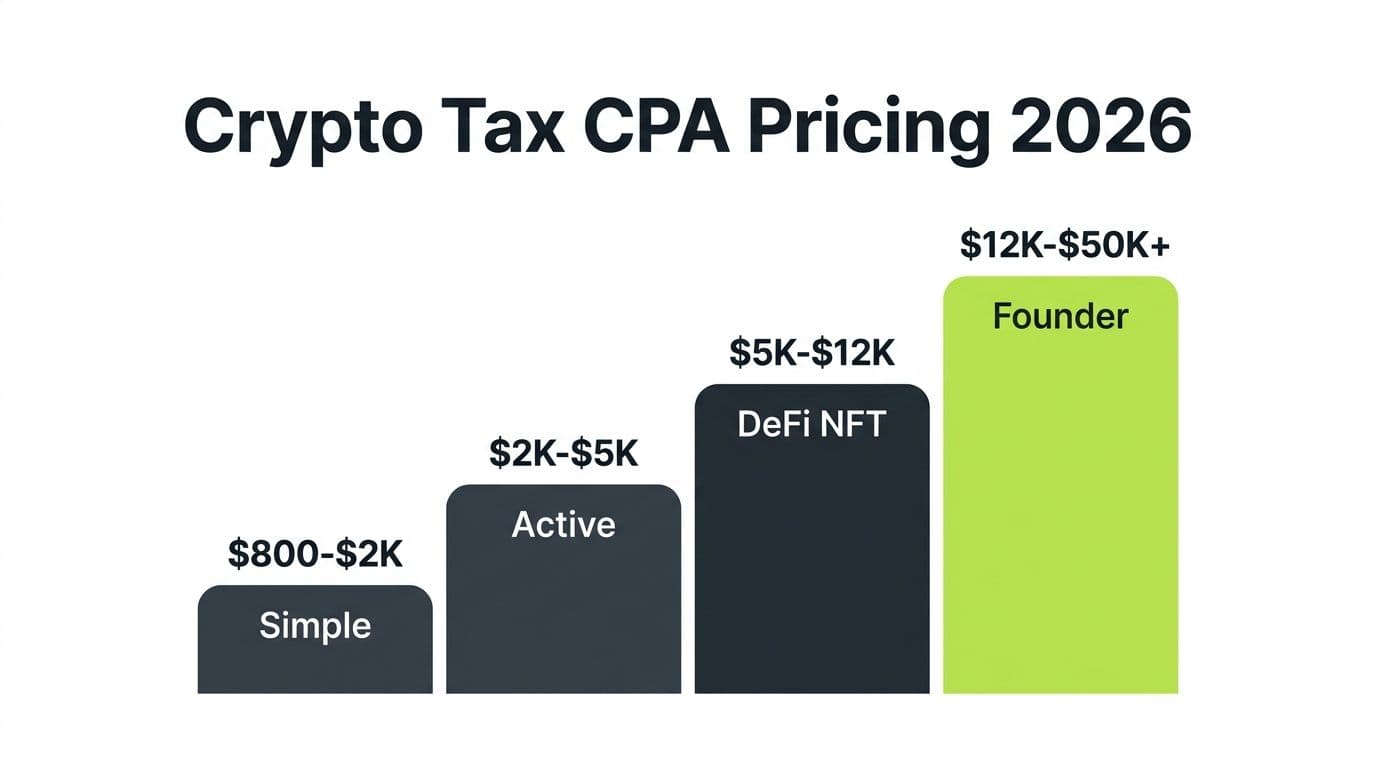
- ✓Crypto tax CPA costs range from $800 for simple portfolios to $50,000+ for multi-entity crypto founders, with most active traders paying $2,000-$5,000
- ✓Flat-fee billing protects you from surprise bills; hourly billing can spiral fast with complex DeFi portfolios
- ✓A $5,000 CPA fee can easily save $50,000+ through optimized cost basis selection, caught errors, and proper DeFi classification
- ✓Always ask about hidden costs upfront: data cleanup, prior-year amendments, IRS notice handling, and FBAR reporting are commonly billed separately
“This guide has been reviewed for accuracy by Leanne Grant, Enrolled Agent, specializing in cryptocurrency tax compliance.”
Most people Google this question expecting a single number.
The honest answer is more useful: here's exactly what crypto tax CPAs charge in 2026, why the range is so wide, and how to know what tier you actually need.
I'm going to lay out real pricing ranges from our practice and what we see across the industry. No vague "it depends." No bait-and-switch. Just transparent numbers so you can budget with confidence.
Here's the thing most CPAs won't tell you: the price you pay matters far less than the value you get back. A $2,000 CPA bill that catches $15,000 in phantom gains from miscategorized DeFi transactions isn't an expense, it’s a return on your investment.
The Quick Answer: What Does a Crypto Tax CPA Cost?
Here's the pricing landscape in 2026. These ranges reflect what we charge at COS Elite and what we see from reputable crypto-specialized firms nationwide.
Crypto Tax CPA Pricing by Complexity Tier (2026)
| Tier | Description | Typical Price Range | What's Included |
|---|---|---|---|
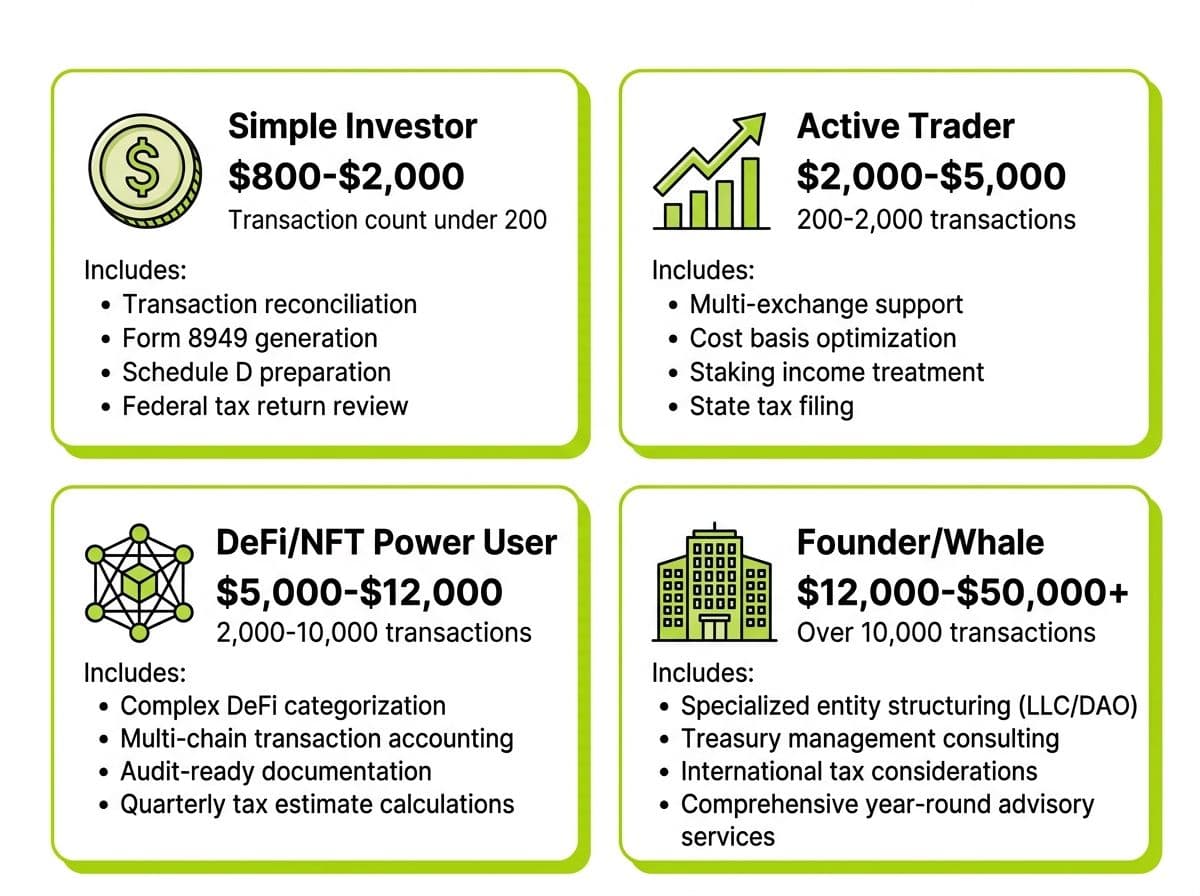
| Simple | Buy/hold/sell on 1–2 exchanges, under 200 transactions | $800–$2,000 | Transaction reconciliation, Form 8949, Schedule D, federal return review |
| Active Trader | Multiple exchanges, 200–2,000 transactions, some staking | $2,000–$5,000 | Full reconciliation, cost basis optimization, income classification, federal + state |
| DeFi/NFT Power User | DeFi protocols, LPs, bridges, NFTs, 2,000–10,000 transactions | $5,000–$12,000 | Complex DeFi categorization, multi-chain reconciliation, software costs, audit-ready documentation |
| Founder/Whale/Multi-Entity | Token issuers, mining ops, multiple entities, 10,000+ transactions | $12,000–$50,000+ | Entity structuring, treasury accounting, payroll in crypto, international reporting, year-round advisory |
Why such a wide range? Because a client with 50 Coinbase trades and a client running a DeFi protocol across four chains with an offshore entity are not the same engagement. The CPA who charges the same fee for both is either overcharging the first or underserving the second.
Why Crypto Tax Costs More Than Regular Tax Prep
You can get a standard W-2 tax return prepared for $200–$400. So why does crypto start at $800 and go up from there?
Four real reasons.
1. Transaction Reconciliation Is Labor-Intensive
A W-2 return has one income source. A crypto return might have 3,000 individual transactions across five exchanges and eight wallets.
Every single transaction needs to be imported, categorized, and matched. Internal transfers between your own wallets need to be identified so they aren't counted as sales. Missing cost basis needs to be tracked down.
This is the single biggest driver of crypto tax CPA cost. For a client with 5,000 DeFi transactions, reconciliation alone can take 8–15 hours of skilled CPA time.
2. Specialized Software Costs Real Money
Your CPA isn't doing this with a spreadsheet. They're running Koinly, CoinTracker, CoinTracking, or similar platforms that cost $100–$500+ per client per year. Those costs get passed through to you, directly or built into the fee.
On top of that, many firms use professional tax software (ProConnect, UltraTax, Drake) with crypto-specific modules that carry their own licensing fees.
For a typical COS Elite client, our cost is about $150 per client just in software fees.
3. IRS Scrutiny Makes Accuracy Non-Negotiable
Crypto is a YMYL (Your Money, Your Life) topic for the IRS. They've issued John Doe summonses to Coinbase, Kraken, and Circle. They launched Operation Hidden Treasure specifically to catch unreported crypto income. Starting in 2026, exchanges must file Form 1099-DA reporting your transactions directly to the IRS.
Your CPA is filing under their license. A crypto return carries higher professional liability risk than a standard return, and that risk is priced into the fee. Rightfully so.
4. Expertise Scarcity Drives Prices Up
There are roughly 650,000 active CPAs in the United States. The number who genuinely understand DeFi liquidity pools, cross-chain bridges, wrapped tokens, staking reward taxation under Jarrett v. United States, and the 2026 1099-DA reporting requirements? A few thousand, maybe.
Scarce expertise commands higher fees. That's not greed. That's economics. You're paying for knowledge that took years to build and that most CPAs simply don't have.
Pricing Tier 1: Simple Crypto Investor ($800–$2,000)
This tier is right for you if:
- You bought and sold crypto on one or two major exchanges (Coinbase, Kraken, Gemini)
- You have fewer than 200 transactions total
- No DeFi, no staking, no NFTs, no mining
- Your total crypto portfolio is under $100K
- You haven't received any IRS notices
What's typically included:
- Import and reconcile transactions from your exchanges
- Select and apply optimal cost basis method (usually HIFO)
- Prepare Form 8949 and Schedule D
- Review for common errors (missing cost basis, duplicate transactions)
- Federal return preparation or review
- Basic state filing guidance
What it looks like in practice: Sarah has a Coinbase account with 85 trades from 2025. She bought BTC and ETH, sold some at a profit, and hasn't done anything complicated. A crypto-specialized CPA reviews her Koinly export, fixes two missing cost basis entries, applies HIFO to reduce her gain by $1,400, and files her return. Total fee: $1,000.
Pro Tip
"Is my situation simple enough for DIY software?" A good CPA will tell you honestly if Koinly or CoinTracker alone would handle your return. That's the kind of CPA you want to work with.
Pricing Tier 2: Active Trader ($2,000–$5,000)
This tier is right for you if:
- You trade on three or more exchanges
- You have 200–2,000 transactions
- You do some staking or earn crypto income
- Your portfolio is $100K–$500K
- You may have transferred crypto between wallets and exchanges
What's typically included:
- Full multi-exchange reconciliation
- Internal transfer matching (so wallet-to-wallet moves aren't taxed as sales)
- Cost basis optimization across all lots
- Staking and income classification (ordinary income vs. capital gains)
- Form 8949, Schedule D, Schedule 1 preparation
- Federal and state return preparation
- Year-end tax planning consultation (30–60 minutes)
What it looks like in practice: Marcus trades on Coinbase, Kraken, and Binance US. He has 1,100 transactions, earns staking rewards on ETH, and moved crypto between exchanges several times. His CPA spends 6 hours reconciling, catches $8,200 in phantom gains from unmatched transfers, switches his cost basis from FIFO to HIFO (saving another $3,400 in taxes), and files both federal and California state returns. Total fee: $2,500.
$4,060 saved
Marcus paid $2,500 for his CPA. His CPA caught $8,200 in phantom gains and avoid $3,400 more through cost basis optimization, saving $4,060 in taxes. Net benefit: $1,560.
Pricing Tier 3: DeFi/NFT Power User ($5,000–$12,000)
This tier is right for you if:
- You're active in DeFi (liquidity pools, yield farming, lending, bridges)
- You buy, sell, or create NFTs
- You have 2,000–10,000 transactions
- You use multiple chains (Ethereum, Solana, Arbitrum, Base)
- Your portfolio is $500K–$5M
What's typically included:
- Everything in Tier 2, plus:
- DeFi protocol categorization (LP entries/exits, swaps, bridges, wrapping)
- NFT cost basis tracking and sale reconciliation
- Multi-chain transaction reconciliation
- Complex income classification (yield farming rewards, NFT royalties)
- Audit-ready documentation package
- Multiple cost basis scenario modeling
- Quarterly estimated tax payment calculations
- Dedicated CPA point of contact
What it looks like in practice: Priya is deep in DeFi. She provided liquidity on Uniswap and Aave, traded NFTs on Blur, bridged assets from Ethereum to Arbitrum, and earned yield farming rewards across three protocols. Her raw transaction count: 4,200.
Her CPA spends 18 hours on reconciliation. Koinly categorized 340 transactions incorrectly. Liquidity pool entries were coded as disposals. Bridge transactions created duplicate entries. Three NFT sales had wrong valuations.
After corrections, her actual tax liability dropped from $67,000 (what Koinly originally calculated) to $31,000. Her CPA fee: $7,500. Her savings: $36,000.
Pro Tip
**If you're in DeFi and your CPA quotes you under $3,000,** ask what's included. At that price, they're likely running your Koinly export through their tax software without a manual review of DeFi categorization. That's how you end up paying tax on $36,000 in phantom gains.
Pricing Tier 4: Crypto Founder / Whale / Multi-Entity ($12,000–$50,000+)
This tier is right for you if:
- You founded or operate a crypto business (token project, mining operation, Web3 startup)
- You hold $5M+ in crypto assets
- You have multiple entities (LLC, S-corp, C-corp, trust)
- You receive or issue crypto payroll
- You have international crypto holdings or entities
- Your transaction count exceeds 10,000
What's typically included:
- Everything in Tier 3, plus:
- Entity structuring and tax optimization (LLC, S-corp, C-corp analysis)
- Treasury management and corporate crypto accounting
- Payroll tax compliance for crypto compensation
- K-1 preparation and partnership returns
- International reporting (FBAR, Form 8938, FATCA)
- Estate planning integration for crypto holdings
- Year-round advisory and planning (monthly or quarterly calls)
- IRS audit defense preparation
- Board-ready tax position documentation
What it looks like in practice: A crypto fund manager with $22M under management, three entities, 40,000+ transactions across 12 platforms, and team members paid partially in tokens. Annual CPA engagement: $35,000, structured as a monthly retainer with unlimited access to the CPA team.
At this level, the CPA isn't just filing returns. They're functioning as an outsourced tax department.
Billing Models Explained: Hourly vs. Flat Fee vs. Retainer
How your CPA charges matters almost as much as what they charge. Here's how the three main models work and when each makes sense.
CPA Billing Models Compared
| Model | How It Works | Typical Range | Best For | Watch Out For |
|---|---|---|---|---|
| Hourly | Pay per hour of CPA time | $250–$500/hr | Simple returns, one-off consultations | Costs can spiral with complex reconciliation; you won't know the total until they're done |
| Flat Fee | Fixed price quoted upfront | $800–$50,000+ | Most crypto tax clients; gives budget certainty | Make sure the scope is clearly defined; out-of-scope work gets billed extra |
| Retainer | Monthly/quarterly fixed payment for ongoing access | $1,000–$5,000/mo | Founders, whales, anyone needing year-round advisory | You're paying even in quiet months; make sure you're using the access |
Hidden Costs to Ask About Before You Sign
The quoted fee rarely covers everything. Here are the costs that catch clients off guard:
- Data cleanup and reconciliation surcharge. What your CPA charges for crypto reconciliation can vary significantly and is often billed more flexibly than tax return preparation, since it can be difficult to determine upfront how much manual work will be needed to establish accurate cost basis and properly categorize transactions. Be sure to get separate estimates for crypto reconciliation and tax return preparation so you clearly understand the cost of each service.
- Prior-year amendments. If you filed incorrectly in 2023 or 2024, amending those returns is a separate engagement. Expect $750–$2,500 per amended year.
- IRS notice handling. If you receive a CP2000 or other notice, responding to it is not included in your tax prep fee. IRS notice response typically runs $1,500–$5,000 depending on complexity.
- Entity preparation. If you're in a partnership or operate an S-corp, tax return preparation for these entities are billed separately from your personal return. Expect $1,200–$5,000 per business entity.
- Foreign exchange reporting (FBAR/Form 8938). If you hold crypto on foreign exchanges (Binance International, KuCoin, Bybit), you may owe FBAR and FATCA filings. These are usually $500–$1,500 extra.
- State returns beyond your home state. If you have nexus in multiple states (common for crypto miners or businesses), each additional state return adds $200–$600.
- Crypto tax software fees. Some CPAs pass through the cost of Koinly, CoinTracker, or CoinTracking directly. Others build it into their fee. Ask which.
- Rush fees. Filing after April 15 on extension is fine. But if you come to a CPA on April 10 with 3,000 transactions, expect a 25–50% rush surcharge.
The ROI Math: When a $5K CPA Bill Saves $50K
Let's run real numbers on three scenarios where a CPA more than earns their fee.
Scenario 1: Cost Basis Optimization
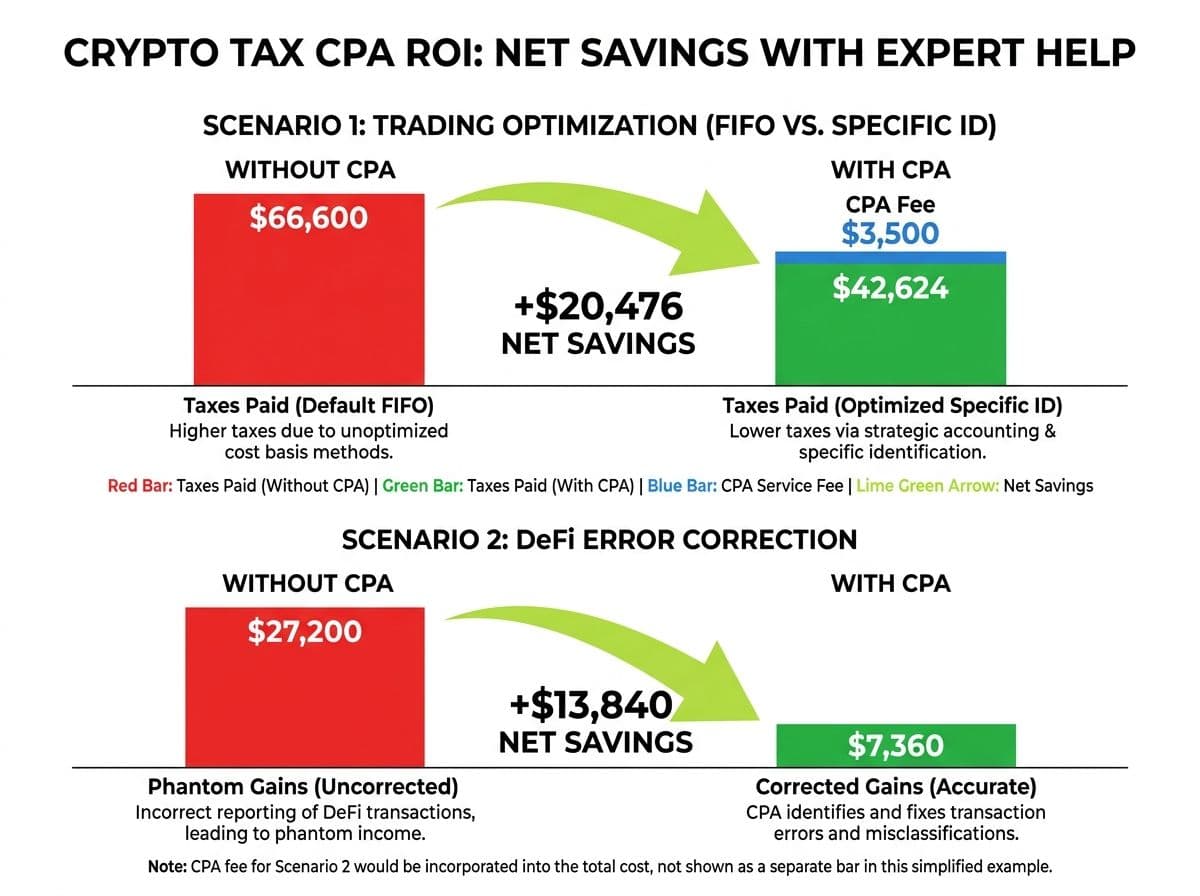
The situation: You have $200,000 in crypto gains across 2,000 transactions. Your default cost basis method is FIFO (first in, first out).
Without a CPA: You use FIFO because Koinly defaults to it. Taxable gain: $200,000. At the 24% federal bracket plus 9.3% California state tax: $66,600 in combined taxes.
With a CPA: Your CPA runs a cost basis comparison across FIFO, HIFO, and specific identification. Specific identification reduces your taxable gain to $128,000 by strategically selecting lots. Tax bill: $42,624.
$23,976 saved
Switching from default FIFO to optimized specific identification on $200K in gains. CPA fee: $3,500. Net savings: $20,476.
Scenario 2: DeFi Error Correction
The situation: Koinly categorized your liquidity pool entries as sales, creating $85,000 in phantom gains.
Without a CPA: You file based on Koinly's output. You pay tax on gains that don't exist. At a 32% effective rate: $27,200 in taxes you didn't owe.
With a CPA: Your CPA reviews every DeFi transaction, recategorizes LP entries correctly, and eliminates the phantom gains entirely. Your actual gain: $23,000. Actual tax: $7,360.
$19,840 saved
Correcting phantom DeFi gains from miscategorized LP transactions. CPA fee: $6,000. Net savings: $13,840.
Scenario 3: IRS Notice Prevention
The situation: Your 1099-DA from Coinbase shows $340,000 in proceeds. Your self-prepared return reports $280,000. The IRS sends a CP2000 notice for the $60,000 discrepancy.
Without a CPA: You get the notice, panic, and either pay the proposed assessment ($19,800 in additional tax plus penalties and interest totaling $24,500) or hire a CPA reactively at emergency rates ($3,000–$8,000 just for notice response).
With a CPA: Your CPA reconciles your return against the 1099-DA before filing. The $60,000 discrepancy was caused by internal transfers being reported as proceeds. Your CPA documents these properly. No notice. No penalties. No panic.
Software vs. CPA Cost: The Break-Even Analysis
Here's the honest comparison. When does DIY software make financial sense, and when does a CPA earn back their fee?
DIY Software vs. Crypto Tax CPA: Cost Comparison
| Factor | DIY Software (Koinly/CoinTracker) | Crypto Tax CPA |
|---|---|---|
| Annual cost | $49–$279 | $800–$12,000+ |
| Your time investment | 5–20 hours | 1–3 hours (gathering documents) |
| Transaction reconciliation | Automated (you fix errors) | Professional review included |
| Cost basis optimization | You choose the method | CPA models multiple scenarios |
| DeFi categorization accuracy | 60–90% automatic | 98%+ after manual review |
| IRS notice risk | Higher (unreviewed errors) | Lower (CPA-verified) |
| Audit defense | You're on your own | CPA representation available |
| Error liability | You bear all risk | CPA carries professional liability insurance |
| Best for | Under 200 transactions, no DeFi, portfolio under $50K | 200+ transactions, any DeFi, portfolio over $50K |
| Break-even point | When potential tax savings from CPA review < CPA fee | When CPA catches even one $2,000+ error |
The break-even math is simple. If your portfolio is complex enough that a CPA is likely to find even one meaningful error or optimization worth more than their fee, the CPA pays for itself.
For a $3,000 CPA fee, your CPA only needs to save you $3,001 in taxes to break even. With cost basis optimization alone (typically saving 10–20% on taxable gains), most clients with $30,000+ in gains will clear that bar.
Red Flags: Pricing Patterns That Should Worry You
Pro Tip
**Not all crypto tax services deliver what they promise.** Here are the pricing red flags we see in the market, and what they usually mean.
- "$499 Crypto Tax Returns!" At that price, they're running your exchange CSV through software and filing whatever comes out. No manual review. No cost basis optimization. No DeFi categorization check. You're paying for data entry, not CPA judgment. If your situation is truly simple enough for a $499 service, you can probably handle it yourself with Koinly or CoinTracker for $49–$99.
- No scope definition in the engagement letter. If a CPA can't tell you exactly what's included in their fee, you'll find out when the "additional services" invoice arrives.
- Hourly billing with no estimate or cap. "We'll bill hourly and see how it goes" is a recipe for a $10,000 surprise. Demand an estimate range, or walk away.
- Quoting without asking about your situation. Any CPA who quotes a price before asking how many transactions you have, whether you're in DeFi, and what exchanges you use is guessing. That guess will be wrong in one direction or the other.
- "We handle all crypto" but no DeFi questions. If your CPA doesn't ask about liquidity pools, yield farming, bridges, or wrapped tokens, they're treating your DeFi activity the same as simple buy/sell trades. That's where the biggest errors happen.
- No engagement letter. A legitimate CPA always provides a written engagement letter specifying scope, fee, timeline, and what happens if the scope changes. No letter = no accountability.
How to Talk to a Crypto Tax CPA About Price
Most people are uncomfortable asking about fees. Here's a simple three-question script that gets you the information you need without awkwardness.
Question 1: "Based on my situation, what's your fee, and what does it include?"
Give them: your exchange list, approximate transaction count, whether you're in DeFi, your rough portfolio size. A good CPA will give you a specific range within 24 hours.
Question 2: "What's not included in that fee? Are there any common add-ons I should budget for?"
This surfaces the hidden costs (data cleanup, amendments, state returns, FBAR) before they surprise you.
Question 3: "If reconciliation takes longer than expected, how does my fee change?"
This is the most important question. It tells you how quickly the estimate that can creep upward.
Pro Tip
When you're evaluating crypto tax CPAs, the consultation itself tells you a lot. Does the CPA actually understand your DeFi activity, or are they Googling terms while you talk? Do they explain their fee structure clearly, or dodge the pricing question? At COS Elite, we publish our pricing tiers because we believe transparency builds trust.
Action Steps: What to Do Next
Here's your game plan based on where you are right now:
- Estimate your complexity tier. Count your exchanges, approximate your transactions, and note whether you have DeFi or NFT activity. Use the pricing table above to set your budget expectations.
- Gather your data first. Connect your exchanges to crypto tax software (Koinly, CoinTracker, or similar). Having clean data ready makes your CPA engagement faster and often cheaper.
- Get 2–3 quotes. Contact crypto-specialized CPAs (not general CPAs who "also do crypto"). Compare fees, scope, and billing model. Use the three-question script above.
- Ask about the engagement letter. Read it. Understand what's included. Know what triggers additional charges.
- Book a free quote. We'll review your situation, tell you which tier you fall into, and give you a straight answer on cost. No commitment, no pressure, no billable clock running.
Frequently Asked Questions

About the author
Garrett Taylor, CPA
Former Big Four CPA. CPA #133092. Garrett answers his phone. Led by expertise. Powered by precision.
Related Articles

How to Choose a Crypto Tax CPA in 2026 (From a CPA Who Files 500+ Crypto Returns a Year)
A CPA's guide to finding the right crypto tax professional. 10 interview questions, real pricing, red flags, and when you need a CPA vs EA vs tax attorney.
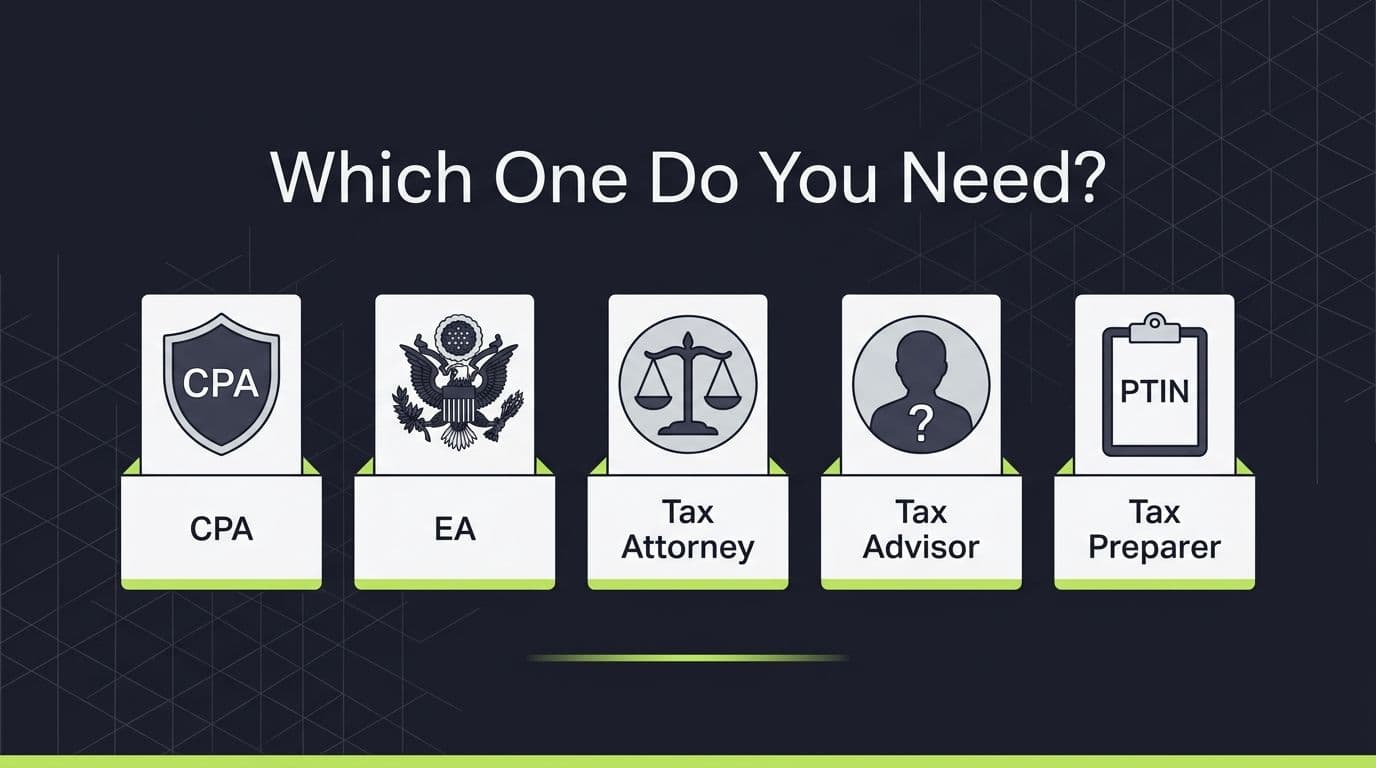
Crypto Tax CPA vs Advisor vs Professional: What's the Real Difference (2026)?
CPA, EA, tax attorney, advisor, preparer — they all sound the same but mean wildly different things. A CPA breaks down what each credential means, what each can legally do for crypto investors, and which one you actually need.
10 Red Flags Your Crypto Tax Preparer Is in Over Their Head (and What to Do About It)
After reviewing 200+ prior-year returns, here are the 10 warning signs your crypto tax preparer is in over their head, the questions to ask, and how to fix it.