Crypto Tax CPA vs Advisor vs Professional: What's the Real Difference (2026)?

By Garrett Taylor, CPA #133092
Reviewed by Leanne Grant, EA #00167954-EA
Key Takeaways
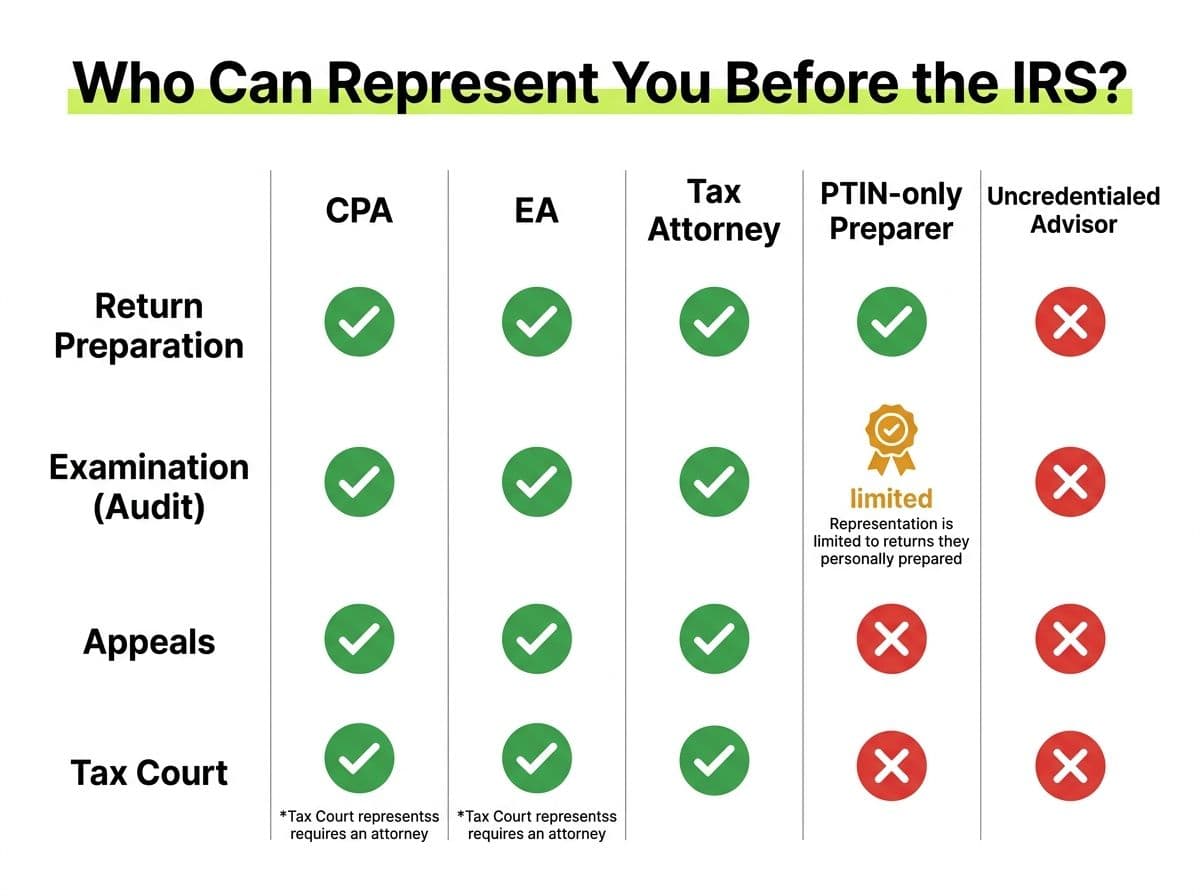
- ✓A CPA and an Enrolled Agent (EA) can both represent you before the IRS — a 'tax advisor' or PTIN-only preparer cannot.
- ✓'Crypto tax advisor' is not a regulated title. Anyone can use it. Always ask for credentials.
- ✓For crypto investors facing IRS scrutiny, audits, or complex DeFi activity, a credentialed professional (CPA or EA) is not optional.
- ✓The best crypto tax firms pair a CPA with an EA for comprehensive coverage across preparation, strategy, and IRS representation.
- ✓Credential requirements matter more for crypto than traditional tax because IRS enforcement is intensifying with 1099-DA and Operation Hidden Treasure.
“This guide has been reviewed for accuracy by Leanne Grant, Enrolled Agent, specializing in cryptocurrency tax compliance and IRS representation.”
You need help with your crypto taxes. You know that much.
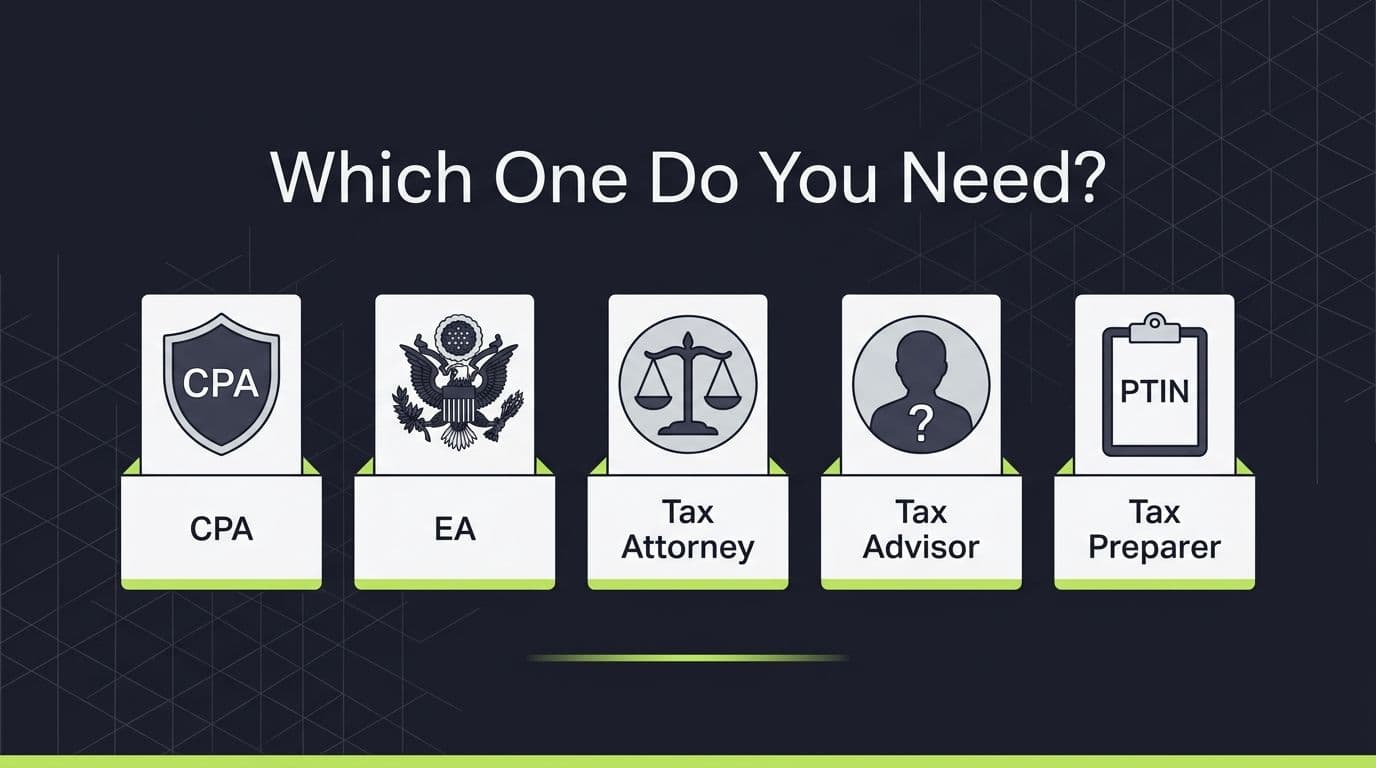
But the second you start searching, you hit a wall of titles. Crypto tax CPA. Crypto tax advisor. Crypto tax professional. Enrolled Agent. Tax preparer. Tax attorney.
They all sound like the same thing. They're not. And picking the wrong one can cost you thousands, or leave you unprotected if the IRS comes knocking.
In this guide, I'll break down exactly what each title means, what each one can legally do for you, and which one you actually need based on your situation. No jargon. No sales pitch. Just the credentials explained by someone who holds them.
The 5 Titles You'll See (and What They Actually Mean)
Let me save you 20 minutes of confusing Google searches.
There are five titles you'll encounter when looking for crypto tax help. Two of them are backed by real credentials with legal authority. Two of them are loosely regulated. And one of them means absolutely nothing from a legal standpoint.
Here's the full breakdown:
Crypto Tax Professional Credentials Compared (Federal)
| Consider: A tax attorney for privilege protection | CPA | Enrolled Agent (EA) | Tax Attorney | "Tax Advisor" | Tax Preparer (PTIN-only) |
|---|---|---|---|---|---|
| **Credential issuer** | State board of accountancy | IRS (federal) | State bar association | None required (varies by state) | IRS (PTIN registration) |
| **Exam required** | CPA Exam (4 parts, 16 hrs) | Special Enrollment Exam (3 parts) | Bar exam + JD degree | No | No |
| **Education required** | 150 credit hours (typically Master's) | None required | Law degree (JD) | None required | None required |
| **IRS representation** | Unlimited | Unlimited | Unlimited | None (unless also credentialed) | Limited (only returns they prepared) |
| **Can sign tax returns** | Yes | Yes | Yes (if also a preparer) | Only if also holding PTIN | Yes |
| **Continuing education** | 80 hrs/2 years | 72 hrs/3 years (IRS-mandated) | Varies by state bar | None required | None required (voluntary AFSP) |
| **Regulated by** | State Boards of Accountancy + AICPA | IRS Circular 230 | State bar + courts | Nobody | IRS (PTIN renewal only) |
| **Scope beyond tax** | Audit, preparation of financial statements, advisory | Tax only | Legal advice, litigation, contracts | Varies wildly | Tax prep only |
| **Typical crypto tax fee** | $500–$5,000+ | $300–$3,000 | $350–$700/hr | $200–$2,000 | $100–$500 |
Let's dig into each one.
CPA Defined: The Gold Standard (With a Catch)
CPA stands for Certified Public Accountant. It's a state-issued license, and earning it is no joke.
What it takes to become a CPA:
- Complete 150 semester hours of education (that's a full year beyond a bachelor's degree in most states)
- Pass the Uniform CPA Exam, a four-part, 16-hour exam with a pass rate that hovers around 50%
- Accumulate 1-2 years of supervised work experience (varies by state)
- Pass an ethics exam
- Maintain the license with 40+ hours of continuing professional education every year
What a CPA can do for you:
- Prepare and sign your tax return. A CPA puts their license number on your return.
- Represent you before the IRS. Audits, appeals, collections. Full, unlimited representation rights under IRS Circular 230.
- Advise on tax strategy. Cost basis optimization, entity structuring, tax-loss harvesting, estimated payments.
- Issue financial statements. If you run a crypto business or fund, a CPA can audit your books and issue certified financials.
- Work across disciplines. Many CPAs handle bookkeeping, payroll, estate planning, and business advisory in addition to tax.
Pro Tip
**IRS Circular 230** is the federal regulation governing who can practice before the IRS. Only three types of professionals have unlimited practice rights: CPAs, Enrolled Agents, and attorneys. Everyone else has limited or zero representation authority. If you receive an audit notice, this distinction becomes the most important thing in the room.
The catch with CPAs and crypto:
Here's something most people don't realize. A CPA license proves competence in accounting and tax law broadly. It does not prove expertise in cryptocurrency taxation specifically.
What to look for in a crypto-specialized CPA:
- They can name the cost basis methods available for crypto (FIFO, LIFO, HIFO, Specific ID) and explain when each is optimal
- They know what a 1099-DA is and how to reconcile it against your actual transaction data
- They've filed returns with DeFi activity, staking income, and NFT transactions
- They use or are deeply familiar with crypto tax software (Koinly, CoinTracker, CoinLedger, etc.)
EA (Enrolled Agent) Defined: The IRS's Own Credential
An Enrolled Agent is a federally authorized tax practitioner. The credential is issued directly by the IRS, not by any state.
Here's what makes EAs unique:
What it takes to become an EA:
- Pass the Special Enrollment Examination (SEE), a three-part exam covering individual tax, business tax, and representation/procedures
- OR have at least five years of relevant experience working at the IRS
- Pass a background check
- Complete 72 hours of continuing education every three years (24 hours/year on average)
What an EA can do for you:
- Prepare and sign your tax return. Same authority as a CPA here.
- Represent you before the IRS. Full, unlimited representation rights. Audits, appeals, collections, penalty abatement. This is the EA's superpower.
- Practice in any state. Because the EA credential is federal, there's no state licensing restriction. A California-based EA can represent a client in New York without additional licensing.
- Specialize deeply in tax. EAs are tax specialists by definition. They don't do financial statements or corporate audits. Tax is all they do.
EA vs. CPA for crypto taxes: the real difference
Both can prepare your return. Both can represent you before the IRS. Both are bound by IRS Circular 230 ethical standards.
The practical differences:
- Scope: A CPA's training is broader (accounting, auditing, business advisory). An EA's training is narrower but deeper on tax procedure and IRS interactions.
- IRS controversy: When it comes to fighting the IRS on audit findings, penalty disputes, or notice responses, EAs are often the better choice. This is their entire professional focus.
- Business advisory: If you need entity structuring, financial statements for investors, or business-level tax planning, a CPA is better equipped.
- Cost: EAs typically charge less than CPAs for comparable crypto tax work ($300-$3,000 vs $500-$5,000+), though ranges overlap significantly.
Bottom line: For pure tax preparation and IRS representation, an EA is every bit as qualified as a CPA. For broader financial advisory work, a CPA has the wider toolkit.
Tax Attorney Defined: When You Need a Lawyer, Not an Accountant
A tax attorney is a licensed attorney (JD degree + bar admission) who specializes in tax law.
When you need a tax attorney for crypto:
- You're under criminal investigation by the IRS for tax evasion or fraud related to unreported crypto
- You're involved in Tax Court litigation (your case has gone beyond audit and appeals)
- You need attorney-client privilege for sensitive disclosures (neither CPAs nor EAs can offer this)
- You're doing a voluntary disclosure to the IRS for unreported crypto income from prior years
- You're structuring a complex entity (offshore trust, DAO with token distributions, crypto fund formation)
When you don't need a tax attorney:
- Filing your annual crypto tax return
- Responding to a standard CP2000 notice
- Optimizing your cost basis method
- Basic tax planning
Tax attorneys are the heavy artillery. They charge $350-$700+ per hour. You bring them in when the stakes are high enough to justify the cost, typically when potential penalties or criminal exposure exceed $50,000.
"Tax Advisor": The Title That Means Nothing (Legally)
Here’s something most people don’t realize: anyone can call themselves a “tax advisor.”
“Tax advisor" is not a regulated title. There is no exam, no license, no credential, no oversight body. Anyone with an internet connection and a LinkedIn profile can call themselves a "crypto tax advisor" today.
What happens when you hire an uncredentialed "advisor":
- They can give you opinions, but those opinions carry no professional liability insurance
- They cannot represent you before the IRS if you get audited
- They have no continuing education requirements, meaning their knowledge of 2026 rules might be based on 2022 blog posts
- If they make a mistake that costs you $30,000, you have limited legal recourse compared to a licensed CPA or EA
- They are not bound by IRS Circular 230 ethical standards
Pro Tip
"Are you a CPA, EA, or licensed attorney?" If the answer is none of the above, ask what specific qualifications they hold. There's nothing wrong with working with an experienced non-credentialed preparer for simple situations. But you need to know what you're getting, and more importantly, what protections you're giving up.
"Tax Preparer" / PTIN-Only: The Minimum Bar
A tax preparer is anyone who prepares federal tax returns for compensation. The only requirement is a PTIN (Preparer Tax Identification Number), which you get by filling out an IRS application and paying $18.75.
That's it. No exam. No education. No experience.
What a PTIN-only preparer can do:
- Prepare and sign your tax return
What a PTIN-only preparer cannot do:
- Represent you before the IRS in an audit (they can only appear for returns they personally prepared, and only at the examination level, not appeals or collections)
- Provide tax planning advice with any professional backstop
- Represent you in penalty disputes
- Practice before the IRS Office of Appeals or in Tax Court
When a PTIN-only preparer is enough:
Honestly? For crypto, almost never. If your crypto situation is simple enough for a PTIN-only preparer, it's probably simple enough for TurboTax.
The whole reason you're paying a human is for expertise and protection. A PTIN-only preparer gives you neither.
Pro Tip
The IRS offers a voluntary **Annual Filing Season Program (AFSP)** that gives non-credentialed preparers slightly expanded representation rights (they can represent clients for returns they prepared before the examination level, not appeals). It requires 18 hours of continuing education per year. It's better than nothing, but it's still not in the same league as a CPA or EA license.
Why Credentials Matter More in Crypto
You might be thinking: "OK, these credential differences exist for all tax work, not just crypto. Why does it matter more for crypto?"
Great question. Here's why.
1. IRS enforcement on crypto is at an all-time high.
The IRS launched Operation Hidden Treasure specifically to find unreported cryptocurrency income. They trained agents. They built tools. They issued John Doe summonses to exchanges including Coinbase, Kraken, and Circle, forcing them to hand over customer records.
If you're on that list, you want a CPA or EA in your corner, not someone who picked up a PTIN last month.
2. The 1099-DA changes everything starting in 2026.
For the first time, crypto exchanges are issuing Form 1099-DA to both you and the IRS. If your tax return doesn't match what the exchange reported, you will hear from the IRS. Guaranteed.
A credentialed professional knows how to reconcile 1099-DA data against your actual cost basis. An uncredentialed preparer may not even know the form exists.
3. The rules change every year, and some aren't settled.
Jarrett v. US raised the question of whether staking rewards are taxable at creation or at disposition. The case is still being debated. A crypto-specialized CPA or EA follows these developments. A generic preparer probably doesn't.
4. The stakes are higher than "normal" tax situations.
A high-volume crypto trader with DeFi activity, staking, and NFTs might have 5,000+ transactions across 10 platforms. The difference between a good and bad cost basis calculation on that portfolio isn't $200. It's $20,000 or more.
When that much money is on the line, credentials aren't just nice to have. They're insurance.
Pro Tip
In 2019, the IRS sent 10,000+ letters to crypto holders. In 2021, they launched Operation Hidden Treasure. In 2023, they used John Doe summonses against multiple exchanges. In 2024, they finalized the 1099-DA reporting rules. In 2026, the first 1099-DAs are being issued. The enforcement ramp is steep, and it's not slowing down. Every year you file crypto taxes without a credentialed professional, you're taking on more risk than the year before.
Decision Framework: Which Pro Do You Actually Need?
Stop guessing. Use this framework.
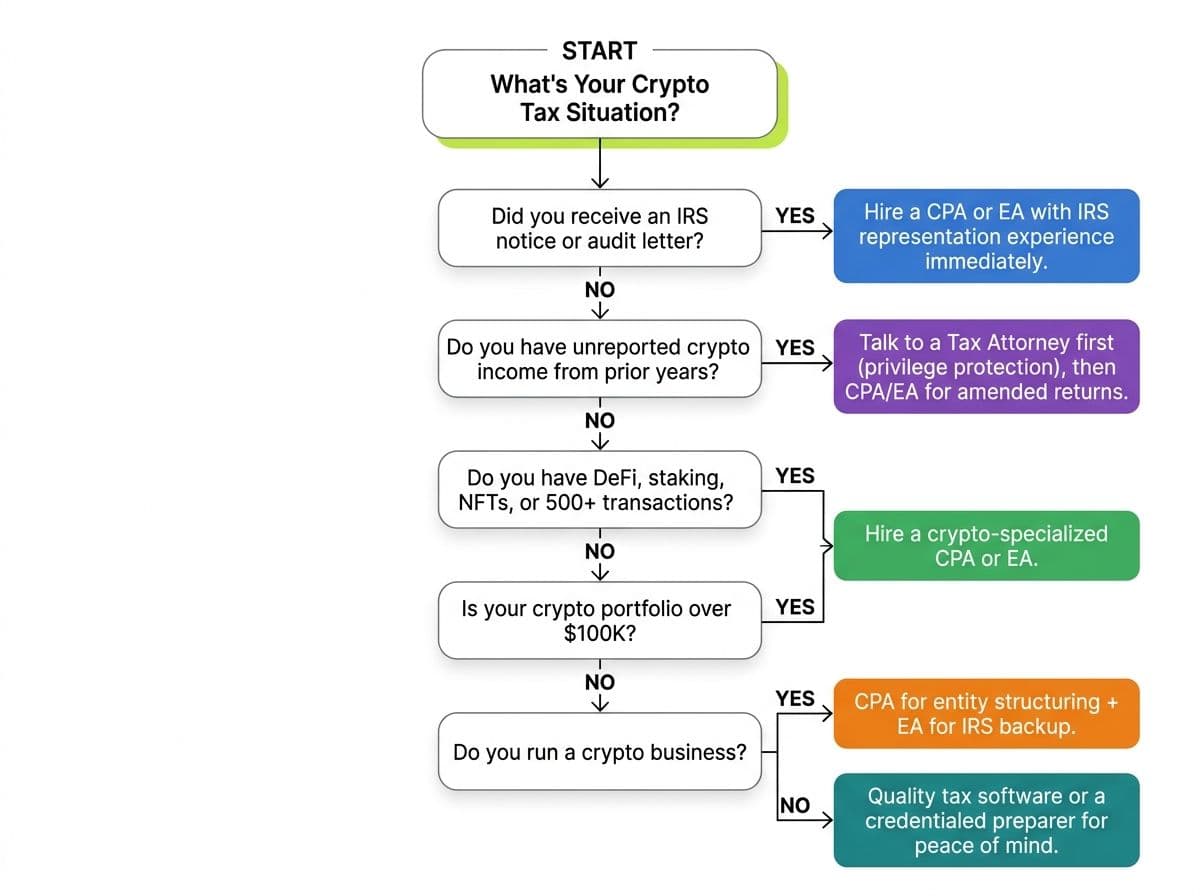
Start here: What's your situation?
Scenario 1: Simple holder (buy, hold, sell on 1-2 exchanges, under $50K portfolio)
- You need: A credentialed preparer (CPA or EA) if you want peace of mind, or quality tax software if you're comfortable DIY
- You don't need: A tax attorney or expensive specialist
Scenario 2: Active trader or DeFi user (3+ platforms, 500+ transactions, staking, LPs, bridges)
- You need: A crypto-specialized CPA or EA. Not optional. The transaction complexity makes errors almost guaranteed without professional review.
- You don't need: A tax attorney (unless you also have IRS issues)
Scenario 3: You received an IRS notice (CP2000, Letter 6173/6174, or audit notification)
- You need: A CPA or EA with IRS representation experience. Immediately. Do not respond to the IRS yourself.
- Consider: A tax attorney if the notice suggests criminal investigation or if the dollar amount exceeds $100K
Scenario 4: You have unreported crypto income from prior years
- You need: ACPA or EA to prepare amended returns
- Do not: Hire a non-credentialed advisor for this. The stakes are too high.
Scenario 5: You run a crypto business (mining operation, NFT project, DAO, trading firm)
- You need: A CPA for entity structuring, financial statements, and ongoing business tax. An EA as backup for IRS representation.
- Consider: A tax attorney for entity formation and contract review
Scenario 6: High-net-worth crypto holder ($500K+ portfolio, estate planning considerations)
- You need: A CPA with tax planning and estate planning capability. Possibly a tax attorney for trust and estate structuring.
- You don't need: A PTIN-only preparer or uncredentialed advisor. Period.
Real Cost Ranges (by Credential and Complexity)
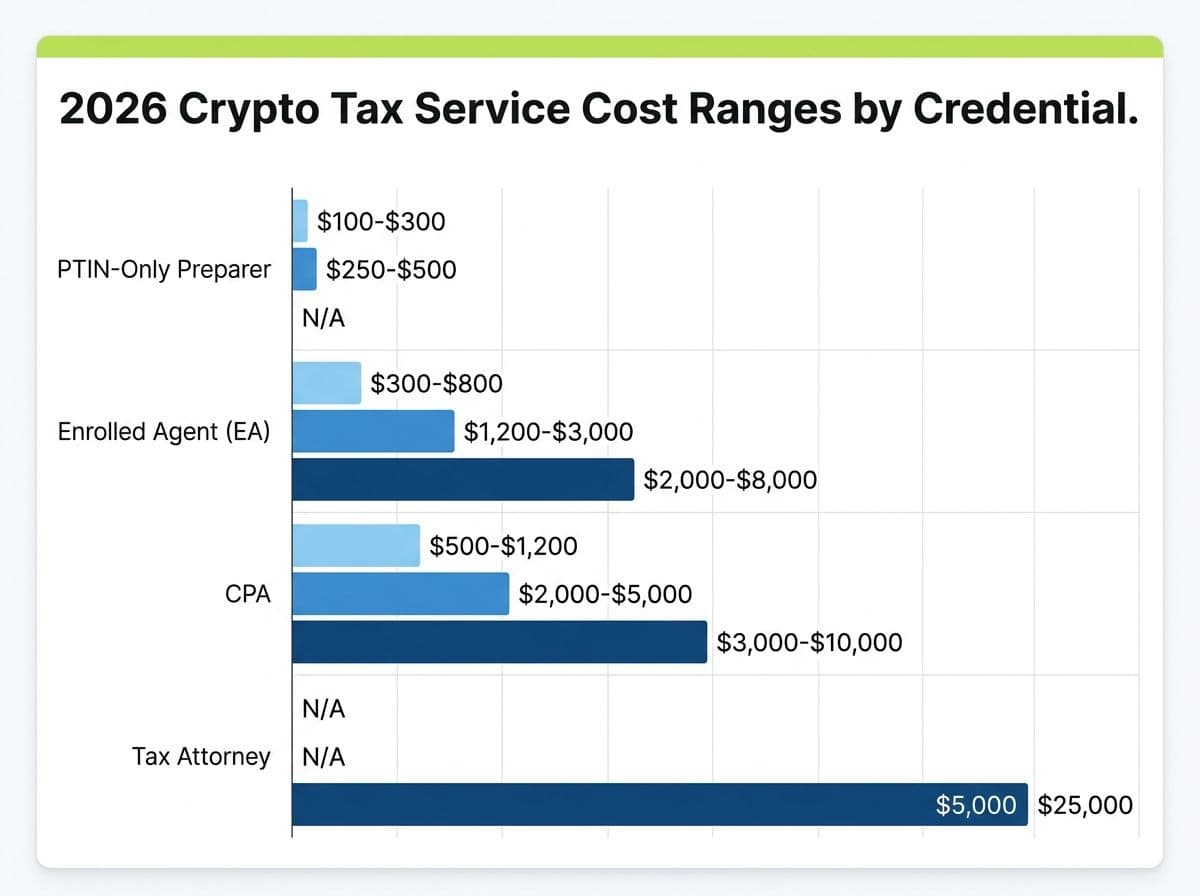
Let's talk actual numbers. These are ranges we see across the industry for crypto-specific tax work in 2026:
Crypto Tax Professional Cost Ranges (2026)
| Service | PTIN-Only Preparer | Enrolled Agent (EA) | CPA | Tax Attorney |
|---|---|---|---|---|
| **Simple return** (1 exchange, <100 trades) | $100–$300 | $300–$800 | $500–$1,200 | N/A |
| **Moderate return** (2-3 exchanges, 100-500 trades) | $250–$500 | $600–$1,500 | $1,000–$2,500 | N/A |
| **Complex return** (DeFi, staking, NFTs, 500+ trades) | Not recommended | $1,200–$3,000 | $2,000–$5,000+ | N/A |
| **IRS notice response** | Cannot do this | $500–$2,000 | $750–$3,000 | $1,500–$5,000 |
| **Audit representation** | Cannot do this | $2,000–$8,000 | $3,000–$10,000 | $5,000–$25,000+ |
| **Amended returns** (per year) | $200–$500 | $500–$1,500 | $800–$2,500 | $1,500–$4,000 |
| **Tax planning session** (1-2 hours) | Not available | $200–$500 | $300–$700 | $350–$700 |
| **Hourly rate** | $50–$150 | $150–$350 | $200–$500 | $350–$700+ |
Red Flags Across All Categories
No matter which type of professional you hire, watch for these warning signs:
Credential red flags:
- They won't provide their PTIN, CPA license number, or EA enrollment number when asked
- Their CPA license is in "inactive" or "retired" status (you can verify at your state board's website)
- They claim to be a "certified crypto tax specialist" but can't name the issuing body (there isn't a widely recognized one)
- They say "I handle crypto" but have never heard of Form 8949 or 1099-DA
Practice red flags:
- They guarantee a specific refund amount before reviewing your data
- They charge based on a percentage of your refund (this is an IRS no-no and an ethical violation)
- They don't use or aren't familiar with any crypto tax software
- They want to file your return under their PTIN but won't sign it (this is illegal)
- They pressure you to claim deductions or losses that don't feel right
- They can't explain the difference between short-term and long-term capital gains treatment for crypto
Communication red flags:
- They don't ask about your DeFi activity, staking, or airdrops (a real crypto pro knows to ask)
- They tell you "crypto-to-crypto trades aren't taxable" (they absolutely are)
- They say you only owe taxes when you cash out to USD (wrong since 2014)
- They recommend a cost basis method without asking about your goals or tax bracket
- They've never mentioned reconciling your 1099-DA against your actual transaction records
Pro Tip
Before hiring anyone, do these three checks in under 5 minutes. **1)** CPA license: Search your state's board of accountancy website. **2)** EA status: Call the IRS at (855) 880-8721 or check the IRS enrolled agent directory. **3)** PTIN: Ask for it directly. If they dodge, walk away.
The Multi-Credential Stack: Why the Best Firms Have Both a CPA and an EA
Here's something most crypto investors never think about:
The strongest crypto tax firms aren't built around a single credential. They stack them.
At our firm, for example, we have a CPA (me, Garrett) handling return preparation, tax strategy, and financial advisory. And we have an Enrolled Agent (Leanne Grant, EA) handling IRS controversy, notice responses, and representation.
Why does this matter?
A CPA's strengths: Big-picture financial strategy. Cost basis optimization. Entity structuring. Financial statements. The CPA sees the whole financial picture and makes the tax return part of a larger plan.
An EA's strengths: Deep IRS procedural knowledge. Representation in audits and appeals. Penalty abatement. Collections defense. The EA is your fighter when the IRS is on the other side of the table.
When you hire a firm with both, you get the best of both worlds:
- Your return is prepared by someone trained in accounting, financial reporting, and tax strategy
- If the IRS challenges anything, you have a dedicated IRS representation specialist ready to go
- You get two sets of credentialed eyes on your crypto data, catching errors that a single reviewer might miss
This is the multi-credential stack. And in a world where IRS crypto enforcement is growing every year, it's a real competitive advantage for your tax compliance.
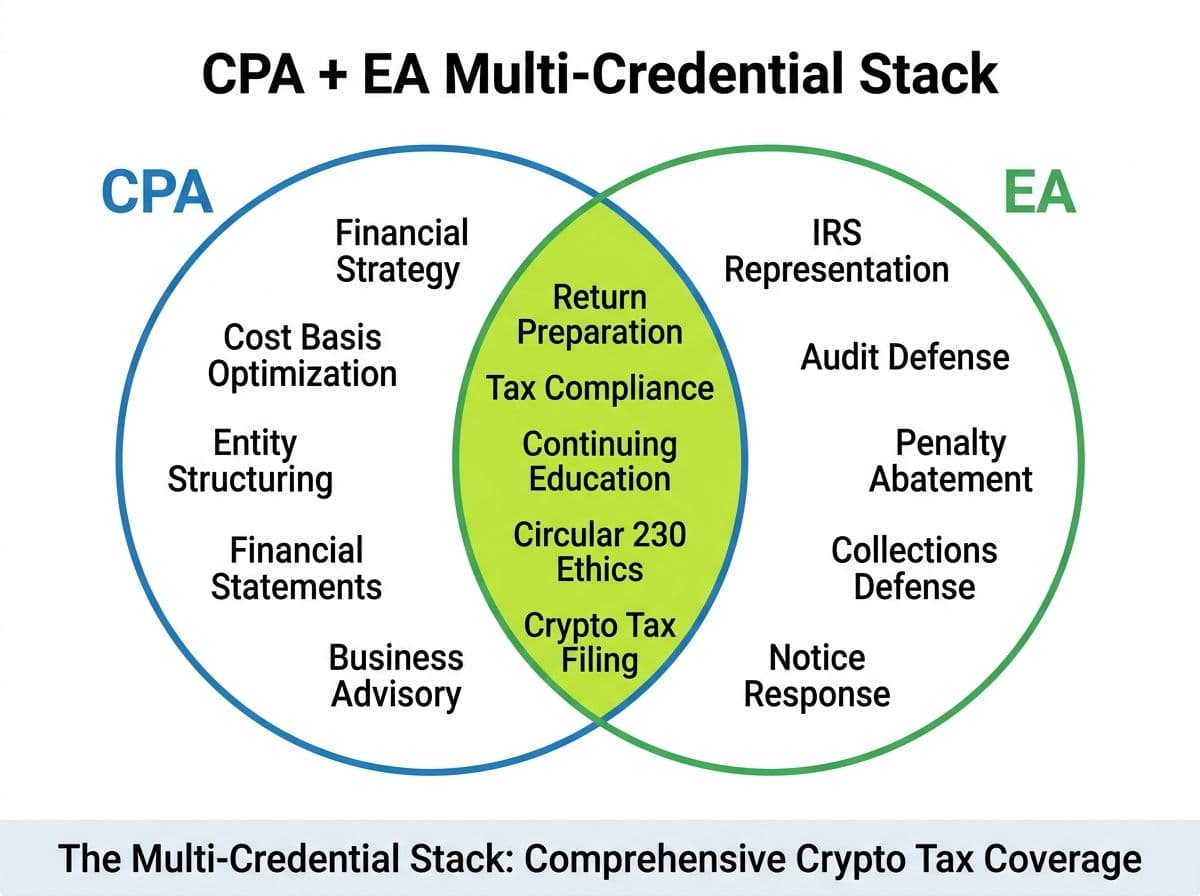
You don't always need both. A simple portfolio with one exchange and a hundred trades? A single CPA or EA handles that easily. But if you're dealing with DeFi complexity, a six-figure portfolio, or any IRS controversy? The stack matters.
Related reading: How to Choose a Crypto Tax CPA and Red flags in crypto tax preparers.
Action Steps: What to Do Right Now
Step 1: Know what credential you need. Use the decision framework above. Match your situation to the right professional type.
Step 2: Verify credentials before your first call. Check the state board for CPAs, IRS directory for EAs, state bar for attorneys. Takes five minutes.
Step 3: Ask the right screening questions.
- "How many crypto tax returns did you file last year?"
- "What crypto tax software do you use?"
- "Can you explain how you'd handle my DeFi LP positions?"
- "What happens if I get an IRS notice after you file?"
Step 4: Get a fee quote in writing. Flat fee preferred. If hourly, get an estimate of total hours with a cap.
Step 5: Check for the stack. Ask whether the firm has both a CPA and an EA on staff. If they do, that's a strong signal of depth.
Step 6: Start early. The best crypto tax CPAs and EAs book up by February. If you're reading this during tax season, book a call today. If it's summer or fall, you're in the sweet spot to get ahead of next year. (“book a call today” link doesn’t work)
Related reading: What to expect cost-wise.
Frequently Asked Questions
What is a crypto tax CPA?
A crypto tax CPA is a Certified Public Accountant who specializes in cryptocurrency taxation. They hold a state-issued CPA license, which requires passing a four-part exam and completing 150 credit hours of education. There is no separate 'crypto CPA' credential — the specialization comes from experience filing crypto returns, working with crypto tax software, and staying current on IRS guidance specific to digital assets.
What's the difference between a crypto tax CPA and a crypto tax advisor?
A CPA is a licensed, regulated professional with a state-issued credential, continuing education requirements, and full IRS representation rights. 'Tax advisor' is an unregulated title that anyone can use. A crypto tax advisor might be a CPA, an EA, or someone with no formal credentials at all. Always ask for specific licensing information before hiring someone who calls themselves an advisor.
Can an Enrolled Agent do everything a CPA can for crypto taxes?
For tax preparation and IRS representation, yes. Both CPAs and EAs have unlimited representation rights before the IRS and can prepare and sign returns. The main difference is scope: CPAs are also trained in financial accounting, auditing, and business advisory, which matters if you need entity structuring or financial statements. For pure crypto tax compliance, an EA is equally qualified.
Do I need a tax attorney for my crypto taxes?
Most crypto investors do not need a tax attorney for routine tax filing. You should consider a tax attorney if you're facing criminal investigation by the IRS, need attorney-client privilege for sensitive disclosures, are involved in Tax Court litigation, or need complex entity structuring for a crypto business. For standard tax preparation, a CPA or EA is the right choice.
How much does a crypto tax CPA cost?
Crypto tax CPA fees range from $500 to $5,000+ depending on the complexity of your portfolio. A simple return with one exchange and under 100 trades might cost $500-$1,200. A complex return with DeFi, staking, NFTs, and 500+ transactions typically runs $2,000-$5,000+. Most crypto-focused CPA firms offer flat-fee packages based on transaction count rather than hourly billing.
What is a PTIN and why should I care?
A PTIN (Preparer Tax Identification Number) is the minimum credential required by the IRS for anyone who prepares tax returns for compensation. It requires only an application and a $30.70 fee, with no exam or education. A PTIN-only preparer has very limited ability to represent you before the IRS — if you're audited, they can only appear for returns they personally prepared and only at the examination level.
What is IRS Circular 230 and why does it matter for crypto?
IRS Circular 230 is the federal regulation governing who can practice before the IRS. It establishes ethical standards, competency requirements, and disciplinary procedures for CPAs, EAs, and attorneys. For crypto investors, it matters because only Circular 230 practitioners can represent you fully before the IRS. Given the increase in crypto audits through Operation Hidden Treasure, having a Circular 230 practitioner provides protection that non-credentialed preparers cannot offer.
Should I hire a CPA or an EA for my crypto taxes?
Either is a strong choice for crypto tax preparation. If you need broader financial advisory (entity structuring, financial statements, estate planning), lean toward a CPA. If your primary concern is IRS representation and tax controversy, lean toward an EA. The best firms have both on staff. For straightforward crypto tax filing without special circumstances, either credential serves you equally well.
How do I verify if someone is really a CPA or EA?
For CPAs, search your state's board of accountancy website. For Enrolled Agents, call the IRS at (855) 880-8721 or search the IRS Return Preparer Office directory. For attorneys, check your state bar association's online member search. All three verifications take under five minutes and cost nothing.
Why do credentials matter more for crypto taxes than regular taxes?
Three reasons: IRS enforcement on crypto is intensifying (Operation Hidden Treasure, 1099-DA reporting, exchange summonses), crypto tax rules are evolving rapidly (Jarrett v. US, wash sale proposals, DeFi classification), and crypto portfolios with DeFi and staking are inherently more complex than traditional investments. In a high-scrutiny, rapidly changing area, credentials are your safety net.

About the author
Garrett Taylor, CPA
Former Big Four CPA. CPA #133092. Garrett answers his phone. Led by expertise. Powered by precision.
Related Articles

How to Choose a Crypto Tax CPA in 2026 (From a CPA Who Files 500+ Crypto Returns a Year)
A CPA's guide to finding the right crypto tax professional. 10 interview questions, real pricing, red flags, and when you need a CPA vs EA vs tax attorney.
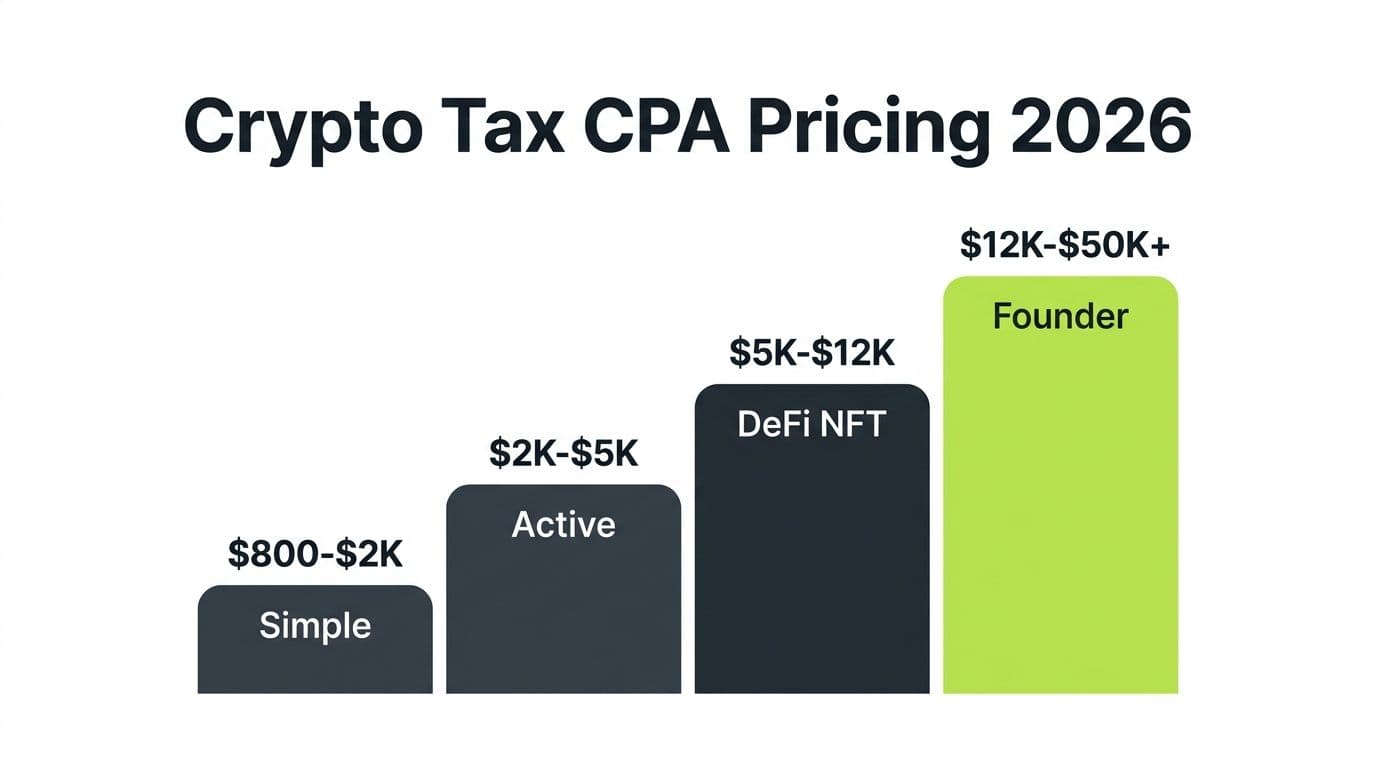
How Much Does a Crypto Tax CPA Cost in 2026? (Real Numbers from a Real CPA)
Real crypto tax CPA pricing for 2026: $800 to $50K+ across four tiers. A working CPA breaks down what you'll pay, what's included, and when the ROI math makes it worth every dollar.
10 Red Flags Your Crypto Tax Preparer Is in Over Their Head (and What to Do About It)
After reviewing 200+ prior-year returns, here are the 10 warning signs your crypto tax preparer is in over their head, the questions to ask, and how to fix it.