IRS Crypto Tax Notices: What to Do If You Get One

By Garrett Taylor, CPA #133092
Reviewed by Leanne Grant, EA #00167954-EA
Key Takeaways
- ✓The IRS now cross-references 1099-DA data from exchanges against your tax return, mismatches trigger automated notices.
- ✓A CP2000 is not an audit. It's a proposed adjustment you can dispute with documentation.
- ✓Letter 6173 is a soft audit request. Ignoring it virtually guarantees a formal examination.
- ✓You have 30 days to respond to most IRS crypto notices. Miss that window and you lose your easiest path to resolution.
- ✓The IRS assumes zero cost basis when exchanges don't report it, meaning your "tax bill" could be wildly inflated.
- ✓Voluntary disclosure is a real option if you have multiple years of unreported crypto income.
- ✓✓ Never ignore a notice hoping it goes away.
“An IRS crypto notice isn't a conviction, it's a question. Answer it correctly, with documentation, and you can resolve most cases without ever stepping foot in an audit room.”
, Reviewed by Leanne Grant, EA
You opened your mailbox and found a letter from the IRS about your cryptocurrency. Your stomach dropped. Now you're Googling "IRS crypto notice" at 11 p.m. trying to figure out if you're about to get audited.
Take a breath. You're not in handcuffs. But you do need to act, and act correctly.
This guide breaks down every type of IRS crypto notice, exactly what triggers them, and the step-by-step response process that keeps a manageable situation from turning into a five-figure penalty. If you're looking for a broader overview of how crypto is taxed, start with our complete crypto tax guide for 2026.
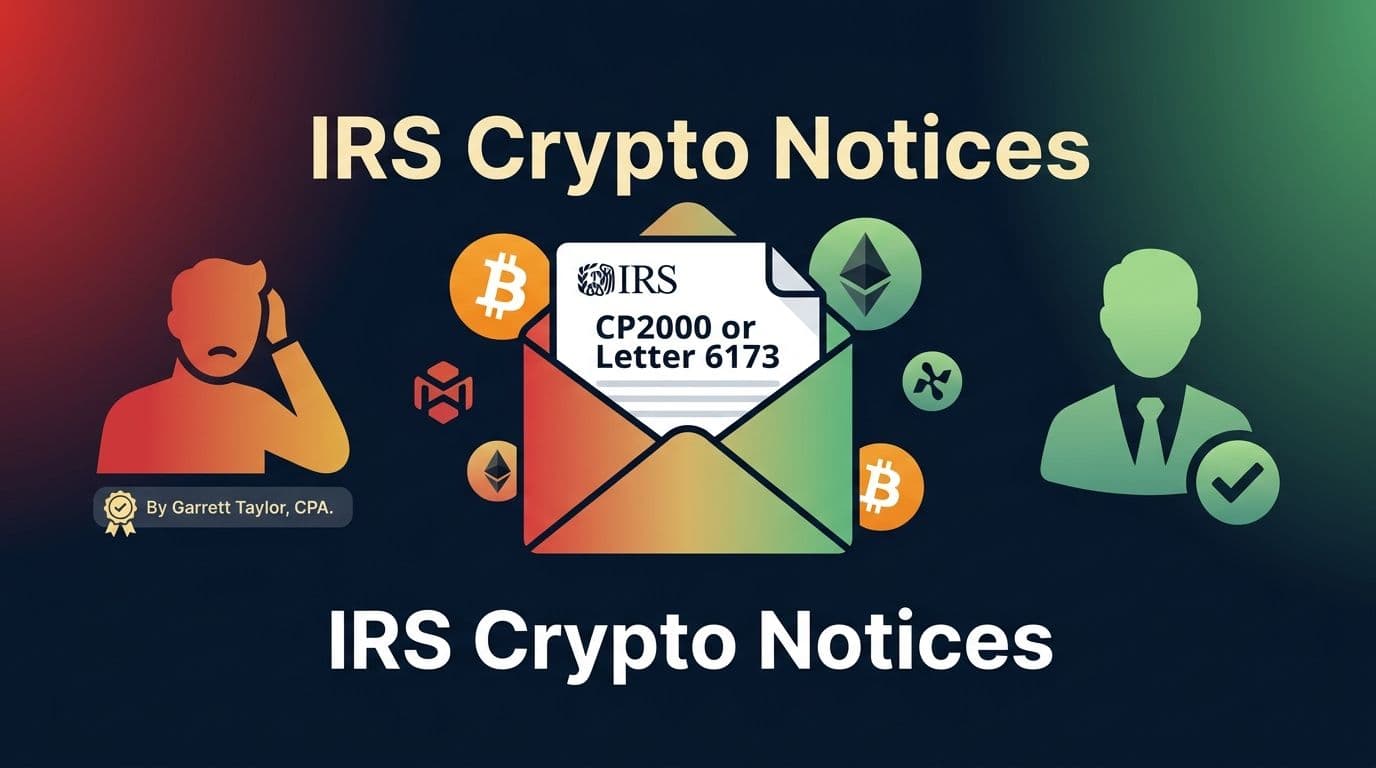
The IRS doesn't send a single generic "crypto letter." There are distinct notice types, each with different severity levels and response requirements. Understanding which one you received is the first step toward resolving it.
| Notice Type | Severity | What It Means | Response Required? | Typical Deadline |
|---|---|---|---|---|
| CP2000 | Medium | Automated mismatch between exchange-reported data and your return | Yes, written response with documentation | 30 days |
| Letter 6173 | High | IRS is requesting specific information; soft audit | Yes, detailed response with records | 30 days |
| Letter 6174 | Low-Medium | Informational; IRS believes you may have unreported crypto | Technically no, but strongly recommended | No formal deadline |
| Letter 6174-A | Medium | Stronger version of 6174; implies IRS has specific data | Yes, you should respond proactively | No formal deadline, but action needed |
Letter 6174: The "We Know" Letter
Letter 6174 is the mildest notice. The IRS is essentially saying: "We have reason to believe you hold cryptocurrency. Make sure you're reporting it correctly." There's no proposed tax change and no formal deadline.
But don't just toss it. If you received Letter 6174, the IRS already has data linking you to crypto transactions, likely from a John Doe summons served on an exchange. Consider it a warning shot.
Letter 6174-A: The Stronger Warning
Letter 6174-A is a step up. It carries the same informational tone but includes language suggesting the IRS has specific transaction data. If your crypto activity isn't properly reflected on your return, this is your cue to review your cost basis calculations and amend if necessary.
Letter 6173: The Soft Audit Letter
This is where things get serious. Letter 6173 is a formal request for information under the IRS compliance campaign for virtual currency. It asks you to respond with transaction records, exchange statements, and sometimes wallet addresses.
Letter 6173 is not optional. Failure to respond will almost certainly escalate your case to a formal examination (audit). The IRS treats non-response as non-cooperation, which changes how they approach your file.
The CP2000 is the most common crypto notice taxpayers receive today. We'll cover it in depth below.
The IRS isn't sending these letters at random. Here's what actually puts your name on the list.
1099-DA Reporting (The Big One)
Starting with the 2025 tax year, centralized exchanges are required to file Form 1099-DA for digital asset transactions. This is the crypto equivalent of a 1099-B for stocks. When the gross proceeds on your 1099-DA don't match what's on your tax return, or when there's a 1099-DA filed and nothing on your return, the IRS computer flags it automatically.
Exchange Data and John Doe Summonses
Even before 1099-DA, the IRS obtained transaction records from major exchanges through John Doe summonses. Coinbase, Kraken, Poloniex, Circle, the IRS has years of data from all of them.
The Crypto Question on Your Tax Return
Since 2019, every individual tax return has asked whether you received, sold, exchanged, or otherwise disposed of digital assets. Answering "No" when exchange records say otherwise is a red flag the IRS actively screens for.
Unusual Filing Patterns
Large deductions against crypto income, claiming losses on lost or stolen crypto without proper documentation, or sudden spikes in income followed by years of non-reporting, these patterns draw attention.
CP2000: The Automated Mismatch Notice
The CP2000 deserves its own section because it's what most people receive, and it's the most misunderstood.
A CP2000 is not an audit. It's a notice saying: "A third party reported income under your Social Security number that doesn't appear on your return. Here's what we think you owe."
The problem with CP2000s regarding crypto is that the IRS typically uses gross proceeds — the total amount you received from selling crypto — without accounting for your cost basis. So if you bought 2 BTC for $80,000 and sold them for $85,000, the IRS might send you a CP2000 saying you have $85,000 in unreported income, when your actual gain was only $5,000.
Pro Tip
The IRS calculates your proposed tax liability using the data they have. If an exchange reported $85,000 in gross proceeds but didn't report your cost basis, the IRS assumes your basis is $0. Your job is to prove otherwise — and you can.
This cost basis gap is the central issue in almost every CP2000 regarding crypto, and it's exactly why understanding how different cost basis methods work matters so much.
Here's the step-by-step process. Follow it exactly.
Step 1: Don't Panic (But Don't Ignore It)
The CP2000 includes a response form and a proposed amount due. You are not required to pay the proposed amount. You have the right to dispute it.
Step 2: Verify the Notice Is Legitimate
Confirm the notice came from the IRS. Check the notice number, verify it against your IRS online account, and look for the CP2000 designation in the upper right corner.
Step 3: Pull Your Transaction Records
Gather the following:
- Exchange transaction history (CSV exports from Coinbase, Kraken, etc.)
- Records of crypto-to-crypto trades during the relevant tax year
- Wallet transfer records showing cost basis carryover
- Purchase receipts, bank statements showing fiat-to-crypto buys
- Any prior tax returns where you reported crypto gains or losses
Step 4: Calculate Your Actual Gain or Loss
Using your records, calculate the correct capital gain or loss for every transaction the IRS flagged. Use the cost basis method you elected (FIFO, LIFO, Spec ID, etc.). If you haven't been consistent with your method, this is where things get complicated, and where a crypto tax CPA earns their fee.
Step 5: Prepare Your Response
Your response should include:
- The CP2000 response form (included with the notice)
- A cover letter explaining the discrepancy
- A complete transaction log showing proceeds, cost basis, and net gain/loss
- Supporting documentation for your cost basis figures
- If applicable, an amended Schedule D and Form 8949
Step 6: Rely to Your Notice
Mail your response to the address on the notice via USPS Certified Mail with return receipt, by fax, or through the IRS document upload too. Keep copies of everything. The IRS does not accept CP2000 responses by email.
Most IRS crypto notices give you 30 days to respond. This is not a suggestion, it's a critical deadline.
If you miss the 30-day window on a CP2000, the IRS will assume you agree with their proposed adjustment and issue a Statutory Notice of Deficiency (also called a "90-day letter"). At that point, your only recourse is Tax Court. Don't let it get there.{
If you need more time, you can request an extension by calling the number on the notice or sending a written request before the deadline. The IRS will typically grant a 30-day extension for CP2000 responses.
For Letter 6173, the stakes are higher. Non-response within the stated deadline moves your case from "correspondence" to "examination", a full audit with an assigned revenue agent.
Don't ignore it. This is the single most common mistake. The IRS does not forget. They escalate.
Don't call the IRS without preparation. Everything you say on a recorded IRS call becomes part of your case file. Do not call to "explain" without having your documentation ready and a clear strategy.
Don't pay the proposed amount without verifying it. The IRS's proposed amount almost always overstates your actual liability because they lack your cost basis. Paying it is volunteering to overpay.
Don't file an amended return as your response. A CP2000 has its own response process. Filing a 1040-X instead of responding to the CP2000 directly creates two parallel processes that can conflict with each other.
Don't assume your exchange records are complete. If you moved crypto between wallets, used DeFi protocols, or had staking income, your exchange CSV may not capture your full picture.
If you have multiple years of unreported crypto income, not just a single mismatch, voluntary disclosure may be the smartest path forward.
The IRS Voluntary Disclosure Practice allows taxpayers to come forward before the IRS contacts them. The benefits are significant:
- Dramatically reduced penalty exposure (penalties for willful non-compliance can reach 75% of the unpaid tax)
- Avoidance of criminal referral in most cases
- A structured process for getting compliant
Voluntary disclosure makes sense when:
- You had substantial unreported crypto gains across 2+ tax years
- You used foreign exchanges that are now sharing data with the IRS
- You received Letter 6174 or 6174-A and know your returns are incomplete
- Your situation involves DeFi income, staking rewards, or other complex crypto income you never reported
Pro Tip
Voluntary disclosure must happen BEFORE the IRS initiates an examination. Once you receive Letter 6173 or a formal audit notice, the voluntary disclosure window has likely closed. Timing is everything.\
Here's what you're looking at if you ignore an IRS crypto notice or fail to respond adequately:
- Accuracy-Related Penalty: 20% of the underpayment attributable to negligence or substantial understatement (IRC Section 6662)
- Failure-to-File Penalty: 5% per month of the unpaid tax, up to 25%
- Failure-to-Pay Penalty: 0.5% per month of the unpaid tax, up to 25%
- Fraud Penalty: 75% of the underpayment if the IRS determines willful intent to evade
- Interest: Compounding daily from the original due date of the return
In extreme cases involving willful tax evasion, the IRS can pursue criminal charges.
Let's walk through a real-world scenario to show why responding correctly matters.
Tom is a software engineer who bought crypto on Coinbase between 2023 and 2025. In 2025, he sold various positions and Coinbase issued a 1099-DA showing $45,000 in gross proceeds.
Tom reported $8,200 in net capital gains on his 2025 return. He used FIFO cost basis and had substantial purchase costs.
The IRS sends a CP2000 notice proposing $45,000 in unreported income, because the 1099-DA from Coinbase reported gross proceeds but the cost basis field was blank (Coinbase didn't have Tom's complete cost basis since he transferred some crypto in from another exchange).
Here's the math:
| IRS Proposed | Tom's Actual | |
|---|---|---|
| Gross Proceeds | $45,000 | $45,000 |
| Cost Basis | $0 (unknown to IRS) | $36,800 |
| Net Capital Gain | $45,000 | $8,200 |
| Federal Tax (24% bracket) | $10,800 | $1,230 (long-term rate) |
| Proposed Penalty (20%) | $2,160 | $0 |
| Total Proposed | $12,960 | $1,230 |
By responding with complete transaction records showing his $36,800 cost basis, Tom reduced his proposed liability from $12,960 to the $1,230 he already paid. The CP2000 was closed with no additional tax due.
If Tom had ignored the notice, he would have owed $12,960 plus interest, over 10x his actual tax liability.
Beyond the "what not to do" list above, here are the technical mistakes that trip people up during the response process:
Using the wrong cost basis method. If you used Specific Identification on your tax return but send FIFO calculations to the IRS, the numbers won't match your filed return. Consistency matters. Learn which cost basis method works best for your situation.
Failing to account for crypto-to-crypto trades. Swapping ETH for SOL is a taxable event. If your response only addresses fiat off-ramps, you're leaving taxable transactions unaccounted for. Our guide on crypto-to-crypto trade taxation explains why.
Reconstructing records from memory. The IRS wants documentation, not estimates. If you've lost exchange records, most platforms allow you to re-download historical data. For defunct exchanges, blockchain explorers can help reconstruct your transaction history.
Submitting incomplete Form 8949. Every disposal should be included on Form 8949. Incomplete reporting is a common reason taxpayers receive IRS notices.
Missing the response deadline and then panicking. If you've already missed the 30-day window, you still have options. But they're more limited and more expensive. Act now, not later.
You can handle a simple CP2000 on your own if:
- You have complete exchange records
- You traded on a single platform
- The discrepancy is clearly a cost basis reporting issue
- You're comfortable preparing Form 8949
You need professional help if:
- You traded across multiple exchanges or used DeFi
- You have unreported crypto income from prior years
- You received Letter 6173 (soft audit)
- You're considering voluntary disclosure
- The proposed amount exceeds $10,000
- You have staking, lending, or yield farming income to account for
At COS Elite, we handle IRS crypto notices for clients across the country, including resolving CP2000 notices, responding to Letter 6173 inquiries, and guiding clients through voluntary disclosure matters.
Got an IRS Crypto Notice?
Don't panic, but don't ignore it either. Book a consultation and we'll review your notice, calculate your actual liability, and prepare a complete response before your deadline.
Talk to GarrettFree 15 minute call. No commitment.
Frequently Asked Questions
Is a CP2000 notice the same as an audit?
No. A CP2000 is an automated proposed adjustment based on a data mismatch. It is handled through the IRS's Automated Underreporter (AUR) unit, not the Examination division. You can resolve it by mail without ever meeting with an IRS agent.
How long do I have to respond to an IRS crypto notice?
CP2000 notices and Letter 6173 typically give you 30 days. You can request one extension (usually 30 additional days) by contacting the IRS before the original deadline expires.
Can I just pay the CP2000 amount to make it go away?
You can, but you probably shouldn't. The IRS's proposed amount almost always overstates your actual liability because they lack your cost basis data. Paying without disputing means you're voluntarily overpaying.
What if I already threw away the notice?
Log into your IRS online account at irs.gov to view your notices. You can also call the number on any IRS correspondence you've received previously, or contact the IRS directly at 1-800-829-1040 to request a copy.
Will responding to a CP2000 trigger an audit?
In most cases, no. The CP2000 process is separate from the audit process. However, if your response reveals significant discrepancies or raises new issues, the IRS may refer your case for examination.
What if I used a foreign exchange that didn't issue a 1099-DA?
You're still required to report the income. The absence of a 1099-DA doesn't eliminate your reporting obligation. If the IRS obtained data from that exchange via treaty or summons, the mismatch will be worse because they'll have gross proceeds data and you'll have nothing on your return.
Do I need a lawyer or a CPA for a CP2000 response?
For a straightforward CP2000 involving a single exchange, a crypto-specialized CPA is usually sufficient and more cost-effective. If you're facing potential fraud allegations, criminal referral risk, or voluntary disclosure, involve a tax attorney as well.
What is Form 1099-DA and when did it start?
Form 1099-DA is the Digital Asset reporting form that centralized exchanges began issuing for the 2025 tax year. It reports gross proceeds from digital asset sales.
My CP2000 includes crypto I transferred between my own wallets. Do I owe tax on that?
No. Transferring crypto between wallets you own is not a taxable event. However, exchanges sometimes report outgoing transfers as dispositions. You'll need to document that the "sale" was actually a wallet transfer, blockchain records showing the same owner on both ends can help.
What if I genuinely forgot to report crypto income?
File an amended return for the relevant tax year and pay any additional tax owed. If you do this before the IRS contacts you, you may qualify for penalty abatement. If you've already received a notice, respond through the notice process rather than filing a standalone amendment.

About the author
Garrett Taylor, CPA
Former Big Four CPA. CPA #133092. Garrett answers his phone. Led by expertise. Powered by precision.
Related Articles

The Ultimate Guide to Crypto Tax (2026 Edition)
The most comprehensive crypto tax guide online, written by a CPA who files 500+ crypto returns a year. Every taxable event, form, strategy, and 2026 update.
Crypto Cost Basis Methods: FIFO vs Specific ID vs HIFO
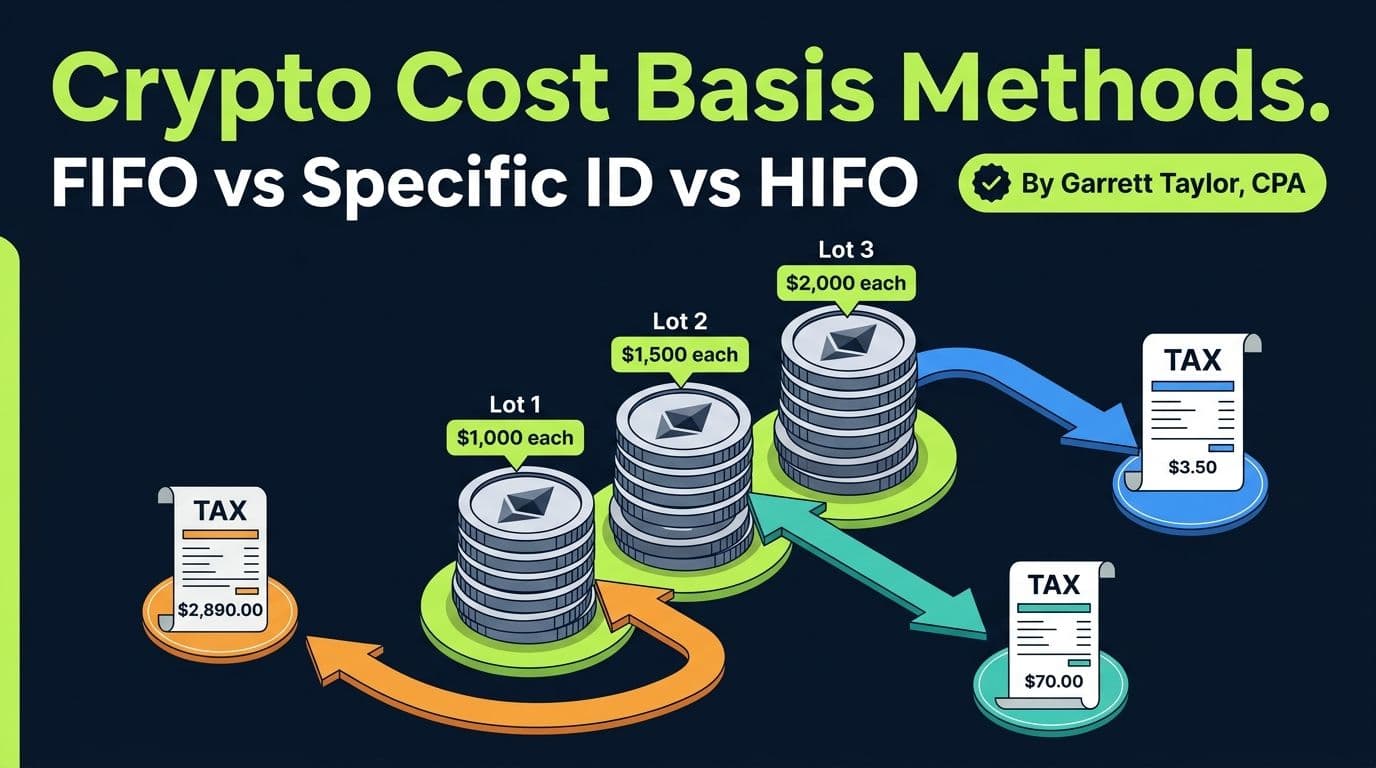
Compare FIFO, LIFO, HIFO, and Specific ID for crypto taxes. Worked example shows how the same sale produces 4 different tax bills. Updated for Rev. Proc. 2024-28, Notice 2026-20, and 1099-DA.

Lost or Stolen Crypto: Tax Treatment (2026)
Can you deduct lost or stolen crypto on your taxes? CPA guide covering TCJA suspension, Ponzi safe harbor, FTX/Celsius/Voyager losses, rug pulls, and abandonment losses for 2026.