The Top 3 Reasons You Are Overpaying Your Crypto Taxes

By Garrett Taylor, CPA #133092
Reviewed by Leanne Grant, EA #00167954-EA
Key Takeaways
- ✓FIFO is the IRS default — it almost always maximizes your tax bill. Specific Identification can legally reduce your gain to zero on the same sale.
- ✓The new 1099-DA reports proceeds but not cost basis for most legacy holdings. If you leave basis blank, the IRS can tax 100% of proceeds.
- ✓Unrealized losses are not tax assets until you sell. Tax-loss harvesting turns down markets into real deductions — but only if your data is clean.
Most crypto investors do not have a tax problem. They have a data problem. Wallets, exchanges, transfers between them, swaps, staking rewards, airdrops, NFT trades — every action generates a record, and most of those records sit in places your CPA never looks. The result is the same story every April: you write a check that is bigger than the law actually requires.
This guide collapses three of the most expensive mistakes we see at COS Elite, then shows you how to spot them in your own returns and what they look like when stacked together. Every example uses real IRS guidance, real reporting forms, and the math that actually moves dollars. For the broader landscape, our comprehensive crypto tax guide covers every taxable event the IRS recognizes.
Key Takeaways
- ✓FIFO is the IRS default after 12/31/2025 — it almost always picks the highest-gain lot in a bull market. Specific ID, elected in writing, is the fix.
- ✓Form 1099-DA reports gross proceeds from 2025 onward and basis from 2026 onward — but only for assets bought and held entirely on one platform. Off-platform transfers create blank or wrong basis.
- ✓Tax-loss harvesting is fully legal for crypto in 2026. Section 1091's wash-sale rule does NOT yet apply to digital assets — that loophole has not been closed by Congress.
- ✓Stacked together, these three mistakes can result in 30-60% overpayment of true tax owed. We've recovered $41K+ on a single amended return.
- ✓You can self-audit any prior return in a weekend. Beyond $500K of activity or multi-year messes, the math favors specialized help.
Reason 1: You Let FIFO Pick Your Lots
When you sell crypto, you do not pay tax on the sale amount. You pay tax on the gain — proceeds minus your cost basis. Cost basis means what you paid for the specific units you sold, including fees. Get the basis wrong, get the tax wrong.
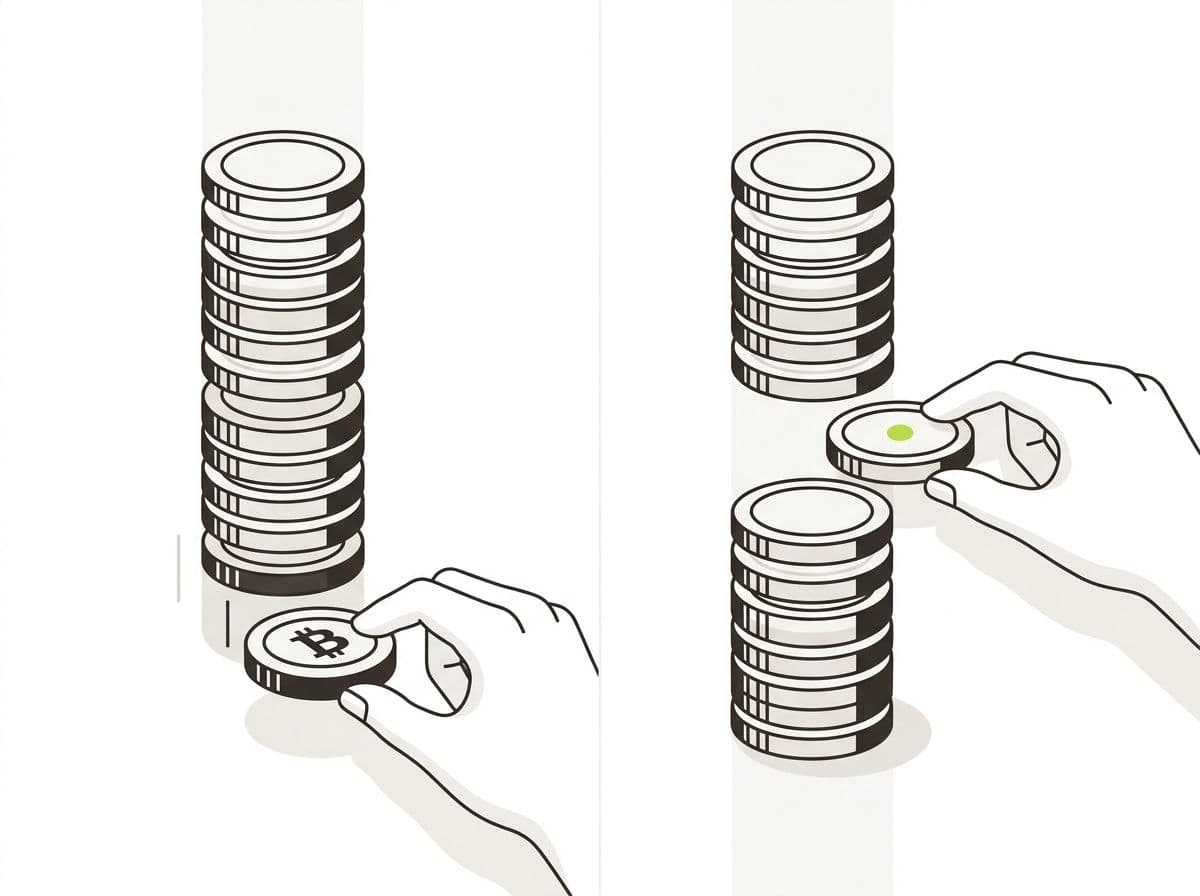
For sales after Dec 31, 2025, the IRS rule is plain: if you do not specify the units you are selling at the time of disposition, the IRS defaults you to First In, First Out (FIFO). FIFO means the oldest lot you own gets sold first. In a market that has gone up over time — which crypto has — FIFO almost always sells your lowest-basis lot first, which means the largest taxable gain.
The Treasury made this default explicit in the final 1099-DA regulations under TD 10000 and clarified the per-wallet treatment in Rev. Proc. 2024-28. The combination matters: starting with sales in 2026, your method election is tracked at the wallet level, not the account level. If you have ETH spread across MetaMask, Coinbase, and a hardware wallet, each location is treated as its own pool with its own ordering.
A Worked Example: When FIFO Costs You $814
Sarah bought 3 ETH in three separate transactions:
- January 2022: 1 ETH at $1,200 (cycle low)
- November 2023: 1 ETH at $1,800
- March 2025: 1 ETH at $3,400 (recent high-basis buy)
In December 2026, she sells 1 ETH for $4,500. She does nothing — no method election, no specific identification — so FIFO kicks in and the January 2022 lot gets sold first.
FIFO vs Specific ID — Sarah's December 2026 Sale
| Method | Lot Sold | Cost Basis | Gain | Federal Tax (37%) |
|---|---|---|---|---|
| FIFO (default) | Jan 2022 lot | $1,200 | $3,300 | $1,221 |
| Specific ID — sell March 2025 lot | March 2025 lot | $3,400 | $1,100 | $407 |
| Difference | — | — | **$2,200 less gain** | **$814 saved** |
Run that across 50 disposals in a year and the gap between deliberate lot selection and FIFO autopilot becomes life-changing money. We have seen clients overpay $20,000 in a single year because nobody asked which lot to sell.
How to Qualify for Specific ID in 2026
Specific ID is not a checkbox. It is a documented identification of which units you are selling, set at the time of the sale, with records that survive an audit. The IRS lays out the requirements in Reg. 1.1012-1(c) for securities; the crypto-specific application appears in Notice 2014-21 and is reinforced by Rev. Proc. 2024-28.
To use Specific ID for a crypto disposition, you need:
- A unique identifier for the lot — date of acquisition, cost basis, and original transaction hash or order ID.
- A clear election — usually made through your exchange's tax-lot tool or recorded in your tax-software account at the moment of the sale.
- Consistent records — the chosen lot has to be the one actually removed from your inventory in your books. You cannot change the answer in April.
Major exchanges handle this differently. Coinbase Advanced lets you set a global default (FIFO, HIFO, LIFO) per asset and override per trade. Kraken offers an account-wide method election. Most decentralized swaps record nothing — the on-chain transaction is your only proof, which is why a clean DeFi tax tool that ingests every wallet matters. For a complete walkthrough of cost-basis methods and when each one wins, see our crypto cost basis methods guide.
Pro Tip
Make your method election in writing, dated, before your first disposal of the year. Tax preparers love a one-paragraph memo that says "I elect Specific Identification for the calendar year, identifying lots by transaction hash." That memo lives in your tax file.
$8,400+
Average over-tax we recover when reviewing prior-year returns where FIFO was applied without consideration
Cost Basis Methods Compared
| Method | When It Wins | When It Loses | IRS Default? |
|---|---|---|---|
| FIFO | Bear markets, holding periods aim for long-term | Bull markets where oldest lots have lowest basis | Yes (after 12/31/2025) |
| HIFO | Bull markets where you want to minimize current-year gain | When you want to lock in long-term capital gains rate | No — must elect Specific ID |
| Specific ID | Almost always — it is the strategic choice | When records are incomplete or the election is not made in time | No |
| LIFO | Volatile, short-term trading | Long-term holding strategies | No |
“FIFO is the tax method for people who think about lot selection on April 14. By then, the choice has already been made for you.”
, Garrett Taylor, CPA #133092
Reason 2: Your 1099-DA Is Missing Your Cost Basis
IRS final regulations under Treasury Decision 10000 phase reporting in over time. Brokers (centralized exchanges) must report gross proceeds on the new Form 1099-DA for transactions starting January 1, 2025. They must report cost basis starting January 1, 2026, but only for assets purchased and held entirely within that broker's platform.
That last clause is the trap. The vast majority of crypto investors move assets between platforms. You buy ETH on Coinbase, send it to MetaMask to ape into a memecoin, swap on Uniswap, bridge to Arbitrum, stake somewhere else. By the time anything gets sold on a centralized exchange and triggers a 1099-DA, the broker has zero idea what the original cost basis was.
Result: the 1099-DA reports the gross proceeds — say $50,000 from a sale — and leaves the basis field blank or shows $0. The IRS receives a copy. Their matching system flags any return where the reported gain differs significantly from what they expect from the 1099-DA. If you do not document your true basis on Form 8949, the IRS computer assumes basis is $0 and treats the entire $50,000 as taxable gain.
Why Your CPA Will Not Catch This
This is not a CPA failure. It is a specialization gap. Traditional CPAs file against the summaries the broker provides because that is how stocks have always worked — your Charles Schwab 1099-B has accurate basis, period. Crypto breaks that assumption, but most general practitioners do not realize how badly it is broken until the CP2000 notice arrives.
We see three flavors of this problem in practice:
- The blank-basis 1099-DA — broker reports $50K proceeds, basis field empty. CPA enters $0 basis on Form 8949 because the form asks for what was reported. IRS taxes the whole $50K.
- The wrong-basis 1099-DA — broker reports basis equal to whatever value showed up in the wallet on the day it arrived from elsewhere. That value is meaningless because it does not reflect the original purchase price.
- The duplicate-reporting 1099-DA — assets that moved between two of your own wallets get reported as a transfer-in by the receiving exchange, and the basis reset there does not match the basis on the sending side.
Real Example: A $43,000 Phantom Gain
A new client came to us in 2027 after receiving a CP2000 notice claiming $43,000 of unreported gain. The story:
- He bought 0.8 BTC on Kraken in 2021 for $42,000.
- Sent it to a hardware wallet for two years.
- Sent it back to Coinbase in 2026, sold it for $50,000.
Coinbase issued a 1099-DA reporting $50,000 in gross proceeds with no cost basis (because the BTC arrived from outside their platform). The IRS computer matched the form, saw no offsetting basis on his Form 8949, and assumed the entire $50,000 was a gain. They sent him a CP2000 proposing $43,000 in additional tax plus penalties and interest.
The truth: his actual gain was $8,000 ($50K − $42K original Kraken basis), and the federal tax owed was about $1,200 long-term, not $43,000. We responded with the original Kraken transaction history and the on-chain transfer records. Notice resolved with no tax owed beyond what he had already paid.
The cost of getting it wrong is not just the overpayment — it is the audit, the months of stress, and the documentation scramble. Every time. For a deeper look at how to handle these notices when they arrive, see our IRS crypto tax notice response guide.
78%
Estimated share of 1099-DA forms that will arrive with incorrect or missing cost-basis information for tax year 2026 — based on industry analysis of off-platform transfer rates
Pro Tip
When you receive a 1099-DA, do **not** simply copy what the form says onto your Form 8949. Compare the broker's basis figure (or absence of one) to your own records — your transaction history from the original purchase exchange, screenshots, transfer hashes. Use the **Box B** or **Box E** classification on Form 8949 to indicate basis was not reported by the broker, then enter the correct basis yourself.
1099-DA Scenarios and How to Respond
| Scenario | Broker Reports | Your Form 8949 Entry | Audit Risk |
|---|---|---|---|
| Bought + sold on same exchange | Accurate basis | Match what was reported (Box A/D) | Low |
| Bought elsewhere, sold on broker | $0 or blank basis | Box B/E with your records | Medium — keep proof |
| Bought on broker, transferred out, sold on same broker after transfer back | Basis may be reset | Box B/E with original records | Medium — document carefully |
| DeFi or DEX disposition | No 1099-DA at all | Self-report all activity | High — most missed area |
“The 1099-DA is the most dangerous tax form crypto investors will receive in 2027. It looks authoritative because it is — but only for what the broker can see, which is a fraction of your true cost basis.”
, Reviewed by Leanne Grant, EA
Not sure if your cost basis is correct?
A 30-minute consultation with Garrett can tell you in plain English whether your last return left money on the table.
Book your 30-min consultFree 15 minute call. No commitment.
Reason 3: You Never Harvested Your Losses
Tax-loss harvesting means selling crypto that is down (at a loss) so the loss becomes a real, usable tax deduction. In a regular taxable account, IRS Section 1091 prevents this for stocks via the wash-sale rule — you cannot buy back the same security within 30 days. As of 2026, that rule does not apply to crypto. The IRS treats crypto as property, not a security, which means you can sell BTC at a $20,000 loss this morning and buy BTC back this afternoon. The loss counts. The position is preserved.
Congress has tried to close this gap multiple times — the Build Back Better Act in 2021 included an extension of Section 1091 to digital assets, but that provision did not survive the final bill. As of writing, no enacted law extends wash-sale to crypto. That window of opportunity is real, and it could close. Lock in losses while it lasts. For a complete breakdown of where the rule stands, see our crypto wash sale rules guide.
Three Ways Losses Save You Money
- Offset gains: Realized losses cancel realized gains, dollar for dollar. The biggest single win. If you have $30K of crypto gains and $10K of crypto losses, you owe tax on $20K, not $30K.
- Deduct income: Net excess losses deduct up to $3,000 against ordinary income each year. That is $3,000 less of W-2 or self-employment income subject to your top marginal rate.
- Carry forward: Unused losses follow you into future years — useful when a big gain finally lands. Capital loss carryforwards have no expiration and survive indefinitely.
A client who realized $50K of crypto losses in a 2022 bear market was able to absorb $50K of gains in 2024 without owing a dollar of capital gains tax on those gains. That is $7,500 to $18,500 saved in a single year, depending on bracket and holding period.
When NOT to Harvest
Loss harvesting is a tool, not a mandate. Cases where you should pause:
- Tiny losses with high gas fees. A $200 loss on Ethereum mainnet that costs $80 in gas to realize is not worth $20 of tax saving. Do the math.
- Tokens with thin liquidity. Selling a low-cap token at a loss can move the price against you and lock in a worse exit than the loss saves. If slippage exceeds the tax benefit, do not.
- Losses you cannot redeploy. The point is to preserve your position. If you cannot or will not buy back, you are just exiting — that is fine, but call it that.
- Year-end timing crunch. Markets move. Trying to harvest in the last 48 hours of December often means worse fills, missed transactions, and rushed records.
Pro Tip
Set a quarterly harvest review on your calendar. The first week of April, July, October, and the first half of December. Review every position that is below your basis and decide consciously whether to realize. Decisions made in March about December prices are usually wrong.
$3,000
Annual ordinary-income deduction limit for net capital losses — every year a portfolio sits on un-harvested losses is a year of free deductions left on the table
“The biggest harvesting mistake is not failure to harvest. It is harvesting in December, when liquidity is thin and emotions are high.”
, Garrett Taylor, CPA #133092
What Overpayment Actually Looks Like: A Composite Case Study
To make the math concrete, here is what these three mistakes look like stacked together. This is a composite drawn from real client engagements, with names and figures changed.
The client: Mike, a software engineer with three years of active crypto trading and a moderately complex setup — Coinbase, Kraken, MetaMask, a Ledger hardware wallet, and a small DeFi position on Arbitrum.
The 2025 return as filed by his prior CPA:
Mike's 2025 Return — As Filed vs Reality
| Item | As Filed | What Actually Happened |
|---|---|---|
| Reported crypto gains | $187,000 | True gain ~$94,000 |
| Method used | FIFO (default — never elected) | Specific ID would have selected higher-basis lots |
| 1099-DA basis errors | None caught | $32,000 of phantom gain from off-platform transfers |
| Losses harvested | $0 | $14,000 of available losses ignored |
| Federal tax paid | ~$69,000 | True tax owed ~$28,000 |
| **Overpayment** | — | **~$41,000** |
We filed an amended return (Form 1040-X) covering tax year 2025, recovered most of the overpayment, and put a method-election memo and quarterly harvest schedule in place for 2026. The total cost of our engagement was a fraction of the recovery.
This is not unusual. The pattern is:
- Multiple platforms → off-platform transfers → broken basis trail.
- No method election → FIFO autopilot → highest gain selected.
- No harvest discipline → losses sitting unrealized while gains are taxed at full rate.
Stack all three and the overpayment is rarely small.
How to Audit Your Own Return for Overpayment
You can do this yourself. It will take a weekend. You need: your last filed tax return, every 1099-B and 1099-DA you received, and read access to every wallet and exchange you used in the tax year.
Step 1: Pull every transaction record.
For each exchange, export the full transaction history (CSV, JSON, or API). For each self-custody wallet, export every send, receive, swap, and contract interaction — Etherscan, Solscan, BscScan, etc. all support address-level CSV exports. The output should be one master spreadsheet of every taxable event in chronological order.
Step 2: Reconcile each disposition to a specific cost basis.
For every sale or swap, identify which lot was disposed of and what it cost. If the disposal was on a broker that provided a 1099-DA, compare the broker's basis figure to your own records. If they differ, the discrepancy is your audit signal.
Step 3: Recompute gain or loss using Specific ID.
For each disposition, ask: would another lot have produced a smaller gain (or a larger loss)? If yes, the 1099-DA almost certainly used FIFO and the difference is your overpayment.
Step 4: List every unrealized loss as of December 31.
Any position below cost basis on the last day of the tax year was a harvest opportunity you missed. Total it up. That is your second overpayment estimate — losses that could have offset gains but did not.
Step 5: Sum the math.
(Overpaid gain × your marginal rate) + (Missed losses × your marginal rate) = your overpayment estimate. If the number is meaningful — generally above $5,000 for the engagement to make sense — file Form 1040-X to amend and recover. The IRS allows amendments within three years of the original filing date or two years from when the tax was paid, whichever is later. See IRS Topic No. 308.
When Self-Audit Becomes Self-Sabotage
The DIY audit works for clean situations. It breaks down at scale or in complexity. Bring a specialist in when:
- You have over $500K of crypto activity in any single tax year. The probability of a costly mistake — yours or the prior preparer's — exceeds the cost of professional review.
- You have multi-year tax messes (2-3 years of unfiled or wrongly-filed returns). Compounding errors and statute-of-limitations risks make this an expert problem.
- You have already received a CP2000 or Letter 6173/6174. Responding to the IRS without a CPA or EA representing you is risky. The IRS is not adversarial, but the system penalizes confusion.
- You used foreign exchanges (Binance international, KuCoin, Bitfinex). Form 8938 and FBAR reporting kick in over certain thresholds, and the penalties for missed reporting are severe.
- You operated as a business — mining, staking-as-a-service, NFT creation at volume — and need to consider Schedule C, self-employment tax, or entity structuring.
For most COS Elite clients, the breakeven point is around $50K-$100K of annual crypto activity. Below that, a careful self-audit and a good consumer tax tool is enough. Above that, the math overwhelmingly favors specialized help. Our digital asset reconciliation service is built for the messy multi-platform cases.
Your 2026 Action Plan
Stop overpaying. Start owning your basis. A 4-step engagement that gets your data clean, your method elected, and your losses captured — every year, before April:
- Book a Call — Free 30-minute consultation with Garrett. Walk through your wallets, exchanges, and goals.
- Custom Strategy — We build a personalized plan: lot method election in writing, a quarterly harvesting calendar, and entity moves if your activity warrants it.
- Execution — COS Elite handles digital asset reconciliation, federal and state filings, entity setup, and IRS communications end-to-end.
- Ongoing Support — Year-round advisory so you never miss a deadline, an opportunity, or a notice.
Bottom Line
Most overpayments do not happen at filing. They happen six months earlier, in your wallets — when nobody documented which lot was sold, nobody flagged the missing basis on the 1099-DA, and nobody harvested the losses sitting in front of you. By April, the choices have already been made. The CPA just enters them.
The fix is not magic. It is the boring work of clean data, deliberate method elections, and a calendar that says "harvest review" four times a year. Bring your wallets, exchanges, and questions. We will tell you — directly, in plain English — whether your prior return left money on the table, and what to change for the next one.
Ready to stop overpaying?
Book a free 30-minute consultation. We'll review your last return and show you what we'd change.
Talk to GarrettFree 15 minute call. No commitment.
Frequently Asked Questions
Can I switch from FIFO to Specific ID after I have already filed?
Not for the year already filed — you need to amend. For future years, yes. The election is made at the time of each sale, so as long as you elect Specific ID before your first disposal of the new tax year and document each lot identification, you are good. We recommend a written method-election memo dated before January 1.
What if my 1099-DA shows the wrong cost basis — am I stuck with what they reported?
No. Form 8949 is where the truth gets reported. Use Box B (short-term) or Box E (long-term) to indicate basis was not reported by the broker, then enter your correct basis from your own records. Keep proof — original purchase confirmation, on-chain transfer hashes, exchange API exports — in case the IRS asks.
Does the wash-sale rule really not apply to crypto?
As of 2026, no. Section 1091 of the Internal Revenue Code applies to securities, and the IRS classifies cryptocurrency as property, not a security. Congress has proposed extending wash-sale to crypto multiple times (notably in the 2021 Build Back Better Act), but no extension has been enacted. That said, the law could change with any new legislation, so keep an eye on the broader regulatory direction.
How far back can I amend a return to recover overpayment?
Generally three years from the original filing deadline, or two years from when the tax was paid, whichever is later. So a return filed on April 15, 2025 can be amended through April 15, 2028. After that, the refund window closes permanently — even if the IRS owes you money.
I got a CP2000 about crypto. Should I just pay it?
Almost never. CP2000 notices are computer-generated and frequently wrong, especially for crypto where they assume $0 basis on transferred-in assets. Respond by the deadline (usually 30 days) with documentation of your actual basis. If the math still favors you, the notice gets dismissed. Do not ignore — but do not pay without verifying.
What is the cheapest way to track my cost basis going forward?
Connect every exchange and wallet to a specialized crypto tax platform (Koinly, CoinTracker, CoinLedger, etc.) at the start of the year, not the end. Real-time syncing prevents the off-platform-transfer basis-loss problem at its source. The annual subscription is small relative to the tax savings from accurate basis.
Can my regular CPA handle a complex crypto return?
Sometimes — depends on the complexity and the CPA. The signal that they cannot is when they ask you to give them a single summary number of your gains. A crypto-literate preparer asks for every wallet, every exchange, every transaction file, and runs reconciliation independently. If your CPA is not asking those questions, they are filing whatever the broker reported, and that is exactly how overpayments happen.

About the author
Garrett Taylor, CPA
Former Big Four CPA. CPA #133092. Garrett answers his phone. Led by expertise. Powered by precision.