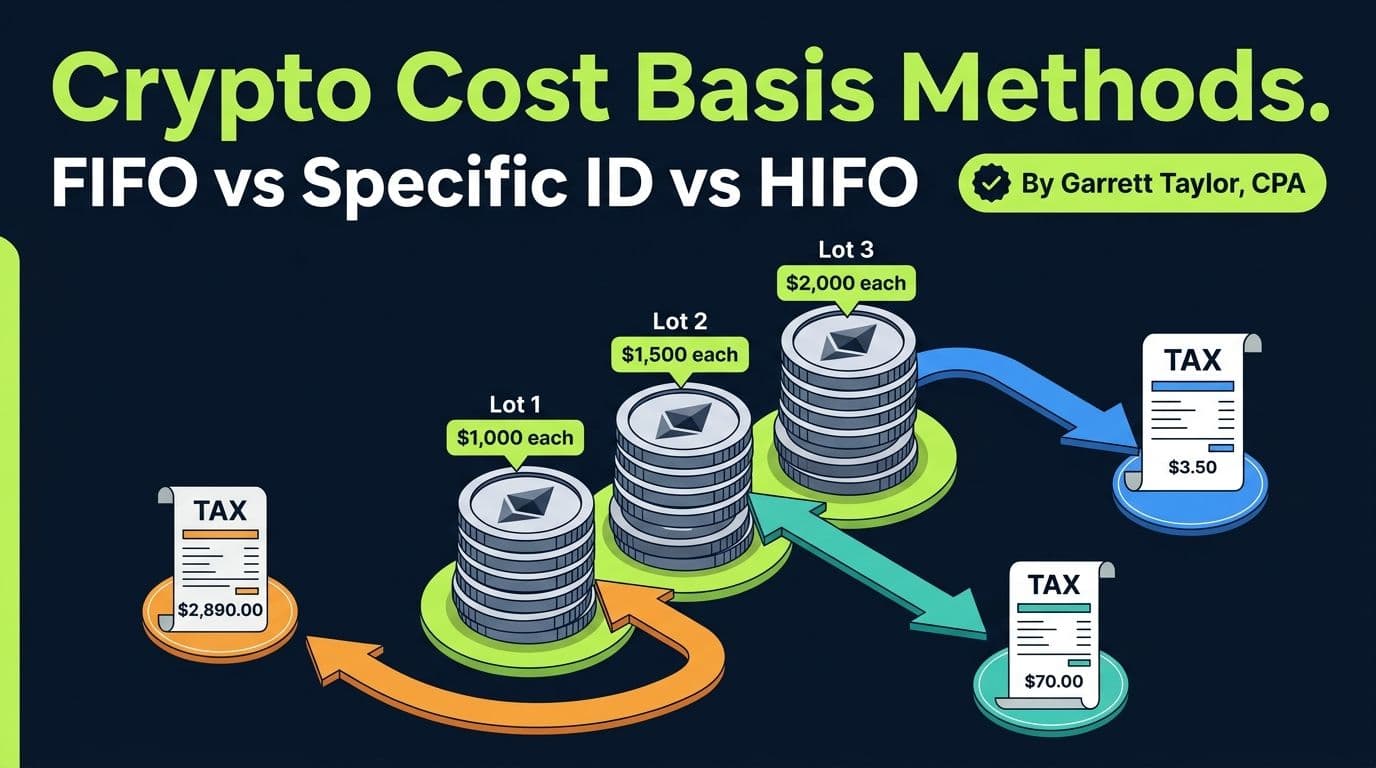
If you've bought, sold, traded, or earned crypto on Coinbase, understanding how Coinbase taxes work is part of staying compliant with the IRS. Many U.S. investors assume the exchange handles everything, or that they only owe tax when they cash out to a bank account. Neither is quite right. This guide walks through what's actually taxable, what forms Coinbase issues, and where the gaps usually show up.
A common misconception is that crypto only becomes taxable once you withdraw dollars to your checking account. In reality, the IRS treats cryptocurrency as property, so a taxable event can happen entirely inside Coinbase, before any cash ever reaches your bank. Another misconception is that the tax report Coinbase generates is the full picture. It often isn't, especially once you've moved coins between wallets or used more than one platform.
Do You Have to Pay Taxes on Coinbase Transactions?
Coinbase is a cryptocurrency exchange where you can buy, sell, trade, and earn digital assets. The exchange itself doesn't create your tax bill. Your activity on it does. The key principle: taxes generally apply to transactions, not to simply holding an asset.
Buying Bitcoin and letting it sit in your account isn't a taxable event, even if the price triples. The tax consequences usually show up when you do something with that crypto, like selling it, swapping it for another coin, spending it, or receiving it as a reward.
Here's a quick overview before we go deeper:
Usually Taxable
- Selling crypto for dollars
- Trading one coin for another
- Spending crypto on goods
- Earning staking or rewards income
Generally Not Taxable
- Buying crypto with cash
- Holding crypto you already own
- Transferring between your own wallets
- Moving funds to self-custody
How Coinbase Taxes Work in the United States

The IRS treats cryptocurrency as property rather than currency. That single classification drives almost everything about how Coinbase taxes work. When you dispose of property, you generally calculate a gain or loss, and that result flows onto your tax return.
There are two broad ways crypto activity gets taxed:
Capital gains. When you sell, trade, or spend crypto, you compare what you received against your cost basis (what you originally paid, including fees). The difference is a capital gain or loss. Hold the asset more than a year and any gain is generally taxed at long-term rates, which are typically lower. Hold it a year or less and short-term rates, equal to ordinary income rates, usually apply.
Ordinary income. When you receive crypto as a reward, payment, or staking yield, the fair market value at the time you received it is often reported as ordinary income. That same value then becomes your cost basis if you later sell.
Transaction type matters because the same coin can be taxed differently depending on how it entered and left your account. A practical example:
Example: You buy 1 ETH for $2,000 on Coinbase. Eight months later you trade it for SOL when the ETH is worth $2,600. Even though no dollars hit your bank, you realized a $600 short-term capital gain on the trade. Your new SOL position carries a $2,600 cost basis going forward.
Taxable Events on Coinbase

These are the activities on Coinbase that may create a taxable event. The exact treatment depends on your situation, but here's why each one tends to matter.
- Selling cryptocurrency: Converting crypto to USD is a disposal. You realize a capital gain or loss based on the difference between sale price and cost basis.
- Trading one cryptocurrency for another: Swapping BTC for ETH counts as selling the first coin, even with no cash involved. It can create a taxable gain or loss.
- Spending cryptocurrency: Using crypto to pay for goods or services is treated as a disposal at the coin's value that day, which can produce a gain or loss.
- Receiving crypto rewards: Promotional rewards or referral bonuses are generally treated as ordinary income at their value when received.
- Staking income: Staking rewards are often reported as income at fair market value on the date you gain control of them.
- Coinbase Earn rewards: Crypto received for completing lessons or tasks is typically treated as ordinary income.
- Airdrops and promotions: Tokens received through an airdrop can create taxable income, generally measured by their value when they land in your account.
Non-Taxable Coinbase Activities

Not everything you do on Coinbase triggers a tax bill. The following activities generally don't create a taxable event on their own:
- Buying crypto with cash: Purchasing Bitcoin or another asset with USD isn't taxable. It just establishes your cost basis.
- Holding cryptocurrency: Unrealized gains aren't taxed. You can watch a position rise or fall without owing anything until you dispose of it.
- Transferring crypto between wallets you own: Moving the same coins between your own accounts isn't a sale, so no gain or loss is realized.
- Moving funds between Coinbase and self-custody: Sending crypto to your own hardware or software wallet is a transfer, not a disposal.
Even though these aren't taxable, recordkeeping still matters. When you later sell coins that arrived from another wallet, you need their original cost basis to calculate the gain. Transfers in and out are exactly where cost basis tends to break, which leads to over-reported or under-reported gains if the history isn't tracked carefully.
What Tax Forms Does Coinbase Issue?

Your Coinbase tax form situation depends on your activity and the tax year. Coinbase provides a tax center inside your account where you can view and download the documents available to you, along with a gain/loss report you can use as a starting point.
The most relevant Coinbase tax documents are 1099 forms:
- Form 1099-MISC. A Coinbase 1099-MISC is typically issued to U.S. users who earned a certain threshold of rewards income, such as staking or Coinbase Earn, during the year. It reports that income to you and the IRS.
- Form 1099-DA. A newer digital asset reporting form is being phased in for exchanges, designed to report proceeds (and eventually cost basis) from sales and dispositions. Expect to see more standardized Coinbase 1099 reporting as these rules take effect.
One point worth emphasizing: not receiving a Coinbase tax form does not eliminate your reporting requirements. Whether or not a 1099 arrives, you're still responsible for reporting taxable transactions on your return. A 1099 is a notice, not a permission slip, and its absence doesn't make a gain disappear.
Does Coinbase Report to the IRS?
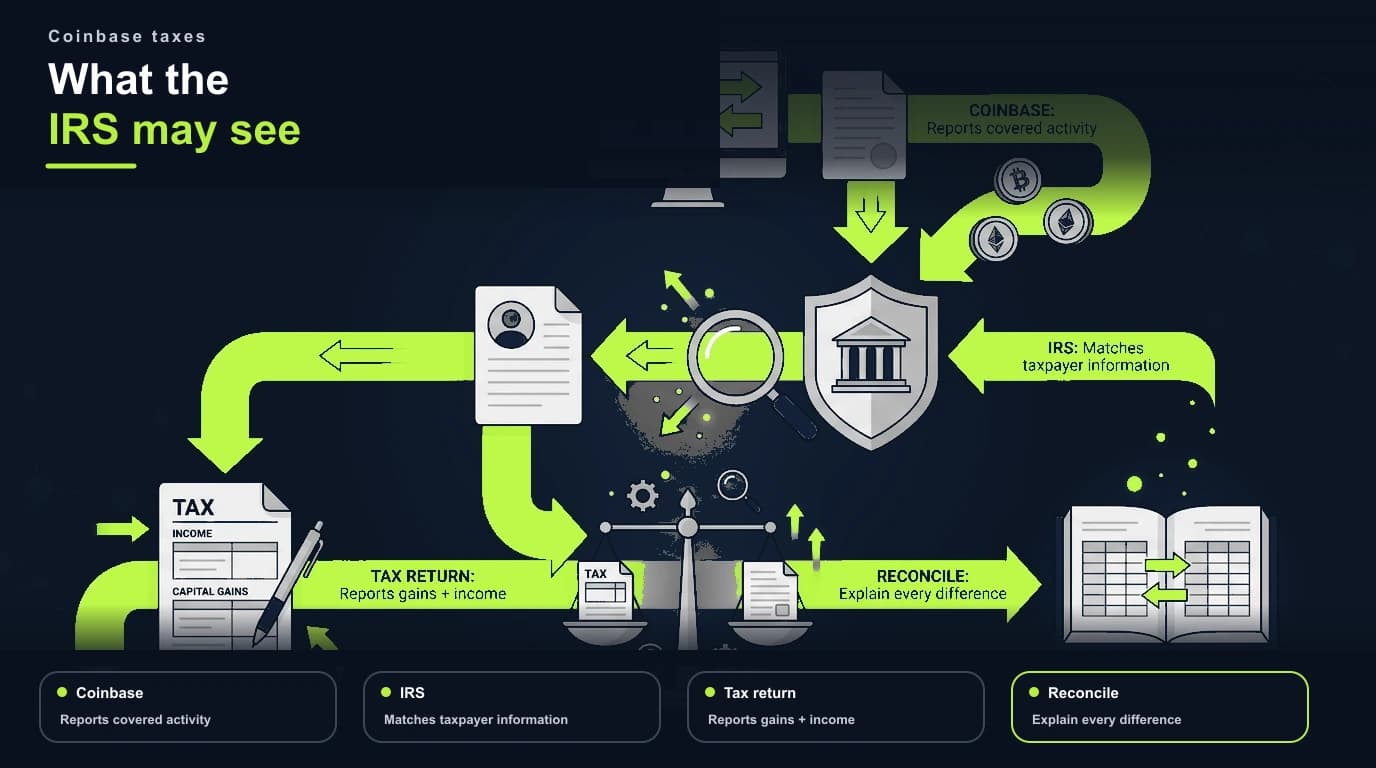
Yes. The question "does Coinbase report to the IRS" comes up constantly, and the short answer is that Coinbase does share certain information with the IRS, primarily through 1099 forms when reporting thresholds are met. When a 1099 is issued to you, a copy generally goes to the IRS as well.
Digital asset reporting rules are expanding, and exchanges are moving toward more detailed reporting of customer transactions over time. The practical takeaway for any U.S. investor is simple: assume your taxable activity can be matched and reviewed, and report it accurately.
When the numbers on your return line up with what the exchange reports, you reduce the chance of a mismatch notice. Accurate reporting is the cleanest path, and it's the standard a CPA holds your return to anyway.
Understanding Cost Basis on Coinbase

Cost basis is what you originally paid for an asset, including fees. It's the anchor for every gain and loss calculation, so getting it right is half the battle in crypto tax reporting.
The formula is straightforward: proceeds minus cost basis equals your gain or loss. Sell 1 BTC for $50,000 that you bought for $30,000, and you have a $20,000 capital gain. Sell it for $25,000 instead, and you have a $5,000 capital loss that may offset other gains.
The trouble starts when crypto enters Coinbase from an outside wallet. Coinbase can see that 2 ETH arrived, but it may not know what you originally paid for that ETH on another platform. When the cost basis is unknown, automated reports sometimes default to a zero basis, which inflates your taxable gain and can cause you to overpay.
Example: You bought 2 ETH for $4,000 on another exchange, transferred it to Coinbase, then sold it for $6,000.
Your real gain is $2,000. But if Coinbase has no record of the original $4,000 purchase, an automated report might treat the basis as $0 and show a $6,000 gain. Reconstructing that history is what protects you from overpaying.
Importing Coinbase Data for Tax Reporting

To report Coinbase taxes, you first need clean transaction data. Coinbase gives you a few ways to pull it:
- Transaction exports: Your account lets you download a full history of buys, sells, trades, and rewards.
- CSV files: Most crypto tax software accepts a CSV export, which you upload to map transactions into taxable events.
- API integrations: Connecting Coinbase to tax software via a read-only API key can pull transactions automatically and keep them in sync.
Crypto tax software is useful, but it has limits. Automated reports are only as accurate as the data they receive. If transfers from other wallets are missing cost basis, if you used multiple exchanges, or if DeFi activity never produced a clean record, the software fills gaps with assumptions that can quietly distort your gains. Tools speed up the easy cases; they rarely solve the messy ones on their own.
Common Coinbase Tax Mistakes

Most reporting errors aren't dramatic. They're small data problems that compound. Watch for these:
Missing transactions
Older trades or rewards left out of the export.
Ignoring transfers
Treating a wallet move as a sale, or losing its basis.
Incorrect cost basis
Defaulting to zero and overstating gains.
Duplicate transactions
The same trade counted twice across tools.
Missing staking income
Rewards income never recorded as ordinary income.
Unreconciled wallets
Multiple platforms never matched against each other.
The fix for most of these is the same: pull every source of activity, match transfers to their original purchases, and reconcile before you file rather than after a notice arrives. And don't assume Coinbase reports everything correctly. The exchange only sees what happened on its own platform.
Why Digital Asset Reconciliation Matters

Reconciliation is the process of building one accurate, complete record of your crypto activity across everywhere you've transacted. It's where serious crypto tax accuracy lives, and it's the step automated reports tend to skip.
It matters most when you have:
- Multiple wallets with coins flowing in and out
- Multiple exchanges that each see only part of the story
- Missing transaction histories from platforms you no longer use
- Cost basis gaps on assets that moved between accounts
For investors with this kind of complexity, our digital asset reconciliation service rebuilds a clean, audit-ready transaction history, fills cost basis gaps, and produces reconciled figures you can actually file with confidence. It turns scattered exports into a single defensible record.
When to Get Professional Help With Coinbase Taxes
Plenty of casual Coinbase users can handle a simple year with good software. Professional help becomes worthwhile once the picture gets complicated. Consider working with a crypto CPA if you have:
- High transaction volume that's impractical to review by hand
- Multiple exchanges that need to be reconciled together
- DeFi activity like liquidity pools, lending, or swaps with no clean 1099
- NFT activity involving mints, sales, and royalties
- Incomplete records from old wallets or closed platforms
- An IRS notice questioning your reported crypto activity
COS Elite is built for exactly these situations. Federal returns are prepared by Garrett Taylor, CPA, a former Big Four professional, with the same discipline applied to a complex crypto portfolio that you'd expect on an institutional return. Our crypto tax return preparation service handles individual, partnership, corporation, and trust filings so your Coinbase activity is reported accurately the first time.
Frequently Asked Questions
Need Help Filing Coinbase Taxes?
Many investors come to us with incomplete records, missing cost basis, and crypto spread across several wallets and exchanges. Those are exactly the situations where automated reports fall short and reporting errors creep in.
A professional review can help reduce errors and improve the accuracy of your crypto tax return. We reconcile your full history, fix cost basis gaps, and file with Big Four rigor, so your Coinbase activity is reported right.
Talk through your crypto tax situation
Start with a paid 30-minute consultation for $199. We will review your records and outline the right next step.
Book a Paid ConsultationFree 15 minute call. No commitment.
Frequently Asked Questions
Do I have to pay taxes on Coinbase?
You may owe taxes on Coinbase activity when you sell, trade, spend, or earn crypto. Simply buying and holding generally isn't taxable. Tax applies to transactions, not to holding an asset.
Does Coinbase report to the IRS?
Yes. Coinbase shares certain information with the IRS, mainly through 1099 forms when reporting thresholds are met. You should assume taxable activity can be reviewed and report it accurately.
What Coinbase tax form will I receive?
It depends on your activity. Many users with rewards income receive a 1099-MISC, and standardized digital asset reporting (Form 1099-DA) is being phased in. Your Coinbase tax center shows which documents apply to you.
What is a Coinbase 1099?
A Coinbase 1099 is an informational tax form that reports certain income or transaction proceeds to you and the IRS. A 1099-MISC commonly covers rewards income such as staking or Coinbase Earn.
What happens if I don't report Coinbase transactions?
Unreported taxable activity can lead to mismatch notices, additional tax, interest, and penalties. Because reporting requirements apply whether or not you receive a form, it's best to report all taxable transactions.
Do transfers between wallets trigger taxes?
Moving crypto between wallets you own is generally not taxable because nothing is sold. Still, keep records, since the original cost basis follows the coins and you'll need it when you eventually sell.
How do I calculate gains on Coinbase?
Subtract your cost basis (what you paid, including fees) from the proceeds when you dispose of the crypto. A positive result is a capital gain; a negative one is a loss that may offset other gains.
Is Coinbase Earn taxable?
Crypto received through Coinbase Earn is generally treated as ordinary income at its fair market value when you receive it. That value also becomes your cost basis if you later sell.
Are staking rewards taxable?
Staking rewards are often reported as ordinary income based on their value when you gain control of them. If you sell those coins later, you may also have a capital gain or loss.
Can Coinbase calculate all my crypto taxes?
Coinbase can report activity on its own platform, but it can't see trades, transfers, or cost basis from other exchanges and wallets. For multi-platform activity, reconciliation across all sources is usually needed for accurate reporting.