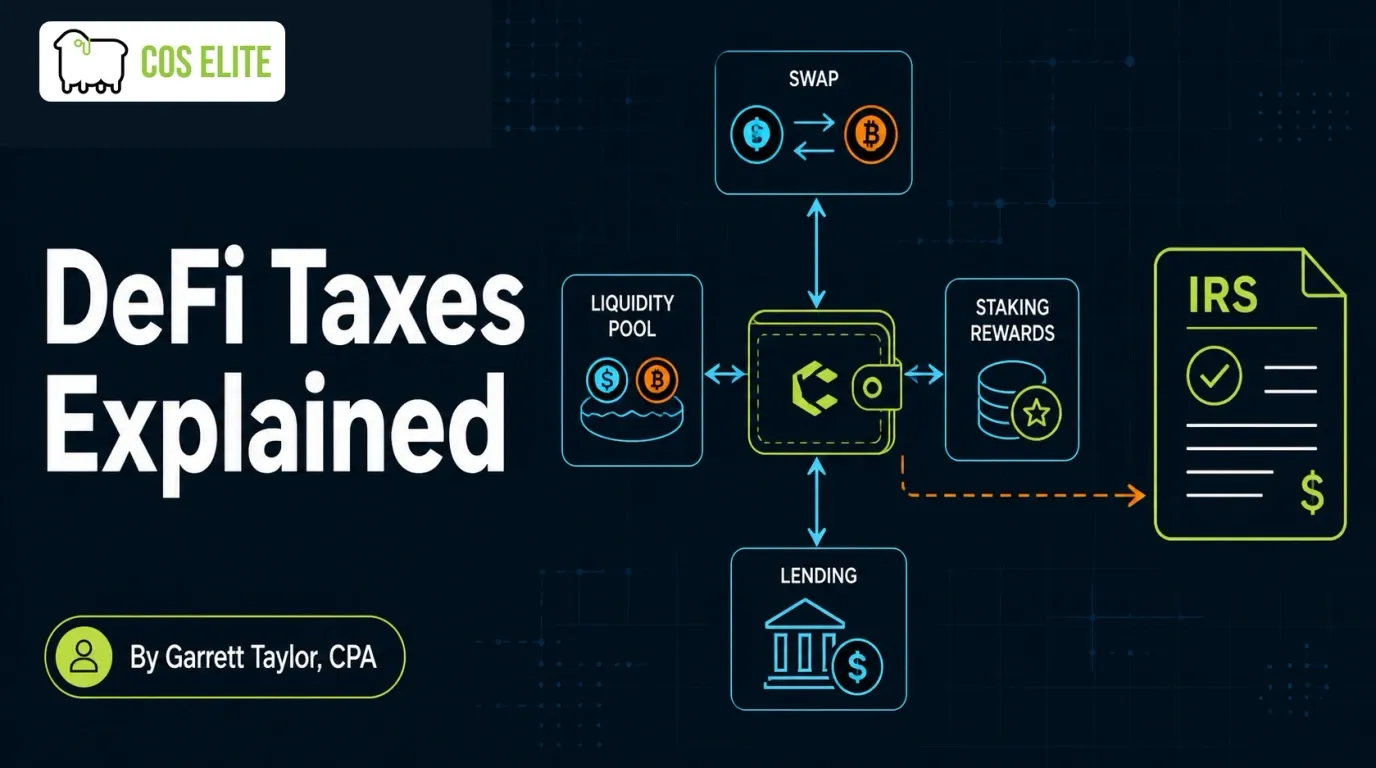
DeFi taxes are one of the most misunderstood areas of crypto tax obligations in the United States. Decentralized finance lets you lend, stake, pool, and farm assets without an intermediary, but the IRS still expects every taxable event to be reported. Because there is no broker issuing a clean 1099 for most of this activity, the burden of accurate DeFi tax reporting falls entirely on the investor.
This guide explains how various DeFi activities may create taxable consequences, where the common reporting traps are, and why careful transaction tracking matters from day one.
How the IRS Views DeFi Transactions
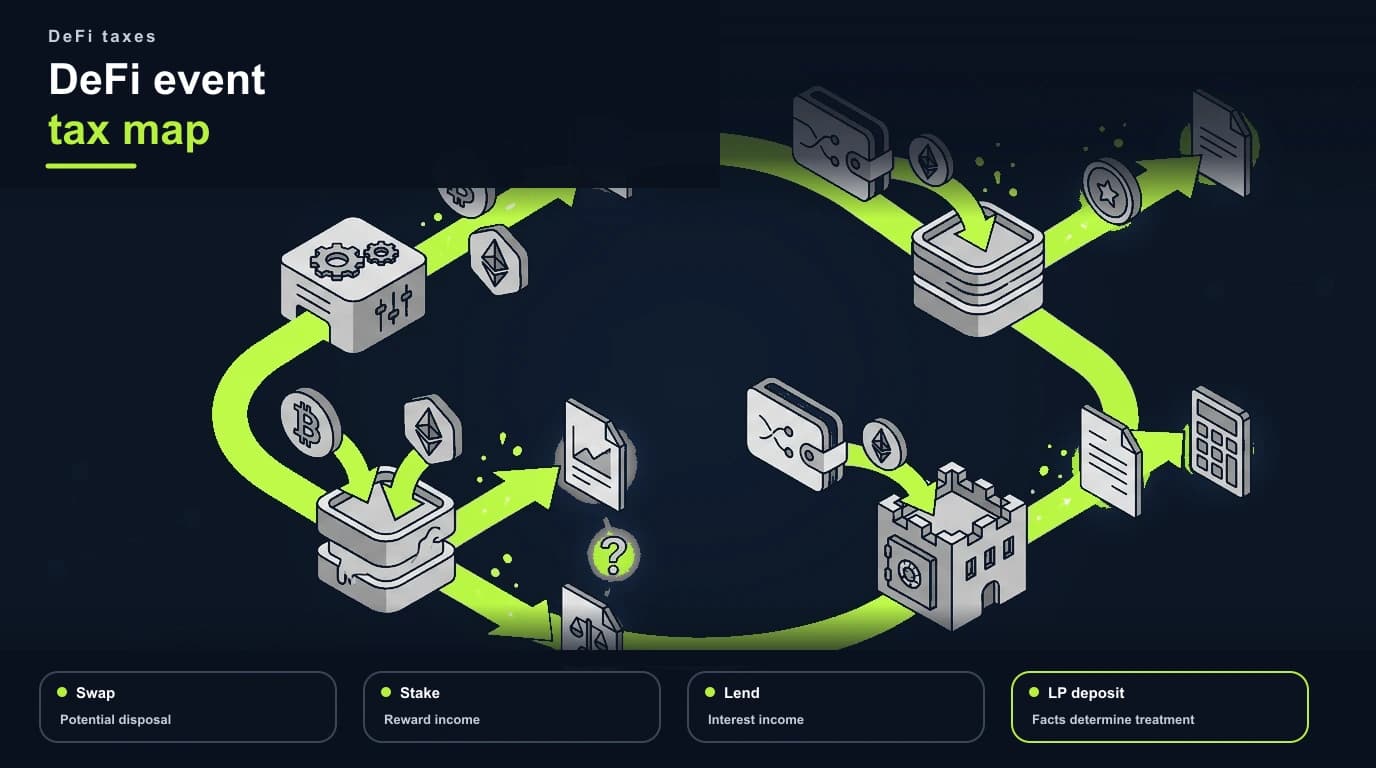
The IRS does not have a separate tax code for DeFi. Instead, it applies existing property rules from Notice 2014-21 and Rev. Rul. 2023-14 to decentralized finance transactions.
Under these rules, cryptocurrency is property. Every time you dispose of property , whether by selling, exchanging, or converting it , you realize a gain or loss. The fact that a transaction happens on Uniswap instead of Coinbase doesn't change the tax treatment.
Here's what that means in practice:
- Selling crypto for fiat: Capital gain or loss.
- Swapping one token for another: Capital gain or loss (this is a disposition of the first token and an acquisition of the second).
- Receiving crypto as income: Ordinary income at fair market value (FMV) on the date of receipt.
- Transferring crypto between your own wallets: Not taxable (no disposition).
DeFi adds complexity because a single interaction with a smart contract can trigger multiple taxable events simultaneously. A liquidity pool deposit on Uniswap, for example, involves sending two tokens and receiving LP tokens in return , potentially creating two separate dispositions.
The IRS has been slow to issue DeFi-specific guidance. But the absence of guidance does not mean the absence of tax obligations. It means you need to apply existing rules carefully and, in genuine grey areas, take a defensible position.
Token Swaps on DEXs: Every Swap Is Taxable
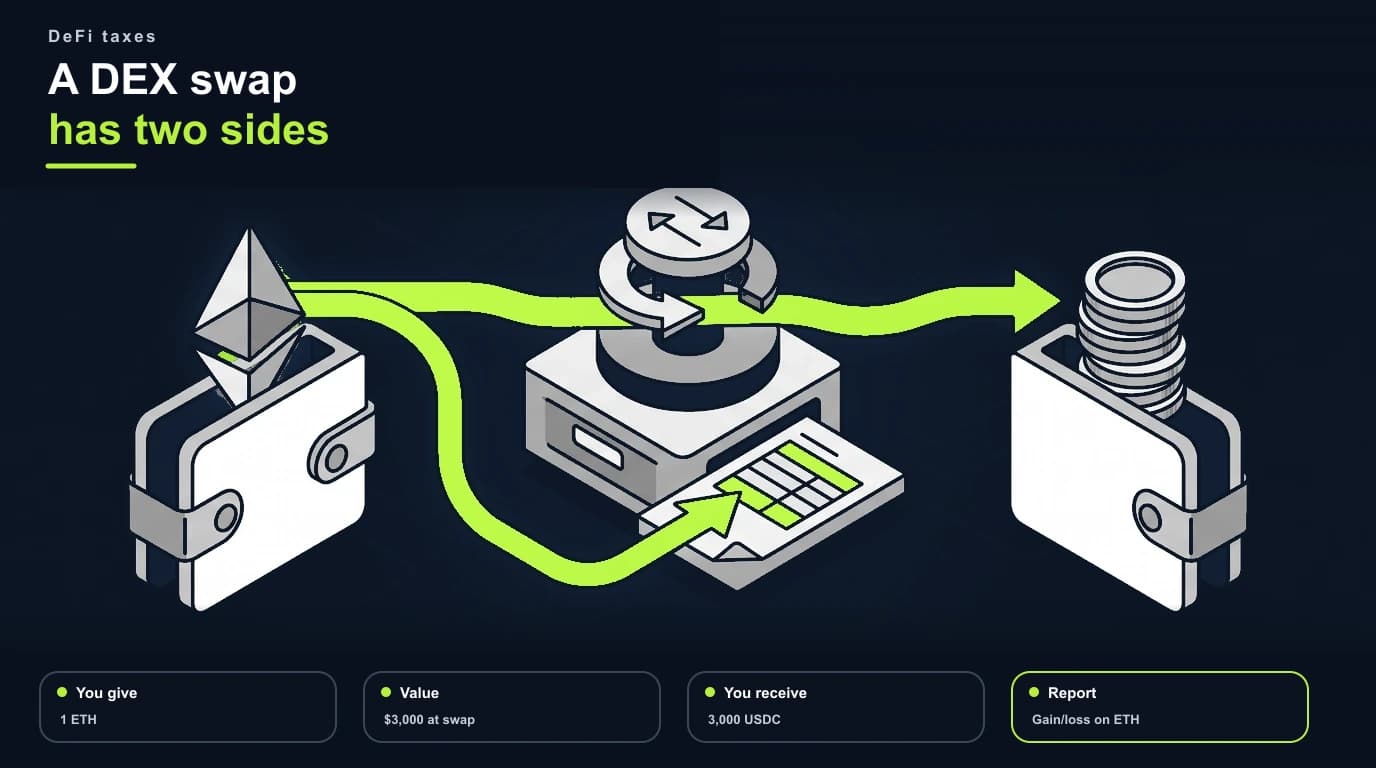
This is the most common DeFi tax event and the one people most frequently overlook.
When you swap ETH for USDC on Uniswap, you have disposed of ETH. You owe capital gains tax on the difference between your cost basis in that ETH and the fair market value of the USDC you received.
When you swap USDC for some new governance token on SushiSwap, you have disposed of USDC. Same rules apply.
It does not matter that you never converted to dollars. A crypto-to-crypto swap is a taxable event under IRS Notice 2014-21. This was true in 2014 and it remains true in 2026.
What you need to track for every swap:
- Date of the swap
- FMV of the token you gave up (at the time of the swap)
- Your cost basis in that token (what you originally paid for it, adjusted for fees)
- FMV of the token you received (this becomes your new cost basis)
- Gas fees (these can be added to your cost basis or treated as a deductible expense, depending on your situation)
If you made 50 swaps across three DEXs in 2025, you have 50 separate capital gain/loss calculations. This is why choosing the right cost basis method matters so much , it directly affects your tax bill.
Pro Tip
Gas fees paid on DEX swaps can increase your cost basis in the token you acquired, reducing your future capital gain when you eventually sell. Don't ignore them , on Ethereum mainnet, they can add up to thousands of dollars over a year.
Liquidity Pools and LP Tokens: The Grey Area
This is where DeFi taxes get genuinely uncertain.
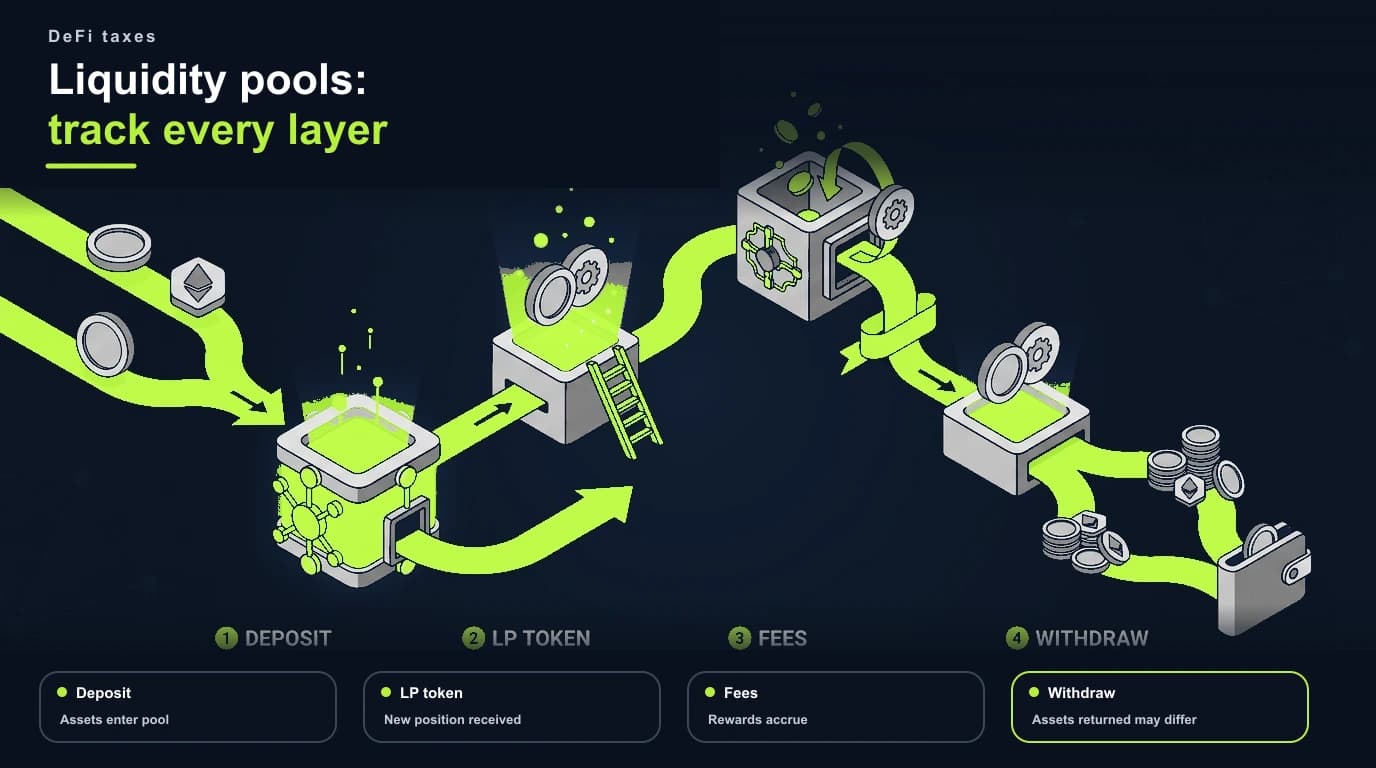
When you deposit tokens into a liquidity pool (say, ETH and USDC into a Uniswap V3 pool), you receive LP tokens in return. The question is: does that deposit trigger a taxable event?
Pro Tip
The IRS has not issued specific guidance on liquidity pool deposits and LP token treatment. What follows is our analysis based on existing tax principles. The conservative position is to treat LP deposits as taxable dispositions. If the IRS issues contrary guidance in the future, taxpayers who took the conservative position will not face penalties. Those who took an aggressive position might.
The conservative position (what we recommend):
Depositing tokens into a liquidity pool is a disposition of those tokens. You are exchanging ETH + USDC for a new asset (the LP token). This triggers capital gains on the ETH and USDC you deposited, based on the difference between your cost basis and FMV at the time of deposit.
Your cost basis in the LP token is the combined FMV of the tokens you deposited.
The aggressive position (some taxpayers take this):
The LP deposit is not a taxable event because you haven't truly disposed of anything , you still have an economic interest in the underlying tokens, and the LP token merely represents that interest.
Why the conservative position is safer:
The IRS has historically treated exchanges of one type of property for another as taxable events. The LP token is a different asset than the tokens you deposited. Until the IRS says otherwise, treating the deposit as taxable is the defensible choice.
Withdrawal from a liquidity pool:
When you withdraw, you receive back the underlying tokens (usually in different proportions due to impermanent loss). Under the conservative approach, this is another taxable event , you are disposing of the LP token and receiving tokens in return.
Trading fees earned while providing liquidity:
Fees accrued in the pool are generally treated as ordinary income, recognized when you have dominion and control over them. In concentrated liquidity pools (Uniswap V3), this timing question adds another layer of complexity.
Yield Farming Tax Treatment
Yield farming , where you stake LP tokens or other assets to earn additional token rewards , creates ordinary income.
When you receive yield farming rewards (whether auto-compounded or manually claimed), you recognize ordinary income equal to the FMV of the tokens at the time of receipt. This is similar to how staking rewards are taxed.
The timing question:
- Manually claimed rewards: Income is recognized when you claim.
- Auto-compounded rewards: This is less clear. The conservative position is that income is recognized as the rewards accrue and are reinvested, even if you never manually claimed them. The argument: the smart contract is acting as your agent, and the reinvestment happens on your behalf.
Pro Tip
Auto-compounding yield farms (like those on Yearn or Beefy) create a tracking nightmare. Each auto-compound is potentially a separate income recognition event AND a new acquisition of the compounded token. If you use these protocols, you need detailed transaction records.
Cost basis of yield farming rewards:
Your cost basis in farming rewards equals the FMV at the time you recognized income. If you receive 100 tokens worth $500 as farming rewards, you report $500 in ordinary income, and your cost basis in those 100 tokens is $500. If you later sell them for $700, you have a $200 capital gain.
The double-tax problem:
Yield farming rewards are taxed as ordinary income when received AND as capital gains when sold (if they appreciate). This is the same treatment as wages , you pay income tax on your salary, and if you invest that salary in stocks that go up, you pay capital gains tax on the appreciation.
Lending and Borrowing on DeFi
Lending (Aave, Compound, etc.)
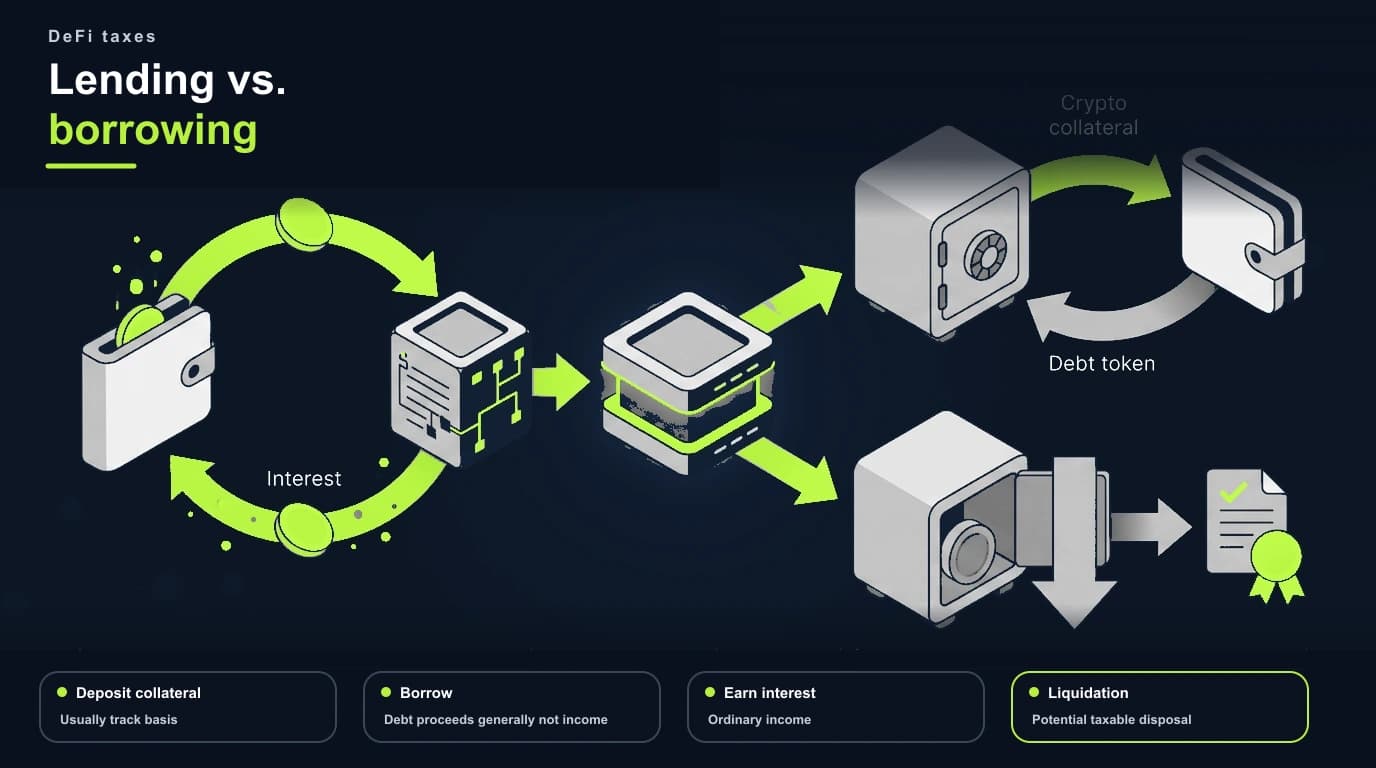
When you lend crypto on Aave or Compound, you deposit tokens and receive interest-bearing tokens (aTokens, cTokens) in return.
Depositing: The deposit itself may or may not be taxable, depending on whether you view the aToken/cToken as a fundamentally different asset. The conservative position: treat it as a taxable exchange (same logic as LP tokens).
Interest earned: Interest that accrues on your lending position is ordinary income. This is analogous to interest earned in a savings account , it's taxed at your ordinary income rate.
Withdrawing: When you redeem your aTokens/cTokens for the underlying asset plus interest, you may realize a gain or loss on the aTokens/cTokens themselves.
Borrowing
Borrowing crypto on DeFi is generally not a taxable event. You are receiving a loan, not income. This is consistent with traditional tax treatment of debt , borrowing money from a bank doesn't create a taxable event.
However:
- Liquidation of your collateral IS a taxable event. If your collateral is liquidated, you've disposed of the collateral tokens, triggering capital gains or losses.
- Interest paid on DeFi loans is generally not deductible for individual taxpayers unless the borrowed funds were used for investment or business purposes (and even then, deductibility rules are complex).
Pro Tip
If you borrow stablecoins against your ETH on Aave to avoid selling, you've deferred the tax event. But if your ETH collateral gets liquidated, you owe capital gains on the entire liquidated amount. Leverage strategies have real tax consequences , plan accordingly.
Wrapped Tokens: Is Wrapping ETH Taxable?
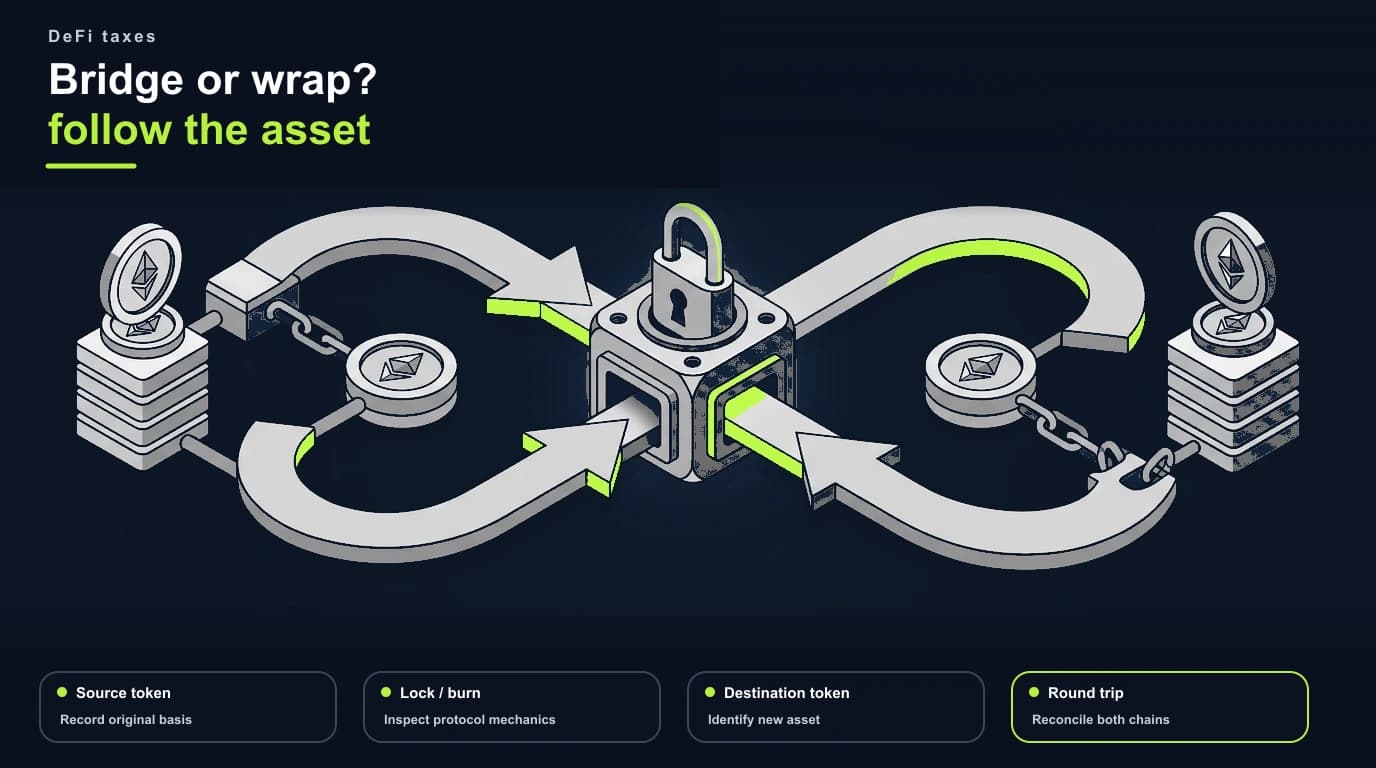
Wrapping ETH to WETH (or BTC to WBTC) is one of the most debated DeFi tax questions.
Pro Tip
The IRS has not issued guidance on whether wrapping a token constitutes a taxable event. There are reasonable arguments on both sides. Here's where things stand.
The argument that wrapping IS taxable:
You are exchanging one asset (ETH) for a different asset (WETH). They have different contract addresses, different names, and arguably different characteristics. Under general tax principles, an exchange of one property for another is a taxable event.
The argument that wrapping is NOT taxable:
WETH is economically identical to ETH. It's a 1:1 representation on the same chain. The wrapping process is more like converting between denominations than truly exchanging assets. Some practitioners compare it to converting a dollar bill into four quarters , no taxable event.
Our recommendation:
The conservative position is to treat wrapping as a taxable event. In most cases, wrapping happens at a 1:1 ratio, so the gain or loss would be minimal (limited to the gas fee). The risk of not reporting is low, but the cost of reporting is also low.
Cross-chain wrapped tokens (like WBTC on Ethereum) have a stronger case for being taxable. You're moving value across chains through a custodian or smart contract system, and the wrapped token has distinct counterparty and smart contract risk.
Governance Token Airdrops

When you receive governance tokens , whether through a retroactive airdrop (like historical UNI or ARB distributions) or as ongoing participation rewards , the tax treatment is clear:
Governance token airdrops are ordinary income at FMV on receipt.
This is consistent with general airdrop tax treatment. The moment you have dominion and control over the tokens, you recognize income.
Key considerations:
- Date of receipt matters enormously. Token prices often drop significantly in the hours and days after an airdrop. Your income is based on the FMV when you received the tokens, not when you claimed them (if they were automatically distributed) or when you sold them.
- Unclaimed airdrops: If tokens are sitting in a claimable contract but you haven't claimed them, you likely don't have dominion and control yet. Income recognition may be deferred until you claim. But this is another grey area , some argue that the ability to claim constitutes constructive receipt.
- Your cost basis in the governance tokens equals the FMV at the time of income recognition. If you received 1,000 tokens worth $5 each, you have $5,000 in ordinary income and a $5,000 cost basis.
DeFi Staking vs. Traditional Staking
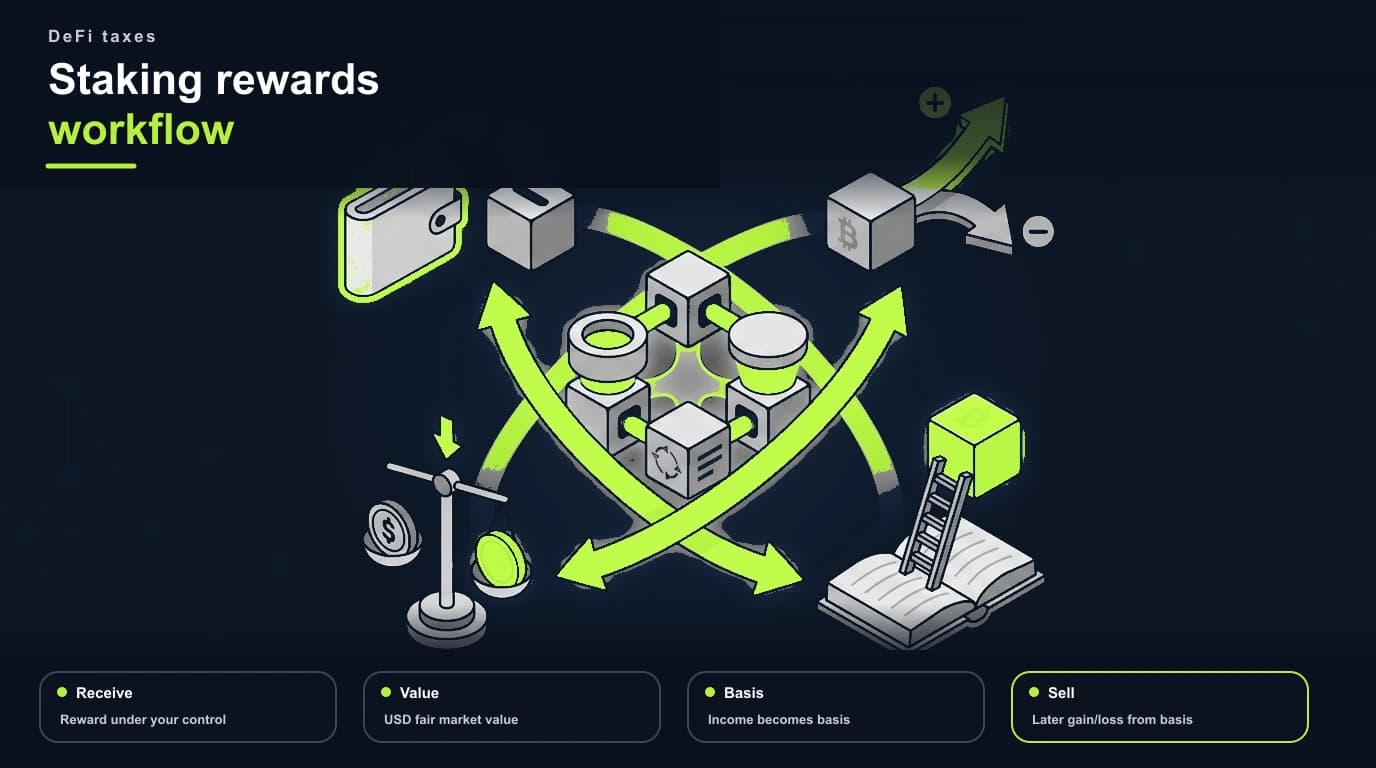
DeFi staking (locking tokens in a protocol to earn rewards) and Proof-of-Stake validation staking have similar tax treatment but different mechanics.
| DeFi Activity | Tax Treatment | Taxable Event Trigger | Income Type | Key Uncertainty |
|---|---|---|---|---|
| Token swap on DEX | Capital gain/loss | At time of swap | Capital | None , clearly taxable |
| LP token deposit | Likely capital gain/loss | At time of deposit | Capital | IRS hasn't ruled on LP tokens |
| LP fee income | Ordinary income | When earned/claimed | Ordinary | Timing of recognition for auto-accrued fees |
| Yield farming rewards | Ordinary income | When received/claimed | Ordinary | Auto-compound timing |
| Lending deposits (aTokens) | Possibly capital gain/loss | At time of deposit | Capital | Whether receipt token is a new asset |
| Lending interest | Ordinary income | As accrued | Ordinary | None , clearly ordinary income |
| Borrowing | Not taxable | N/A | N/A | None , borrowing isn't income |
| Liquidation | Capital gain/loss | At time of liquidation | Capital | None , clearly a disposition |
| Wrapping (ETH to WETH) | Unclear | At time of wrap | Capital | IRS hasn't ruled |
| Cross-chain bridge | Likely capital gain/loss | At time of bridge | Capital | Depends on bridge mechanism |
| Governance airdrop | Ordinary income | When received | Ordinary | Claimed vs. claimable timing |
| DeFi staking rewards | Ordinary income | When received/claimed | Ordinary | Similar to PoS staking questions |
Both DeFi staking and PoS staking rewards are generally treated as ordinary income when received. The key difference is mechanical: DeFi staking usually involves depositing tokens into a smart contract and receiving reward tokens, while PoS staking involves validating transactions and receiving new tokens from the protocol.
For a deeper dive on staking specifically, see our complete crypto staking tax guide.
Bridge Transactions Between Chains
Bridging tokens from one blockchain to another (Ethereum to Arbitrum, Solana to Ethereum, etc.) creates tax questions similar to wrapping.
When you bridge ETH from Ethereum mainnet to Arbitrum:
- Your ETH on Ethereum is locked in a bridge contract
- You receive ETH (or wrapped ETH) on Arbitrum
Is this taxable?
The argument is similar to wrapping. If the bridged token is economically identical to the original, there's a case that no taxable event occurred. But the tokens exist on different chains, have different contract addresses, and may have different risk profiles.
Our position: If you're bridging the same native token (ETH on Ethereum to ETH on Arbitrum), we lean toward non-taxable, similar to a wallet-to-wallet transfer. If you're bridging and receiving a wrapped or synthetic version, the conservative position is to treat it as taxable.
Regardless of whether the bridge itself is taxable, you must maintain accurate records of your cost basis as tokens move across chains. Losing track of basis across bridges is one of the most common DeFi tax mistakes people make.
Worked Example: Complete DeFi Tax Scenario
Let's walk through a realistic DeFi tax scenario to see how all these rules apply together.
Maria's DeFi activity in 2025:
January: Maria buys 5 ETH at $2,000 each ($10,000 total) on Coinbase and transfers to her MetaMask wallet.
February: Maria swaps 2 ETH for 4,000 USDC on Uniswap when ETH is at $2,200.
- Taxable event: Disposition of 2 ETH.
- Proceeds: $4,400 (2 ETH x $2,200)
- Cost basis: $4,000 (2 ETH x $2,000)
- Short-term capital gain: $400
March: Maria provides liquidity to the ETH/USDC pool on Uniswap with $5,000 USDC + 2.27 ETH (worth $5,000 at $2,200/ETH). She receives LP tokens.
- Taxable event (conservative position): Disposition of 2.27 ETH.
- Proceeds: $5,000 (FMV at deposit)
- Cost basis: $4,540 (2.27 ETH x $2,000 original basis)
- Short-term capital gain: $460
- USDC disposition: Minimal gain/loss (stablecoin)
- LP token cost basis: $10,000
March through June: The pool earns $800 in trading fees attributed to Maria's position.
- Ordinary income: $800 (recognized as earned)
June: Maria withdraws from the pool. Due to impermanent loss, she receives 3,500 USDC + 2.95 ETH (worth $7,375 at $2,500/ETH). Total withdrawal value: $10,875.
- Taxable event: Disposition of LP token.
- Proceeds: $10,875
- Cost basis of LP token: $10,000 + $800 fees already recognized = $10,800
- Short-term capital gain: $75
- New cost basis: 3,500 USDC at $1 each, 2.95 ETH at $2,500 each
July: Maria stakes her remaining 0.73 ETH (from original purchase) in a DeFi protocol and earns 0.05 ETH in staking rewards over the rest of the year at an average price of $2,600.
- Ordinary income: $130 (0.05 ETH x $2,600)
September: Maria receives a 500-token governance airdrop from a protocol she used. FMV at receipt: $2 per token.
- Ordinary income: $1,000
Maria's 2025 DeFi tax summary:
- Short-term capital gains: $935 ($400 + $460 + $75)
- Ordinary income: $1,930 ($800 + $130 + $1,000)
- Total taxable DeFi income: $2,865
That's from what many people would consider "moderate" DeFi usage. Now imagine doing this across five protocols on three chains with hundreds of transactions. This is why professional digital asset reconciliation exists.
“A single DeFi user with moderate activity can easily generate dozens of taxable events across multiple income categories in a single year. Without proper tracking from day one, reconstructing this at tax time is extremely difficult.”
Common DeFi Tax Mistakes
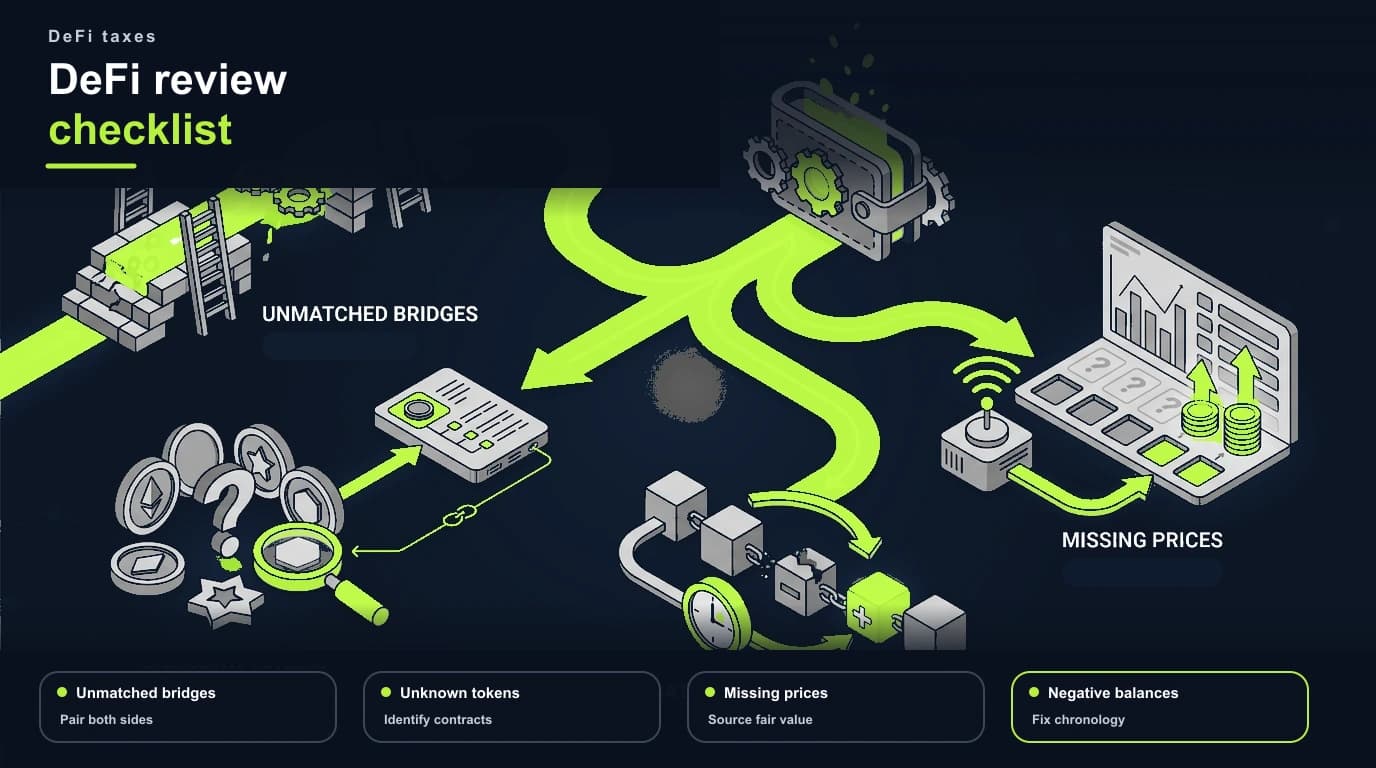
1. Ignoring DEX swaps. Every swap is taxable. If you made 200 swaps in 2025, you have 200 capital gain/loss calculations. "I didn't sell for dollars" is not a defense.
2. Not tracking LP deposits and withdrawals. Even if you believe LP deposits aren't taxable, you need to track cost basis for when you eventually withdraw and sell.
3. Missing yield farming income. Auto-compounded rewards are easy to forget because you never manually claimed them. But they're still income.
4. Zero-basis errors. If you can't prove your cost basis, the IRS can assume it's zero. That means your entire proceeds become taxable gain. This happens frequently with tokens that have moved across multiple wallets and chains.
5. Ignoring failed transactions. Gas fees on failed transactions are still deductible (as a loss of the gas token). Don't ignore them.
6. Double-counting bridge transactions. If you bridge ETH from Ethereum to Arbitrum and treat it as a new acquisition, you might accidentally double-count your holdings. Maintain consistent records across chains.
7. Not reporting governance airdrops. "I didn't ask for these tokens" doesn't exempt you from reporting them as income.
8. Confusing borrowing with income. Receiving a loan on Aave is not income. But the interest you earn on deposits IS income. And liquidation of collateral IS a taxable disposition.
When You Need a Crypto Tax CPA
DeFi taxes are the most complex area of crypto tax law. If any of these apply to you, trying to handle this yourself is a risky proposition:
- You used more than 2-3 DeFi protocols in the tax year
- You provided liquidity to any pool
- You had positions liquidated
- You farmed yield across multiple protocols
- You bridged tokens across chains and lost track of cost basis
- You received governance token airdrops
- Your total DeFi volume exceeded $50,000
A crypto-specialized CPA can reconcile your on-chain activity, apply consistent and defensible tax positions across grey areas, and make sure nothing falls through the cracks.
The cost of professional tax return preparation is almost always less than the cost of an IRS audit triggered by unreported DeFi income.
{{CTA}} DeFi taxes are the most complex area of crypto taxation, and grey areas abound. COS Elite specializes in digital asset tax compliance for DeFi users. Book a free consultation to get your DeFi transactions reconciled and reported correctly.
{{/CTA}}
What Are DeFi Taxes?
Decentralized finance, or DeFi, refers to financial services built on public blockchains that run through smart contracts instead of banks or brokers. Lending, borrowing, trading, staking, and earning yield all happen directly between users and protocols such as Uniswap, Aave, Curve, or Lido. There is no central party recording your activity for tax purposes.
"DeFi taxes" is shorthand for the federal income tax and capital gains consequences that flow from this activity. The IRS treats digital assets as property, so the same principles that apply to selling stock or earning interest apply here, just across far more transactions and far less paperwork.
Simple crypto investing is straightforward by comparison. You buy Bitcoin on an exchange and the exchange tracks your cost basis and often issues a tax form. DeFi breaks that model: a single yield strategy can generate token swaps, reward accruals, LP token issuance, and wrapped-asset conversions, each potentially a separate taxable event with its own cost basis.
That is why decentralized finance taxes demand recordkeeping most investors underestimate, since activity spreads across wallets and chains and no one reconstructs it for you.
Why DeFi Investors Need Accurate Digital Asset Reconciliation
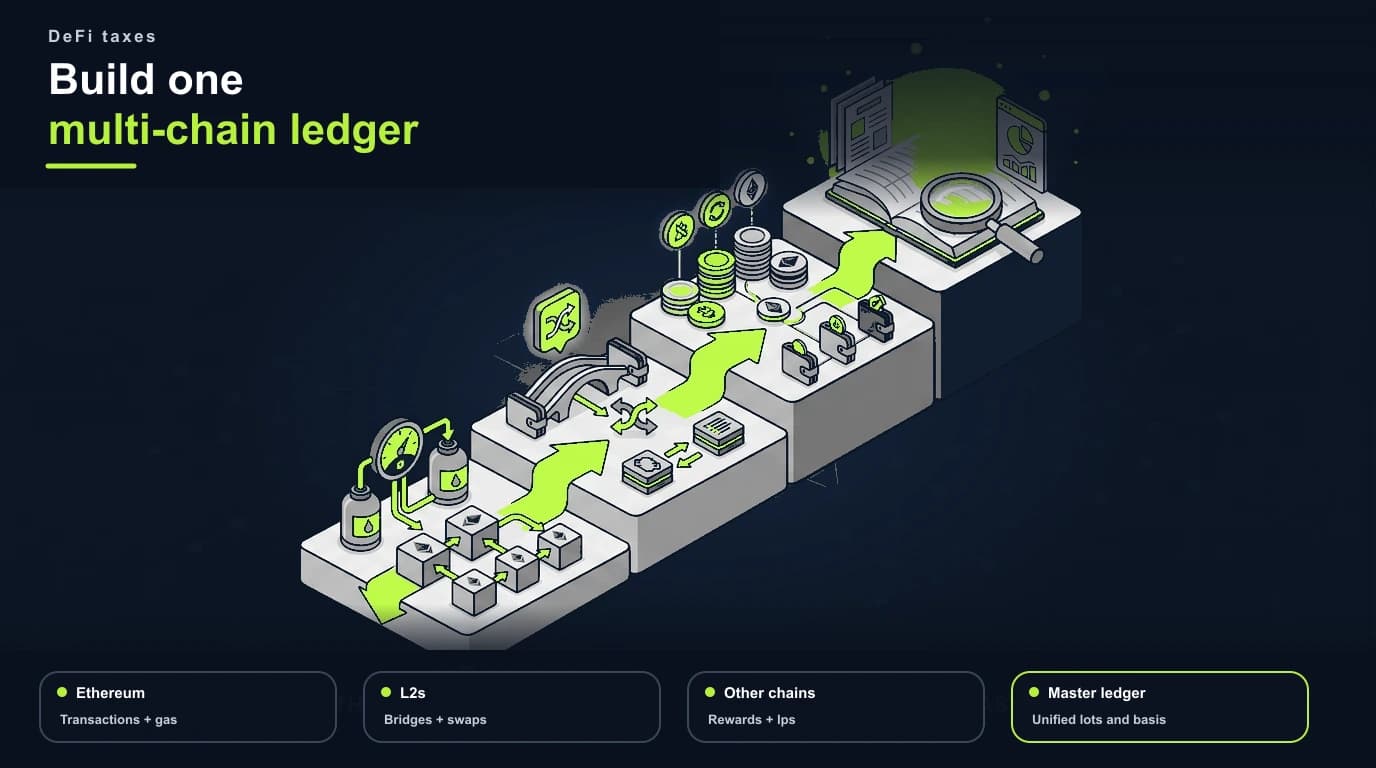
Reconciliation means matching every on-chain transaction to its correct tax treatment and cost basis so nothing is missed or double-counted. For active DeFi users, this is rarely something a single piece of software handles cleanly.
Several factors compound the difficulty: transaction volume that runs into the thousands per year, multiple wallets that fragment the picture, multiple chains with different explorers and pricing sources, and missing cost basis from early transfers or unsupported protocols that distorts gains.
Our digital asset reconciliation service is built for exactly this. We untangle complex DeFi transactions across wallets and chains, rebuild missing history, and produce audit-ready records that map cleanly to Form 8949, so your DeFi tax reporting rests on a verified foundation rather than guesswork.
Tax Strategies DeFi Investors Should Consider
Good planning starts with good data. These approaches can help manage crypto tax obligations, though outcomes depend on your specific facts and current law.
Recordkeeping first: Export wallet history regularly, save transaction hashes, and capture fair market values at receipt. Real-time records are far more reliable than year-end reconstruction.
Timing considerations: Holding periods affect whether gains are short or long term, and the timing of claiming rewards or exiting positions can influence which tax year they land in.
Loss harvesting opportunities: Volatile DeFi positions can produce realized losses that may offset gains elsewhere. Our crypto tax-loss harvesting work focuses on identifying and timing those trades without forcing you out of long-term positions.
Professional planning: Because the rules around DeFi are still developing, a CPA who follows this space can help you take reasonable, well-documented positions. No strategy guarantees a particular result, and the goal is compliant, defensible reporting.
When to Work With a Crypto Tax CPA
Plenty of casual investors handle their own crypto taxes with off-the-shelf software. DeFi changes the calculation. A crypto CPA earns their keep when the activity outgrows what a tool can reliably interpret.
Consider professional help when you have complex DeFi activity across staking, pools, and farms; a multi-chain portfolio spanning several networks; missing transaction histories that need reconstruction; a high-value portfolio where mistakes carry real cost; or IRS reporting concerns such as prior unreported years or a notice in hand.
COS Elite is led by Garrett Taylor, CPA, a former Big Four professional who works exclusively with crypto investors and businesses. We bring institutional-grade tax discipline to digital assets and serve clients remotely in all 50 states. If your DeFi footprint has gotten ahead of your records, that is precisely the problem we solve.
Frequently Asked Questions
Is every DEX swap a taxable event?
Yes. Every time you swap one token for another on a decentralized exchange, you realize a capital gain or loss on the token you gave up. This is a disposition of property under IRS Notice 2014-21.
How are liquidity pool (LP) tokens taxed?
The IRS hasn't issued specific guidance. The conservative position treats LP deposits as taxable dispositions. Fee income earned in the pool is ordinary income. Withdrawal is another taxable event.
Is yield farming income taxable?
Yes. Yield farming rewards are ordinary income at the fair market value when received. If you later sell those reward tokens at a higher price, the appreciation is a capital gain.
Do I owe taxes on DeFi lending interest?
Yes. Interest earned from lending on platforms like Aave or Compound is ordinary income, just like interest from a bank savings account.
Is borrowing on DeFi taxable?
No. Borrowing is not a taxable event. However, if your collateral is liquidated, that IS a taxable disposition.
Is wrapping ETH to WETH a taxable event?
The IRS hasn't ruled on this. The conservative position treats it as taxable. In practice, the gain or loss is usually minimal since the ratio is 1:1.
How are governance token airdrops taxed?
Governance tokens received via airdrop are ordinary income at fair market value on the date you receive or claim them.
Are bridge transactions between chains taxable?
It depends. Bridging native tokens is arguably not taxable. Bridging to a wrapped or synthetic version has a stronger argument for being taxable. The IRS hasn't provided specific guidance.
What happens if I get liquidated on a DeFi loan?
Liquidation of your collateral is a taxable disposition. You realize a capital gain or loss based on the difference between your cost basis and FMV at liquidation.
Can I deduct gas fees?
Gas fees can generally be added to your cost basis or treated as transaction expenses. Gas fees on failed transactions may be deductible as a loss.
How do I track cost basis across multiple DeFi protocols and chains?
You need a unified transaction ledger across all wallets, chains, and protocols. For complex DeFi users, professional digital asset reconciliation is strongly recommended.
What records should I keep for DeFi taxes?
Keep dated records of every transaction: amounts, token types, fair market values at the time, transaction hashes, wallet addresses, and the chain involved. Exporting wallet history regularly and saving reward claim details makes accurate DeFi tax reporting far easier at filing time.