A licensed crypto CPA firm that reconciles wallets, exchanges, DeFi activity, and 1099-DAs, then turns the complete record into an accurate, supportable US tax return.
Prepared and filed by a CPA, reviewed by an Enrolled Agent. Serving clients in all 50 states.
Before you read further
Is this the right fit?
Built for
Multiple exchanges and wallets
DeFi, staking, or NFTs
Missing cost basis or broken imports
1099-DA that does not match your records
IRS letter about digital assets
Multi-year catch-up or amended returns
Probably not for
One exchange, clean history
Under roughly 50 trades
No prior-year issues to fix
If that is you, good crypto tax software plus your current preparer will likely do the job.
What does a crypto CPA do?
A crypto CPA turns activity from your exchanges, wallets, and protocols into an accurate tax record. That work can include reconciling transfers, reconstructing missing cost basis, classifying DeFi, staking, NFT, and derivative transactions, tying out Form 1099-DA reporting to the return, and preparing the federal and state returns that apply to your situation.
Your return is only as accurate as your least complete wallet.
A crypto tax return is only as accurate as the transaction history behind it. Exchanges, wallets, bridges, and protocols each hold one slice of the story. When one slice is missing, every gain calculated after it is wrong, and the software that produced it will not tell you. That is why every engagement starts with digital asset reconciliation, not with a form.
Why you need a crypto CPA: a crypto CPA rebuilds the complete record across every platform, matches each transfer, reconstructs missing cost basis, ties the result to your 1099-DAs, and signs the return. Software calculates from what it is given. A CPA is accountable for what is filed.
ledger.view // one tax year4 of 6 legs found
Buy
Coinbase
basis confirmed
Transfer
to cold wallet
missing
Swap
Uniswap
basis unknown
Stake
Lido
basis unknown
Transfer
to Kraken
missing
Sell
Kraken, 1099-DA
basis unknown
Every transfer needs a matching leg
A withdrawal with no matching deposit becomes a taxable disposal in most software.
1099-DA reports proceeds, not your basis
For most 2025 activity, brokers report what you sold for. Your cost is still on you to prove.
Software guesses when data is missing
A missing wallet defaults to zero basis. The gain is overstated, and nobody flags it.
Who needs a crypto CPA
When a specialized crypto CPA is worth it, and when it is not.
Tap what describes your situation. The marker shows the level of help that fits. Most visitors to this page land on level three, but not all of them, and we would rather tell you that now.
You are here
level 01
Tax software
Good for
One exchange, clean imports, simple buys and sells, verified basis.
Breaks down when
Any transfer it cannot match, any wallet it cannot see, any DeFi it cannot classify.
You are here
level 02
General CPA
Good for
A clean, reconciled Form 8949 report and no on-chain activity.
Breaks down when
They are handed a software export and have no way to test whether it is right.
You are here
level 03
Crypto-specialized CPAThis is COS Elite
Good for
Multiple wallets or exchanges, DeFi, NFTs, staking, mining, derivatives, missing basis, 1099-DA mismatch, amended years, or an IRS notice.
Breaks down when
Rarely. If a matter turns criminal, we bring in counsel and keep doing the accounting.
You are here
level 04
Tax attorney
Good for
Attorney first if you are under criminal investigation, facing a subpoena, or have a securities issue. We work alongside counsel when needed.
Breaks down when
Attorneys do not reconcile wallets or prepare returns. You will still need the accounting done.
Ist year with COS and I feel like I made a good decision moving from my old CPA after 20 years. My crypto investments over the last few years complicated my returns but COS has a special team to work on this. They were able to reach back and capture losses that I thought were already taken care of. Ended up with a refund which is rare for me. Btw, we are a retired couple that appreciate the young smart team at COS.
Great communication and strategic mindset. Leanne and Garret walked me through every question I had, during a complicated tax year. Absolutely took the edge off!
I highly recommend this firm for their technical expertise and streamlined communication. They possess a deep understanding of complex tax codes and financial regulations, delivering results with high precision.
What sets them apart is their commitment to efficiency and clarity. Rather than overwhelming clients with dense jargon, they provide insights in a clear, succinct format that prioritizes actionable information. Their ability to distill complex data into a readable, professional structure is invaluable for anyone who values their time and expects top-tier accuracy.
I got scammed to a fake crypto platform and lost a huge amount of money. A traditional accountant wasn’t able to help me until I found COS elite in reddit. Very knowledgeable, helpful and easy to contact. I appreciate what they have done for us.
Comprehensive tax and crypto accounting from a personable, professional, organized group. Highly recommend. They exceeded my expectations. In addition to traditional tax reconciliation they are also able to reconcile crypto transactions which can be a nightmare going it alone. They offered year end advice for tax loss harvesting. I highly recommend COS Elite.
I am so fortunate to have found Garrett, the head CPA of the COS Elite. After leaving my previous CPA, I was amazed by the level of service he provided. After my first meeting in the beginning of April, during the peak of a busy tax season, he managed to finalize my returns in under a week. He handled my transaction as a new client seamlessly, answering all my questions promptly usually by next day. Furthermore, his expertise in Crypto currency is unmatched. In my experience, he is the best CPA in San Diego for anyone trading with Crypto trading and losses. I strongly recommend this firm for anyone looking for a talented and experienced CPA.
My husband and I were extremely pleased with the personal attention we received from COSElite tax service. They stayed in touch with us throughout the entire process of submitting information, having our questions answered, and assisting us with computer operations. We always felt supported. Their communication was clear and they were quick to respond. Thank you for a smooth tax tax year and we look forward to continuing to work with you in the future.
I came to them several years behind on my crypto tax reporting, with transactions spread across multiple wallets and accounts, including some I had honestly forgotten about. They were able to go through everything in detail, reconcile it properly, and help get my reporting compliant and fully up to date.
Before working with them, I had reached out to more than 10 CPAs, tax attorneys, and crypto tax specialists. Out of everyone I spoke with, they stood out for both their professionalism and competitive pricing.
What impressed me most was the attention to detail. They took the time to account for every transaction and wallet instead of rushing through the process or giving me a broad estimate.
Special thanks to Garrett for answering all of my questions, explaining things clearly, and working with me throughout the entire process. He was patient, responsive, and made a complicated situation much easier to deal with.
If you’re behind on crypto taxes or have a complicated transaction history, I’d highly recommend them.
This is my first year working with Garret’s team, and I have to say I’m very happy with their quality and delivery.
Two things that stand out about their firm compared to other CPAs:
1) Their word is their bond. They told me they would charge XYZ, and at the end of the project, they did exactly that. Unlike many other firms in this space that deceptively add bogus bonus charges or surprise you with prices that are completely divorced from reality. Their transparency is refreshing.
2) The other thing I enjoyed about working with this group is that they don’t force clients into using data-harvesting proprietary software that locks you in, sells your data, and leaves you vulnerable to phishing attacks. Their tech stack is lean, and they show you the actual work they’ve done instead of hiding behind some esoteric, vague trap.
Honestly, I’m happy with them and would recommend them without hesitation.
Choose the free intro or the $199 strategy consultation, pick a date, and the time slots appear right here.
Crypto tax services
What our crypto CPAs handle.
Ten things, each one a sentence. Tap a tile for the two lines underneath it. This is crypto accounting and tax preparation from raw data to a signed return, not a review of somebody else's export.
details
Reconciliation across every wallet, exchange, and chain
Transfer matching, duplicate removal, and gap detection across 200+ platforms
Output: a reconciled ledger and an exceptions report you can read
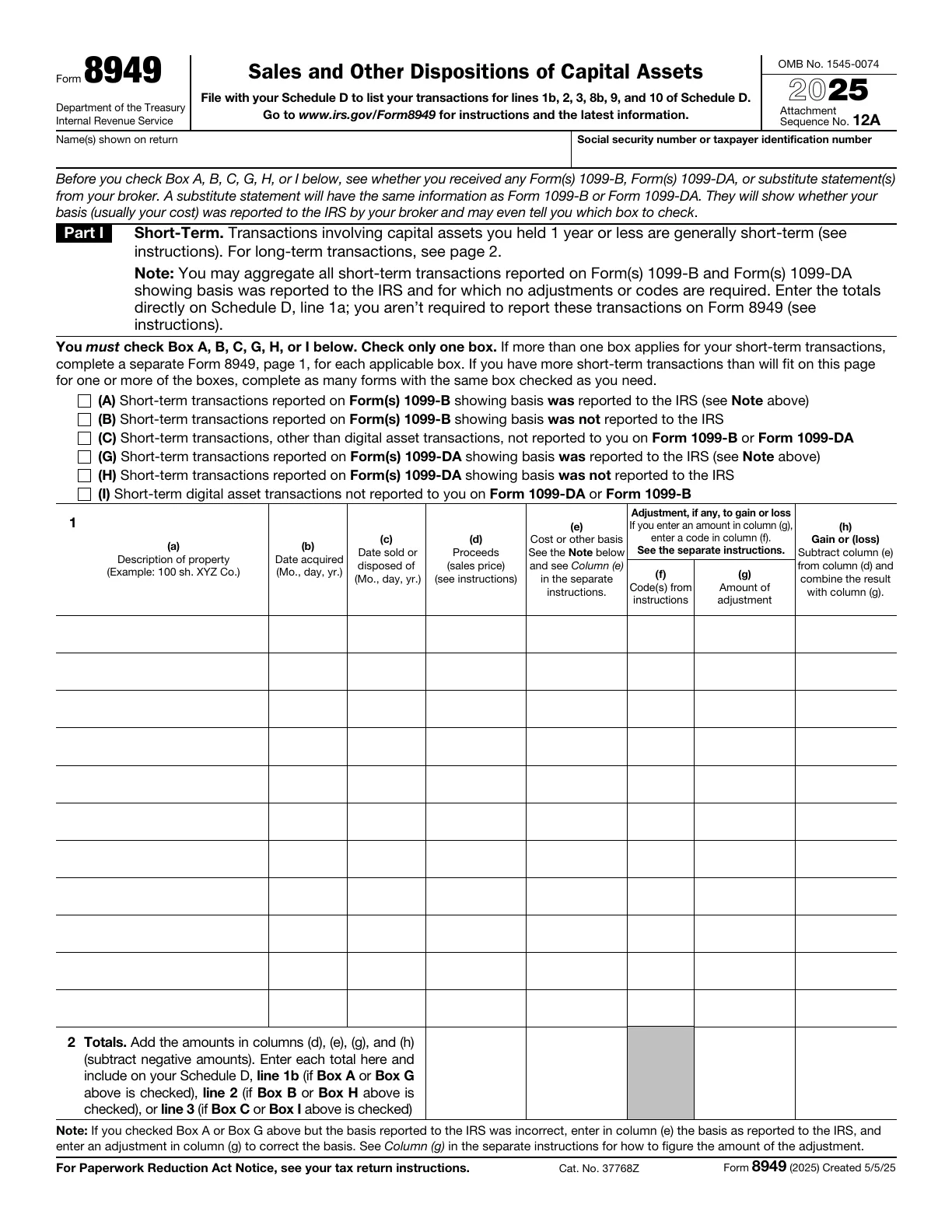
Crypto tax preparation ends in a filing package you can hand to anyone. The forms shown are the official blank IRS forms, so you can see exactly which boxes our work fills in. Nothing here is client data.
What it proves
Every disposal listed with date acquired, date sold, proceeds, basis, and gain or loss.
Where it goes
Totals flow to Schedule D. One page per basis-reporting category.
123
1Column (e), cost or other basis: the number we reconstruct and document for every disposal.
2Column (h), gain or loss: correct only if the basis behind it is.
3Line 2 totals: carried to Schedule D lines 1b, 2, 3, 8b, 9, or 10.
Not listed? We import CSV and on-chain data directly. The list above is a sample of what we work with, not the ceiling. We also repair exports from Koinly, CoinTracker, CoinLedger, CoinTracking, ZenLedger, and Summ rather than starting over.
How the engagement works
Six steps. At each one you know what you do and what we do.
0101
Scoping call
15 to 30 minutes
1
01Scoping call
15 to 30 minutes
You
Tell us your years, platforms, and what went wrong
Share any prior return or notice
Us
Confirm fit and flag anything out of scope
Send over our engagement and hourly quote
Output: signed engagement letter and secure upload link
2
02Data collection
Typically 1 to 2 weeks
You
Connect wallets and exchanges (read only)
Share wallet addresses and existing software exports
Us
Pull on-chain history directly
Build the platform map and log every source
Output: complete source inventory, gaps listed
3
03Reconciliation and exceptions review
Depends on volume and gaps
You
Answer specific questions about unmatched transfers
Provide all missing wallet and exchange data for full scope
Us
Match every transfer leg, reconstruct missing basis
Classify DeFi, staking, NFT, and derivative activity
Tie out to every 1099-DA
Output: reconciled ledger and exceptions report
4
04Your review and sign-off
A few days
You
Read the exceptions report and ask anything
Approve method elections and positions
Us
Walk you through what changed and why
Document the positions we are taking
Output: approved ledger, cost basis summary, and draft schedules
5
05Filing
On your timeline, before the deadline
You
Review the return and sign the e-file authorization
Us
Prepare federal and state returns from the ledger
Second licensed review by Leanne Grant, EA
Garrett Taylor, CPA, signs and files
Output: filed return with acceptance confirmation
6
06Defense-ready package and next-year plan
Within two weeks of filing
You
Keep the package. It answers any letter that arrives
Us
Deliver the full support file
Set up next year: elections, estimated payments, harvesting windows
Output: defense file and written plan for next year
Case studies
Examples of complex crypto tax work.
Real outcomes with numbers, anonymized. We do not promise savings. We show what the reconciliation found and what changed because of it.
RECEIPT 01ENGAGEMENT RECORD
Profile
Long-time holder, multiple exchanges, early miner
Problem
Cost basis gaps and unexplained transfers across old accounts
What we did
Digital Asset Reconciliation traced every transfer leg and surfaced a forgotten mining wallet
Timeframe
Multi-year reconciliation
Result
0.86 BTC recovered
nearly a full bitcoin the client did not know they still held
Your return is led by credentialed tax professionals. Both named, both licensed.
A crypto tax accountant should be a person, not a team page. A CPA prepares and signs. An Enrolled Agent reviews. That is the whole chain, and both links are on this page with license numbers you can check.
CPA #133092
01
Garrett Taylor
Prepares, signs, and files
Former Big Four CPA (Ernst & Young), then Director of Tax at a $1.2 billion family office
Author of the COS Elite crypto tax guides on 1099-DA, DeFi, perps, and cost basis
California CPA license #133092, active and in good standing
Crypto CPA vs tax software vs a traditional accountant.
Capability by capability, here is what each option actually delivers. Section three diagnosed your situation. This one compares the outputs. Filled circle means yes, hollow means partial, a dash means no.
capability
Imports raw wallet and exchange data
Reconstructs missing cost basis
Reconciles transfers between your own wallets
Ties 1099-DA to your records
Handles DeFi, staking, NFTs, perps
Chooses and documents tax positions
Signs and files the return
Represents you on an IRS notice
Plans next year
Human accountable for the numbers
Best when one exchange, clean history, no prior-year issues.
Best when someone else has already reconciled the data and nothing is on-chain.
Best when your data is fragmented or the stakes are high.
Partial means the option can do it in the easy cases and fails in the hard ones. A traditional CPA can sign a return built on a software export, but cannot tell you whether the export was right. Longer comparison: crypto tax CPA vs advisor vs professional.
Pricing and scoping
How your quote is determined.
Crypto CPA fees depend primarily on tax years, transaction volume, wallet and exchange count, DeFi complexity, missing records, and whether return preparation or IRS response is required. Everything is quoted in writing as estimated hours after a scoping call, because the price of the work is the price of the data. Set the six dials to your situation and read the sentence below.
Tax years
one year to reconcile and file
Transaction volume
high volume means more legs to match and more exceptions to clear
Exchanges and wallets
every additional platform is another source to map and verify
DeFi, staking, NFTs, perps
bridges, LP positions, and perps each need hand classification
Missing records or broken imports
reconstruction from chain data and pricing history takes real time
Filing only vs IRS response
reconcile and file
READ
Your quote will lean higher because high volume means more legs to match and more exceptions to clear; every additional platform is another source to map and verify; bridges, LP positions, and perps each need hand classification.
01
Scoping call
Free 15 minutes to confirm fit, or the $199 strategy consultation if you want advice on the call.
02
Engagement and hourly quote in writing
Estimated hours for the scope we agree on, before any work starts.
03
Scope changes are re-quoted first
If the data footprint changes, the estimate is updated in writing before we continue.
Seven questions to ask before hiring a crypto CPA. Including us.
Bring these to any crypto tax professional you interview. Flip each card for what a good answer sounds like, what a red flag sounds like, and how we answer.
Q1
Do you reconcile raw wallet and exchange data, or do you require a clean report?
tap to flip
A good answer sounds like
“We pull your data ourselves and reconcile it before anything is filed.”
A red flag sounds like
“Just send me your Koinly report and I will file it.”
Our answer
We reconcile raw data across 200+ platforms. A software export is an input, never the answer.
Q2
Which tools, chains, and protocols do you actually work with?
tap to flip
A good answer sounds like
“Named chains, named protocols, and a plan for anything not on the list.”
A red flag sounds like
“We handle all crypto. Long pause when you name a bridge.”
Our answer
Bitcoin, Ethereum, Solana, Base, Arbitrum, and the rest of the majors, plus DeFi, perps, and prediction markets from raw records.
Q3
Who reviews and who signs the return?
tap to flip
A good answer sounds like
“Two named, licensed people, and you know which one is which.”
A red flag sounds like
“Our team of experts.”
Our answer
Garrett Taylor, CPA #133092, prepares and signs. Leanne Grant, EA #00167954-EA, reviews every return.
Q4
How do you handle missing cost basis and unmatched transfers?
tap to flip
A good answer sounds like
“Trace the transfer, reconstruct the basis from chain data and historical pricing, document the method.”
A red flag sounds like
“The software defaults it to zero, that is conservative.”
Our answer
Zero basis is not conservative, it is wrong. We reconstruct it and show our work in the exceptions report.
Q5
How do you reconcile 1099-DA reporting?
tap to flip
A good answer sounds like
“Line by line against your disposals, with a documented explanation for every difference.”
A red flag sounds like
“We just report what the broker sent.”
Our answer
Every 1099-DA is tied out to Form 8949. Where the broker has no basis, we supply and document it.
Q6
What deliverables and supporting records do I receive?
tap to flip
A good answer sounds like
“A reconciled ledger, an exceptions report, a cost basis summary, and the filed return.”
A red flag sounds like
“A copy of your return.”
Our answer
Everything in the deliverables section above, plus a defense file that answers any letter that arrives.
Q7
What happens if the IRS questions the filing?
tap to flip
A good answer sounds like
“We respond from the same records we filed from, and we can represent you.”
A red flag sounds like
“You would need to find someone for that.”
Our answer
Both of us are licensed to represent you before the IRS. The defense file exists so the response is fast.
Every question answered in the first sentence. Nothing hidden.
Q01What does a crypto CPA do?
A crypto CPA turns activity from your exchanges, wallets, and protocols into an accurate tax record. That work can include reconciling transfers, reconstructing missing cost basis, classifying DeFi, staking, NFT, and derivative transactions, tying out Form 1099-DA reporting to the return, and preparing the federal and state returns that apply to your situation.
The key difference is where the work begins. A general tax preparer may expect a finished gain and loss report. A crypto CPA can help build and test the transaction record behind that report before using it on the return. Read our full guide to what a crypto tax accountant does.
Crypto CPA costs depend on the number of tax years, transactions, exchanges and wallets, the complexity of DeFi or other on-chain activity, the condition of your records, and whether you need filing or IRS-response work. After a scoping call, COS Elite provides a written hourly quote with estimated hours for the agreed scope. Any scope change is discussed before additional work begins.
Transaction count alone does not determine the fee. A clean export from one exchange takes less work than records spread across closed exchanges, unsupported wallets, and missing transfer history. The pricing section above explains the factors we use, and our cost guide covers common pricing models across the market.
You may benefit from a crypto CPA if your activity spans multiple exchanges or wallets, includes DeFi, staking, NFTs, mining, or derivatives, has missing cost basis, conflicts with a Form 1099-DA, involves unfiled or amended years, or has led to an IRS notice. A simple account with complete records may only need reliable tax software and a qualified return preparer.
The right level of help depends on the condition of the records, not simply whether you own crypto. Our complexity guide above separates situations that software may handle from those that usually require reconciliation or specialized tax review.
Q04Can a regular CPA handle cryptocurrency?
A general CPA can handle cryptocurrency when the transaction history is complete and the gain and loss report is accurate. Complex portfolios may require a specialist who can test that report, trace wallet transfers, reconstruct missing basis, classify on-chain transactions, and address Form 1099-DA differences before the figures reach the tax return.
Ask where the CPA's work begins. Some firms prepare the return from a completed Form 8949 report but do not reconcile the underlying crypto activity. That may be enough for a simple portfolio. It is a material limitation when the records contain gaps, unsupported protocols, or unexplained balances.
A crypto CPA may be worth the fee when incomplete records could overstate gains, omit income, create duplicate transactions, or leave you unable to support the return if the IRS asks questions. The value is usually highest for fragmented, multi-year, or high-value portfolios. A clean account with complete records may not require specialist-level work.
Compare the fee with the specific risk being resolved, such as missing basis, an unexplained Form 1099-DA difference, or years of unreconciled wallet transfers. Our first case study shows a reconciliation that surfaced 0.86 BTC the client did not know remained in the portfolio, but results vary by engagement.
Q06Can you work with Koinly, CoinTracker, CoinLedger, or raw wallet data?
Yes. COS Elite works with exports from Koinly, CoinTracker, CoinLedger, CoinTracking, ZenLedger, and Summ, as well as CSV files and on-chain records. We can review and repair an existing software workspace when the underlying data supports it, or rebuild the transaction record from source data when the existing file is unreliable.
You do not need to choose new software before the scoping call, and an existing workspace does not automatically need to be discarded. We first assess its imports, balances, transfer matches, classifications, and missing-data warnings, then recommend the most efficient path.
Q07Can you fix missing crypto cost basis?
Yes, when reliable source records are available. We trace transfers to their origin, review exchange history and on-chain transactions, identify acquisition dates and amounts, apply supportable historical pricing when needed, and document unresolved gaps. The goal is a basis calculation supported by records and a stated method, rather than an unsupported zero-basis default.
The exceptions report shows each gap, the evidence reviewed, how the item was resolved, and what remains uncertain. Available cost basis methods are evaluated under the rules that apply to the tax year, and the method used is documented in the cost basis summary that accompanies the filing schedules.
Q08What if my 1099-DA is wrong or does not match my records?
First, compare the Form 1099-DA with your reconciled transaction record and ask the broker to correct inaccurate information. If basis was not reported to the IRS, the correct supported basis is generally entered on Form 8949. If incorrect basis was reported, Form 8949 generally uses code B and an adjustment. The treatment depends on what the broker actually reported.
We tie out the broker form to the ledger line by line, document each difference, and prepare the applicable Form 8949 treatment from the records. Clear support matters because an unexplained mismatch can increase the chance of IRS correspondence. Our Form 1099-DA guide explains why broker data, tax software, and the underlying transaction history can differ.
Q09Do you work with clients in all 50 states, or only near San Diego?
Yes. COS Elite serves crypto investors, traders, founders, and businesses nationwide from San Diego, California. Engagements can be completed remotely through secure document upload, read-only data connections, and video calls. When state returns are included in the agreed scope, they are prepared with the federal return for the jurisdictions in which you have filing obligations.
For crypto tax work, relevant experience can matter more than physical distance because the records are usually digital and the federal reporting rules are national. Clients near San Diego may also have the option to meet in person.
Q10How long does crypto reconciliation and filing take?
A clean, single-year engagement may take days to reconcile once all records are available, while multi-year, high-volume, or DeFi-heavy work can take several weeks. Filing follows reconciliation and your review. COS Elite confirms the expected schedule in the written quote and discusses an extension when more time is needed for an accurate return.
Timing depends heavily on when complete records become available. Providing exchange exports, wallet addresses, prior-year returns, tax-software files, and requested read-only access at the start reduces delays. Missing accounts or records from closed platforms can extend the reconciliation period.