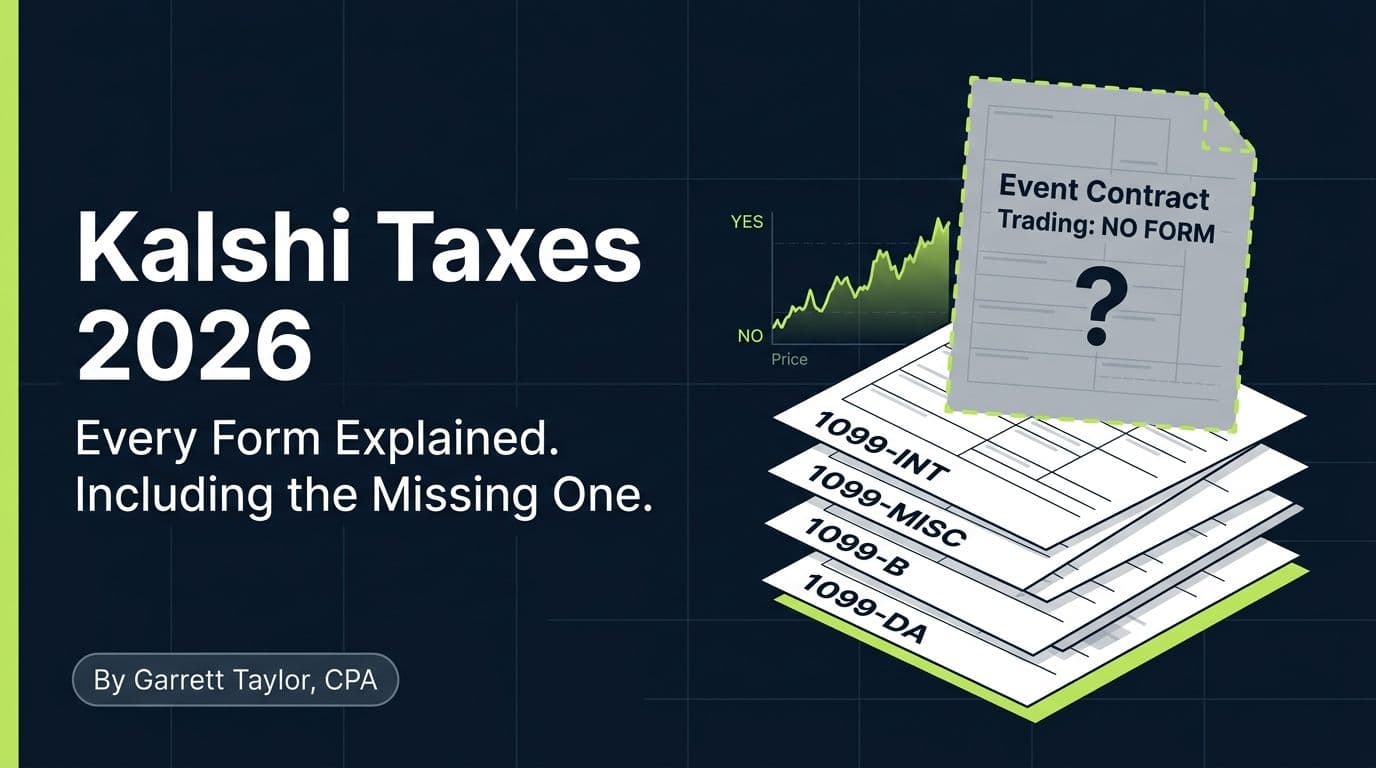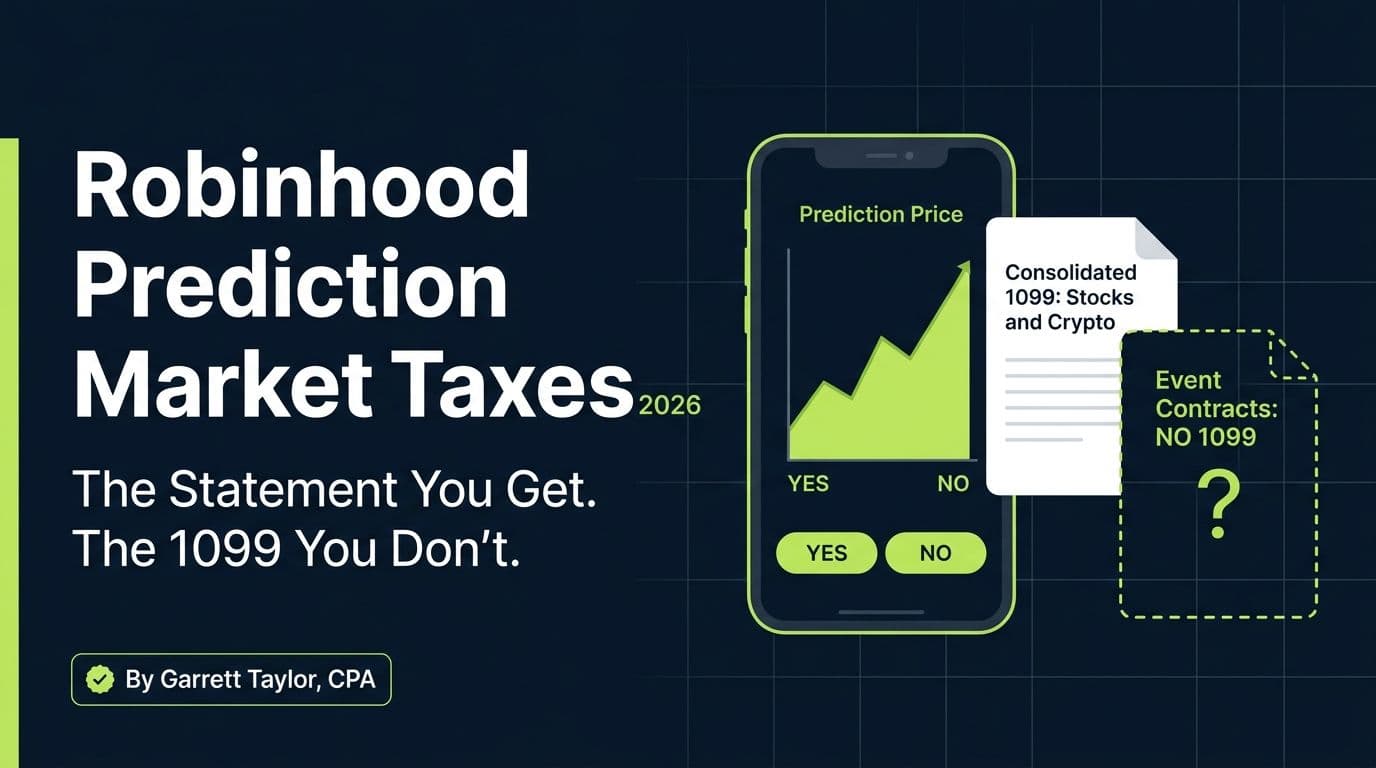
Quick answer: Yes, Robinhood prediction market profits are taxable from the first dollar, and Robinhood withholds nothing. Robinhood does not issue a 1099 for event contract trades. Instead you get an Event Contracts Annual Statement, which Robinhood itself says is not a substitute tax reporting form. Your stocks and crypto still show up on the consolidated 1099, but your event contracts appear on no IRS form at all. You compute the profit yourself, pick a defensible tax treatment (the IRS has never said which one applies), and report it. This guide walks through the statement, the missing form, the four candidate treatments, and one trader's complete year priced under each.
You traded the Fed, the World Cup, maybe the weather, all inside the same app that holds your index funds.
Then February arrives. Your Robinhood consolidated 1099 shows up right on schedule, listing every stock sale down to the penny. And your event contracts, the trades that actually made you money this year? Nowhere. Not on the 1099, not on any form the IRS will ever receive. That gap is the whole story of Robinhood prediction market taxes, and it catches thousands of filers every spring.
Here's the deal: Robinhood prediction market taxes confuse people precisely because the same account produces both the best tax paperwork in the industry and none at all. We prepare returns for prediction market traders every season, and Robinhood filers have a distinctive failure mode: they hand their preparer the consolidated 1099, assume it covers everything, and file a return that silently omits an entire income stream.
In this guide we'll walk through exactly what Robinhood sends and what it doesn't, the three-exchange plumbing under the hood and why it matters, the four candidate tax treatments with real numbers under each, and a complete worked year from trade log to filed forms.
Let's dig in.
Do You Have to Pay Taxes on Robinhood Prediction Markets? (Yes, All of It)
Start with the rule that answers most versions of this question: Section 61 of the tax code taxes all income from whatever source derived unless Congress carves out an exemption. There is no carve-out for event contracts, prediction markets, or profits that never generated a tax form.
So every profitable outcome is income. A Yes contract bought at $0.45 that settles at $1.00. A position sold early for more than you paid. A referral bonus. All taxable, whether you made $60 or $60,000, whether you withdrew the money or left it in the app, and whether or not any document ever arrives.
Two more things W-2 filers consistently miss. First, Robinhood withholds nothing from event contract profits. Every dollar arrives pre-tax, and a genuinely good year means quarterly estimated payments, not one big check in April. Second, the $600 figure people quote from gig-economy rules is a form-issuance threshold for platforms, not a tax exemption for you. And as we'll see, for 2026 payments that threshold is not even $600 anymore.
$0 withheld, 0 forms
Robinhood withholds no tax from event contract profits and files no 1099 for the trades. Every dollar of reporting responsibility transfers to you the moment a contract settles.
What Robinhood Actually Sends for Event Contracts (and What It Doesn't)
Robinhood is famous for tidy tax documents. Stocks get a 1099-B. Crypto gets a 1099-DA. Dividends, interest, options, it all lands in one consolidated PDF with a document ID you can import straight into tax software.
Event contracts break the pattern completely. Here's the full document picture for a Robinhood prediction market trader:
Robinhood Tax Documents: Event Contracts vs Everything Else (2026)
| Document | What It Covers | Event Contracts Included? | Filed With the IRS? |
|---|---|---|---|
| Consolidated 1099 (1099-B, 1099-DIV, 1099-INT, 1099-MISC) | Stocks, ETFs, options, dividends, interest, bonuses | No | Yes |
| Form 1099-DA | Robinhood Crypto digital asset sales | No | Yes |
| 1099-B Section 1256 section | Regulated futures traded through Robinhood Derivatives | No | Yes |
| Event Contracts Annual Statement | Aggregate event contract gains, losses, fees | Yes | **No** |
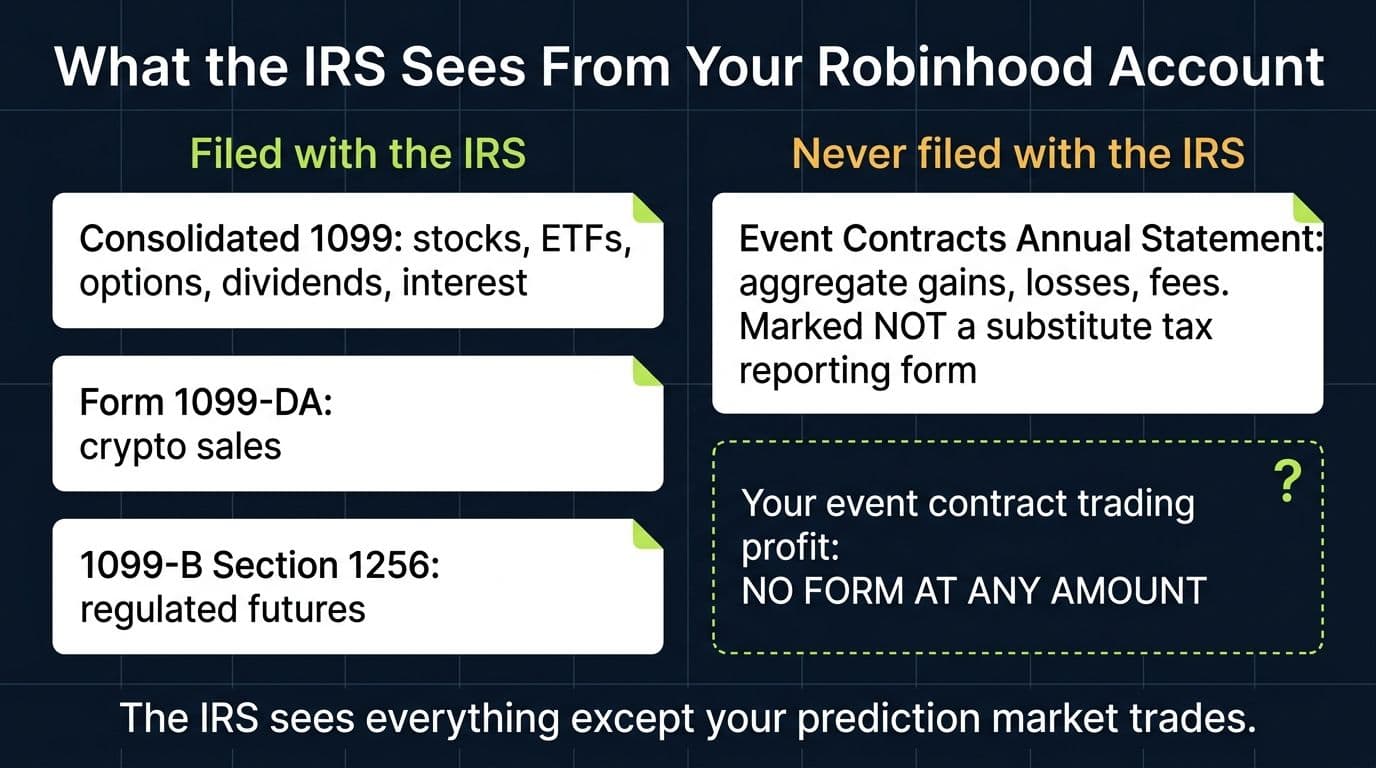
Three details in that table deserve a closer look.
The Event Contracts Annual Statement Is Not a Tax Form
The one document that does cover your prediction market activity is the Event Contracts Annual Statement, and Robinhood explicitly states it is not a substitute tax reporting form. It summarizes aggregate gains, losses, and total fees and commissions for the calendar year. It is genuinely useful as a starting point.
What it does not give you is what a tax return actually needs: individual contract acquisitions and dispositions with dates, cost basis, and proceeds. Sports contracts and macro contracts appear together in one aggregate number, which matters more than you'd think, because as we'll cover below, those two categories may not even belong under the same tax treatment. If you need position-level detail, you're exporting your own transaction history and rebuilding it.
The Consolidated 1099 Trap
This is the mistake we see most. Your consolidated 1099 from Robinhood Markets arrives in February looking complete: securities, crypto, interest, dividends, maybe a Section 1256 section if you traded regulated futures. Traders (and busy preparers) reasonably assume it covers the whole account.
It doesn't. Event contracts live in a separate reporting universe, and that universe sends nothing to the IRS. The result is a return that perfectly matches every form the IRS received while omitting the prediction market profit entirely. That's not a rounding error. That's unreported income sitting one records request away from discovery, on a KYC'd account tied to your Social Security number.
The 1099-MISC Threshold That Just Changed
Robinhood may issue a 1099-MISC for referral bonuses and promotional credits, and a 1099-INT for interest, when you cross the IRS thresholds. Here's what most guides haven't caught up with: the One Big Beautiful Bill Act raised the 1099-MISC threshold from $600 to $2,000 for payments made in 2026, with inflation indexing after that. A $700 promo bonus generated a form in 2025 and generates nothing in 2026. It is fully taxable either way. The form threshold changed; your obligation didn't.
Does Robinhood Report Prediction Markets to the IRS?
For the event contracts themselves: no. No proceeds, no basis, no net profit, no W-2G, nothing at the contract level goes to the IRS.
Before you exhale, look at what the IRS does see. Your Robinhood account is fully KYC'd. Every stock and crypto trade in the same account is reported. Interest and larger bonuses are reported. The IRS knows the account exists, knows it's active, and can see everything except the event contracts.
We'd argue that's the worst possible visibility profile for someone tempted to skip reporting. A completely invisible account is at least consistent. A Robinhood account is a lit house with one dark room: the surrounding paper trail makes the account impossible to miss, while Robinhood Derivatives keeps complete trade-level records that the IRS can summons whenever it cares to look. And a return that reports the visible income while omitting the invisible income is the easiest kind of understatement to prove.
“The Robinhood returns that go wrong are rarely deliberate. Someone imports the consolidated 1099, the software says everything matches, and the event contracts just never come up. Matching every form the IRS received is not the same thing as reporting all your income.”
, Leanne Grant, EA
The Plumbing: Kalshi, ForecastEx, and Rothera (and Why It Matters for Your Taxes)
Robinhood doesn't run a prediction market by itself. When you tap Yes or No in the app, your order flows through Robinhood Derivatives, LLC, a CFTC-registered futures commission merchant, and executes on one of three regulated exchanges. Per Robinhood's own event contracts documentation, those are KalshiEX LLC, ForecastEx LLC, and Rothera Exchange and Clearing LLC.
The timeline explains the mix. Robinhood entered prediction markets in October 2024 with presidential election contracts routed through ForecastEx. In March 2025 it launched the full Prediction Markets Hub in partnership with Kalshi, whose CFTC-designated exchange handled the bulk of volume. Then in January 2026, a Robinhood and Susquehanna joint venture completed its acquisition of the MIAXdx exchange, relaunching it as Rothera Exchange and Clearing, a CFTC-regulated designated contract market and clearinghouse. By mid 2026, World Cup and baseball contracts were already trading on Rothera, moving Robinhood toward owning its prediction market infrastructure end to end.
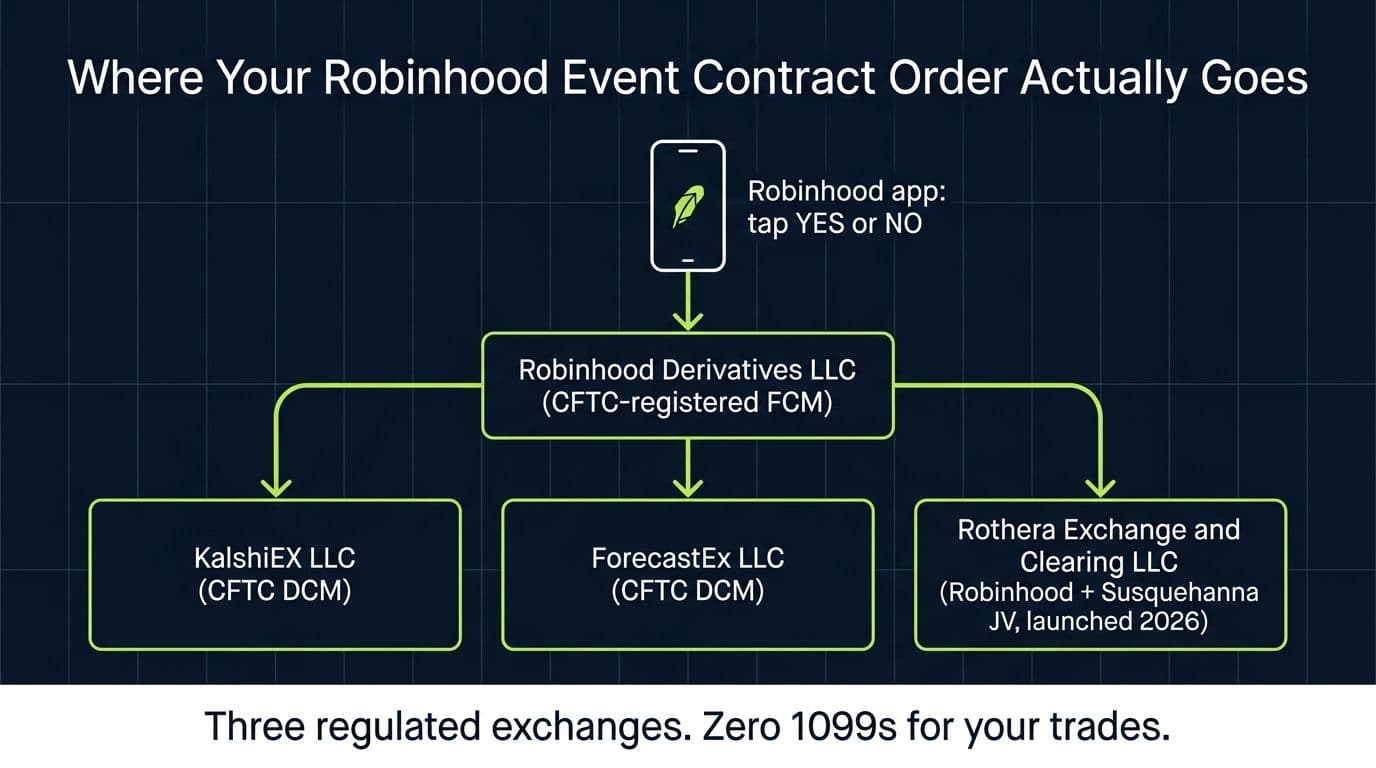
Why should a tax guide care about market plumbing? Two reasons.
First, the CFTC-regulated exchange structure is the foundation of the Section 1256 argument. Section 1256 contracts must trade on a qualified board or exchange, and a CFTC-designated contract market qualifies. Every venue Robinhood routes to clears that threshold. That does not resolve the question (the contracts must also fit one of Section 1256's enumerated contract types, which is genuinely disputed), but it keeps the argument alive.
Second, the multi-exchange structure means your trades are scattered across venues while your tax records arrive as one aggregate statement. If you ever need position-level detail, or if the tax treatment ends up differing by contract type, the reconstruction work runs through your own exports, not anything Robinhood files.
One thing the plumbing does not change: none of these exchanges issues you a 1099 for trading profits either. Kalshi's narrow forms go to direct Kalshi customers, not to Robinhood users trading through the app. If you also hold a direct Kalshi account, the forms and mechanics differ enough that we compare the two paper trails side by side below.
How Are Robinhood Event Contracts Taxed? The Four Candidate Treatments
Now the uncomfortable center of the whole topic: the IRS has never said how event contracts are taxed. No revenue ruling, no notice, no regulation. Every Robinhood prediction market trader is choosing a filing position under genuine uncertainty, whether they realize it or not. We covered the full cross-platform analysis in our prediction market taxes pillar guide; here's the Robinhood-specific version.
The Four Possible Tax Treatments of Robinhood Event Contracts
| Treatment | Where It Goes | Loss Rules | Robinhood-Specific Note |
|---|---|---|---|
| Ordinary income | Schedule 1, Line 8z | Net losses generally deductible against activity gains | The conservative default most filers use |
| Capital asset | Form 8949 + Schedule D | Offset capital gains; $3,000/yr vs ordinary income; carryforward | Can net against your stock gains in the same app |
| Section 1256 | Form 6781, 60/40 split | Netted; 3-year carryback | CFTC exchanges satisfy one prong; contract type is unresolved |
| Gambling | Schedule 1 + Schedule A | Itemizers only; 90% cap from 2026 | Biggest risk for sports-heavy accounts |
Ordinary Income: The Conservative Default
Compute net profit (proceeds minus cost minus fees), report it as Other Income on Schedule 1, Line 8z, labeled something like "Robinhood event contract trading." Taxed at your ordinary rate. Simple, defensible, and it never overstates a benefit the IRS might claw back.
Capital Asset: The Netting Play
Event contracts are arguably property under Section 1221, making gains and losses capital, reported on Form 8949 and Schedule D. Almost everything will be short-term (event contracts rarely live longer than a year), so the rate usually matches ordinary treatment. The real difference is losses: capital losses offset capital gains from anything, including the stocks sitting in the same Robinhood account, plus $3,000 a year against ordinary income with unlimited carryforward.
Section 1256: The 60/40 Prize With an Asterisk
Section 1256 taxes qualifying contracts at a blended 60% long-term, 40% short-term rate with mark-to-market accounting and a three-year carryback for net losses. Commentators, including a widely cited Forbes analysis calling prediction markets the tax-advantaged way to gamble on sports, have made the case for event contracts.
Here's the honest state of play. Robinhood's venues clear the qualified-exchange prong. The fight is over contract type: a binary contract that pays $1 or $0 on a discrete factual outcome has to qualify as a non-equity option or regulated futures contract, the CFTC has described event contracts as binary options that are swaps in other contexts, and the Dodd-Frank swap exclusion in Section 1256(b)(2)(B) may knock them out entirely. KPMG's analysis treats the question as open. Interestingly, Robinhood's own tax documentation describes the Section 1256 section of its 1099-B as covering regulated futures and non-equity options, and event contracts are conspicuously not reported there. If you take a 1256 position, get the analysis documented, apply year-end mark-to-market correctly, and consider a Form 8275 disclosure. Do not claim it because a chart on the internet said 60/40.
Gambling: The Treatment You Don't Want (Especially Now)
If event contracts are wagering, winnings are gross income and losses deduct only on Schedule A, only for itemizers, only against winnings, and starting with 2026 tax years, only up to 90% of losses under the One Big Beautiful Bill Act. Take the standard deduction and your losses do nothing at all. Most practitioners do not treat exchange-traded event contracts as gambling by default, but the argument is strongest exactly where Robinhood's growth is: sports.
The Mixed-Book Problem Nobody Warns You About
Here's a wrinkle specific to how people actually use Robinhood: the characterization analysis arguably runs contract by contract, not account by account. A "Fed cuts rates" contract and a "Chiefs win the Super Bowl" contract raise different questions. Sports contracts carry the highest wagering-characterization risk; macro and economic contracts look far more like financial instruments. A trader who runs both through a single framework without thinking about the mix is making the most common error in this space. At minimum, keep your own records split by category, because the Annual Statement won't do it for you.
A Worked Example: Dana's Robinhood Prediction Market Year
Numbers make this concrete. Meet Dana: 22% federal bracket, standard deduction, no Robinhood Gold, and eight event contract positions across 2026. Here's her complete trade log.
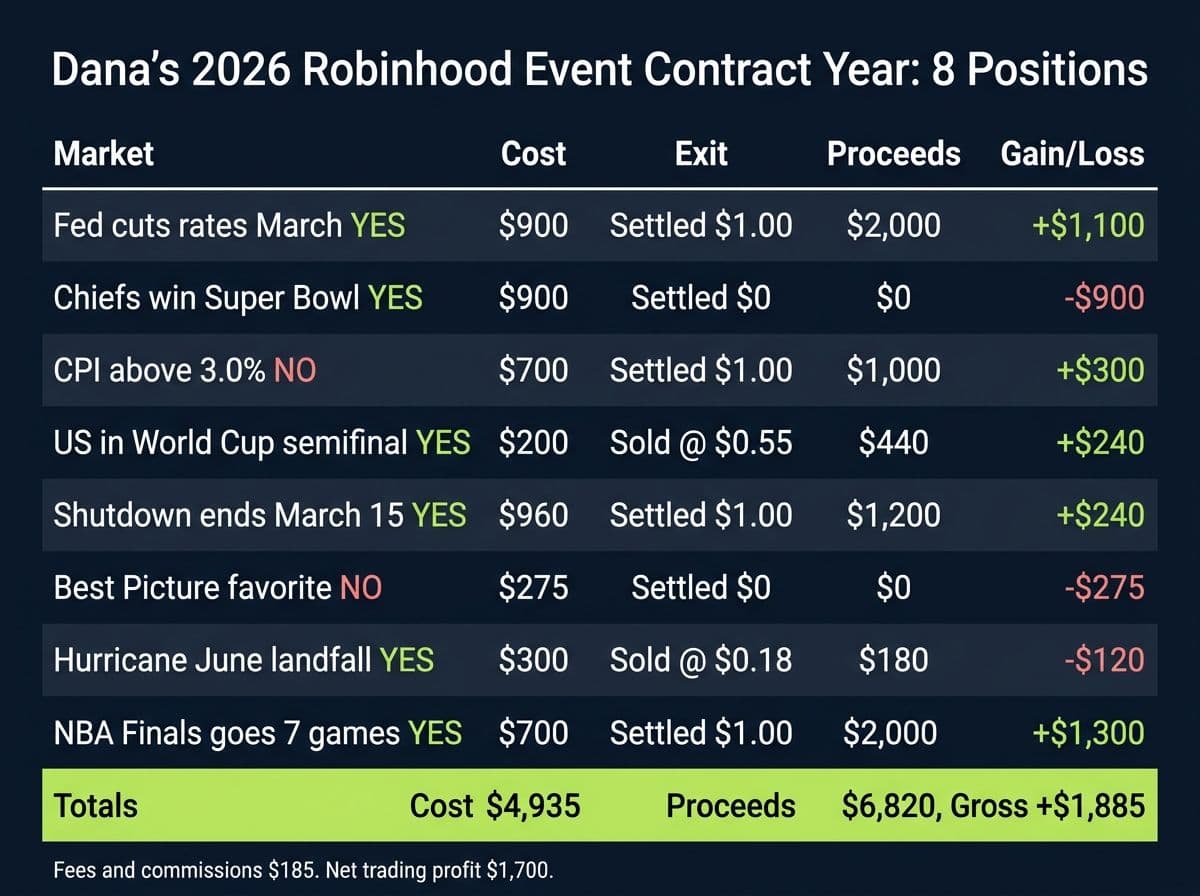
Dana's 2026 Event Contract Trade Log
| Market | Contracts | Cost | Exit | Proceeds | Gain/Loss |
|---|---|---|---|---|---|
| Fed cuts rates in March: YES | 2,000 @ $0.45 | $900 | Settled $1.00 | $2,000 | +$1,100 |
| Chiefs win Super Bowl: YES | 1,500 @ $0.60 | $900 | Settled $0 | $0 | -$900 |
| CPI above 3.0%: NO | 1,000 @ $0.70 | $700 | Settled $1.00 | $1,000 | +$300 |
| US reaches World Cup semifinal: YES | 800 @ $0.25 | $200 | Sold @ $0.55 | $440 | +$240 |
| Shutdown ends by March 15: YES | 1,200 @ $0.80 | $960 | Settled $1.00 | $1,200 | +$240 |
| Best Picture favorite wins: NO | 500 @ $0.55 | $275 | Settled $0 | $0 | -$275 |
| Hurricane US landfall in June: YES | 1,000 @ $0.30 | $300 | Sold @ $0.18 | $180 | -$120 |
| NBA Finals goes 7 games: YES | 2,000 @ $0.35 | $700 | Settled $1.00 | $2,000 | +$1,300 |
Totals: $4,935 cost, $6,820 proceeds, $1,885 gross profit. Her Annual Statement also shows $185 in total fees and commissions for the year (more on that below), so her net trading profit is $1,700. Winning positions gained $3,180 gross; losing positions lost $1,295.
What Actually Arrives in January
Dana also sold some index fund shares during the year, so in February she gets a consolidated 1099 showing those stock sales. For the event contracts: an Annual Statement showing aggregate figures, and no 1099 of any kind. The IRS's complete picture of Dana's year contains her stock trades and nothing else. The $1,700 only enters her return if she puts it there.
The Same Year Under All Four Treatments
Now price Dana's identical trading year under each candidate treatment:
Dana's $1,700 Net Profit: Federal Tax Under Each Treatment (22% Bracket, 2026)
| Treatment | How It's Computed | Federal Tax |
|---|---|---|
| Section 1256 (if it applied) | 60% at 15% LTCG + 40% at 22% on $1,700 | $303 |
| Ordinary income | $1,700 at 22% | $374 |
| Capital asset (all short-term) | $1,700 at 22% | $374 |
| Gambling, itemizing | $3,180 winnings minus 90% of $1,480 losses, at 22% | $407 |
| Gambling, standard deduction | $3,180 gross winnings at 22%, losses wasted | $700 |
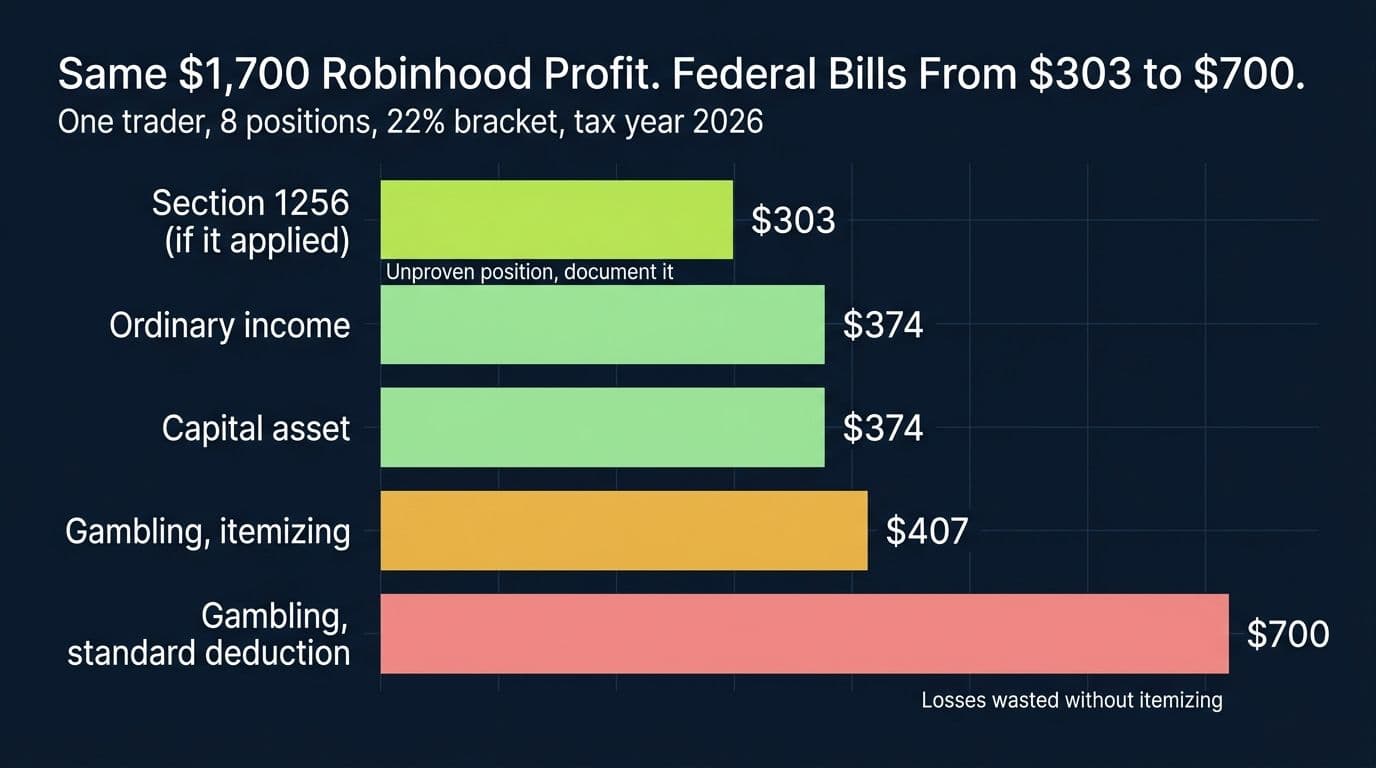
Same trades, same profit, and the bill ranges from $303 to $700. Add a zero to Dana's numbers and the characterization question is worth thousands. (The gambling rows treat each position as a separate wagering transaction and fold fees into the wagers; the IRS has never defined a "session" for continuous digital markets, which is one more unsettled layer.)
And notice the mixed-book stakes hiding in her log. Dana's sports and entertainment positions (Super Bowl, World Cup, NBA Finals, Best Picture) netted +$365 while her macro positions netted +$1,520. If a future IRS position treats the sports side as gambling while the macro side stays ordinary, her clean single-number filing splits into two regimes with different loss rules. Records split by category cost nothing today and solve an expensive problem later.
Not Sure Which Treatment Fits Your Year?
We prepare returns for prediction market traders: treatment analysis documented, records rebuilt, and a return that holds up if the IRS ever asks. Flat-fee, handled by a CPA who does this all season.
Book a callFree 15 minute call. No commitment.
The Fee Math Nobody Notices at Tax Time
Robinhood moved to probability-weighted commissions on June 1, 2026: commission = k x p x (1 - p) x c, where k is 10% (or 5% with Gold), p is the contract price, and c is the contract count, capped at $0.01 per contract. Exchange fees add up to another $0.01 per contract on opening and closing trades. Cheap per contract, real money at volume: Dana's 10,000 contracts generated $185 in combined fees and commissions.
The tax point: fees are not a deduction you claim separately, they belong inside your gain and loss math. Under ordinary or capital treatment, fees fold into cost basis and reduce proceeds, exactly like stock commissions. Your Annual Statement reports Total fees and commissions as one aggregate line, so if you rebuild position-level records, allocate fees to positions rather than double-counting them as both basis and expense. Under gambling treatment fee handling gets murkier, one more reason that characterization creates work.
Robinhood vs Direct Kalshi: Same Contracts, Different Paper Trails
Plenty of traders hold both a Robinhood account and a direct Kalshi account, and it's worth being precise about how the taxes on Robinhood prediction markets differ from trading the same markets on Kalshi directly, because the differences are all paperwork, not law.
Robinhood vs Direct Kalshi: The Tax Paperwork (2026)
| Feature | Robinhood Event Contracts | Direct Kalshi Account |
|---|---|---|
| Form for trading profit | None | None |
| Year-end summary | Event Contracts Annual Statement | PnL statement (FIFO) |
| Interest income | 1099-INT if $10+ | 1099-INT if $10+ (APY program) |
| Bonuses and promos | 1099-MISC at $2,000+ (2026) | 1099-MISC at $2,000+ (2026) |
| Crypto deposit forms | Not applicable (USD only) | 1099-B / 1099-DA via ZeroHash |
| Settlement | US dollars | US dollars |
The punchline: neither venue sends the IRS your trading profit, and both leave the characterization question entirely to you. The real differences are at the edges. Kalshi's APY program pays interest on cash and open-position collateral, so direct Kalshi traders almost always have a 1099-INT anchoring their account in IRS systems. Kalshi also accepts crypto deposits, which trigger their own taxable conversions and forms; Robinhood's event contract flow is dollars only. And each platform's summary uses its own conventions, so if you trade both, compute each venue's P&L separately and report them as what they are: two accounts, one activity, one set of consistent treatment decisions across both. Our full Kalshi taxes guide covers the direct-account side form by form.
What you should not do is assume either platform's statement is filing-ready, or let the treatment you pick on one account contradict the position you take on the other. Consistency across venues is one of the first things an examiner would check.
How to Report Robinhood Event Contracts, Step by Step
Here's the workflow we use in practice:
- Download everything in January. The Event Contracts Annual Statement plus your full transaction history export. Don't rely on the app staying available forever; regulators have already forced contract delistings in some states.
- Rebuild your net number. Total proceeds minus total cost minus total fees. Verify the aggregate against the Annual Statement before trusting either.
- Split by category. Sports and entertainment in one bucket, macro and economic in another. You may file them identically this year; keep the split anyway.
- Pick your treatment deliberately. Ordinary income on Schedule 1 Line 8z is the conservative default. Capital treatment goes on Form 8949 and Schedule D. Section 1256 requires documented analysis and Form 6781. Get advice before electing anything exotic.
- Report the side income separately. Bonuses and promotional credits are ordinary income whether or not a 1099-MISC arrives, and interest is interest. Don't bury them in your trading P&L.
- Answer the digital asset question correctly. Robinhood event contracts settle in dollars, so the contracts themselves are not digital assets. If you traded crypto in the same app, that's a separate answer and a separate form (the 1099-DA).
- Plan estimates for next year. Profitable traders owe quarterly estimated payments. The IRS charges interest on underpayment even when every dollar gets reported eventually.
Pro Tip
Keep a one-page memo with your return: which treatment you used, why, and how you computed the number. If the IRS ever asks about an unguided area like event contracts, contemporaneous documentation is the difference between a position and an improvisation.
Losses, the 90% Cap, and Why 2026 Raised the Stakes
Losing years happen, and this is where treatment choice really bites.
Under ordinary treatment, a net trading loss from the activity generally offsets the activity's gains, with the deductibility of a true net loss depending on how the activity is classified. Under capital treatment, net losses offset any capital gains plus $3,000 of ordinary income per year, and carry forward. Under Section 1256 (if it applied), net losses can even carry back three years against prior 1256 gains.
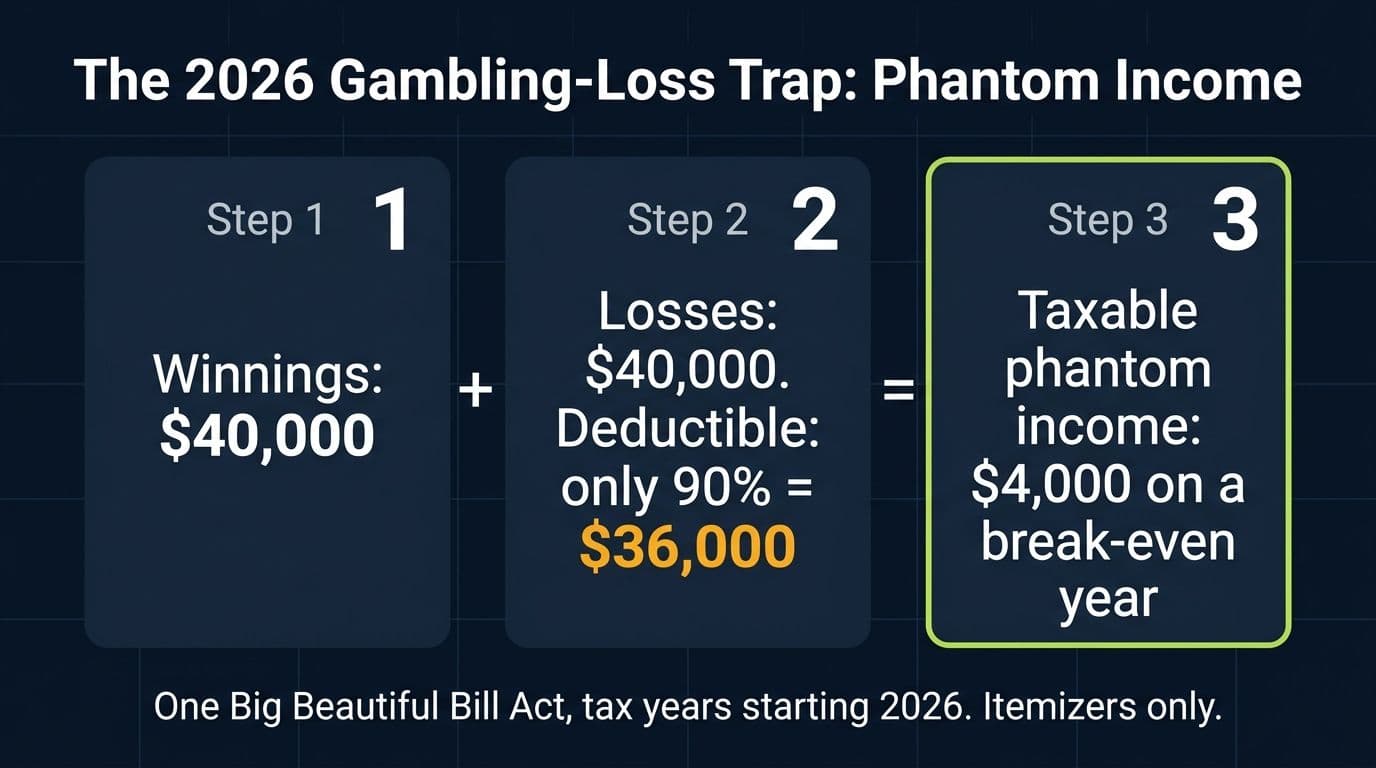
Under gambling treatment, the 2026 rules are brutal. The One Big Beautiful Bill Act amended Section 165(d) so that, for tax years beginning after December 31, 2025, gambling losses are deductible only up to 90% of losses (and still capped at winnings, still itemizers-only). Run the phantom-income math: win $40,000, lose $40,000, break exactly even, and the deduction caps at $36,000. You pay tax on $4,000 you never made. That's the strongest practical argument for keeping event contract activity out of the gambling bucket where the facts support it, and for getting professional analysis where they don't.
One more 2026 note: state rules are drifting too. Maryland residents can't trade Robinhood event contracts at all, Nevada blocked new sports contracts, and several states are litigating whether sports event contracts are gambling under state law. Your state return may not follow your federal characterization, especially in states that tax gross gambling winnings without allowing loss deductions. If you're filing in a gross-winnings state, the characterization question gets a second, state-sized price tag.
When to DIY and When to Bring In a Pro
Straight talk:
Handling Robinhood prediction market taxes yourself is fine if: your net profit is modest, your positions are mostly macro rather than sports, you're comfortable reporting ordinary income on Schedule 1, and your Annual Statement reconciles cleanly against your own export.
Get professional help if: you're up (or down) five figures, your book mixes sports and macro contracts, you're weighing a Section 1256 or capital position, you also trade on Kalshi or crypto-settled platforms like Polymarket, you have unreported prior years, or the OBBBA phantom-income math could apply to you. Here's what a crypto-specialized CPA costs and how to vet one.
The economics are simple. Dana's spread was $303 to $700 on a $1,700 year. Scale that spread to a real trading year and the characterization analysis pays for itself several times over, before counting the value of a return that's actually defensible. Robinhood prediction market taxes are not hard because the math is hard; they're hard because nobody hands you the number and nobody tells you the rules. Both problems are solvable.
Get Your Robinhood Year Filed Right
Flat-fee preparation for prediction market traders: Annual Statement reconciled, sports and macro categories split, treatment documented, return signed by a CPA who has done this before.
Book a callFree 15 minute call. No commitment.
FAQ: Robinhood Prediction Market Taxes
Frequently Asked Questions
Do you have to pay taxes on Robinhood prediction markets?
Yes. All event contract profits are taxable from the first dollar, whether or not you receive any tax form and whether or not you withdraw the money. Robinhood withholds nothing, so the full reporting and payment obligation is yours.
Does Robinhood report prediction markets to the IRS?
Not at the contract level. Robinhood issues no 1099 for event contract trading and the Annual Statement is not filed with the IRS. But the account is fully KYC'd, your stocks and crypto in the same account are reported, and Robinhood Derivatives keeps complete records the IRS can request.
Does Robinhood send a 1099 for event contracts?
No. Robinhood provides an Event Contracts Annual Statement summarizing aggregate gains, losses, and fees, and explicitly states it is not a substitute tax reporting form. A 1099-MISC can arrive for referral bonuses above the threshold ($600 for 2025, $2,000 for 2026) and a 1099-INT for interest, but no 1099 covers the trades.
Are Robinhood prediction markets considered gambling for taxes?
There's no IRS guidance either way. Most practitioners treat exchange-traded event contracts under ordinary income or capital asset principles, but sports contracts carry real wagering-characterization risk. The stakes rose in 2026: gambling losses are now deductible only up to 90% of losses, and only for itemizers.
What tax form do I use to report Robinhood event contracts?
It depends on your treatment. Most filers report net profit as Other Income on Schedule 1, Line 8z. A capital asset position uses Form 8949 and Schedule D. A documented Section 1256 position uses Form 6781. Bonuses and interest are reported separately from trading profit.
Do Robinhood event contracts show up on the consolidated 1099?
No. The consolidated 1099 covers securities, crypto, dividends, interest, and regulated futures. Event contracts appear only on the separate Annual Statement, which is not an IRS form. Assuming the consolidated 1099 covers the whole account is the most common Robinhood filing mistake.
Can I deduct Robinhood event contract losses?
Generally yes, but the mechanics depend on treatment. Ordinary treatment nets losses against the activity's gains. Capital treatment offsets capital gains plus up to $3,000 of ordinary income per year with carryforward. Gambling treatment helps only itemizers, only against winnings, and only up to 90% of losses from 2026.
Can Robinhood prediction market losses offset my stock gains?
Only under capital asset treatment, where event contract losses net against capital gains from stocks on Form 8949 and Schedule D. Under gambling treatment they cannot, and under ordinary treatment the netting stays inside the activity.
Do Robinhood event contracts qualify for Section 1256 60/40 treatment?
Unresolved. Robinhood routes contracts through CFTC-designated exchanges (Kalshi, ForecastEx, and Rothera), which satisfies the qualified-exchange prong, but whether binary event contracts fit Section 1256's enumerated contract types is genuinely disputed, and Robinhood itself does not report them in the Section 1256 section of its 1099-B. Take the position only with documented analysis and consider a Form 8275 disclosure.
Do I have to report Robinhood prediction markets if I made less than $600?
Yes. The $600 figure (now $2,000 for 2026 payments) is a form-issuance threshold for things like referral bonuses, not a tax exemption. Trading profit is taxable from the first dollar regardless of whether any form exists.
Where do I find my Robinhood Event Contracts Annual Statement?
In the app under your account's tax documents and statements section, alongside your consolidated 1099. Download it and your full event contract transaction history each January, and reconcile the two before filing.
What happens if I don't report Robinhood prediction market profits?
You've understated income on a fully KYC'd account with a partial paper trail, which is the easiest kind of omission for the IRS to prove once it looks. Penalties scale from accuracy-related (20%) toward civil fraud (75%) depending on intent. If you have unreported prior years, fix them proactively before a notice arrives.