Quick answer: Prediction-market profits are taxable, but the IRS has not assigned every contract to one federal tax regime. Depending on the product and platform, the income may be analyzed as ordinary income, capital gain, Section 1256 gain, or wagering income. Crypto-settled trades can also create separate digital-asset disposals.
Prediction markets went mainstream fast. You can now trade the Fed, the World Cup, and the weather on your phone, and Americans put over $3.3 billion into Polymarket's 2024 presidential markets alone.
The tax rules did not go mainstream with them.
Here's the problem: the IRS has never said how prediction market winnings should be taxed. Not for Kalshi, not for Polymarket, not for the Robinhood contracts riding on top of Kalshi's exchange. Meanwhile the platforms send you anywhere from partial tax forms to absolutely nothing.
We file returns for prediction market traders across every major platform, and in this guide we'll give you the map: which platforms send which forms, how the crypto-settled exchanges differ from the dollar ones, what the four possible tax treatments are, and a worked example showing the same bet taxed on two different rails.
Let's get into it.
Are Prediction Market Winnings Taxable?
Yes. Prediction-market profits are taxable even if no tax form arrives and even if the cash or crypto remains on the platform.
Section 61 of the tax code taxes all income from whatever source derived, and there's no carve-out for event contracts. If you bought a Yes contract for $0.40 and it settled at $1.00, the $0.60 is income. If you sold a position early at a profit, that's income too.
Three things people get wrong immediately:
- A reporting threshold never creates a tax-free amount. Prediction-market income remains taxable from the first dollar even when no information return is required.
- No form does not mean no tax. Most prediction market activity generates no comprehensive 1099 anywhere. The reporting obligation is yours either way.
- Nothing is withheld. Unlike a paycheck, your winnings arrive gross. Big year? Plan for the bill, and consider estimated payments.
So the "do I owe taxes" question is easy. The real questions are what forms exist, what rate applies, and how losses work. All three depend on which platform you're using. Which brings us to the split that organizes this entire guide.
What Determines How a Prediction Market Trade Is Taxed?
Two facts drive the analysis: the legal type of contract you traded and whether settlement occurred in dollars or digital assets.
Contract type affects whether ordinary, capital, Section 1256, or wagering rules may apply, while settlement method determines whether a separate digital-asset reporting layer exists.
Fiat-settled platforms pay you in US dollars. You deposit dollars, you win dollars, you withdraw dollars. Tax-wise there's exactly one thing happening: gains and losses on event contracts.
Crypto-settled platforms pay you in cryptocurrency, almost always the stablecoin USDC. And because the IRS treats digital assets as property, every USDC movement is itself a potential tax event. You get the event contract layer plus a crypto layer stacked on top, and you'll answer "yes" to the Form 1040 digital asset question.
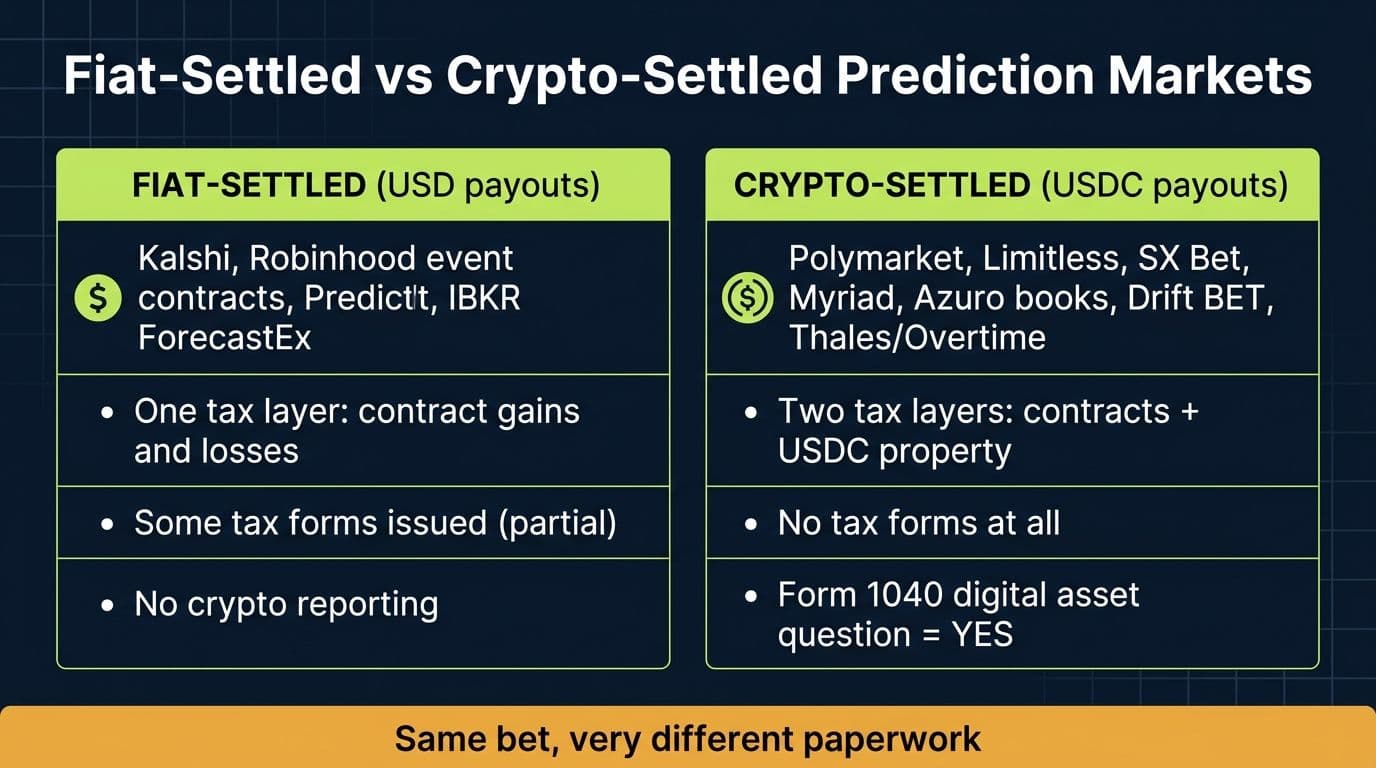
Here's the full map as of 2026:
Prediction Market Platforms by Settlement Type (2026)
| Platform | Settlement | Regulation | Tax documents | Crypto tax layer |
|---|---|---|---|---|
| Kalshi | USD | CFTC DCM | PnL statement; limited activity may generate 1099-INT, 1099-MISC, 1099-B, or 1099-DA | Only if crypto is deposited or withdrawn |
| Robinhood event contracts | USD | CFTC-regulated intermediaries and venue | Check the annual statement and current tax documents | No |
| PredictIt | USD | CFTC no-action framework | Check current platform records and tax documents | No |
| Interactive Brokers ForecastEx | USD | CFTC DCM | Check the current consolidated statement and tax documents | No |
| Polymarket.com | On-chain digital assets | International product; not the CFTC-regulated US DCM | Check current platform records | Yes |
| Polymarket US | Check the specific US product and statement | QCX LLC d/b/a Polymarket US is a CFTC-designated contract market | Check current US product documentation | Depends on product and settlement method |
| Limitless Exchange | USDC (Base) | Offshore/on-chain | None | Yes |
| SX Bet | USDC | Offshore/on-chain | None | Yes |
| Myriad | Crypto (Abstract/Linea) | On-chain | None | Yes |
| Azuro-based books | USDC/USDT pools | On-chain protocol | None | Yes |
| Drift BET | USDC (Solana) | On-chain | None | Yes |
| Thales / Overtime | Crypto (Optimism/Arbitrum) | On-chain | None | Yes |
Bold takeaway: if your payout arrives in USDC, you have crypto taxes now, even if you never touched Bitcoin in your life.
Let's walk each family.
How Are Fiat-Settled Prediction Markets Taxed?
Fiat settlement removes the separate crypto-disposal layer, but the form and tax treatment still depend on the platform and the contract.
Kalshi Taxes: What You Actually Get (and Don't)
For the form-by-form breakdown, a full worked trading year, and the filing workflow, see our complete Kalshi taxes guide.
Kalshi is the flagship US prediction market: a CFTC-regulated Designated Contract Market that settles everything in dollars. Because "Kalshi taxes" generates more searches than any other platform, let's be surgical about what Kalshi actually provides, straight from Kalshi's own documentation:
- A Profit and Loss (PnL) statement summarizing your trading activity: profits, losses, and fees, calculated FIFO. Find it under Account, then Tax Info. This is your best starting document, but it is not an IRS information return.
- 1099-INT if Kalshi paid you interest on cash balances.
- 1099-MISC for credits and rewards (referral bonuses and promos), not trading profits.
- 1099-B covering proceeds from broker transactions involving crypto transfers.
- 1099-DA for digital asset transactions, issued through its custodian ZeroHash, if you funded with crypto.
Notice what's missing? Kalshi does not issue a comprehensive 1099 covering your event contract trading gains. Plenty of articles claim Kalshi "sends a 1099 if you profit $600+." That's not how it works. The 1099-MISC covers promos, and your actual trading P&L arrives on a statement, not an IRS form.
What that means practically: download your full trade history, compute net profit (proceeds minus cost, minus fees), and report it yourself. Most Kalshi filers report the net figure as Other Income on Schedule 1, Line 8z, or take a capital asset position on Form 8949. Some take the aggressive Section 1256 position (more below).
Pro Tip
Even when a Kalshi form does arrive, reconcile it against your own records before filing. A 1099-MISC for a $700 referral bonus is rewards income; don't accidentally double-count it inside your trading P&L.
Robinhood Prediction Market Taxes: The Form That Never Comes
For the Annual Statement mechanics, the consolidated 1099 trap, and a full worked year under every treatment, see our complete Robinhood prediction market taxes guide.
Robinhood's event contracts run through Robinhood Derivatives LLC, a CFTC-registered futures commission merchant, and execute on Kalshi's exchange. Dollars in, dollars out, familiar app.
Here's what surprises people: Robinhood has stated it will not issue 1099s for event contract trades. You get an "Event Contracts Annual Statement" instead, which Robinhood itself labels as not a substitute tax reporting form.
So despite trading on the most mainstream brokerage app in America, you're in the same self-reporting position as a Kalshi trader: export the statement, compute net gain or loss, pick a defensible treatment, report it. The trades don't appear on the consolidated 1099 that covers your Robinhood stocks.
PredictIt Taxes
PredictIt winnings remain taxable whether or not a form arrives. Check the current platform statement and tax documentation instead of assuming an older $600 practice still applies, and use the general 2026 information-return rules for any covered payment.
Interactive Brokers ForecastEx
ForecastEx is a CFTC-designated contract market owned by Interactive Brokers. Check the current IBKR consolidated statement and product documentation, then reconcile any reported amount to the actual proceeds, cost, fees, and economic result before filing.
Action steps for fiat platform traders:
- Download every platform's year-end statement and full trade export in January.
- Compute net P&L yourself; never assume a form is complete or correct.
- Note which forms went to the IRS (they get matched) and reconcile before filing.
What Is the 1099-MISC Threshold for Prediction Markets in 2026?
For covered payments made in 2026, the general federal Form 1099-MISC threshold increased to $2,000, but a platform may still issue a form below that amount and income remains taxable when no form arrives.
How Are Crypto-Settled Prediction Markets Taxed?
On crypto-settled markets, track both the gain or loss on the event contract and each taxable disposal of USDC or other digital-asset property.
Polymarket.com, Limitless Exchange, SX Bet, Myriad, Drift BET, and other on-chain products commonly settle positions in digital assets, often USDC.
That single design choice triggers three tax consequences that fiat traders never face:
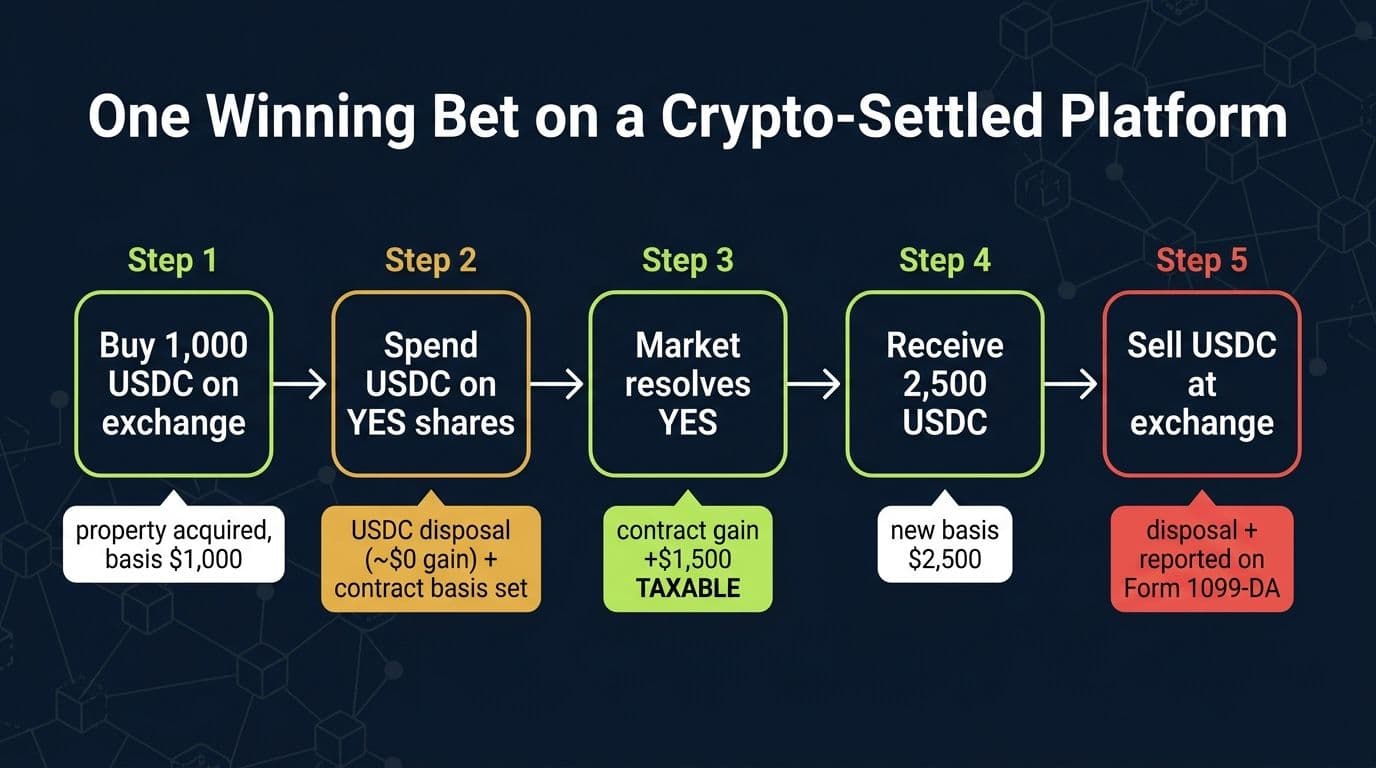
1. Every payout is a crypto acquisition. Win 2,500 USDC and you now hold property with a $2,500 cost basis. Sell it, swap it, or spend it later and that's a second taxable disposal. Our guide to crypto-to-crypto trades covers why each hop matters.
2. Separate the products. Polymarket.com and Polymarket US are different products. Polymarket.com uses an on-chain international rail, while QCX LLC d/b/a Polymarket US is listed as a CFTC-designated contract market. Check each product, settlement method, statement, and tax document separately.
3. The IRS still sees you. Every trade lives permanently on a public blockchain, and the moment your USDC touches a KYC exchange like Coinbase, the exchange's Form 1099-DA reports your proceeds to the IRS, usually with a blank cost basis. Unexplained proceeds are precisely what triggers automated mismatch notices. If one already found you, here's how to respond to an IRS crypto notice.
Polymarket is by far the biggest of these, and it deserves its own deep dive: the four-framework analysis, a full 10-position worked filing, and the 1099-DA off-ramp trap are all covered in our complete guide to Polymarket taxes.
Are Polymarket US and Polymarket.com Taxed the Same Way?
Not automatically. Polymarket US and Polymarket.com are separate products, so their regulation, settlement assets, records, and tax analysis must be checked separately.
Polymarket's product-separation guidance explains the website and US app distinction, and the CFTC designated contract market list identifies the regulated US venue.
Pro Tip
"Crypto gambling taxes" shortcuts on Reddit often suggest reporting only your final cash-out. That's wrong on both layers: the contract gains were taxable when positions settled, and the USDC disposals are taxable when they happen. Reporting only the off-ramp understates income in the trading years and mismatches the blockchain record.
Are Prediction Markets Taxed as Gambling, Capital Gains, Ordinary Income or Section 1256?
The IRS has not issued comprehensive prediction-market guidance, so none of these four treatments applies automatically to every platform or contract.
The correct analysis depends on the legal product, the platform, the taxpayer's facts, and the reporting position supported by the records.
The Four Candidate Tax Treatments for Prediction Market Winnings
| Treatment | Reported On | Rate | Loss Rules |
|---|---|---|---|
| Ordinary income (common default) | Schedule 1, Line 8z | 10-37% | Depends on investment, business, and other facts; not automatically fully deductible |
| Capital asset | Form 8949 + Schedule D | Short-term = ordinary; long-term 0/15/20% | Offset gains; $3,000/yr vs ordinary income; carryforward |
| Gambling | Schedule 1 + Schedule A | 10-37% on gross winnings | Itemizers only; 90% cap from 2026 |
| Section 1256 | Form 6781 | 60/40 blend (max ~28%) | Netted; 3-year carryback |
The framework fight matters most in two places:
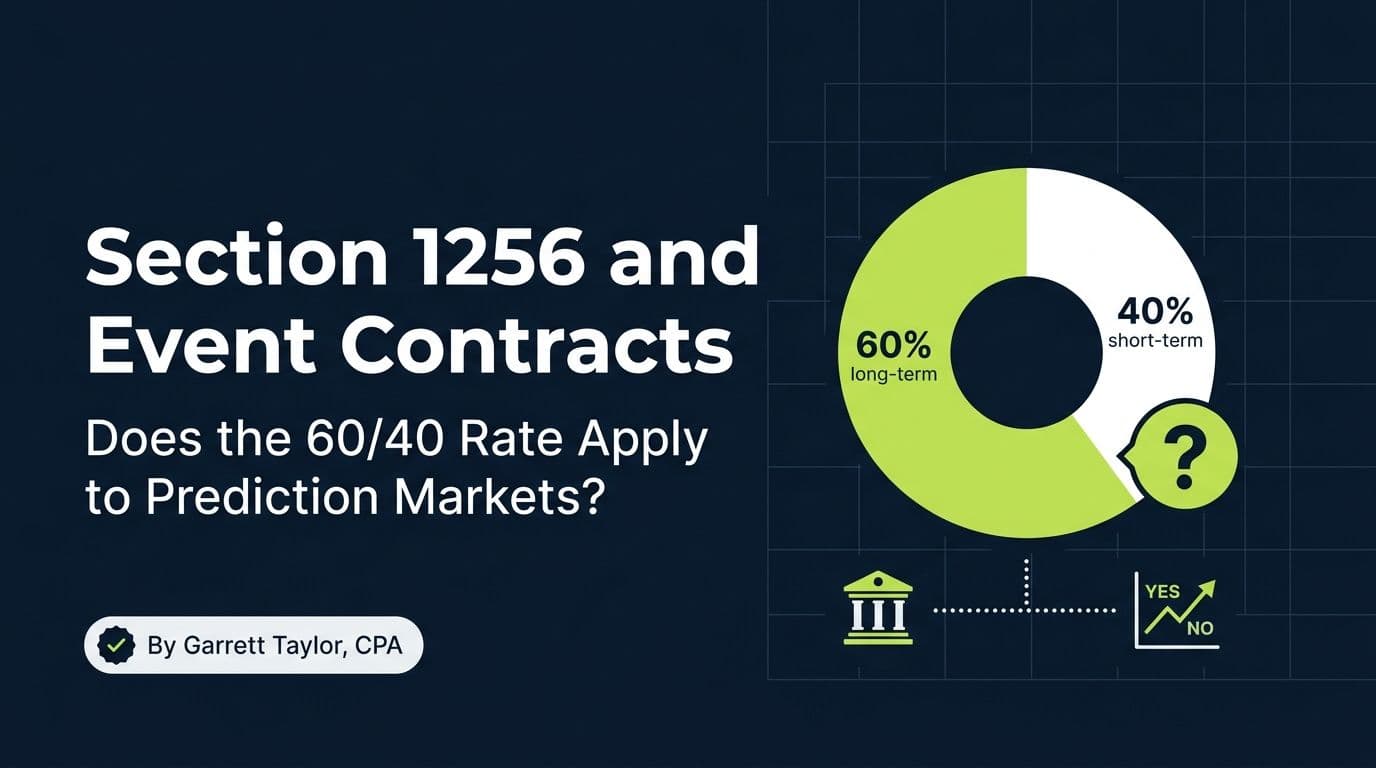
The Section 1256 question is strongest for products that satisfy the IRS regulated-futures categories. Many CFTC-listed event contracts are binary-option swaps, which may fall within the statutory swap exclusion, so venue status alone does not settle the tax result.
We walk the full statutory test, the worked 60/40 math, and the Form 6781 and Form 8275 mechanics in our dedicated Section 1256 event contracts analysis.
How Does the 2026 Gambling Loss Cap Affect Prediction Markets?
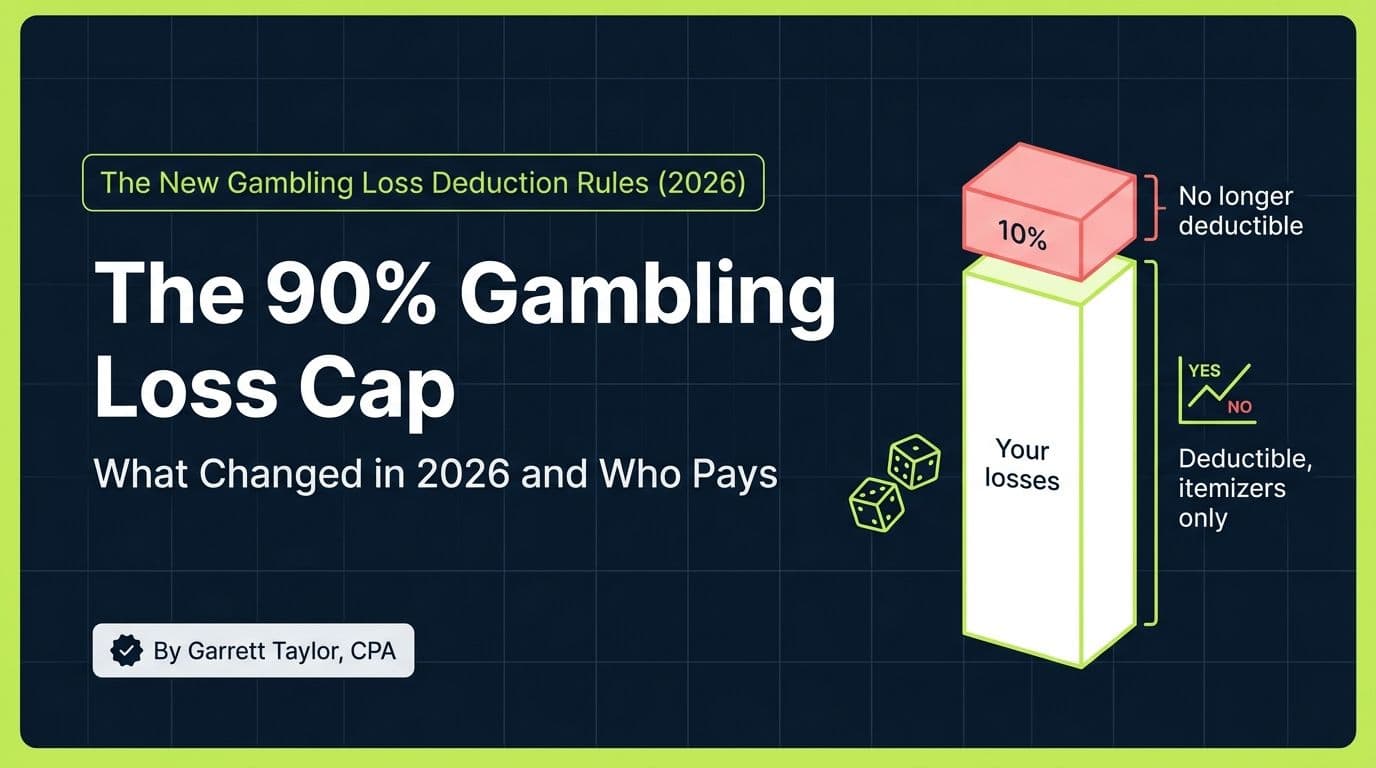
If prediction-market activity is treated as wagering, the 2026 federal deduction is generally limited to the lesser of 90% of gambling losses or gambling winnings, and the deduction requires itemization.
The gambling question, which is now expensive to lose. A March 2026 Ipsos poll found 61% of Americans think prediction market trading is closer to gambling than investing. If the IRS or courts agree, winnings are ordinary income under the gambling income rules, and losses deduct only for itemizers, only against winnings. And starting with 2026 returns, the One Big Beautiful Bill Act caps the gambling loss deduction at 90% of losses.
Watch the phantom income that creates:
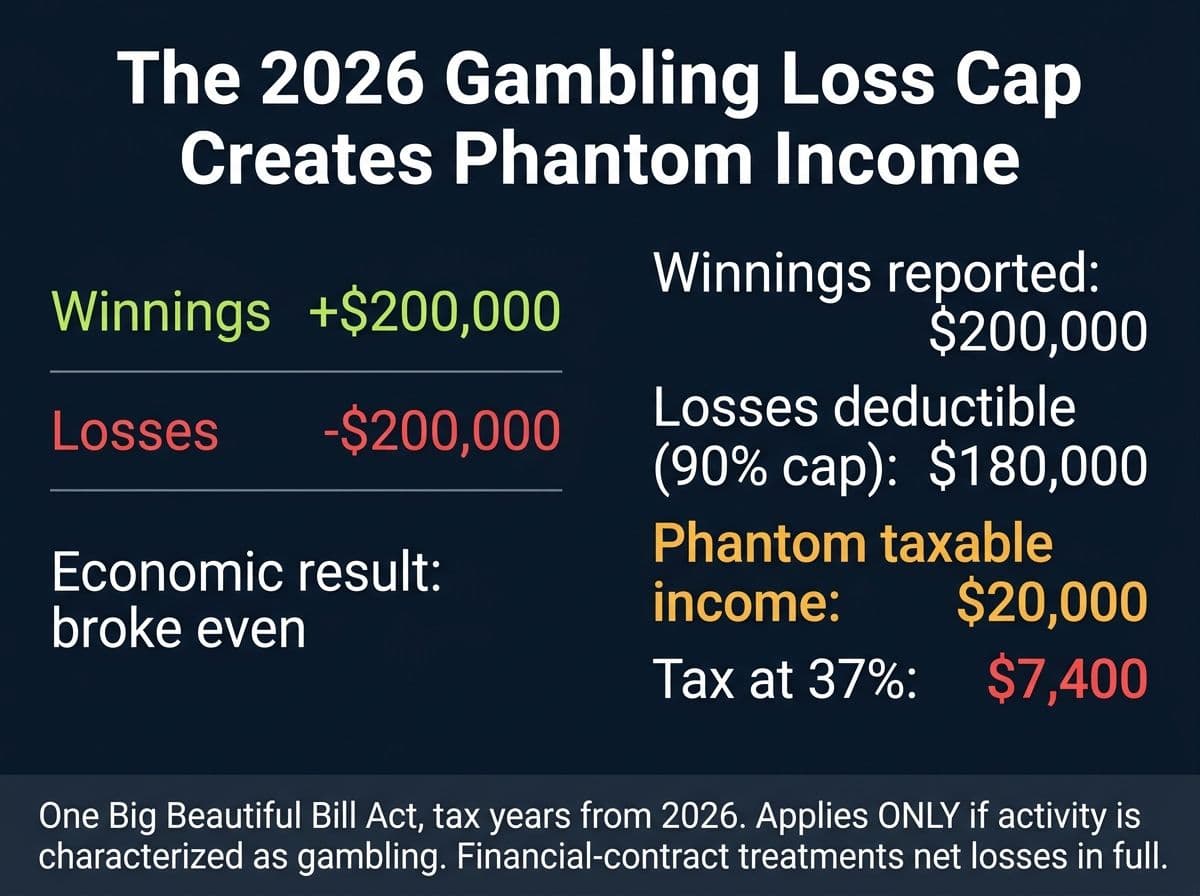
Win $200,000, lose $200,000, break exactly even. Under 2026 gambling treatment you report $200,000 of winnings but deduct only $180,000 of losses. You owe tax on $20,000 you never made: $7,400 at a 37% marginal rate. Financial-contract characterization (ordinary, capital, or 1256) avoids the cap entirely because gains and losses net in full. That asymmetry is already pushing sports bettors from sportsbooks toward event contracts, and it's why the characterization fight has real stakes.
For the full 2026 rules, the itemizing trap, session accounting, and worked examples for every kind of bettor, see our complete gambling loss deduction guide.
“On identical facts, the gap between the best and worst characterization can be a five-figure tax difference. Nobody can promise you the IRS's answer, because there isn't one yet. What a good CPA gives you is a position your records can defend.”
, Garrett Taylor, CPA
Worked Example: The Same $1,000 Bet on Kalshi vs Polymarket
Let's make the settlement split concrete with one bet, two platforms.
Jordan puts $1,000 into "Team USA reaches the semifinal: YES" at $0.40 per contract, once on Kalshi, once on Polymarket. That's 2,500 contracts each. Team USA delivers. Both positions settle at $1.00, paying $2,500 each. Economic profit: $1,500 per platform. Identical bets, identical profits.
Now the tax paperwork:
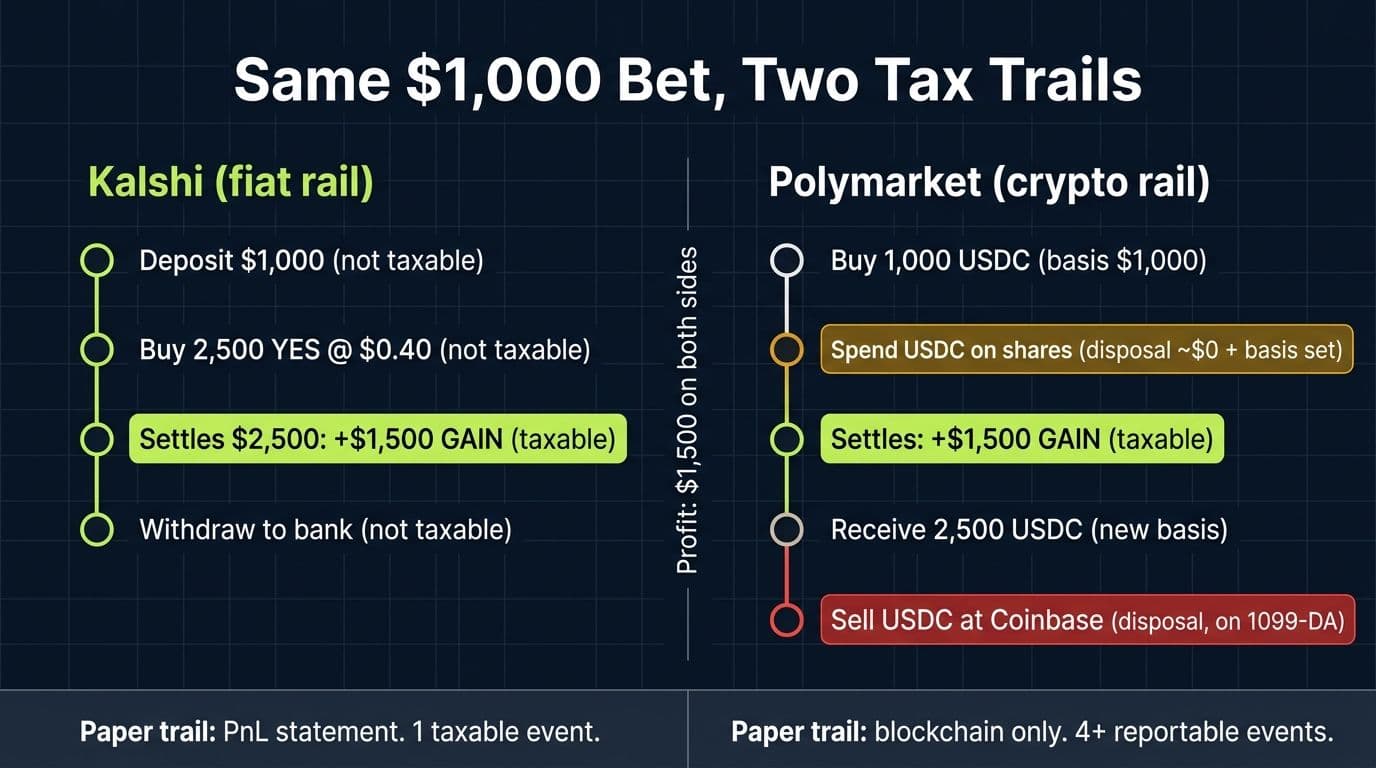
On Kalshi (fiat rail):
- Deposit $1,000 by bank transfer. Not a taxable event.
- Buy 2,500 YES at $0.40. Not a taxable event (basis established: $1,000).
- Settlement pays $2,500. Taxable event: $1,500 gain.
- Withdraw to bank. Not a taxable event.
- Paper trail: Kalshi PnL statement shows the profit. No 1099 for the trade. Jordan reports $1,500 on Schedule 1 (or Form 8949 under a capital position). Done.
On Polymarket (crypto rail):
- Buy 1,000 USDC on Coinbase for $1,000. Acquisition of property, basis $1,000.
- Bridge to Polygon and spend USDC on 2,500 YES shares. Two things happen: a disposal of the USDC (gain roughly $0 since the peg held) AND basis of $1,000 established in the contracts.
- Settlement pays 2,500 USDC. Taxable event: $1,500 gain on the contracts, plus acquisition of 2,500 USDC with a fresh $2,500 basis.
- Send USDC back to Coinbase and sell for $2,500. Disposal of property (gain roughly $0), and Coinbase reports $2,500 of proceeds to the IRS on Form 1099-DA, likely with a blank basis field since the USDC arrived from an external wallet.
- Jordan reports the $1,500 contract gain, reports the USDC disposals, and checks "yes" on the digital asset question. Records come from the Polygon blockchain and Polymarket trade history, because no form summarizes any of it.
Same profit. Same tax owed (under matching treatments). Roughly four times the reporting surface on the crypto rail, plus an IRS-visible off-ramp that must reconcile with the return. That's the practical meaning of "prediction market taxes depend on settlement type."
Trading on Both Rails?
Garrett files prediction market returns across Kalshi, Robinhood, Polymarket and the on-chain platforms, with the crypto layer reconciled to the blockchain. One conversation now beats a mismatch notice later.
Book a callFree 15 minute call. No commitment.
How Do You Report Prediction Market Trades on a Tax Return?
Start by separating activity by platform and product, reconciling gains, losses, fees, statements, and tax forms, then use the return form that matches the documented characterization.
Prediction Market Federal Reporting Paths
| Possible treatment | Common federal form path | Record needed |
|---|---|---|
| Ordinary income | Schedule 1 as applicable | Reconciled net result and support for the position |
| Capital treatment | Form 8949 and Schedule D | Trade-level basis, proceeds, dates, and fees |
| Section 1256 | Form 6781 | Product-level support that Section 1256 applies |
| Wagering treatment | Schedule 1 and Schedule A as applicable | Gross winnings, substantiated losses, and itemization support |
| Crypto settlement | Form 8949 and Schedule D as applicable | Wallet-level digital-asset basis and proceeds in addition to contract records |
Can You Deduct Prediction Market Losses?
Possibly, but the amount and timing depend on characterization: capital losses, Section 1256 losses, ordinary losses, and wagering losses follow different rules.
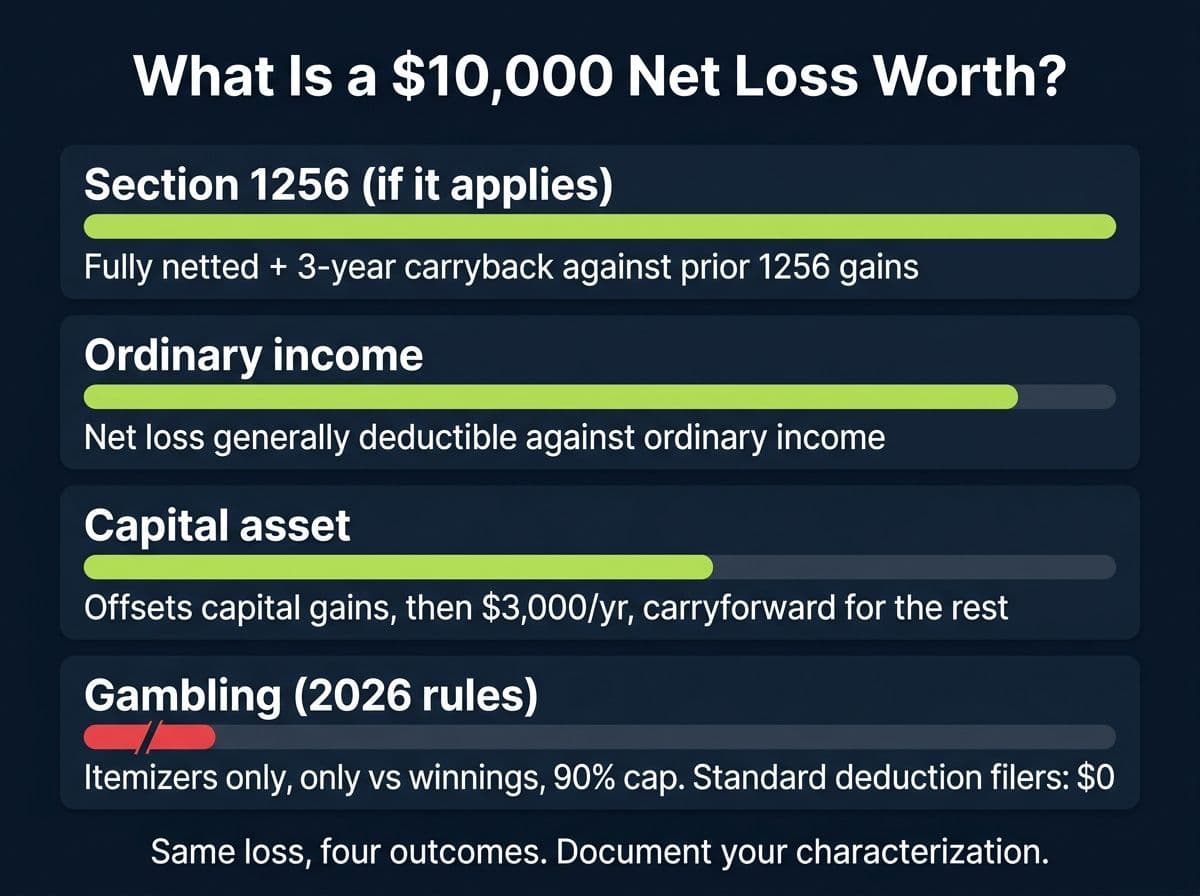
- Ordinary income treatment: net trading losses are generally deductible against ordinary income, without the gambling limitations.
- Capital treatment: losses offset capital gains from anywhere (stocks, crypto, other markets), then $3,000 per year against ordinary income, with indefinite carryforward.
- Gambling treatment: losses help only if you itemize, only against winnings, and only up to 90% of losses starting in 2026. Standard-deduction filers get nothing.
- Section 1256 (if it applies): losses net fully and can be carried back three years against prior 1256 gains, the only framework with a carryback.
Two extras worth knowing. First, the wash sale rule doesn't currently reach event contracts or crypto, so exiting a losing position and re-entering doesn't void the loss under present law (the same logic as crypto wash sales). Second, on crypto-settled platforms your losses only exist if your cost basis is documented, which is a records problem, not a law problem. Choose and document a basis method before the trade count gets away from you; our cost basis guide shows how.
Do States Tax Prediction Market Winnings?
Usually yes, but state conformity and loss deductions vary, so the same federal position can produce a different state result.
Federal characterization is only half the fight. States are moving faster and more aggressively than the IRS:
- States that tax gambling winnings gross with no loss deduction are brutal if gambling characterization applies: $60,000 of wins and $55,000 of losses can mean state tax on the full $60,000.
- New Jersey and others don't conform to some federal treatments, so a Section 1256 or long-term capital position at the federal level may not translate.
- Kentucky enacted a 14.25% excise tax on prediction market operators in April 2026 (now in litigation), and the New York attorney general is pushing to have event contracts declared gambling. Where states land will shape your state return.
If you moved states mid-year or trade at volume in a high-tax state, this deserves a professional look before you file, not after.
What Are the Most Common Prediction Market Tax Mistakes?
The most common errors are waiting for a 1099, combining unlike products, ignoring the crypto settlement layer, mixing tax treatments, and failing to preserve trade-level records.
- Assuming no form means no tax. The top mistake on both rails.
- Trusting a platform form as complete. Kalshi's 1099-MISC covers rewards, not P&L. ForecastEx 1099s can overstate proceeds. Reconcile everything.
- Ignoring the crypto layer on USDC-settled platforms. The 1099-DA off-ramp mismatch is how the IRS finds these accounts.
- Mixing frameworks opportunistically. Capital treatment for wins and gambling treatment for losses is not a position, it's an audit finding.
- Reconstructing a year of on-chain trades in April. Start in January. Or better, now.
Action steps:
- List every platform you touched this year and classify it: fiat-settled or crypto-settled.
- Pull trade exports and year-end statements from each.
- For crypto rails, pull wallet histories and match every on-ramp and off-ramp.
- Pick one characterization per activity, write down why, and apply it consistently.
- If your volume is five figures or the framework choice moves real money, get a specialist. Here's what a prediction market CPA costs and how to choose one.
Prediction markets sit inside your bigger tax picture too. If you also hold crypto, stake, or trade DeFi, start with our complete crypto tax guide to see how it all fits together.
Which Primary Sources Support This Guide?
This guide uses current IRS, CFTC, and platform documentation for the specific reporting, product-classification, and tax-rule claims below.
- IRS Publication 505
- IRS Instructions for Forms 1099-MISC and 1099-NEC
- IRS Publication 550
- IRS digital-assets guidance
- CFTC event-contract product listings
- Polymarket US and international product guidance
- CFTC designated contract market listings
Get Your Prediction Market Year Handled
Prediction market and crypto tax work is scoped through an engagement with a fixed fee in writing, based on the records, products, platforms, and filing work required.
Book a callFree 15 minute call. No commitment.
Frequently Asked Questions
Do I owe prediction-market taxes if I received no 1099?
Yes. A reporting threshold determines when a payer must issue a form; it does not create tax-free income for the recipient.
Does Kalshi give tax forms?
Partially. Kalshi provides a Profit and Loss statement in the app, plus 1099-INT for interest, 1099-MISC for credits and rewards, 1099-B for crypto transfer proceeds, and 1099-DA for digital asset transactions through ZeroHash. It does not issue a comprehensive 1099 covering your event contract trading profits.
Will Kalshi send me a 1099?
Only in specific situations: interest paid (1099-INT), promotional credits or rewards (1099-MISC), or crypto-related transactions (1099-B or 1099-DA). Your trading P&L itself does not arrive on a 1099, so never wait on a form before calculating what you owe.
Does Robinhood send a 1099 for prediction markets?
No. Robinhood has stated it will not issue 1099s for event contract trades. You receive an Event Contracts Annual Statement, which Robinhood labels as not a substitute tax reporting form. You must compute and report gains yourself, separately from your Robinhood stock 1099.
Are prediction markets taxed like sports betting?
Not necessarily, and that's the fight. Sportsbook winnings are clearly gambling income with W-2G withholding rules and the new 90% loss cap. Prediction market platforms argue their contracts are CFTC-regulated financial instruments that net gains and losses in full. The IRS hasn't ruled, which is why identical bets can produce different tax outcomes on different rails.
Can you deduct prediction market losses?
Usually, but the path depends on characterization. Capital treatment: offset gains plus $3,000 a year with carryforward. Ordinary treatment: net losses generally deductible. Gambling treatment: itemizers only, capped at 90% of losses from 2026. Section 1256, where it applies, allows full netting and a three-year carryback.
Are PredictIt winnings taxable?
Yes. PredictIt winnings are taxable whether or not a form arrives. Check the current platform tax documentation and your year-end records, and note that the general federal Form 1099-MISC threshold for covered 2026 payments is $2,000.
How much capital gains tax will I pay on $100,000 of prediction market profit?
If treated as short-term capital gains or ordinary income (the usual case, since contracts resolve quickly), roughly $24,000 to $35,000 federal depending on your bracket, plus state tax. If Section 1256 treatment applied, the 60/40 blend would cap the effective federal rate near 28% and often lands lower. At this size, characterization is worth a professional conversation before filing.