Quick answer: Kalshi profits are taxable even when no tax form reports your event-contract trading profit. Kalshi may issue Forms 1099-INT, 1099-MISC, 1099-B, and 1099-DA for specific activity, while your PnL statement and trade history support the separate calculation of trading gains and losses. The federal characterization of event contracts remains unsettled.
You had a good year on Kalshi. You called the Fed, the weather, maybe a championship.
Then tax season arrived, and nothing in your Kalshi account adds up to anything a tax return recognizes. A PnL statement that says "not tax advice." Maybe a tiny 1099-INT. Nothing that mentions the thousands you actually made trading.
Here's the deal: Kalshi taxes confuse people precisely because Kalshi sends some forms but not the one that matters. We prepare returns for prediction market traders every season, and the Kalshi tax filings we review have a distinctive failure mode: people report what the forms show and skip what the forms don't. The IRS eventually notices the difference.
In this guide to Kalshi taxes, we'll walk through every document Kalshi issues and what each one covers, the four possible tax treatments and what each costs, one trader's complete year from trade log to filed forms, and the crypto and interest wrinkles almost nobody mentions.
Let's dig in.
Do You Have to Pay Taxes on Kalshi Winnings?
Yes. Kalshi profits are taxable from the first dollar even if no form arrives, no cash is withdrawn, and the platform withholds nothing.
So every profitable Kalshi outcome is income: a contract bought at $0.55 that settles at $1.00, a position sold early for more than you paid, interest on your cash balance, a referral bonus. All of it is taxable whether or not a form arrives, whether or not you withdrew to your bank, and whether you made $50 or $50,000. The $600 figure people quote is a form-issuance threshold for platforms, not a tax exemption for you. (And as we'll see, for 2026 that threshold isn't even $600 anymore.)
One more thing traders coming from W-2 jobs miss: Kalshi withholds no taxes. Every dollar of profit arrives pre-tax. If your winnings are large, the IRS expects quarterly estimated payments along the way, not one big check in April.
What Tax Forms Does Kalshi Provide in 2026?
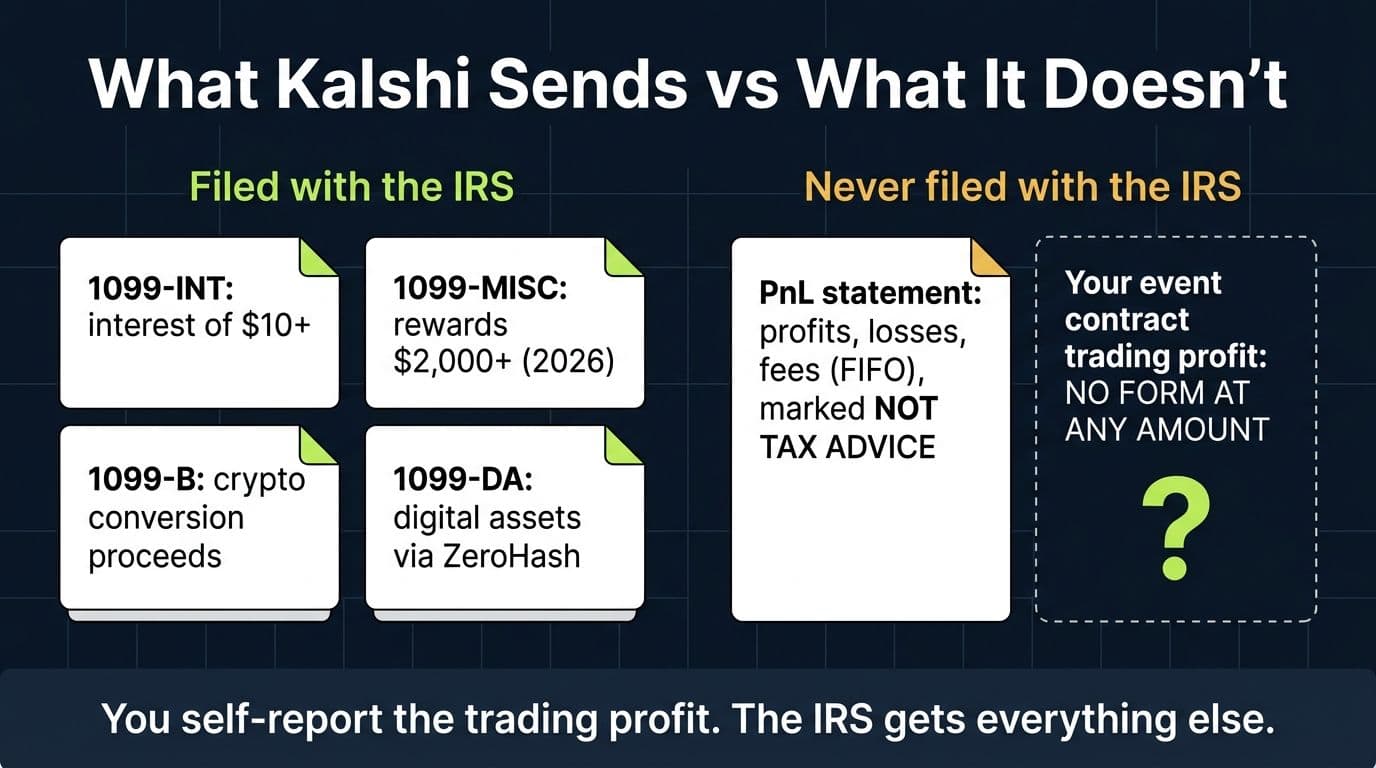
Kalshi may provide Forms 1099-INT, 1099-MISC, 1099-B, and 1099-DA for specific activity, plus a separate PnL statement for trading activity.
Kalshi's current tax documentation explains which activities can generate each form and confirms that the PnL statement is separate from an IRS information return.
Every Tax Document Kalshi Provides (2026)
| Document | What It Covers | When You Get It | Filed With the IRS? |
|---|---|---|---|
| Form 1099-INT | Interest paid on your cash and position collateral | Interest of $10 or more for the year | Yes |
| Form 1099-MISC | Credits and rewards (referral bonuses, promos) | $600+ for 2025; $2,000+ for 2026 payments | Yes |
| Form 1099-B | Proceeds from crypto transfer transactions | If you deposited or converted crypto | Yes |
| Form 1099-DA | Digital asset reporting from ZeroHash | If you moved crypto through ZeroHash | Yes |
| PnL statement | Your trading profit, loss, and fees summary | Always available in Account, under Tax Info | **No** |
Each form has a trap in it, so let's take them one at a time.
Form 1099-INT: The Interest Form
Kalshi pays interest on your account, and not just on idle cash: under its APY program, interest accrues daily on your cash balance plus the value of your open positions, at a variable rate (3.25% as of this writing) passed through from Kalshi's banking partners and paid monthly. Leave $20,000 on the exchange through a season of trading and it earns the whole time, win or lose.
Nice feature, and taxable exactly like a savings account: ordinary interest income, no characterization debate. At $10 or more for the year, Kalshi sends a 1099-INT and files a copy with the IRS, and over $1,500 of total interest from all sources puts it on Schedule B.
The trap: interest income is completely separate from your trading P&L. It doesn't offset trading losses and doesn't belong inside your net profit calculation. And because interest is the one Kalshi number the IRS always sees, it anchors your account's existence in their systems. Report everything else accordingly.
When Does Kalshi Provide Form 1099-MISC?
Kalshi may provide Form 1099-MISC for referral bonuses, deposit promotions, and credits, not event-contract trading profits.
For covered payments made in 2026, the general Form 1099-MISC threshold increased to $2,000. A platform may issue a form below that amount, and the payment remains taxable when no form arrives.
Form 1099-B and 1099-DA: The Crypto Conversion Forms
These two confuse Kalshi traders more than everything else combined, so let's be precise. Kalshi's 1099-B does not cover your event contract trades. It covers proceeds from crypto transfer transactions: when you fund your account with bitcoin, USDC, SOL, or another supported asset, Kalshi's crypto partner ZeroHash converts it to dollars, and that conversion is a broker transaction with reportable proceeds. The 1099-DA is the digital asset version of the same reporting, issued through ZeroHash.
If you've never touched the crypto deposit option, you'll never see either form. If you have, there's a full section below on why that deposit was a taxable event all by itself.
The PnL Statement: Useful, Official-Looking, and Not a Tax Form
Your Profit and Loss statement lives in the Account tab under Tax Info. It summarizes trading profits, losses, and fees using first-in, first-out (FIFO) accounting. It is the single most useful document Kalshi gives you, and it is not filed with the IRS and not tax advice (Kalshi says so itself). Treat it as a starting point you verify against your full trade history, not a number you copy onto a return unexamined.
Does Kalshi Send a 1099 for Trading Profits?
No. Kalshi's current tax documentation lists Forms 1099-INT, 1099-MISC, 1099-B, and 1099-DA for specific activities, but it does not list a 1099 that reports event-contract trading profit.
Kalshi provides a separate PnL statement, which is not an IRS information return and should be reconciled to the full trade history.
What Changed for Kalshi Taxes in 2026?
Two federal changes matter in 2026: the general Form 1099-MISC threshold for covered payments increased to $2,000, and wagering losses are generally deductible only up to 90% of losses if the activity is treated as gambling.
Neither change makes unreported income tax-free, and neither resolves whether Kalshi event contracts are wagers, capital assets, ordinary activity, or Section 1256 contracts.
Does Kalshi Report to the IRS?
Yes, but only for the specific items on the information returns it issues; Kalshi's current documentation does not describe a form that reports event-contract trading profit.
What the IRS receives: every 1099 Kalshi issues to you also goes to the IRS. Interest, rewards over the threshold, crypto conversion proceeds. The IRS also knows the account is KYC'd to your Social Security number, because Kalshi is a CFTC-regulated exchange with full identity verification.
What the IRS doesn't receive: any contract-level record of your trading. No proceeds, no basis, no net profit from event contracts.
Some traders read that gap as safety. We read it as the opposite. The partial forms create a visible trailhead: a 1099-INT for $142 tells the IRS an account exists and holds real money, and an examiner who pulls the thread gets to ask what else that account did. Meanwhile the reporting burden legally sits with you either way, on a regulated exchange that keeps complete records and can produce them under summons.
The honest framing: Kalshi reports enough to make you findable, and not enough to make your return for you. That combination only works out if you self-report properly.
“The Kalshi returns that go wrong are almost never fraud. They're people who reported the 1099-INT because a form showed up and skipped the trading profit because no form did. The IRS doesn't grade on which income came with paperwork.”
, Leanne Grant, EA
Are Kalshi Event Contracts and Perpetual Futures Taxed the Same Way?
Not automatically. The CFTC lists many Kalshi event contracts as binary-option swaps, while it has approved Kalshi products such as BTCPERP, GOLDPERP, and SILVERPERP as futures, so the Section 1256 analysis is materially different.
Do Kalshi Event Contracts Qualify for Section 1256?
Possibly, but not automatically: Kalshi trades on a CFTC-designated contract market, while many event contracts are listed as binary-option swaps that may fall outside Section 1256.
How Are Kalshi Perpetual Futures Taxed?
Kalshi perpetual futures have a stronger Section 1256 case because the CFTC approved named products as futures, but the requirements still must be checked for the product and taxpayer.
How Are Kalshi Winnings Taxed?
Kalshi winnings are taxable, but the IRS has not assigned all event contracts to one tax regime; depending on the contract and facts, practitioners analyze ordinary income, capital treatment, Section 1256, or wagering treatment.
The Four Possible Tax Treatments of Kalshi Trading
| Treatment | Where It Goes | Loss Rules | Kalshi-Specific Note |
|---|---|---|---|
| Ordinary income | Schedule 1, Line 8z | Depends on the facts; a full ordinary-loss deduction is not automatic | The conservative default most filers use |
| Capital asset | Form 8949 + Schedule D | Offset gains; $3,000/yr vs ordinary income; carryforward | Nearly all Kalshi gains are short-term anyway |
| Section 1256 | Form 6781, 60/40 split | 3-year carryback of net losses | Product-level test; event-contract swaps may be excluded, while approved futures have a stronger case |
| Gambling | Schedule 1 + Schedule A | Itemizers only; 90% cap from 2026 | Least favorable; most practitioners avoid electing it |
So we work from existing law, which offers four candidate frameworks. We covered the full cross-platform analysis in our prediction market taxes pillar guide; here's the Kalshi-specific version.
Can Kalshi Winnings Be Reported as Ordinary Income?
Possibly. Some filers use ordinary-income treatment for the documented net result, but the reporting path and loss treatment depend on the taxpayer and activity facts.
Simple, defensible, low mismatch risk. Its cost: no preferential rates, ever. For most Kalshi traders that cost is zero, because positions resolve in days and short-term capital rates equal ordinary rates anyway.
Can Kalshi Winnings Be Reported as Capital Gains?
Possibly. A capital position treats each contract disposition as a capital transaction supported by basis, proceeds, dates, and fees on Form 8949 and Schedule D.
The rate usually matches ordinary treatment (short holding periods mean short-term rates). The real difference is losses: capital losses offset capital gains from anything, stocks, crypto, other contracts, plus $3,000 a year against ordinary income, with indefinite carryforward. A losing Kalshi year and a winning stock year get to talk to each other.
What Are the Tax Consequences of a Section 1256 Position?
If Section 1256 applies, qualifying contracts use mark-to-market accounting, Form 6781, and a 60% long-term and 40% short-term split, but the IRS categories must be tested for the specific product.
The argument for Kalshi is stronger than for any other prediction market: it's a CFTC-regulated Designated Contract Market with standardized, exchange-traded contracts. A widely cited Forbes analysis went as far as calling prediction markets the tax-advantaged way to gamble on sports on exactly this theory.
The argument against: the CFTC has classified event contracts as binary options that are swaps, and Section 1256(b)(2)(B), added by Dodd-Frank, excludes most swaps from 60/40 treatment. KPMG's analysis treats the question as genuinely open with materially different outcomes on each side.
Two practical notes if you're tempted:
- 1256 is a package, not a rate. Mark-to-market means positions still open on December 31 get taxed on unrealized gains. Traders who want the 60/40 rate rarely think about the year-end mark.
- Take it as a documented position, not a vibe. Written analysis, consistent application, and consider a Form 8275 disclosure. Every 1256 return we've filed for a prediction market trader had a memo behind it.
Can Kalshi Winnings Be Taxed as Gambling Income?
Possibly. If Kalshi activity is treated as wagering, winnings are taxable and the 2026 federal deduction is generally limited to the lesser of 90% of gambling losses or gambling winnings, with itemization required for the loss deduction.
That 90% cap creates phantom income. Win $80,000 and lose $80,000 on Kalshi in 2026 under gambling treatment and you still have $8,000 of taxable income, because only $72,000 of the losses count. Break even in reality, pay tax anyway.
Most practitioners, us included, don't reach for gambling treatment on a regulated exchange where you're trading transferable contracts at market prices rather than betting against a house. But the characterization question is live (several commentators think sports event contracts especially look like wagers), so the framework belongs on this list, and the OBBBA math belongs in your risk assessment.
Pro Tip
Whichever treatment you choose, choose once and stay consistent. Reporting wins under capital treatment and losses under some other theory is the single fastest way to turn a gray area into an audit problem.
A Worked Example: Sam's Complete Kalshi Year
Theory tells you the options. Numbers tell you what they cost. Let's build a realistic Kalshi year and file it every possible way.
Meet Sam: single filer, $85,000 W-2 salary, 22% federal bracket. In 2026 Sam deposits $8,000 by bank transfer plus 0.02 BTC (bought years ago for $600, worth $2,000 on deposit day), trades 10 event contract positions, earns $142 of interest, and collects a $250 referral bonus.
Here's the trading year:
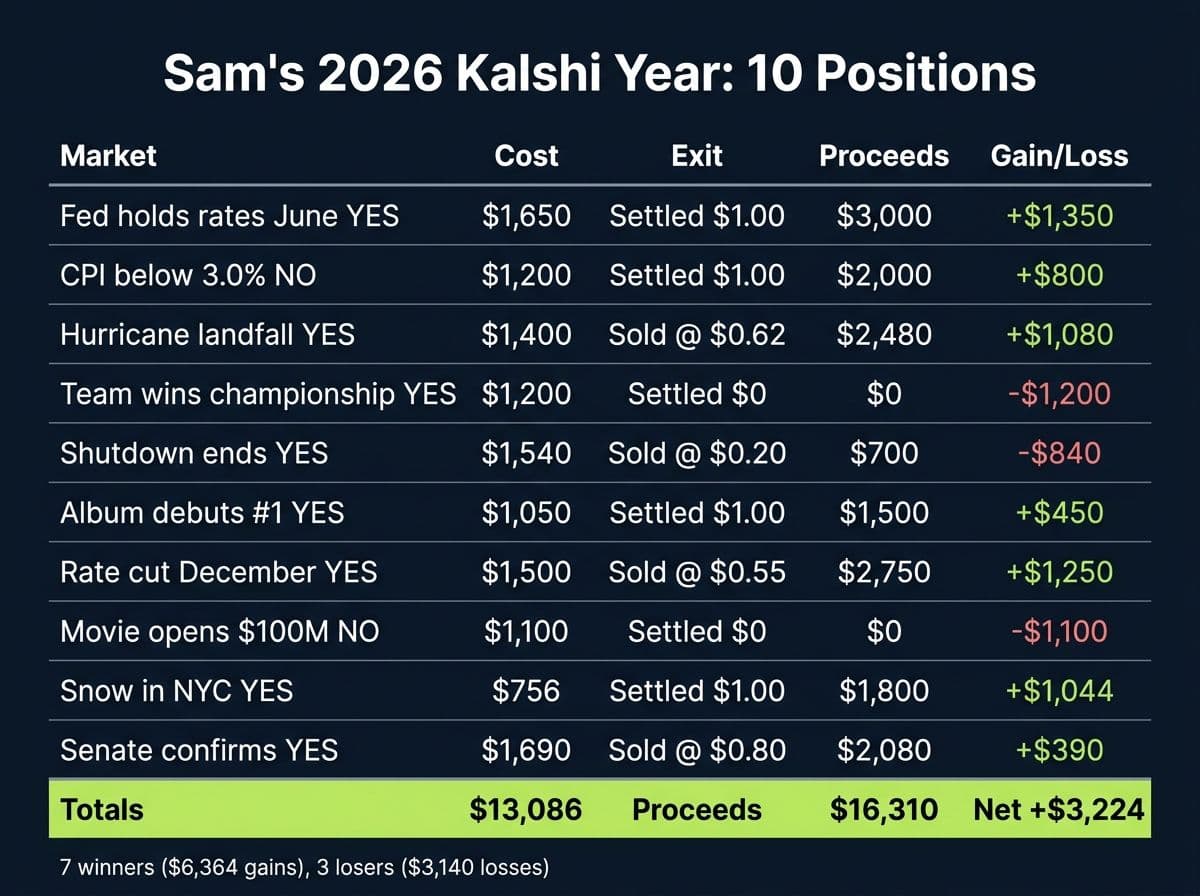
Sam's 2026 Kalshi Trade Log
| # | Market | Contracts | Cost | Exit | Proceeds | Gain/Loss |
|---|---|---|---|---|---|---|
| 1 | Fed holds rates in June: YES | 3,000 @ $0.55 | $1,650 | Settled $1.00 | $3,000 | +$1,350 |
| 2 | CPI below 3.0% in May: NO | 2,000 @ $0.60 | $1,200 | Settled $1.00 | $2,000 | +$800 |
| 3 | Hurricane landfall by Sept: YES | 4,000 @ $0.35 | $1,400 | Sold @ $0.62 | $2,480 | +$1,080 |
| 4 | Team wins championship: YES | 2,500 @ $0.48 | $1,200 | Settled $0 | $0 | -$1,200 |
| 5 | Shutdown ends by Oct 15: YES | 3,500 @ $0.44 | $1,540 | Sold @ $0.20 | $700 | -$840 |
| 6 | Album debuts #1: YES | 1,500 @ $0.70 | $1,050 | Settled $1.00 | $1,500 | +$450 |
| 7 | Rate cut in December: YES | 5,000 @ $0.30 | $1,500 | Sold @ $0.55 | $2,750 | +$1,250 |
| 8 | Movie opens above $100M: NO | 2,200 @ $0.50 | $1,100 | Settled $0 | $0 | -$1,100 |
| 9 | Snow in NYC by Dec 25: YES | 1,800 @ $0.42 | $756 | Settled $1.00 | $1,800 | +$1,044 |
| 10 | Senate confirms nominee: YES | 2,600 @ $0.65 | $1,690 | Sold @ $0.80 | $2,080 | +$390 |
| **Totals** | **$13,086** | **$16,310** | **+$3,224** |
Seven winners produced $6,364 of gains, three losers produced $3,140 of losses. Net trading profit: $3,224 (figures shown net of Kalshi's trading fees, which belong in your calculation).
What Actually Arrives in January
Here's Sam's January tax mail, the part that surprises people:
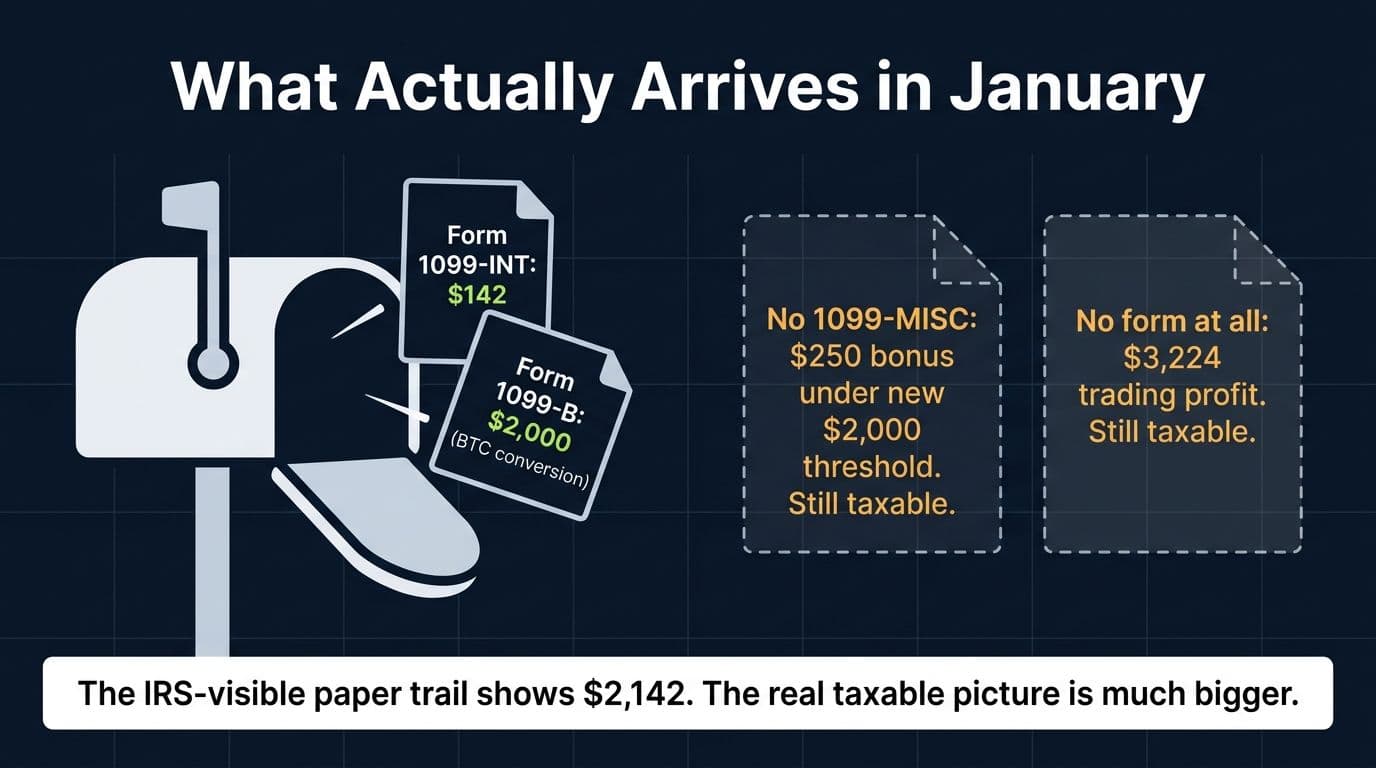
- Form 1099-INT for $142. Arrives, and the IRS has a copy.
- Form 1099-B for $2,000. The BTC deposit. ZeroHash converted Sam's bitcoin to dollars on arrival, and that conversion is reportable proceeds. The IRS has a copy.
- No 1099-MISC. Sam's $250 bonus is under the new $2,000 threshold. Still taxable.
- Nothing for the $3,224 trading profit. The PnL statement sits in the Tax Info tab, unfiled and unofficial.
So the IRS-visible paper trail shows $2,142 of activity, while Sam's actual taxable picture adds $3,224 of trading profit plus a $1,400 capital gain hiding inside that BTC deposit (next section). A return that only reports what the forms show misses most of the income.
Sam's Return, Line by Line (Capital Asset Treatment)
Say Sam files under capital treatment:
- Form 8949, Part I, Box C (short-term, no 1099-B received): all 10 positions, one row each. Totals flow to Schedule D: $16,310 proceeds, $13,086 basis, $3,224 net short-term gain.
- Form 8949, Part II (long-term): the BTC deposit. Proceeds $2,000, basis $600, $1,400 long-term gain. This row reconciles the ZeroHash 1099-B.
- Interest line: the $142 of Kalshi interest.
- Schedule 1, Line 8z: the $250 referral bonus.
- Form 1040 digital asset question: Sam answers Yes (the BTC disposal makes this unambiguous).
Federal tax on the Kalshi activity: $3,224 x 22% = $709 on trading, $1,400 x 15% = $210 on the BTC gain, ($142 + $250) x 22% = $86 on interest and bonus. Total: about $1,005.
The Same Trading Year Under All Four Treatments
Now the comparison nobody on page one of Google runs. Same 10 trades, same $3,224 economic profit, four different bills on the trading activity alone (interest, bonus, and BTC gain stay constant):
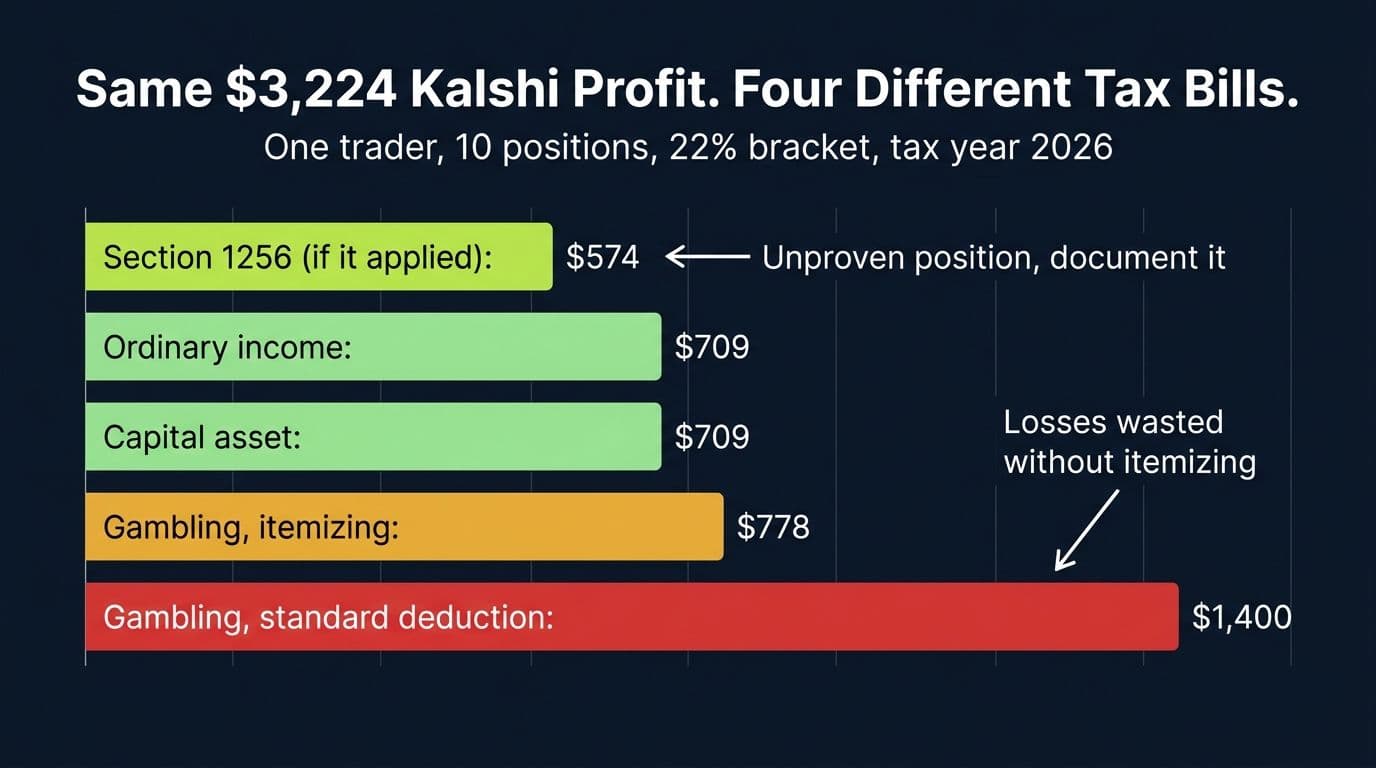
Sam's Trading Tax Bill Under Each Treatment (2026, 22% Bracket)
| Treatment | What's Taxed | Federal Tax | Notes |
|---|---|---|---|
| Section 1256 (if it applied) | 60/40 split on $3,224 | $574 | $1,934 at 15% + $1,290 at 22%; unproven position, document it |
| Ordinary income | $3,224 net profit | $709 | Schedule 1, Line 8z; simplest paper trail |
| Capital asset | $3,224 net short-term gain | $709 | Form 8949 + Schedule D; best loss flexibility |
| Gambling, itemizing | $6,364 winnings less $2,826 (90% of $3,140 losses) | $778 | OBBBA cap adds $69 vs pre-2026 rules |
| Gambling, standard deduction | Full $6,364 winnings, losses wasted | $1,400 | Nearly double the default treatments |
Look at that spread. Identical trades, and the answer to one unresolved legal question moves Sam's bill from $574 to $1,400. Scale Sam's numbers by ten and the characterization question is worth more than most people's entire refund.
(Honest caveats: the gambling rows treat each position as its own wager because the IRS has never defined a "session" for exchange-traded contracts, and the 1256 row assumes the position survives scrutiny, which is genuinely uncertain.)
Want These Numbers Run on Your Actual Kalshi Year?
Garrett has filed prediction market returns under every treatment on this table. Bring your trade history and get a defensible answer, with the math shown.
Book a callFree 15 minute call. No commitment.
Is Depositing Crypto Into Kalshi Taxable?
Yes. When deposited crypto is converted into dollars, the conversion is a disposition of digital-asset property and can create a gain or loss separate from later Kalshi trades.
Kalshi lets you fund your account with crypto: BTC, USDC, SOL, and other supported assets. But Kalshi is a dollar-denominated exchange, so its partner ZeroHash converts your crypto to US dollars the moment it arrives. Your account is credited in dollars; the crypto is gone.
From the IRS's perspective, per its digital assets guidance, crypto is property, and converting property to dollars is a disposal. The deposit itself is the taxable event. Sam's 0.02 BTC, bought for $600 and converted at $2,000, produced a $1,400 long-term capital gain before Sam placed a single trade.
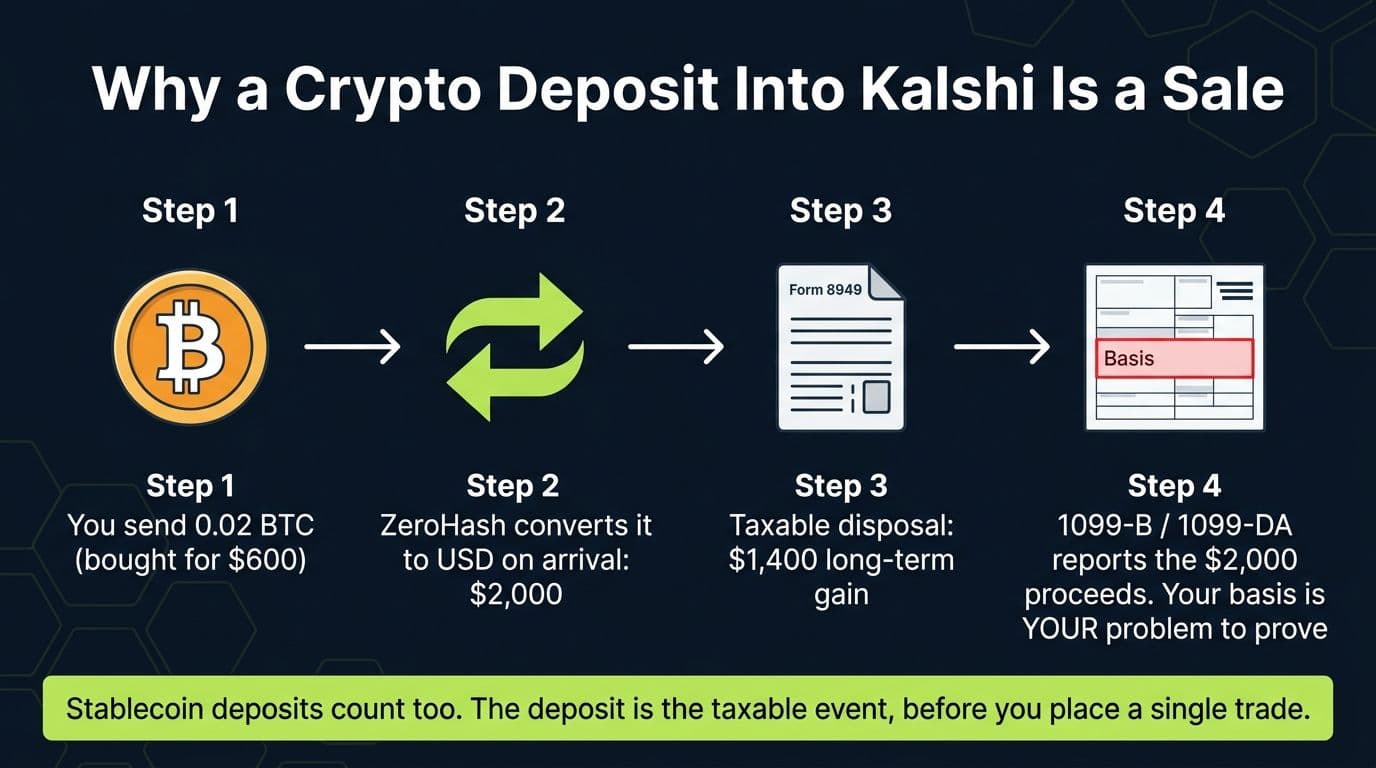
Three traps live inside this flow:
- The proceeds get reported; your basis doesn't. The ZeroHash 1099-B or 1099-DA shows what the conversion produced, but the platform has no idea what you originally paid for that bitcoin. If your return doesn't supply the basis, the IRS's default assumption is basis zero, meaning 100% gain. It's the same 1099-DA reconciliation problem hitting the whole crypto world in 2026.
- Stablecoins count too. Depositing USDC is also a disposal. The gain is usually pennies (USDC holds its peg), but the transaction belongs in your records, and it flips your Form 1040 digital asset answer to Yes.
- Withdrawing to crypto starts a new clock. Cash out of Kalshi into crypto and the conversion price becomes your new cost basis with a new holding period. Track it from day one.
If most of your prediction market activity lives on crypto rails instead, the picture inverts entirely: no forms at all, plus a stablecoin layer on every trade. That's a different article, and we wrote it: Polymarket taxes.
Pro Tip
Deposit crypto into Kalshi only after checking what gain you're about to realize. We've seen traders trigger five-figure capital gains funding an account, without realizing a sale happened, because the word "deposit" sounds harmless.
How Do You Report Kalshi Trades on a Tax Return?
Start by reconciling Kalshi's PnL statement and full trade export, then report the result on the form that matches the documented tax treatment for those contracts.
Kalshi Documents and Federal Reporting Paths
| Document or treatment | What it covers | Typical return location | Key caution |
|---|---|---|---|
| Form 1099-INT | Kalshi interest | Schedule B when required | Separate from trading PnL |
| Form 1099-MISC | Credits and rewards | Depends on payment type and facts | Not the event-contract trading form |
| Form 1099-B or 1099-DA | Crypto transfer or digital-asset activity | Form 8949 and Schedule D as applicable | Reconcile basis independently |
| Ordinary-income position | Event-contract net result | Schedule 1 as applicable | Classification and loss treatment are unsettled |
| Capital position | Contract dispositions | Form 8949 and Schedule D | Trade-level support may be required |
| Section 1256 position | Qualifying contracts only | Form 6781 | Kalshi venue status alone is not enough |
| Wagering position | Gross winnings and allowed loss deduction | Schedule 1 and Schedule A as applicable | 90% loss limit applies in 2026 |
Step 1: Export everything. Download your full trade history and PnL statement from the Tax Info page. Now, not in April; you want time to fix anomalies.
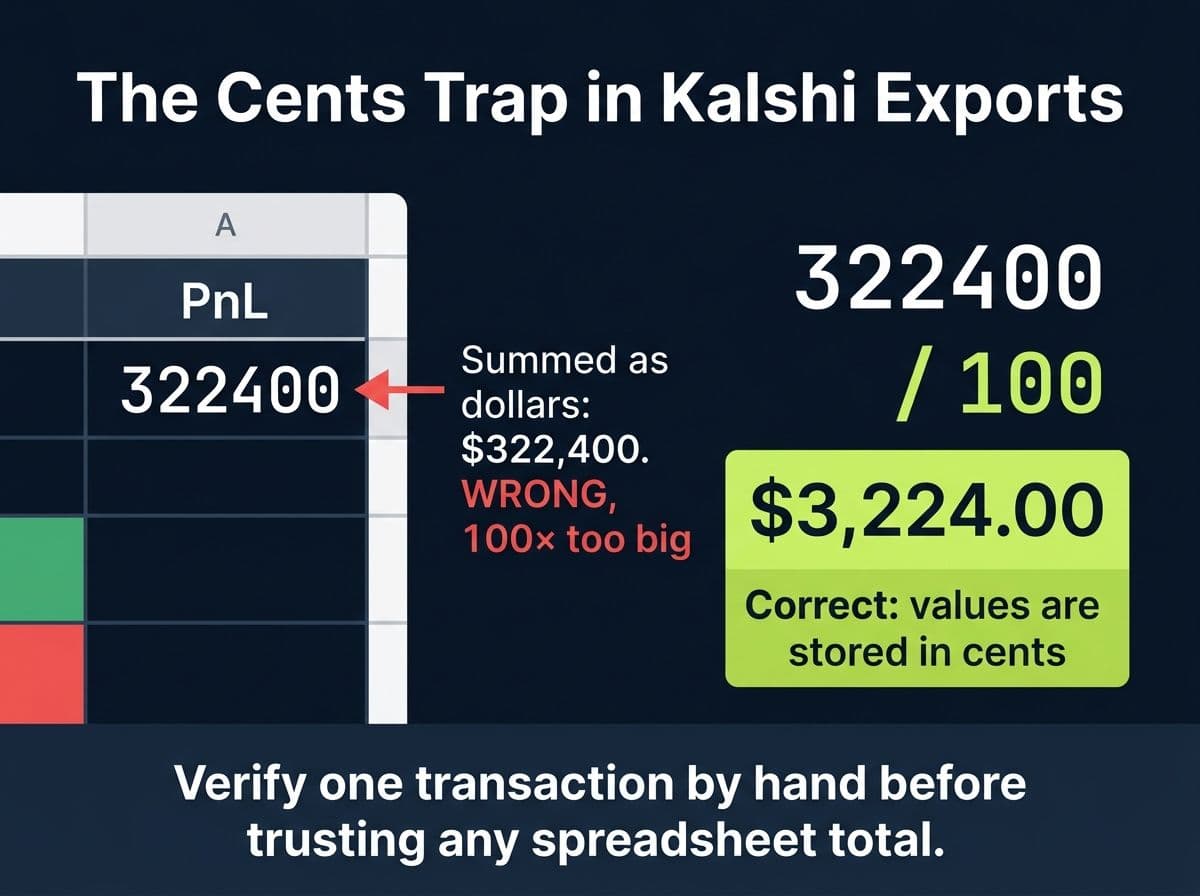
Step 2: Mind the cents. Kalshi's transaction export stores monetary values in cents, not dollars. A PnL entry of 322400 means $3,224.00. Sum the raw column without dividing by 100 and your profit comes out exactly one hundred times too large. Verify one transaction by hand before trusting any spreadsheet total; a surprising number of self-prepared Kalshi tax returns fail this check.
Step 3: Compute net profit independently. Total proceeds minus total cost minus fees, across every position closed during the year. Reconcile against the PnL statement (remember it uses FIFO). If they disagree, find out why before filing.
Step 4: Pick your treatment and place the income. Ordinary income goes on Schedule 1, Line 8z. Capital treatment goes position-by-position on Form 8949, Box C, flowing to Schedule D. A documented 1256 position goes on Form 6781. Whatever you choose, write down why and keep it with your records.
Step 5: Add the side income. Interest from the 1099-INT. Bonuses and credits, form or no form. Any crypto conversion gains, with basis you can prove.
Step 6: Check the estimated tax math. No withholding means a big Kalshi year can trigger underpayment penalties even if you pay in full by April. If you're up meaningfully by mid-year, make quarterly payments.
Step 7: Keep the file. Trade history, PnL statements, bank and crypto records, your treatment memo. Seven years.
Pro Tip
Set a calendar reminder for the first week of January: download your prior-year trade history and PnL statement while the year is fresh. Platform exports change format, support queues get long in March, and the trader with clean records in January files a better return than the one reconstructing in April.
How Do Kalshi, Polymarket and Robinhood Differ for Taxes?
Kalshi and Robinhood event contracts settle in dollars with limited trading tax documents, while Polymarket.com uses an on-chain digital-asset rail that adds a separate property-reporting layer.
Do States Tax Kalshi Winnings?
Usually yes. States with individual income taxes generally include the federal income or gain, but their treatment of gambling losses, capital losses, and deductions can differ.
Your state taxes the income too. If you live in a state with an income tax, your Kalshi profit is taxable there under whatever character it takes federally. California, New York, New Jersey: plan on your marginal state rate on top of the federal numbers above. The no-income-tax states spare you this layer.
Characterization can matter more at the state level. Some states tax gambling winnings gross while limiting or denying loss deductions entirely. If gambling treatment ever sticks to event contracts, a break-even year could produce a real state bill in those states. One more reason most filers document a non-gambling position.
The regulatory fight isn't a tax fight. Kalshi operates nationwide under CFTC jurisdiction and has spent two years litigating with state gaming regulators over its sports contracts. Interesting law, irrelevant to your return: whether a state regulator thinks Kalshi should operate there has no bearing on whether your profits are taxable. They are.
What Are the Most Common Kalshi Tax Mistakes?
The most common errors are waiting for a trading 1099, double-counting fees, mixing tax treatments, and failing to reconcile the PnL statement to the trade export.
- Reporting only what came on a form. The 1099-INT gets reported, the $9,000 trading profit doesn't. The signature Kalshi tax mistake.
- The cents-to-dollars error. Raw export values summed without dividing by 100.
- Not realizing a crypto deposit was a sale. Five-figure BTC deposits with unreported gains, discovered when the ZeroHash form surfaces basis questions.
- Claiming 60/40 rates with zero documentation. Section 1256 without a memo, a consistent method, or Form 6781 mechanics done right, including year-end marks.
- Netting the bonus into trading P&L. Rewards income double-counted or vanished, so nothing ties to the 1099-MISC when one exists.
- Ignoring estimated taxes. A $40,000 profit year, zero withholding, and an April surprise with an underpayment penalty attached.
Every one is preventable with the workflow above. If you've already received an IRS notice about a past year, move quickly and deliberately: our guide to responding to IRS crypto tax notices applies to prediction market mismatches too.
When Should a Kalshi Trader Hire a Tax Professional?
Get professional help when contract classification changes the result materially, records do not reconcile, crypto transfers are involved, or the activity spans several platforms or states.
Handling Kalshi taxes yourself is fine if: you made a modest profit across a manageable number of trades, you're comfortable with ordinary income or capital treatment, you never deposited crypto, and your records reconcile cleanly.
Get professional help if: you're up five figures or more, you're weighing a Section 1256 position, you funded with crypto and don't know your basis, you trade multiple platforms (especially crypto-settled ones), you have unreported prior years, or a notice already arrived. Here's what a prediction market CPA costs and how to choose one.
The economics are usually simple. On a big year, the characterization question alone (remember Sam's $574 to $1,400 spread, then add zeros) is worth more than the fee, and a documented position beats an improvised one in every audit we've ever handled.
Which Primary Sources Support This Guide?
This guide uses current IRS, CFTC, and platform documentation for the specific reporting, product-classification, and tax-rule claims below.
- Kalshi tax documentation
- IRS Instructions for Forms 1099-MISC and 1099-NEC
- IRS Publication 505
- IRS Publication 550
- CFTC event-contract product listings
- CFTC approval for named Kalshi perpetual futures
- IRS digital-assets guidance
Get Your Kalshi Year Filed Right
Preparation for prediction market traders: trade history reconciled, treatment documented, crypto deposits handled, and a fixed fee in writing based on the work required.
Book a callFree 15 minute call. No commitment.
Frequently Asked Questions
What tax form do I use to report Kalshi trading?
It depends on your treatment. Most filers report net profit as Other Income on Schedule 1, Line 8z, or list positions on Form 8949 and Schedule D under capital treatment. A documented Section 1256 position uses Form 6781. Interest goes on your interest line, rewards on Schedule 1.
Do I have to report Kalshi if I made less than $600?
Yes. The $600 figure (now $2,000 for 2026) is a form-issuance threshold for the 1099-MISC, not a tax exemption. All trading profit is taxable from the first dollar regardless of whether any form is generated.
How do I find my Kalshi tax documents?
Open the Account tab and go to the Tax Info page. Any 1099s you qualified for appear there, along with your Profit and Loss statement. Download your full trade history too, and remember the export stores values in cents, not dollars.
Is Kalshi trading treated as gambling for taxes?
Not by default. The IRS has issued no guidance, and most practitioners treat exchange-traded event contracts under ordinary income or capital asset principles rather than gambling rules. The distinction matters more from 2026, when the One Big Beautiful Bill Act caps gambling loss deductions at 90% of losses.
Can you write off Kalshi losses?
Generally yes, depending on treatment. Under ordinary income treatment, losses net against gains from the activity. Under capital treatment, losses offset any capital gains plus up to $3,000 of ordinary income per year with carryforward. Under gambling treatment, losses help only if you itemize and are capped at 90% from 2026.
Do Kalshi contracts qualify for Section 1256 60/40 treatment?
It's unresolved. Kalshi's status as a CFTC-regulated exchange makes the argument stronger than for any other prediction market, but the Dodd-Frank swap exclusion may disqualify event contracts, and the IRS has never ruled. If you take the position, document the analysis, apply mark-to-market correctly, and consider a Form 8275 disclosure.
Is depositing crypto into Kalshi taxable?
Yes. ZeroHash converts your crypto to dollars the moment it arrives, and that conversion is a disposal of property. You recognize gain or loss equal to the conversion value minus your original cost basis, and the proceeds are reported on a 1099-B or 1099-DA. The same logic applies to stablecoins, just with tiny gains.
Do I pay taxes on Kalshi interest?
Yes. Interest from Kalshi's APY program is ordinary interest income, exactly like a savings account. Kalshi issues a 1099-INT at $10 or more and files it with the IRS, so this is the one Kalshi number the IRS always has. Report it separately from your trading profit.
Does Kalshi withhold taxes on winnings?
No. Kalshi withholds nothing from trading profits, interest, or bonuses. In a significantly profitable year, plan on quarterly estimated tax payments to avoid an underpayment penalty.