“This guide has been reviewed for accuracy by Leanne Grant, Enrolled Agent, specializing in cryptocurrency and prediction market tax compliance.”
, Reviewed by Leanne Grant, EA
Getting a prediction market tax quote can feel like comparing four different products. One firm may quote a return. Another may quote reconciliation only. A third may include both, but exclude state filings and post-filing support.
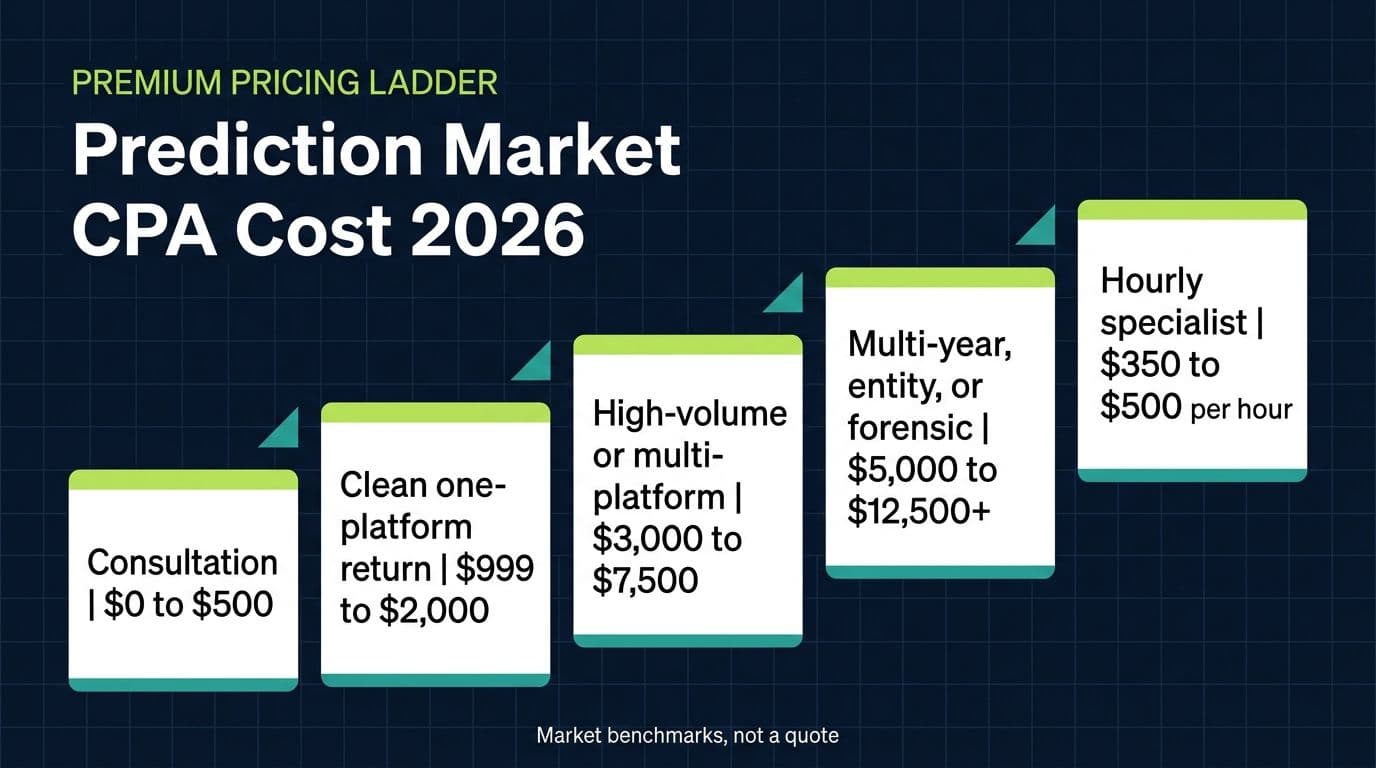
Quick answer: In 2026, a consultation or second opinion can cost $0 to $500. A clean, one-platform individual return typically falls around $999 to $2,000. High-volume, multi-platform, or on-chain work often runs $3,000 to $7,500. Multi-year, entity, amended-return, or forensic work can reach $5,000 to $12,500+. Hourly specialist work typically runs $350 to $500 per hour for a CPA with former Big 4 tax experience. These are 2026 market benchmarks from public specialist pricing, not a quote for your situation.
The useful question is not just, "How much?" It is, "How much for which work?"
I will show you the benchmark ranges, the factors that move a quote, what should be included, and four realistic examples you can use to set a budget.
What does a prediction market CPA cost in 2026?
A prediction market CPA typically costs $999 to $2,000 for a clean one-platform return, $3,000 to $7,500 for high-volume or multi-platform work, and $5,000 to $12,500+ for multi-year, entity, or forensic work. A consultation may cost $0 to $500, while hourly specialist work typically runs $350 to $500 per hour for a CPA with former Big 4 tax experience.
Prediction Market CPA Cost Benchmarks for 2026
| Engagement type | Realistic 2026 market range | Usually includes | Common exclusions or add-ons |
|---|---|---|---|
| Consultation or second opinion | $0 to $500 | Introductory call or limited technical review | Return preparation, reconstruction, written memo |
| Clean, one-platform individual return | $999 to $2,000 | Federal return, one state, basic reconciliation, treatment review | Extra states, crypto wallets, amendments, entity return |
| High-volume or multi-platform individual | $3,000 to $7,500 | Deeper reconciliation, several venues, crypto settlement, written assumptions | Prior years, entity books, litigation or audit defense |
| Multi-year, entity, fund, or forensic cleanup | $5,000 to $12,500+ | Reconstruction, entity or amended filings, complex workpapers | Ongoing bookkeeping, legal opinions, examination representation unless stated |
| Hourly specialist work | Typically $350 to $500 per hour | Consultation, cleanup, research, or work outside the fixed scope | Total cost remains uncertain without an estimate or cap |
These bands come from several kinds of public evidence, not one firm's price card. A specialist crypto accounting firm's 2026 cost guide reports observed fixed-fee ranges and transaction tiers. A crypto-focused solo CPA's published fee schedule separates straightforward, advanced, and complex work. A done-for-you reconciliation service from a large crypto tax software company starts at $3,500 and includes reconciliation, missing-basis work, forms, and an audit trail. A crypto tax preparation firm publishes report tiers and a $200 hourly rate for missing-basis research.
A portfolio software vendor's 2026 cost guide provides a useful secondary range comparison, but it is not an accounting authority and should not carry the benchmark by itself.
The scopes are not identical. That is the point. A $995 transaction report and a $3,500 done-for-you engagement may solve different problems.
At COS Elite, we currently publish service floors of $999 for standard-volume work and $3,000 for high-volume, multi-platform reconciliation. Check the live COS Elite prediction market CPA pricing page for the current scope and quote policy. Those public starting points help anchor the market range, but they are not a promise that every return fits a starting tier.
What is the lowest realistic fee for a clean Kalshi return?
About $999 is a realistic 2026 starting point for a clean Kalshi return when the taxpayer has one account, complete records, one tax year, and a limited federal and state filing scope.
That does not mean every Kalshi return should cost $999. The quote can increase if the export does not tie to statements, the taxpayer traded other products, multiple states are involved, or the reporting position needs deeper research. The professional still has to reconcile the activity and map the supported treatment to the return.
When does the fee rise above $3,000?
The fee often rises above $3,000 when the engagement includes several platforms, thousands of fills, Polymarket or other wallet activity, missing data, multiple states, a written treatment memo, prior years, amendments, entities, or an urgent deadline.
Each item adds either reconstruction time, professional judgment, or another filing. A 4,000-fill file that imports cleanly may be less work than 400 fills spread across broken exports and unlabeled wallets. Transaction count matters, but it is not a complete pricing formula.
Why do prediction market CPA fees vary so much?
Prediction market CPA fees vary because the price usually follows record reconstruction and professional judgment, not the dollar amount of your winnings.
What Raises or Lowers a Prediction Market CPA Quote
| Cost factor | Lower-cost profile | Higher-cost profile |
|---|---|---|
| Platforms | One Kalshi account | Kalshi, Polymarket, Robinhood, ForecastEx, and newer venues |
| Records | Complete native exports and statements | Missing exports, inconsistent statements, inaccessible accounts |
| Volume | Hundreds of clean fills | Thousands or millions of fills, automation, market making |
| Settlement | Dollars only | USDC or other crypto funding and settlement |
| Tax position | Straightforward, documented facts | Material Section 1256, capital, ordinary, or wagering analysis |
| Filing scope | One federal and one state return | Multiple states, entities, funds, amendments, estimates |
| Support | Filing only | Memo, planning, notices, audit, or ongoing accounting |
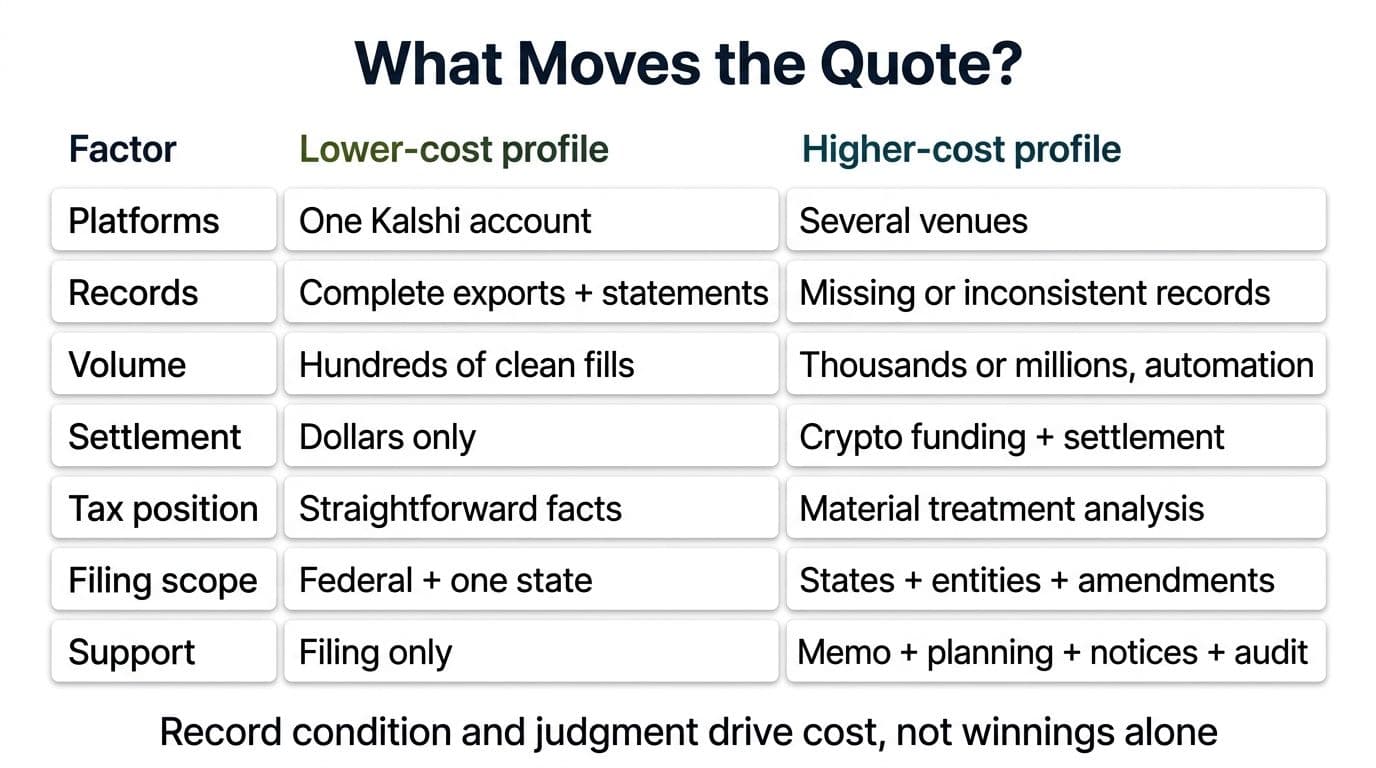
The tax-position row deserves special attention. Prediction market contracts do not have one universal federal treatment. Product terms, venue status, settlement mechanics, taxpayer activity, and other facts can affect the analysis. IRS Publication 550 provides background on Section 1256 contracts, while the CFTC event-contract product listings help identify products that may need contract-level review.
That analysis is separate from the broader question of prediction market tax treatments. A careful quote should budget for the facts that must be reviewed without promising the answer before the work begins.
Does the size of your winnings determine the fee?
No, winnings usually do not determine the fee directly. Record condition, product complexity, platform count, filing scope, and documentation needs are better predictors of the work.
A material position can still justify more review. If a classification decision has a large tax impact, I would expect a stronger assumptions file or written memo than I would for an immaterial item. That increases the professional work, but the fee is still tied to scope rather than a percentage of winnings or refund.
The IRS guidance on choosing a tax professional warns taxpayers to understand fees and avoid preparers who base fees on refund size.
Does Polymarket usually cost more than Kalshi?
Often, yes, when Polymarket activity requires wallet reconciliation and digital-asset cost-basis work. But it is not a universal rule. A clean, labeled Polymarket wallet can be easier than a damaged Kalshi history with missing exports.
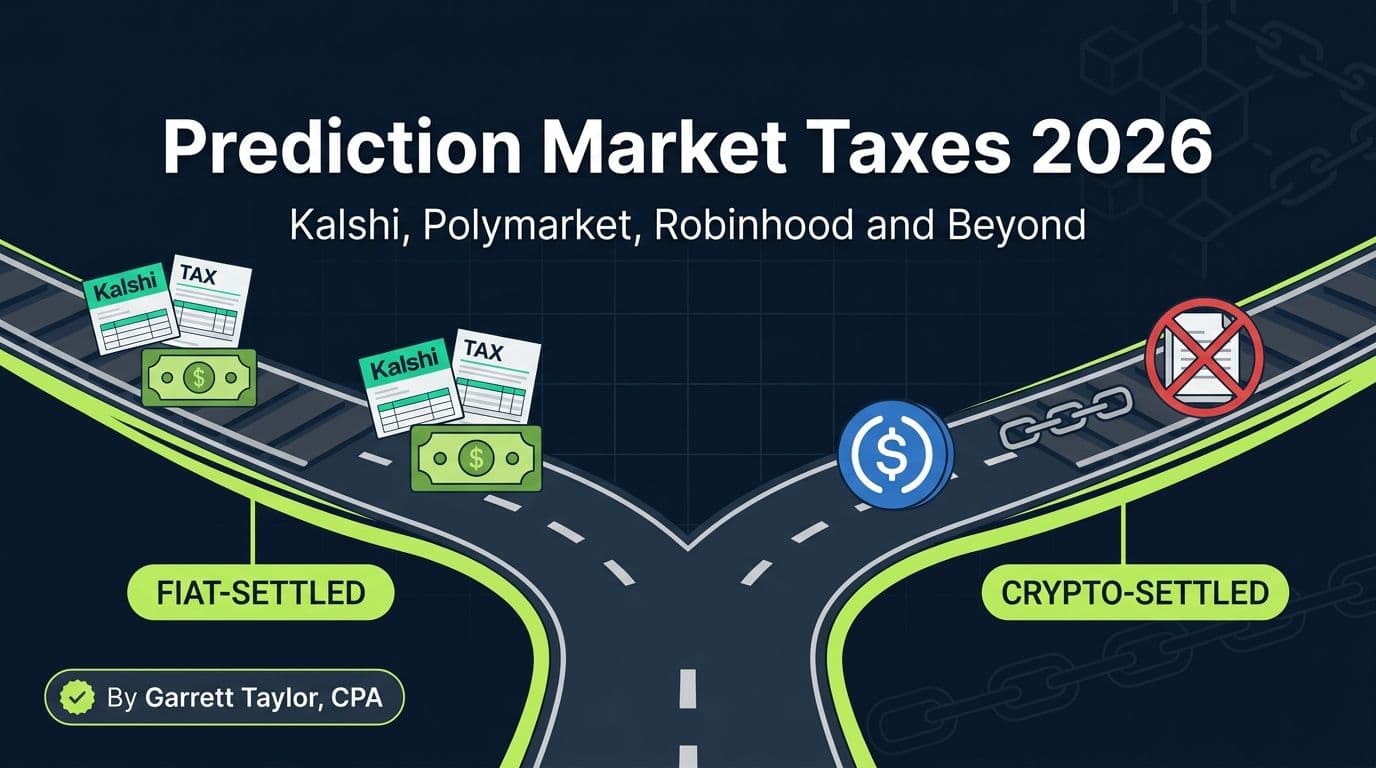
Crypto funding can add a separate reporting layer because acquiring, moving, and disposing of USDC or another digital asset may require wallet-level support. The IRS digital-assets guidance explains the federal reporting framework for digital assets. Our Polymarket reporting and wallet records guide covers the platform-specific record problem in more depth.
How do prediction market CPAs charge?
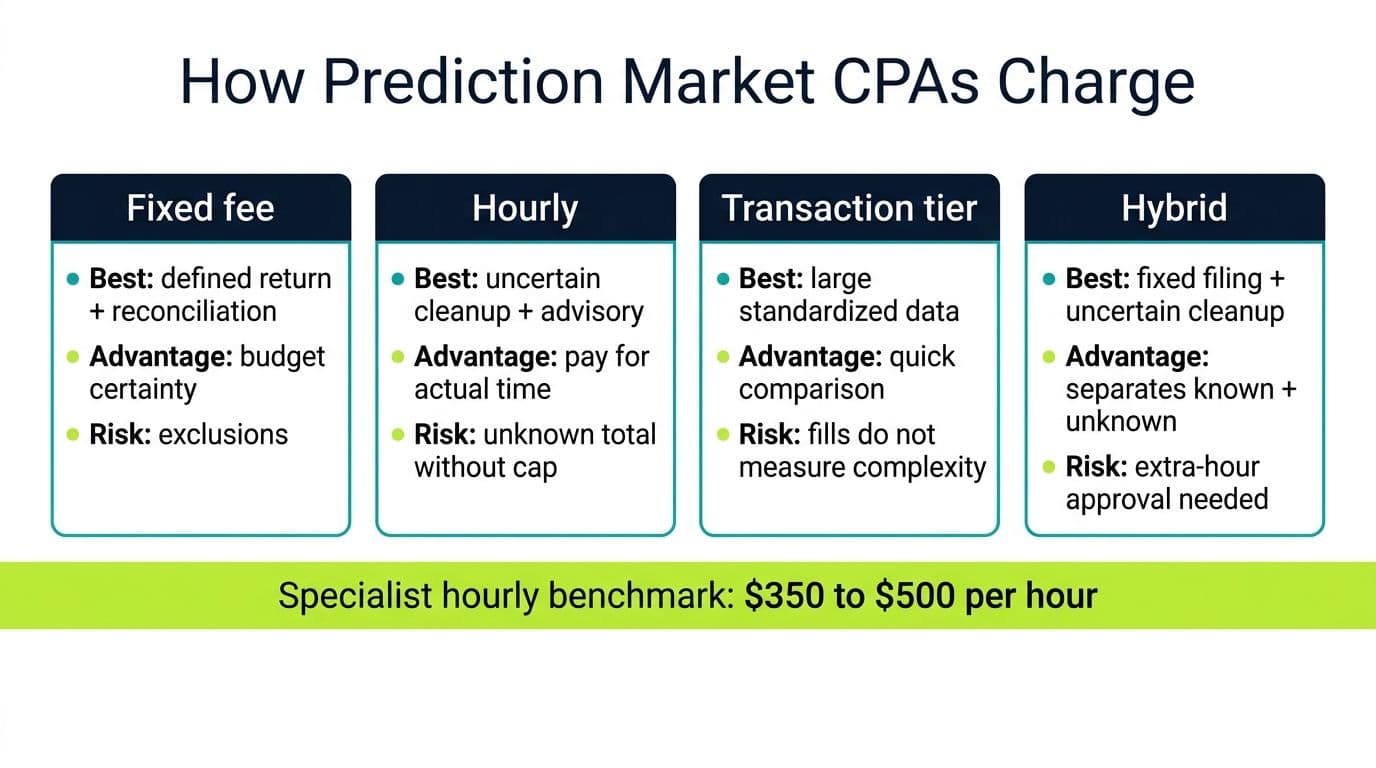
Prediction market CPAs commonly charge a fixed fee, an hourly rate, a transaction-based tier, or a hybrid quote with hourly work outside the defined scope.
Prediction Market CPA Billing Models
| Billing model | Best for | Advantage | Risk |
|---|---|---|---|
| Fixed fee | Defined return and reconciliation scope | Budget certainty | Scope exclusions can make a low quote misleading |
| Hourly | Uncertain cleanup or advisory | You pay for actual time | Total cost is unknown without an estimate or cap |
| Transaction tier | Large but standardized data sets | Easy first-pass comparison | Fill count does not measure product or data complexity |
| Hybrid | Defined filing plus uncertain cleanup | Separates known and unknown work | Requires a clear approval process for extra hours |
A fixed fee works well when the platforms, tax years, return types, and records are known. Hourly or staged billing can be more honest when nobody knows how damaged the data is. A hybrid engagement might fix the return fee in writing, then require approval before missing-basis research or extra-year reconstruction begins.
What is a normal hourly rate?
A CPA with former Big 4 tax experience typically bills $350 to $500 per hour for specialist crypto and prediction-market work. Less specialized preparers may charge $200 to $300 per hour, and highly specialized forensic work can price higher.
The 2025 National MAP Survey executive summary reports a $170 median net hourly billing rate across surveyed CPA firms. It also reports 2024 median role rates ranging from $127 for associates to $275 for equity partners or owners. Specialist pricing sits well above that profession-wide median because event-contract and digital-asset work demands reconstruction skill and product-level judgment that general preparers do not carry.
$170 median net hourly rate
The 2025 National MAP Survey reports this profession-wide benchmark across surveyed CPA firms. Specialist crypto, prediction-market, and forensic work can price higher.
Is a flat fee always better than hourly billing?
No. A flat fee is only better when the scope is specific enough to make the number meaningful.
A vague $1,500 flat quote that excludes reconciliation could cost more than capped hourly cleanup followed by a fixed return fee. Ask what happens if records are missing, how extra work is approved, and whether there is a written cap or pause point. The billing label matters less than the boundary around the work.
What should be included in the quoted fee?
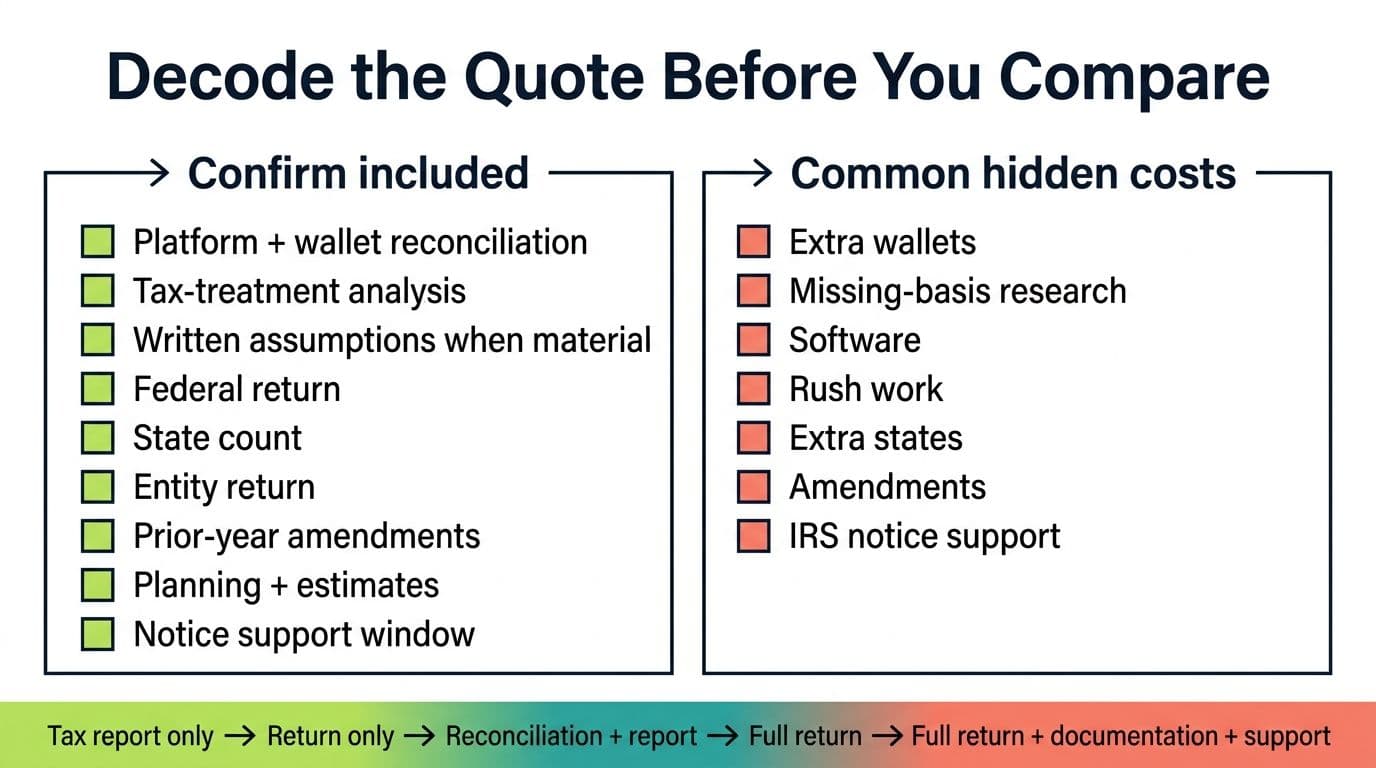
A comparable quote should say whether it includes data intake, reconciliation, tax-treatment analysis, federal and state preparation, review, filing, workpapers, and post-filing questions.
What to Check in a Prediction Market Tax Quote
| Deliverable | Ask whether included | Why it changes the price |
|---|---|---|
| Platform and wallet reconciliation | Yes | Often the largest labor component |
| Tax-treatment analysis | Yes | Prediction-market characterization is fact-specific and can be unsettled |
| Written assumptions or position memo | When material | Creates support beyond a number on the return |
| Federal individual return | Yes | Some vendors sell only a crypto or transaction report |
| State return | State count | Each state can add forms and review |
| Entity return | Entity type | Separate filing and books may be required |
| Amendments or prior years | Year count | Each year needs reconstruction and a filing decision |
| Estimated taxes and planning | Frequency | Separate from annual compliance |
| Notice or audit support | Time window and limits | Post-filing representation is not always included |
When I compare two proposals, I normalize them line by line. If Firm A quotes $1,400 for return preparation and Firm B quotes $2,600 for reconciliation, a federal return, one state return, a written assumptions log, and 90 days of notice support, those are not competing prices for the same service.
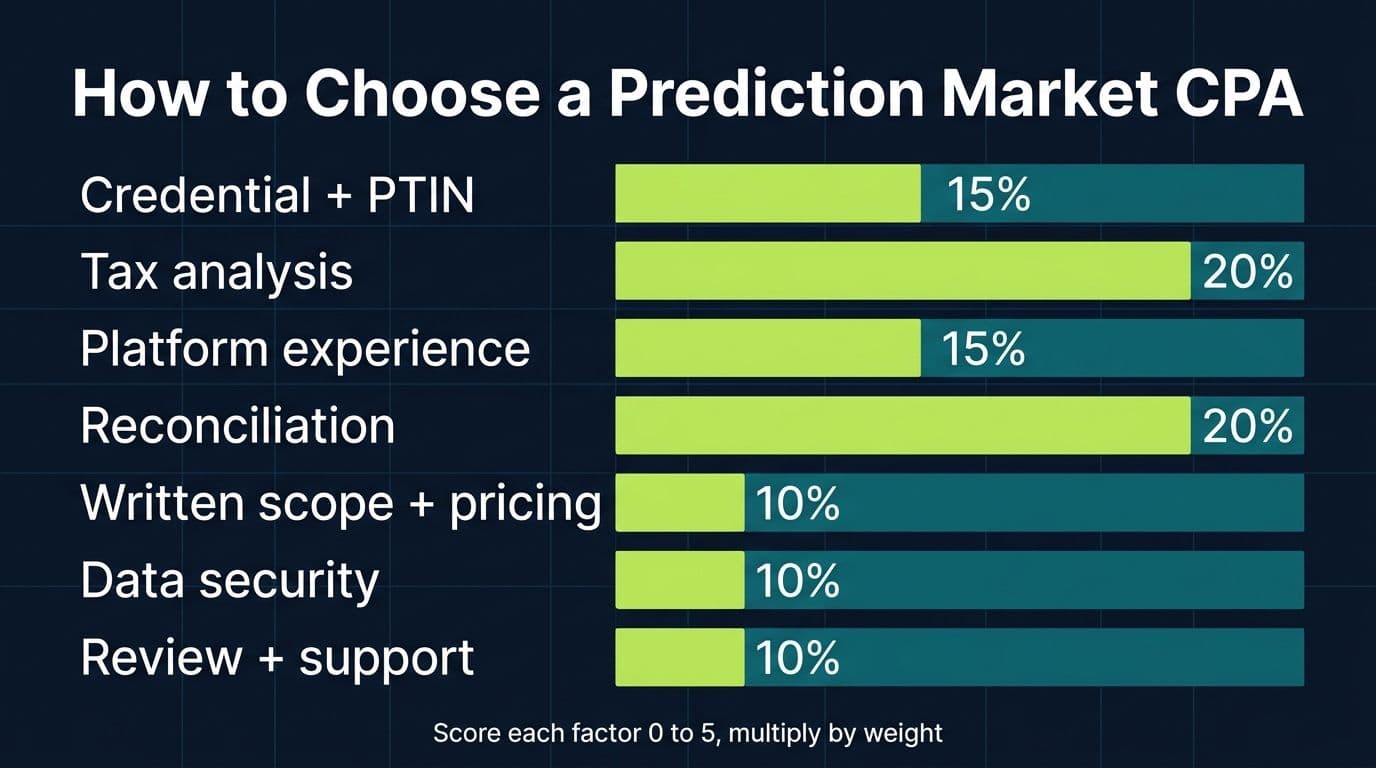
Use our guide to compare prediction market CPA quotes before you choose a provider. It covers credentials, reconciliation capability, engagement terms, and the questions to ask the person who will review and sign the return.
What are the hidden costs in a cheap prediction market tax quote?
The most common hidden costs are reconciliation, extra wallets, state returns, amendments, missing-basis research, software, rush work, and IRS notice support.
The phrase on the quote matters:
- Tax report only: A transaction or gain-and-loss report that still must be reviewed and entered into a tax return.
- Return preparation only: Preparation based on records you provide, with cleanup or reconciliation excluded.
- Reconciliation plus report: Data cleanup and a supported transaction report, but possibly no signed federal or state return.
- Full federal and state return: A prepared return, but not automatically a written treatment memo or notice representation.
- Full return plus documentation and support: The broadest scope, with assumptions, workpapers, and a defined post-filing window.
A cheap quote becomes expensive when essential work sits outside the scope. Ask whether software fees are passed through, how many states and tax years are included, and what triggers a new quote. Also ask who owns the clean ledger and workpapers at the end.
What do four worked prediction market CPA pricing examples look like?
Four worked examples show why the same taxpayer category can produce very different fees: a clean Kalshi return may cost $999 to $1,500, while missing records and entity filings can push a multi-year engagement to $6,000 to $12,500+.
These are hypothetical budgeting examples based on the 2026 market benchmarks above. They are not COS Elite quotes and do not predict any taxpayer's final fee.
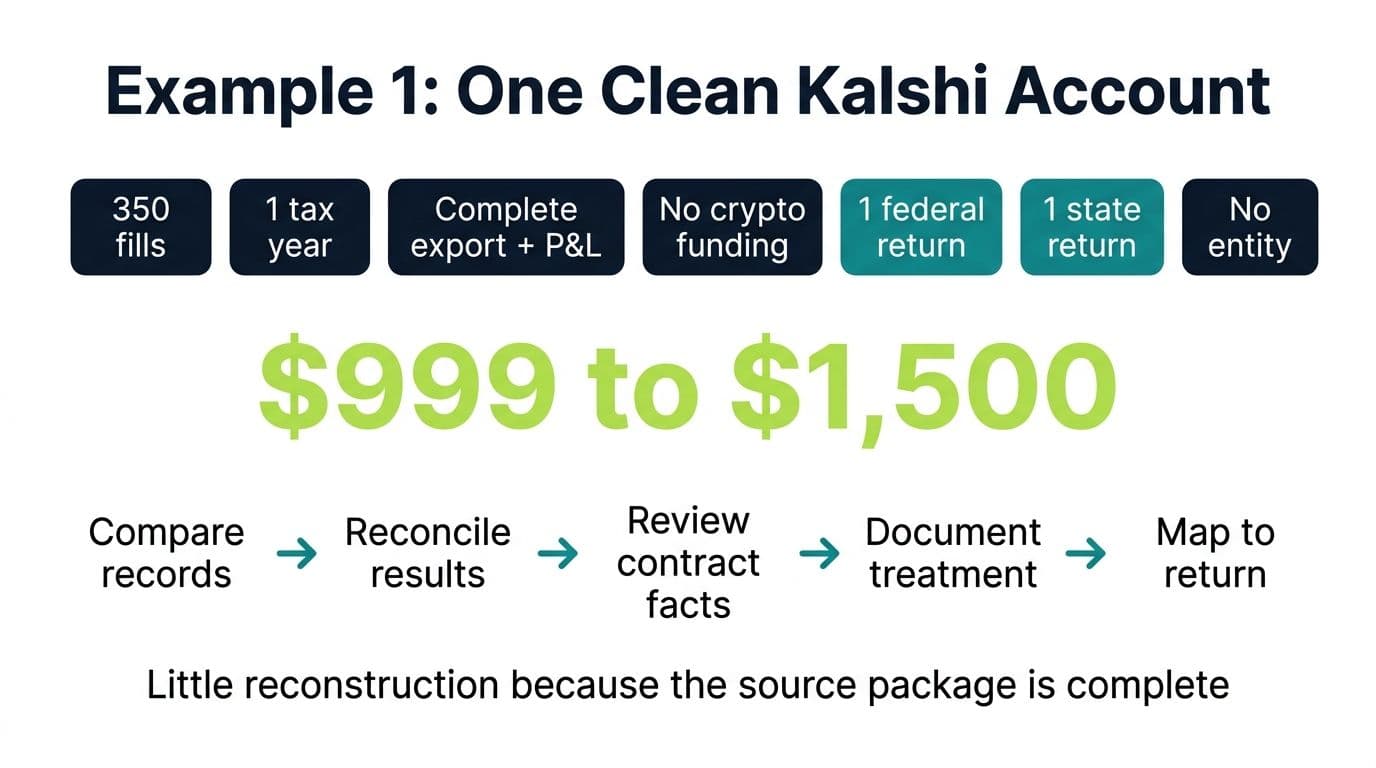
Example 1: One clean Kalshi account
Facts: 350 fills, one tax year, a complete export and profit-and-loss statement, no crypto funding, one federal return, one state return, and no entity.
Expected 2026 market range: $999 to $1,500.
The work is still more than copying a Form 1099. The professional needs to compare the available records, reconcile trading results, review the contract facts, document the selected treatment, and map the result to the return. But there is little reconstruction because the source package is complete.
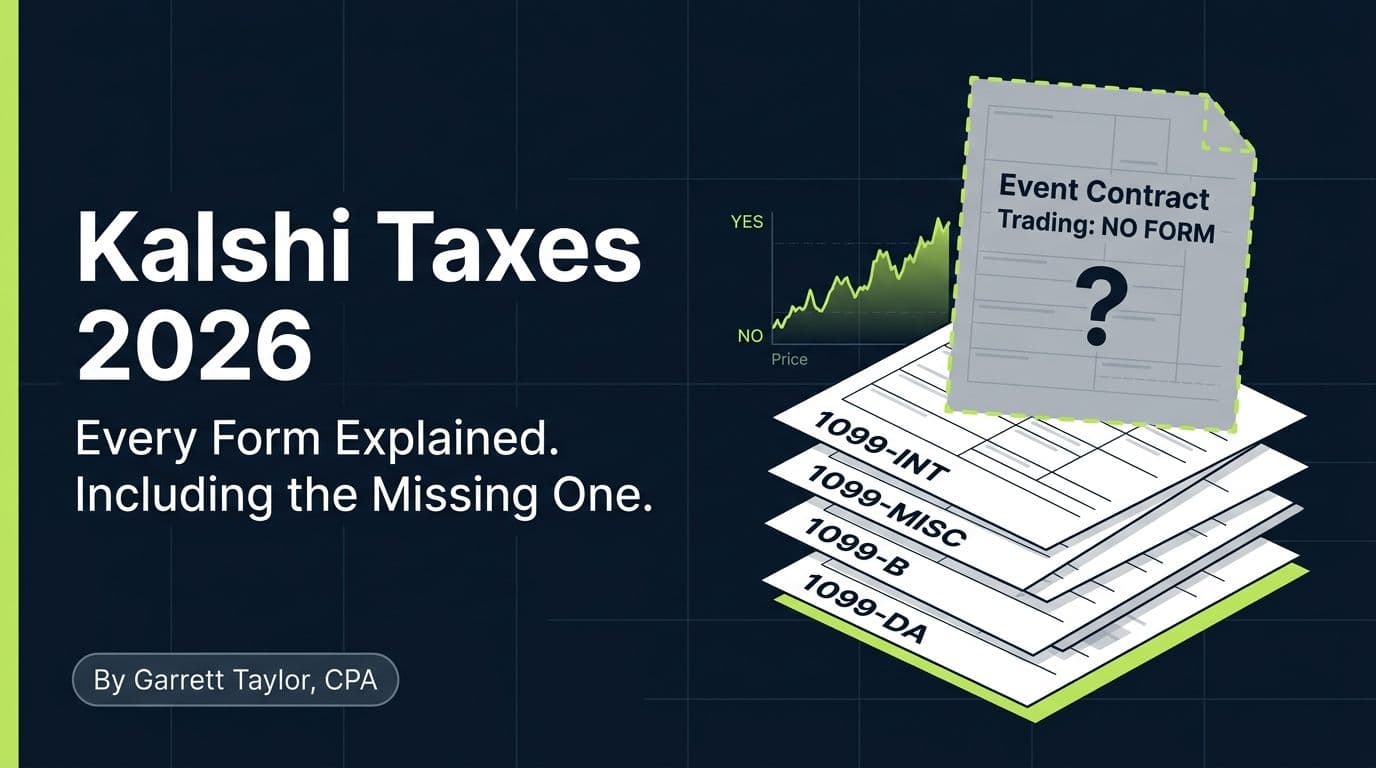
Kalshi explains which current records and forms it provides in its tax documentation. Our Kalshi tax records and forms guide explains why the native activity details can still matter.
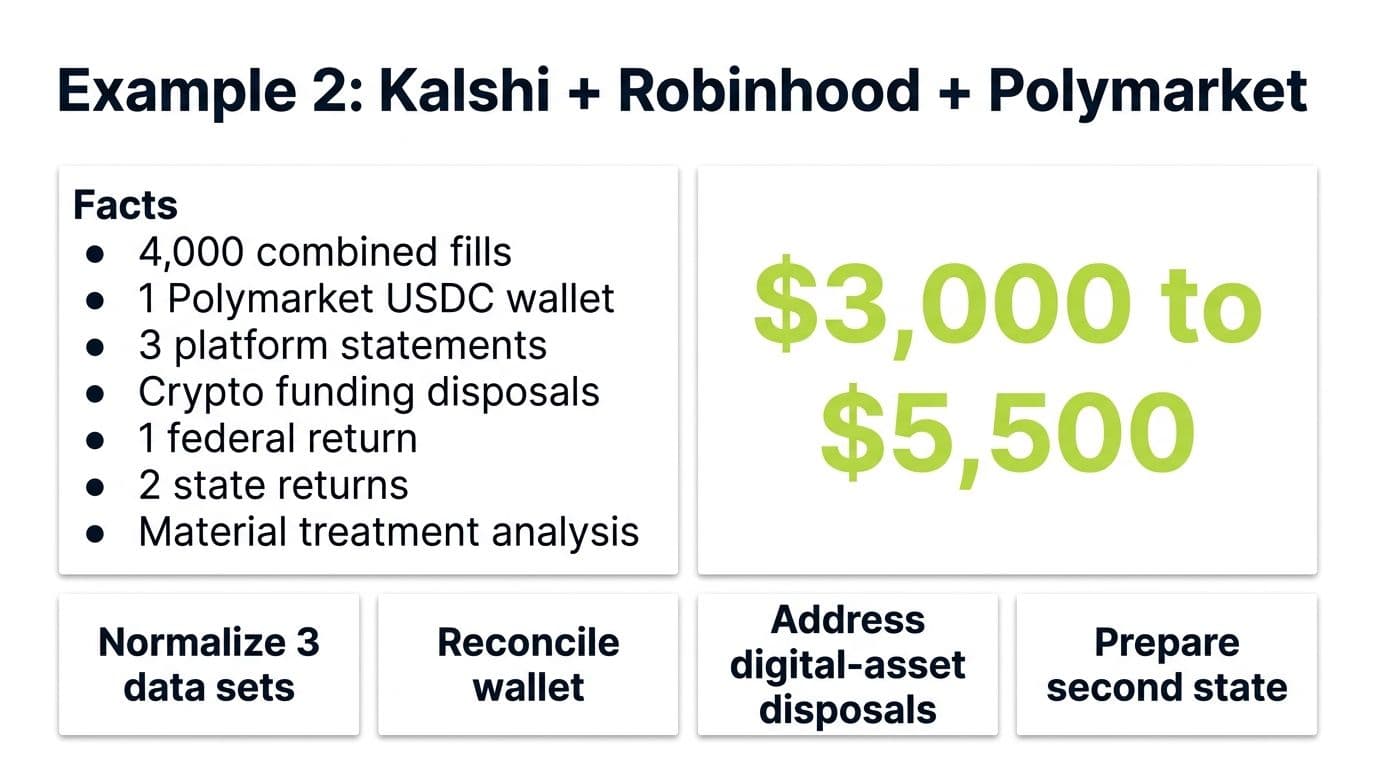
Example 2: Kalshi, Robinhood, and Polymarket
Facts: 4,000 combined fills, one Polymarket USDC wallet, three platform statements, crypto funding disposals, one federal return, two state returns, and material treatment analysis.
Expected 2026 market range: $3,000 to $5,500.
The higher price comes from four distinct workstreams. The firm must normalize three platform data sets, reconcile the wallet, address digital-asset disposals, and prepare a second state return. A written assumptions package may also be appropriate because several products and reporting paths are involved.
The fee should identify whether wallet history, Form 8949 support, Form 6781 analysis, and both state filings are included. It should not assume every event contract receives the same tax treatment.
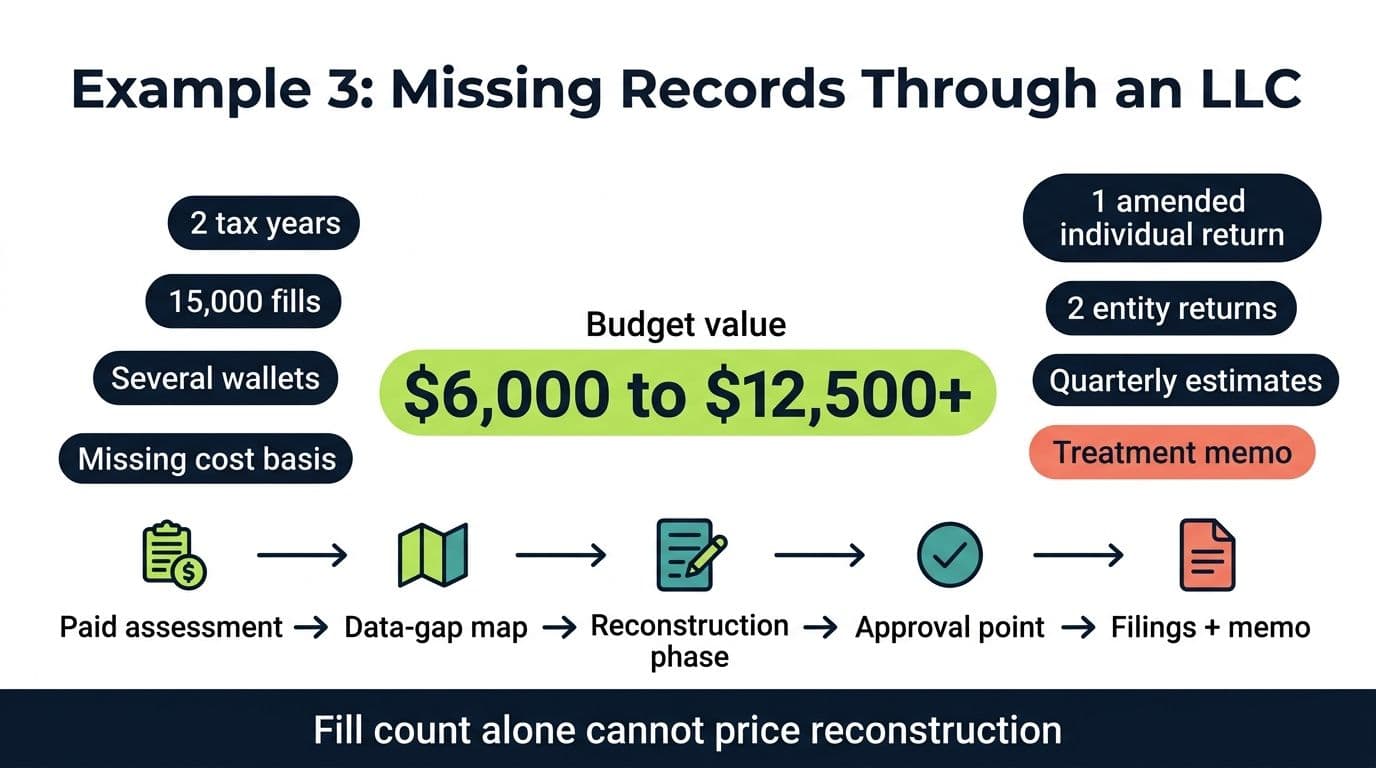
Example 3: Two years of missing records through an LLC
Facts: 15,000 fills, several wallets, missing cost basis, one amended individual return, two entity returns, quarterly estimates, and a treatment memo.
Expected 2026 market range: $6,000 to $12,500+.
This engagement combines reconstruction, amendment decisions, entity compliance, and planning. Nobody can price it responsibly from fill count alone. A paid assessment, an hourly reconstruction phase, or a staged engagement can be more honest than an instant fixed quote.
The first milestone should identify the available data, the gaps, the years and entities affected, and the approval point before deeper cleanup begins. The taxpayer should also know whether ongoing bookkeeping and IRS examination support are outside the engagement.
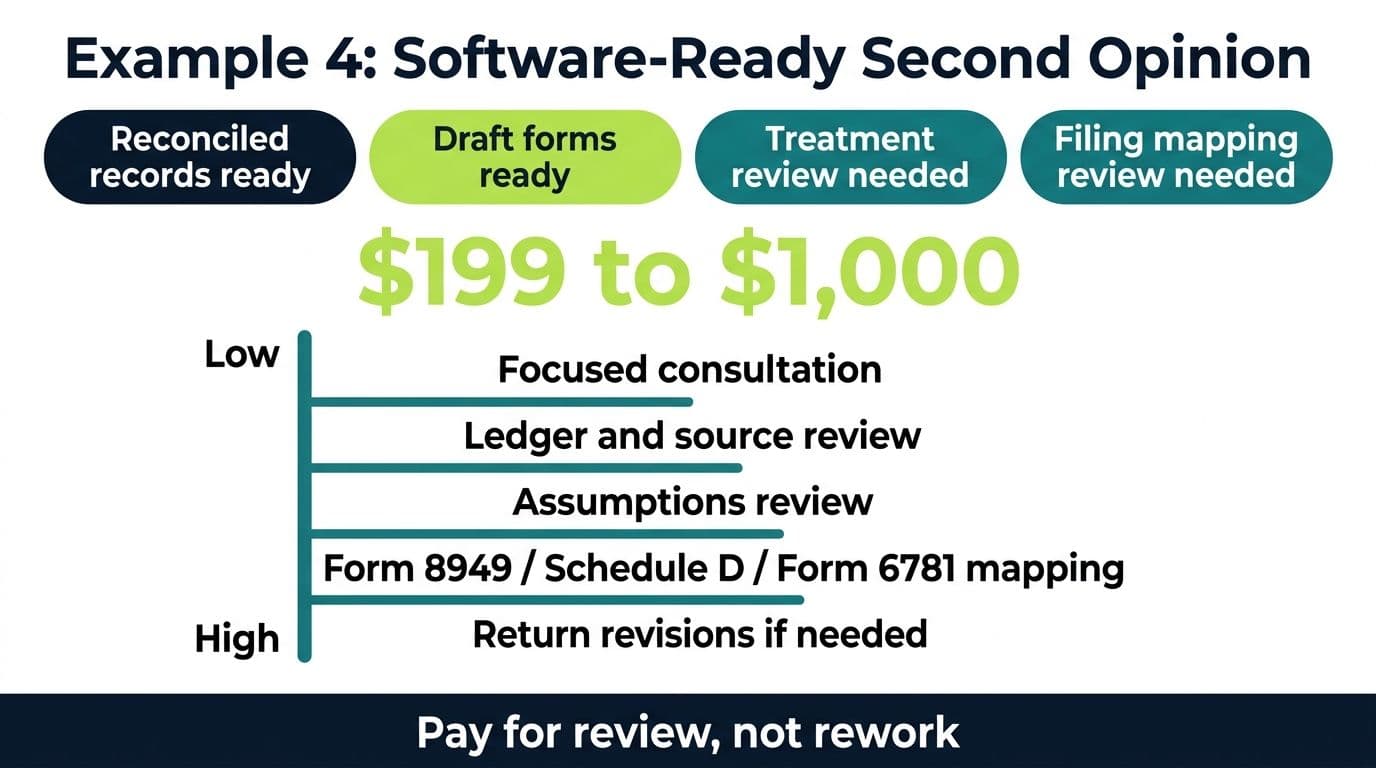
Example 4: Software-ready records and a second opinion
Facts: Reconciled records and draft forms are ready, but the taxpayer wants a credentialed review of treatment and filing mapping.
Expected 2026 market range: $199 to $1,000.
The low end may cover a focused consultation. The high end may include review of the ledger, source records, assumptions, Form 8949, Schedule D, Form 6781, Schedule 1, or return revisions, depending on the facts. A narrow second opinion can be enough when the data is clean and the open question is clearly defined.
This example matters because not every prediction market trader needs a full-service engagement. The right scope solves the actual problem without paying for work that has already been done well.
Get a Written Prediction Market Tax Quote
Bring your platform list, approximate fill count, tax years, states, entities, and record gaps. COS Elite can scope the work and explain what is included before you decide.
Book a Prediction Market Tax CallFree 15 minute call. No commitment.
Can you reduce the fee before hiring a CPA?
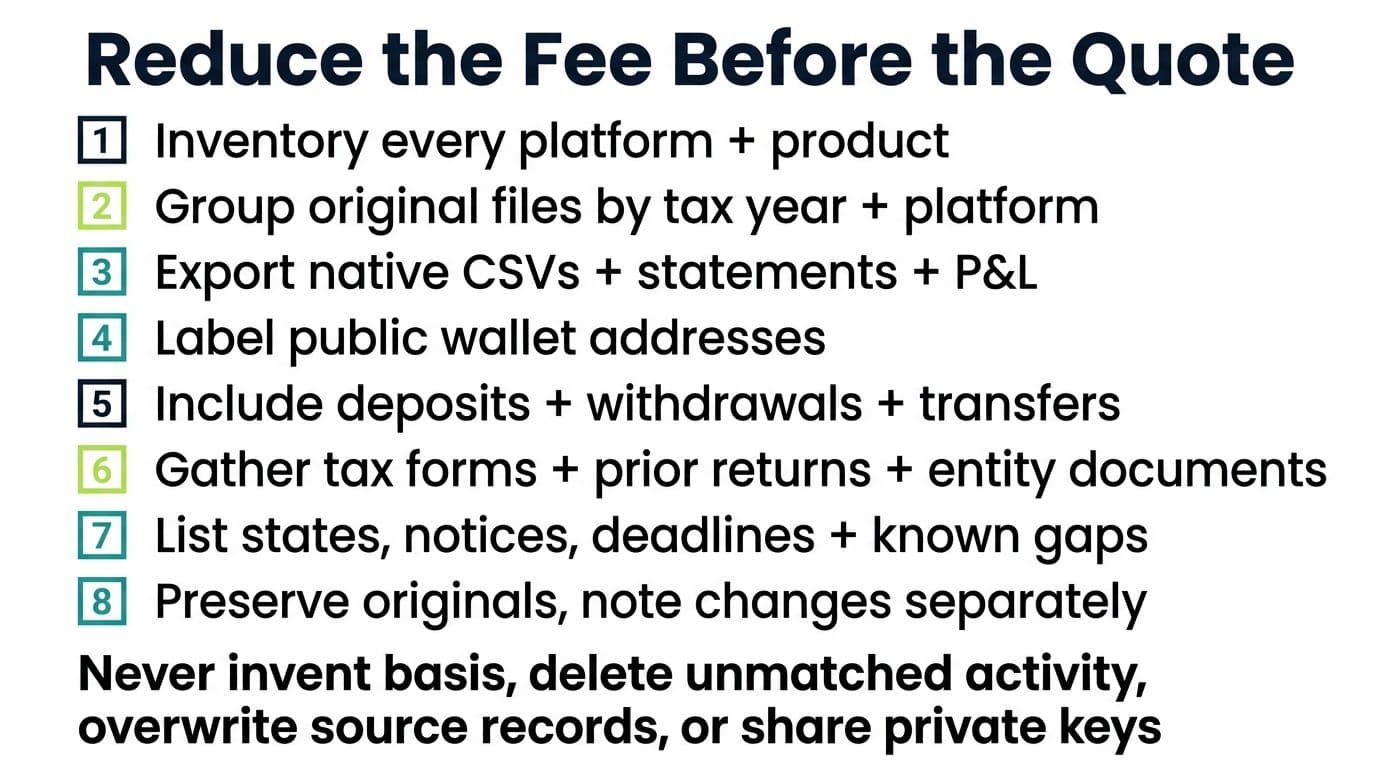
Yes. A complete platform inventory, native exports, labeled wallet addresses, prior returns, and a written list of missing records can reduce intake and reconstruction time.
Start with a simple folder structure by tax year and platform. Keep original files untouched. Add a separate note that lists accounts, wallet addresses, states, entities, tax forms received, and known gaps. If a platform account is inaccessible, say so before the quote rather than after the engagement begins.
Which records save the most time?
Native platform exports, profit-and-loss statements, annual statements, wallet addresses, deposit and withdrawal history, tax forms, prior-year basis records, entity documents, a state list, and IRS or state notice copies usually save the most time.
Do not send only screenshots or a single tax form if fuller records exist. Keep the original filenames and date ranges so the preparer can trace the source. Never share a seed phrase or private key. Public wallet addresses and read-only exports are enough for legitimate reconciliation work.
Should you clean the data yourself?
Organizing the data yourself can help, but manually rewriting source files can destroy the audit trail and create new errors.
Label accounts, identify obvious transfers in a separate working copy, and write down what you changed. Do not invent missing basis, delete unmatched transactions, or overwrite native exports. If the records are materially incomplete, ask the professional which cleanup steps will actually reduce billable work before you spend a weekend editing spreadsheets.
Is a prediction market CPA worth the cost?
A specialist is most likely to be worth the fee when treatment could materially change the result, the records do not reconcile, crypto settlement adds another reporting layer, or several returns and years are involved.
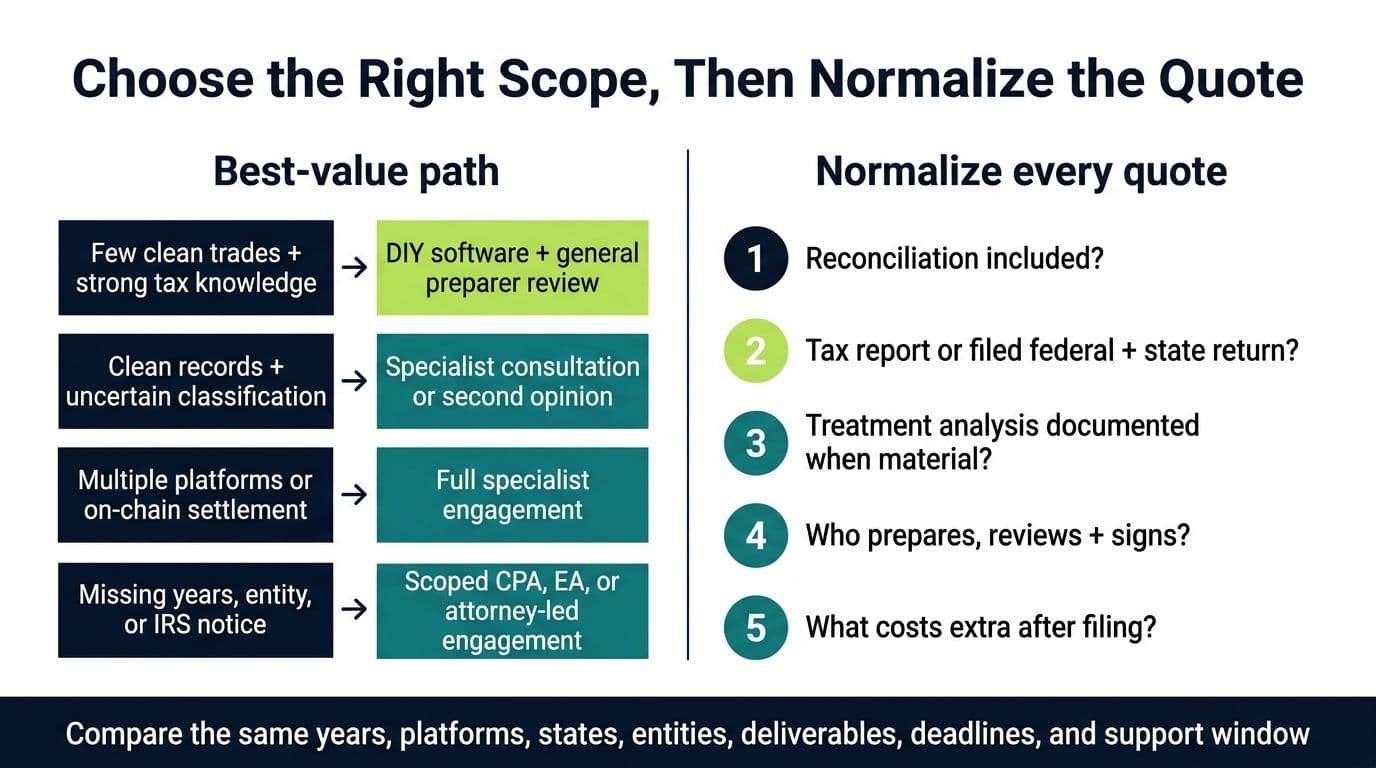
When Specialist Help Is Most Likely to Add Value
| Situation | Likely best value |
|---|---|
| Few clean trades and strong tax knowledge | DIY software plus general preparer review |
| Clean records but uncertain classification | Paid specialist consultation or second opinion |
| Multiple platforms or on-chain settlement | Full specialist engagement |
| Missing years, entity, or IRS notice | Scoped CPA, EA, or attorney-led engagement |
The decision is not simply software versus CPA. It can be software plus review, reconciliation plus a general preparer, a full specialist engagement, or a CPA or EA working with a tax attorney when controversy or privilege issues matter.
Ask what failure you are paying to prevent. It might be an unreconciled ledger, an unsupported position, a missing filing, or a response deadline. If the quote does not address that risk, the engagement may not be worth the price even if the headline fee looks low.
How do you compare prediction market CPA quotes?
Normalize every quote to the same scope before comparing the price.
Use these five questions:
- Is platform and wallet reconciliation included?
- Is this a tax report, or a filed federal and state return?
- Is the tax-treatment analysis documented when material?
- Who prepares, reviews, and signs the return?
- What costs extra after filing?
Then compare the same tax years, platforms, states, entities, deliverables, deadlines, and support window. A provider should be able to state the assumptions behind the quote and explain what happens when those assumptions are wrong.
The IRS also recommends checking credentials, PTIN status, signing practices, records policies, and availability when choosing a tax professional. Price matters, but accountability matters too.
If you want a scoped answer for your records, get a written prediction market tax quote. Bring the facts that drive the price, and ask for every inclusion and exclusion in writing.
What are the most common questions about prediction market CPA costs?
The most common questions are about Kalshi versus Polymarket pricing, fixed versus hourly billing, reconciliation, deductibility, value, and the steps that lower preparation costs.
Frequently Asked Questions
How much does a prediction market CPA cost?
In 2026, a clean one-platform individual return often costs $999 to $2,000. High-volume, multi-platform, or on-chain work often costs $3,000 to $7,500. Multi-year, entity, amended-return, or forensic work can reach $5,000 to $12,500+. These are market benchmarks from public specialist pricing, not a quote for a specific taxpayer.
How much does a CPA charge for Kalshi taxes?
A clean Kalshi engagement with one tax year, complete exports, basic reconciliation, and a federal plus one state return may start around $999 and often falls between $999 and $2,000. Missing records, multiple products, additional states, an entity, amendments, or written treatment analysis can move the quote higher.
Does Polymarket tax preparation cost more than Kalshi?
It often can because Polymarket activity may add wallet reconciliation, USDC cost basis, transfers, and separate digital-asset reporting. It is not automatic. A clean, labeled Polymarket wallet may require less work than a Kalshi account with missing exports or inconsistent statements. The condition of the records matters more than the platform name alone.
Do prediction market CPAs charge hourly or a flat fee?
Both models are common. A fixed fee fits a defined return and reconciliation scope. Hourly billing can fit uncertain cleanup, research, or advisory work. Some firms use transaction tiers or a hybrid model. Whatever the label, ask for the included years, platforms, returns, deliverables, approval process, and any hourly cap in writing.
What is a normal hourly rate for a crypto or prediction market CPA?
A CPA with former Big 4 tax experience typically bills $350 to $500 per hour for prediction market and crypto tax work. The 2025 National MAP Survey reports a $170 median net hourly billing rate across surveyed CPA firms, which is why specialist rates look high until you weigh the reconstruction and product-level judgment involved.
Does the fee include trade reconciliation?
Not always. Some quotes cover only return preparation, and some vendors sell a transaction report without preparing or signing the federal and state returns. Ask whether the fee includes platform normalization, wallet matching, missing-basis work, fee treatment, ledger delivery, and tie-out to the filed forms. The engagement letter should answer each item.
Can I deduct CPA fees for prediction market tax preparation?
Possibly, but not universally. The answer can depend on whether fees relate to a trade or business, investment activity, an entity return, or personal tax preparation, plus federal and state law for that year. Do not assume the full invoice is deductible. Garrett Taylor, CPA and Leanne Grant, EA should confirm the 2026 treatment before publication.
Is a prediction market CPA worth the cost?
Specialist help is most likely to be worth the cost when records do not reconcile, several platforms or wallets are involved, classification could materially change the return, or prior years, entities, amendments, and notices expand the risk. A focused second opinion may be enough when records are clean and only one technical question remains.
How can I lower the cost of tax preparation?
Gather native exports, statements, wallet addresses, transfer history, tax forms, prior returns, entity documents, and notice copies before requesting a quote. Label accounts and list known gaps, but preserve original files. A complete inventory reduces discovery time. Never invent basis, delete unmatched activity, overwrite source records, or share private keys and seed phrases.