“This guide has been reviewed for accuracy by Leanne Grant, Enrolled Agent, with a focus on federal tax compliance and IRS representation.”
, Reviewed by Leanne Grant, EA #00167954-EA
Quick answer: Choose a prediction market CPA who can verify an active credential, explain the competing tax treatments for event contracts, and reconcile your actual platform and wallet records before selecting a reporting position. Get the full scope, fee, assumptions, deliverables, security process, and post-filing support in writing before you sign.
Finding a tax professional is easy. Finding one who can look at a Kalshi export, a Polymarket wallet, and a Robinhood statement without flattening every product into the same tax bucket is much harder.
That distinction matters because prediction market tax treatment is unsettled and fact dependent. Venue status, contract design, settlement mechanics, taxpayer activity, and the records you can support may all affect the analysis. The professional you hire should be comfortable saying what is known, what is uncertain, and what evidence supports the filed position.
We prepare returns for prediction market traders, and the strongest engagements start the same way: credential verification, product-level questions, clean reconciliation, and a written scope. This guide gives you a practical scorecard for comparing any provider on those points.
What should you look for in a prediction market CPA?
Look for three things first: a verifiable professional credential, direct event-contract experience, and a documented reconciliation process that connects raw trades to the filed return.
Do not stop at a polished website or a claim of being "crypto friendly." Ask for proof you can check. Then score every candidate on the same seven factors.
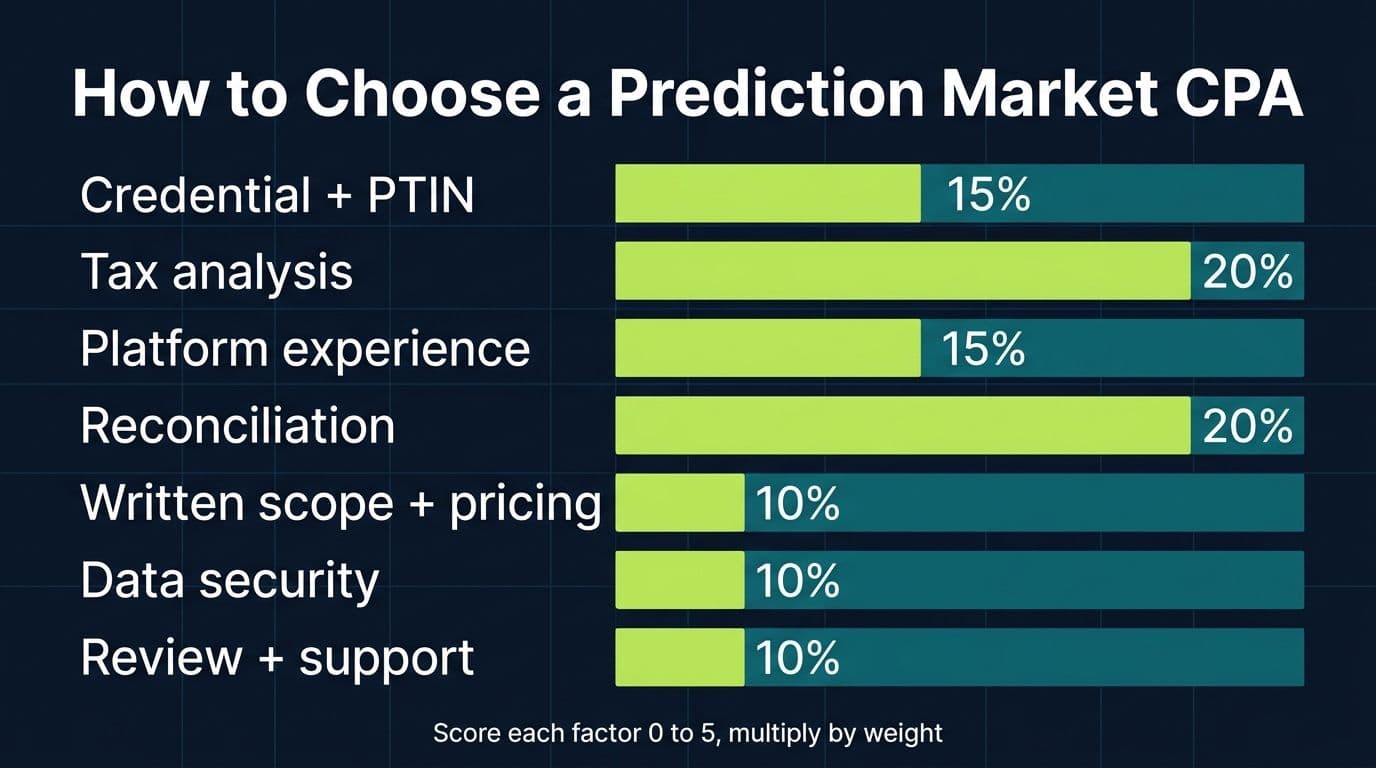
Seven-factor prediction market CPA scorecard
| Factor | Weight | Proof to request |
|---|---|---|
| Active credential and PTIN | 15% | State license or IRS directory result, PTIN confirmation |
| Prediction market tax analysis | 20% | Clear explanation of ordinary, capital, Section 1256, and wagering possibilities |
| Platform and product experience | 15% | Specific Kalshi, Polymarket, Robinhood, or ForecastEx examples without client disclosure |
| Reconciliation capability | 20% | Sample workflow from exports and wallets to workpapers and return forms |
| Written scope and pricing | 10% | Engagement letter, inclusions, exclusions, states, years, amendments, and support |
| Data security | 10% | Secure portal, access controls, retention policy, no seed phrases or private keys |
| Review and post-filing support | 10% | Named reviewer, notice process, record package, availability after filing |
Score each factor from 0 to 5, multiply it by the weight, and compare the totals. A candidate who is excellent at sales but weak on reconciliation should not outscore a quieter firm that can show exactly how its workpapers reach the return.
If you want to compare our process against the same neutral framework, review the prediction market CPA service after you finish the scorecard.
How do you verify a CPA, EA, or tax preparer's credentials?
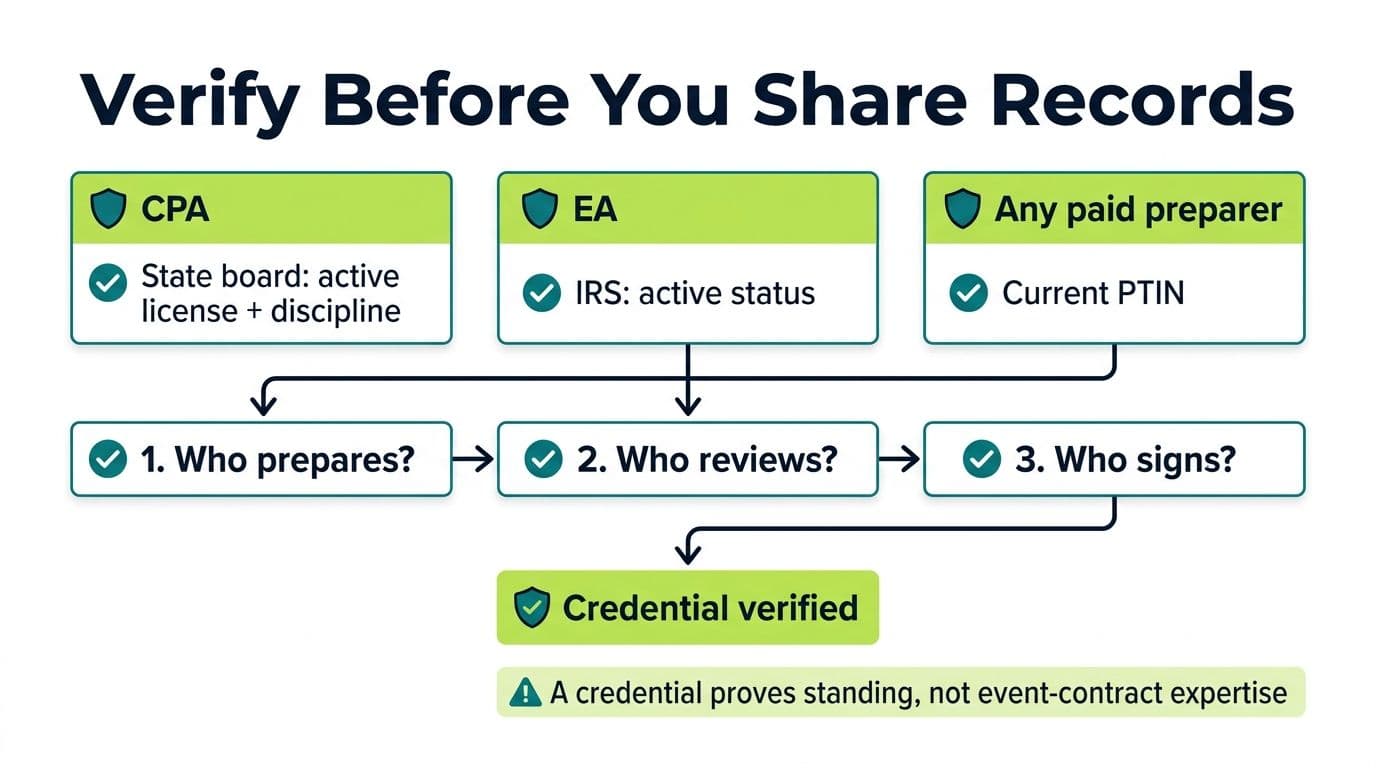
Verify a CPA through the applicable state board of accountancy, an enrolled agent through IRS resources, and every paid return preparer through a current PTIN and a named signer.
The IRS guidance for choosing a tax professional recommends checking qualifications, history, service fees, availability, and the preparer's willingness to sign the return. The IRS also explains the differences among CPAs, enrolled agents, attorneys, and other preparers in its credential comparison.
Use those official checks before you discuss sensitive records. For a CPA, confirm the license status and review any public disciplinary history. For an EA, confirm active status through IRS tools. For any candidate, ask who holds the PTIN, who will sign, and whether a different person will prepare or review the work.
One warning: an active credential proves professional standing. It does not prove that the person understands event contracts, platform statements, wallets, or reconciliation.
Is a CPA always better than an enrolled agent or tax attorney?
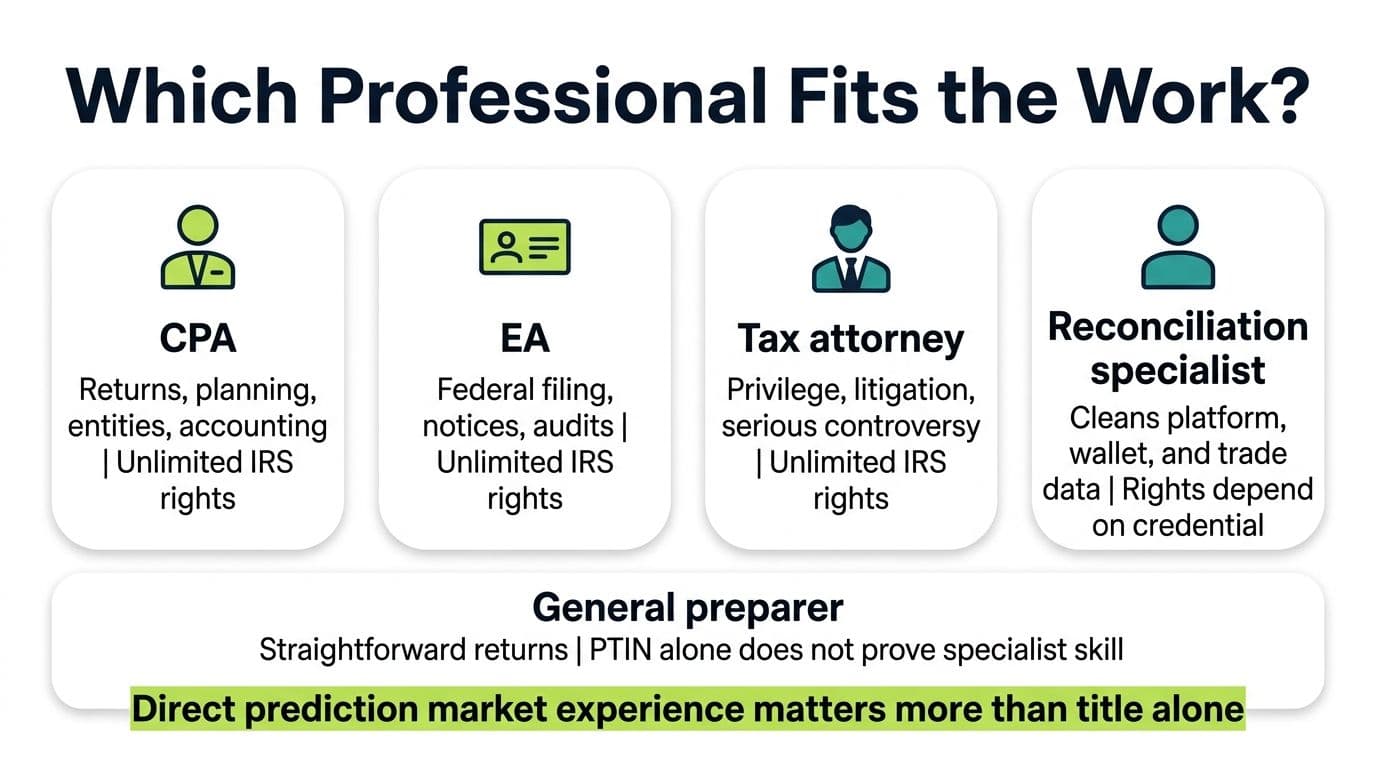
No. The right credential depends on the work, and direct prediction market experience matters more than a title by itself.
CPA, EA, attorney, and preparer roles
| Professional | Best fit | Representation rights | Main caution |
|---|---|---|---|
| CPA | Return preparation, planning, entity, and accounting issues | Unlimited before the IRS | A CPA license does not prove event-contract expertise |
| Enrolled agent | Federal tax filing, notices, audits, and representation | Unlimited before the IRS | Verify platform and reconciliation experience |
| Tax attorney | Privilege-sensitive disputes, litigation, and serious controversy | Unlimited before the IRS | Often unnecessary for routine preparation and usually higher cost |
| Reconciliation specialist | Cleaning platform, wallet, and trade data | Depends on credential | May prepare reports but not sign or defend the return |
| General preparer | Straightforward returns | Varies | A PTIN alone does not prove specialist skill |
A CPA may be the natural lead when the engagement includes an entity, books, planning, and return preparation. An EA can be an excellent choice for federal filing, notices, and IRS representation. A tax attorney belongs in the conversation when privilege, litigation, criminal exposure, or a novel legal dispute is material.
The team can also be mixed. A reconciliation specialist may organize records, an EA may prepare or review federal tax work, and a CPA may sign the return. That structure can work well if the engagement letter names each role and one credentialed professional owns the final filing position.
What prediction market tax questions should a qualified CPA answer?
A qualified specialist should explain what is known, what is unsettled, and which facts would change the treatment. Certainty without product-level analysis is a red flag.
The goal is not to hear a memorized tax label. The goal is to learn how the candidate reasons. Ask them to identify the facts they need, the authorities they would review, and how they would document a supportable position.
How would you analyze ordinary income, capital gain, Section 1256, and wagering treatment?
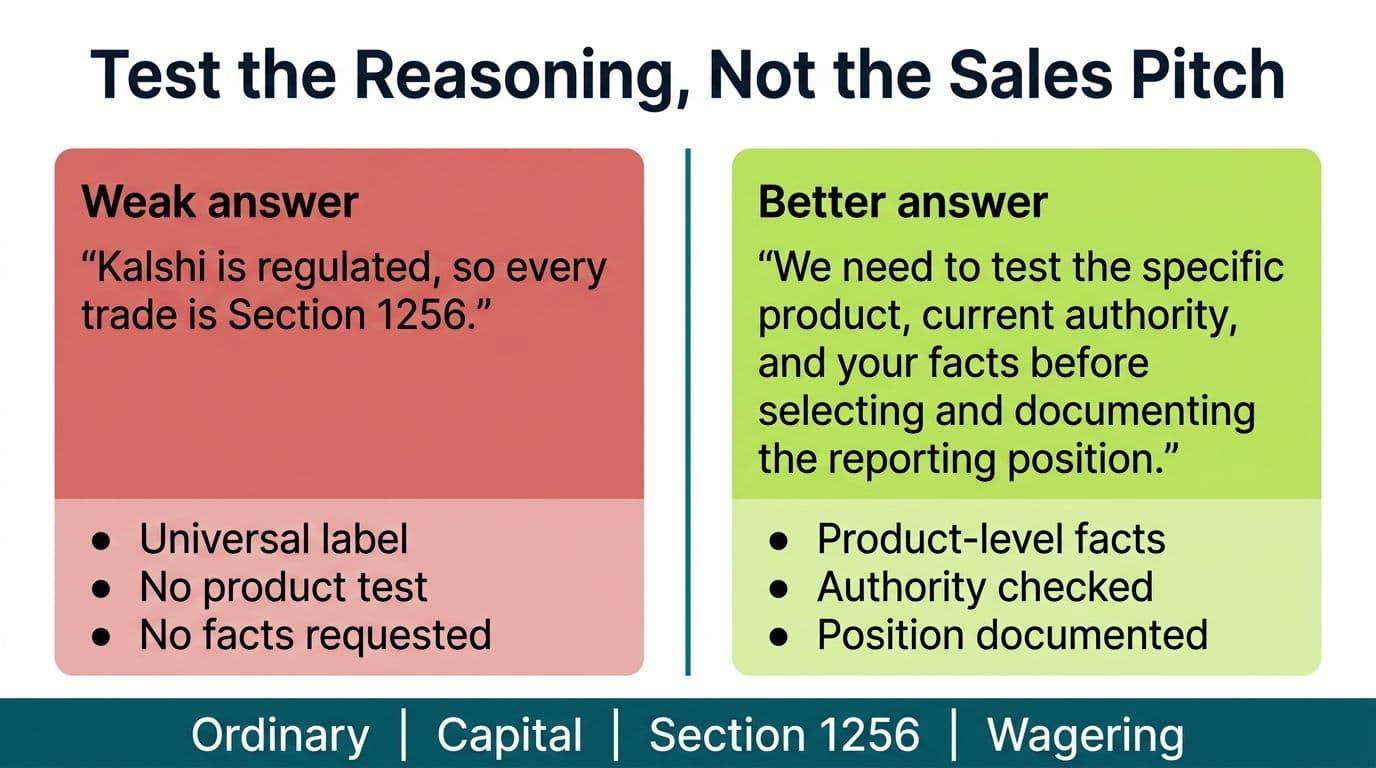
A strong answer starts with the specific contract and taxpayer facts, then tests the possible ordinary, capital, Section 1256, and wagering treatments without assuming one applies to every event contract.
Listen for questions about the venue, product terms, contract type, settlement, transferability, trading frequency, business activity, and taxpayer capacity. A candidate may refer to IRS Publication 550 for Section 1256 background and to the CFTC event-contract product listings when researching product-level facts.
A weak answer sounds like this: "Kalshi is regulated, so every trade is Section 1256." A better answer is: "We need to test the specific product, current authority, and your facts before selecting and documenting the reporting position."
For a deeper explanation of the competing regimes, read how prediction markets are taxed. Your interview question is simpler: can the professional explain the analysis without pretending the uncertainty does not exist?
How do Kalshi event contracts differ from Kalshi perpetual futures?
The candidate should separate Kalshi event contracts from Kalshi perpetual futures because product mechanics and potential reporting treatment cannot be assumed to be identical.
Ask them to identify which product you traded before discussing forms. Then ask what records they need and which authority they would consult. Current Kalshi tax documentation can help establish which platform records exist, but a form or statement does not decide the entire federal treatment by itself.
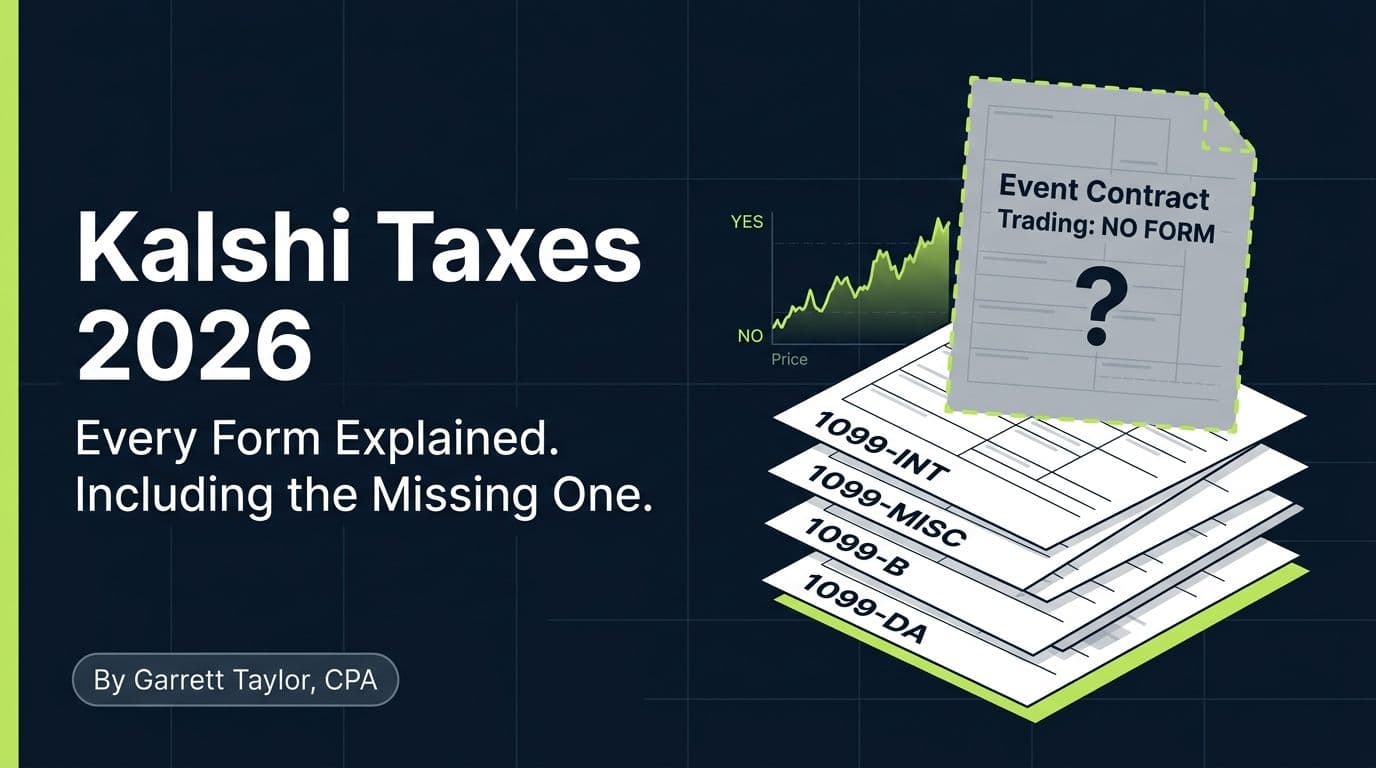
The full platform analysis belongs in our guide to Kalshi tax forms and treatment. During a hiring call, you are testing whether the candidate notices the product distinction at all.
How do you handle Polymarket.com, Polymarket US, and crypto settlement?
The candidate should distinguish Polymarket.com from Polymarket US and analyze both the contract and any separate digital-asset transactions created by funding or settlement.
If USDC or another digital asset moves through a wallet, there may be a second recordkeeping layer. The IRS digital-assets guidance explains that digital assets are treated as property for federal tax purposes. That means the professional may need to reconcile wallet transfers and dispositions separately from the event-contract result.
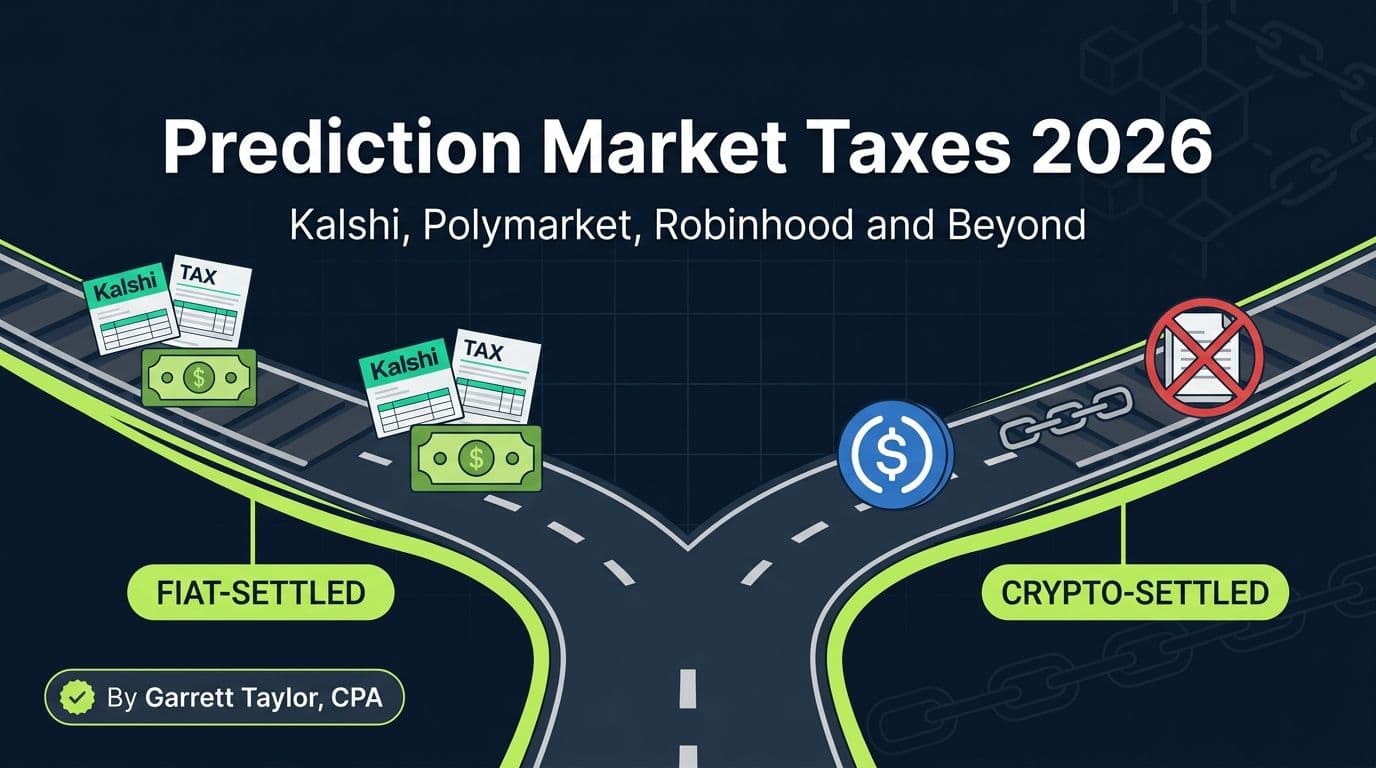
A good Polymarket answer mentions public wallet addresses, deposit and withdrawal matching, gas or platform fees, token units, timestamps, and basis history. It should never include a request for a seed phrase or private key. Our Polymarket tax reporting guide covers the platform mechanics in more detail.
What records do you need from Robinhood, ForecastEx, and other venues?
A qualified candidate should ask for native trade detail, account statements, fees, open positions, settlements, deposits, withdrawals, and funding records instead of relying only on a year-end tax form.
The specific file names will vary by platform. The principle does not. A summary tax form is one input, not the ledger. If the candidate cannot tell you how they will test the form against your actual activity, ask who performs reconciliation and whether that work is included.
How should a prediction market CPA reconcile your records?
The CPA or their in-house reconciliation team should tie every platform, wallet, deposit, withdrawal, fee, position, and settlement to a supportable ledger before the tax treatment is applied.
In our practice, we want the reconciliation sequence to be visible. You should be able to ask how a number moved from a platform export to a workpaper and then to the filed return. "The software calculated it" is not an answer.
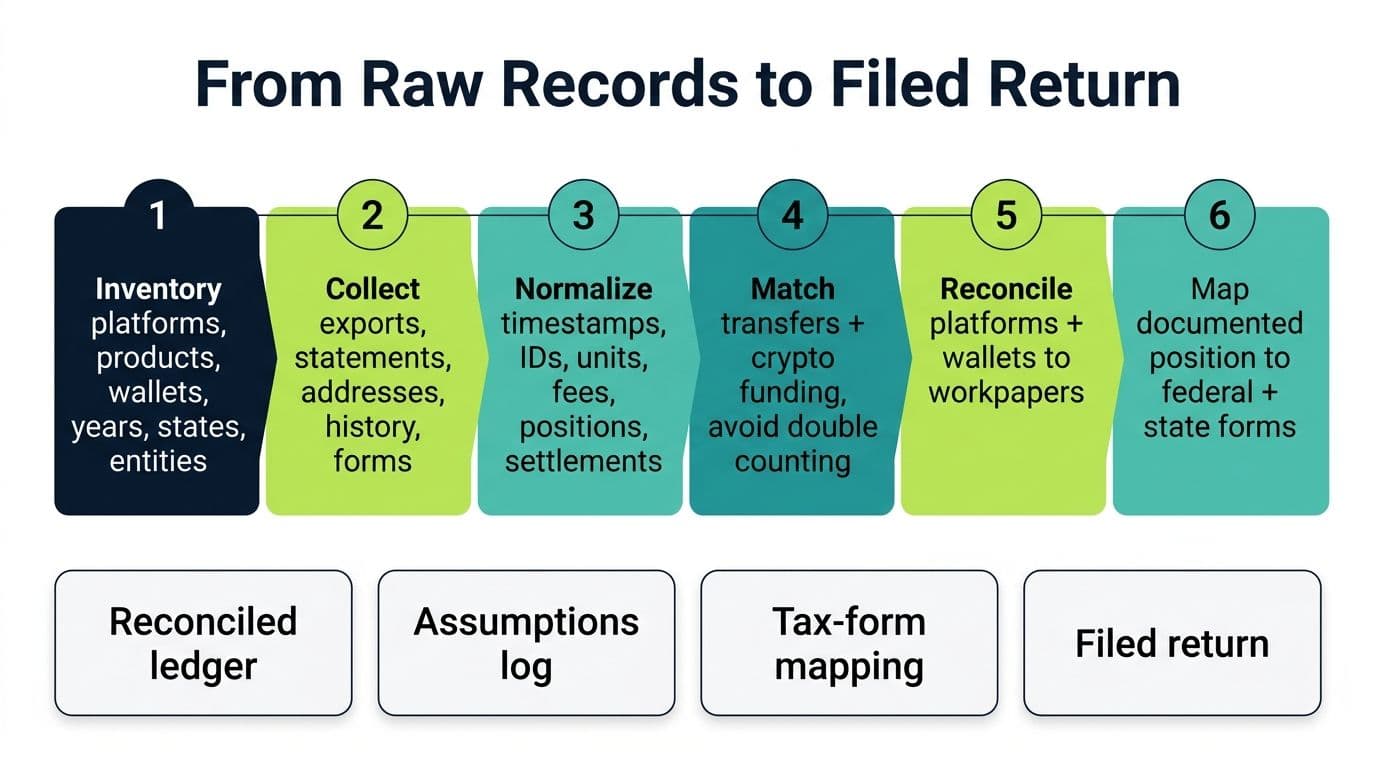
Here is the six-step process to look for:
- Inventory every platform, product, wallet, account, tax year, state, and entity.
- Collect native exports, statements, wallet addresses, transaction history, and tax forms.
- Normalize timestamps, contract identifiers, units, fees, positions, and settlement records.
- Match transfers and crypto funding without double counting deposits or withdrawals as income or sales.
- Reconcile platform totals, wallet activity, and source documents to the workpapers.
- Map the documented tax position to the appropriate federal and state return forms.
Software can speed up steps two through five. It cannot decide which source is authoritative, resolve every duplicate, or select a tax position without professional judgment.
What does a good deliverable look like?
A good deliverable lets another qualified professional trace the source records, adjustments, assumptions, tax position, and filed amounts without rebuilding the engagement from scratch.
Prediction market tax deliverables
| Deliverable | What it should show | Why it matters |
|---|---|---|
| Reconciled ledger | Trades, positions, fees, settlements, transfers, and wallet activity | Establishes the factual record |
| Assumptions log | Missing data, judgment calls, estimates, and client confirmations | Makes uncertainty visible |
| Treatment memo when material | Facts, authorities considered, analysis, and selected position | Supports a significant or unsettled position |
| Tax-form mapping | Workpaper totals tied to Form 8949, Schedule D, Form 6781, Schedule 1, or other applicable forms | Connects analysis to filing |
| Filed return copy | Final federal and state returns plus signature records | Confirms what was submitted |
| Retained source package | Native exports, statements, forms, and correspondence | Preserves the audit trail |
Not every return needs a long legal memorandum. Materiality and complexity matter. But every engagement should produce enough documentation to explain where the numbers came from and why the selected treatment was used.
What should be included in the engagement letter?
The engagement letter should name the tax years, returns, platforms, states, entities, reconciliation work, treatment analysis, deliverables, deadlines, fee model, and post-filing support.
Read it before paying a retainer. If an important item appears only in a sales call or email, ask for it to be added to the signed scope.
Does the fee include reconciliation or only return preparation?
The letter should state plainly whether the provider will reconcile raw records or prepare a return from numbers you supply.
This is the most common scope trap. A quote for "prediction market tax preparation" may cover only the federal return after you deliver final totals. Another quote may include platform normalization, wallet reconciliation, treatment analysis, federal and state filings, and workpapers. Those are not comparable services.
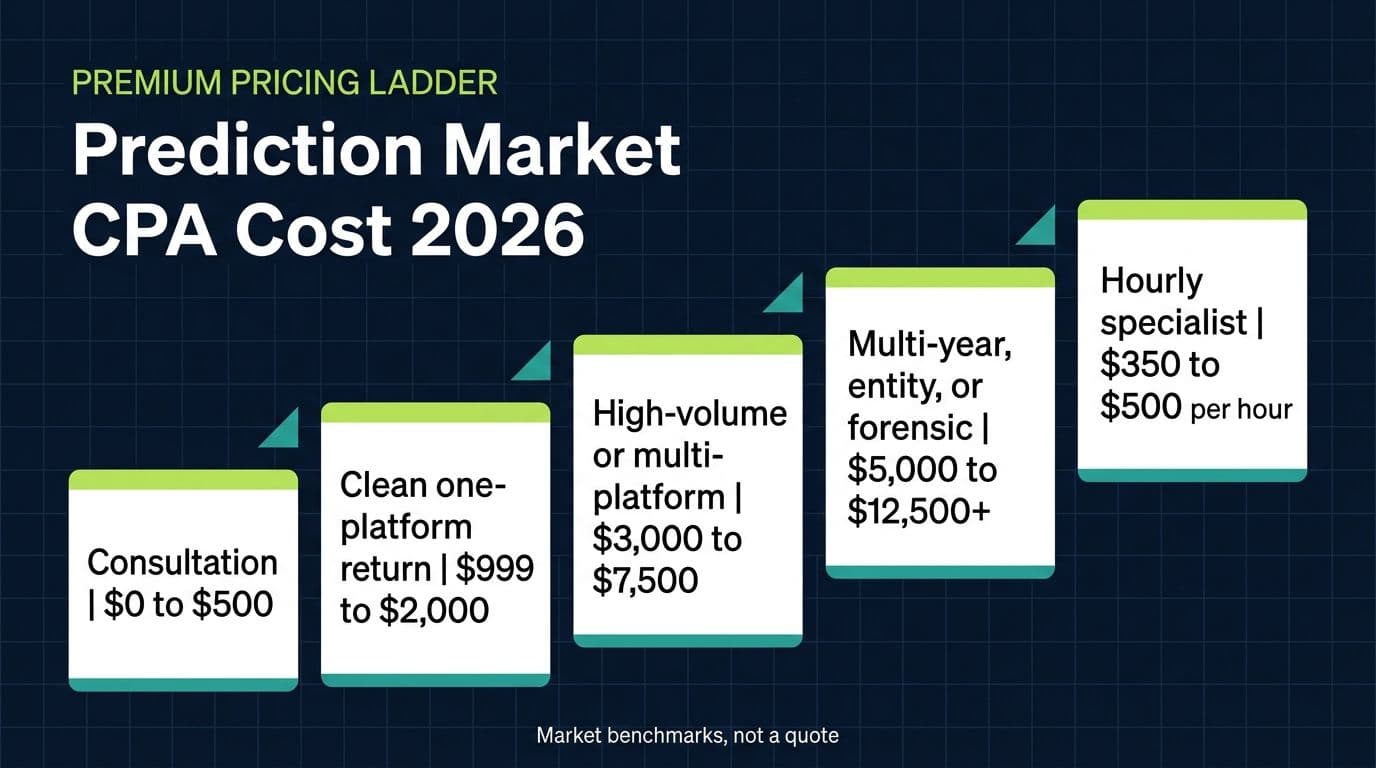
Use the separate guide to what prediction market CPA work costs when you normalize two quotes.
Who makes the tax-treatment decision and who signs the return?
The letter should identify who performs the analysis, who prepares the forms, who reviews the work, and who signs the return with a PTIN.
If subcontractors or an offshore team touch the data, ask what they do, which controls apply, and who remains accountable. Delegation is not automatically a problem. Unclear ownership is.
Are amended returns, state returns, estimates, and IRS notices included?
The letter should mark each additional return and post-filing service as included, excluded, separately priced, or available only under a new engagement.
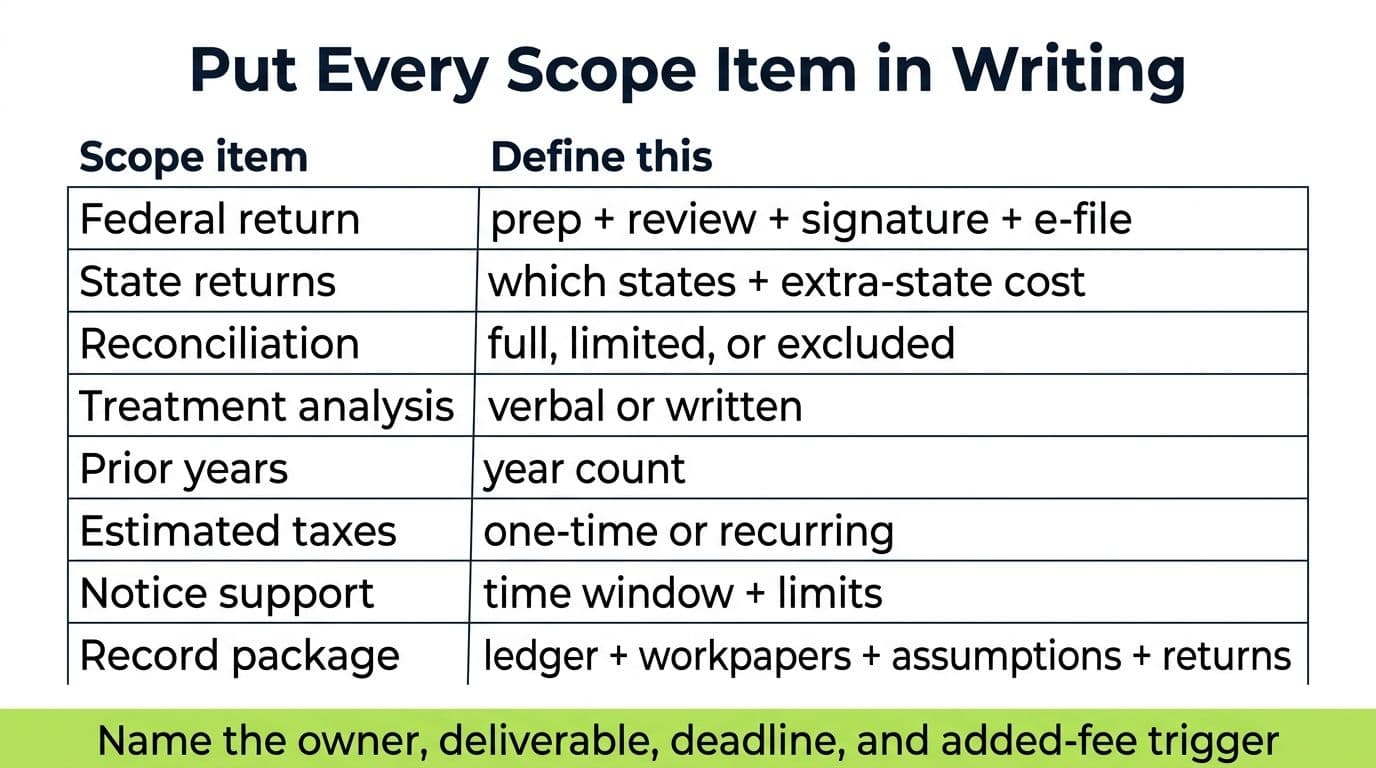
Proposal scope matrix
| Scope item | Included? | Exact question to ask |
|---|---|---|
| Federal individual return | Yes or no | Is preparation, review, signature, and e-file included? |
| State returns | Number of states | Which states are covered, and what does each extra state cost? |
| Reconciliation | Full, limited, or excluded | Who cleans the raw records and resolves exceptions? |
| Treatment analysis | Verbal or written | Will material assumptions and positions be documented? |
| Amended or prior-year returns | Year count | Is each year separately scoped and priced? |
| Estimated taxes | One-time or recurring | Are federal and state estimates included? |
| IRS or state notices | Time window and limits | What happens if a notice arrives after filing? |
| Record package | Specific files | What ledger, workpapers, assumptions, and return copies do I receive? |
Pro Tip
Ask the candidate to rewrite vague scope language before you sign. "Tax services as needed" is not enough. A useful engagement letter names the work, the owner, the deliverable, the deadline, and the trigger for any added fee.
What are the red flags when hiring a prediction market CPA?
Walk away if the preparer promises one universal treatment, asks only for a 1099, will not sign the return, bases the fee on your refund, or cannot explain how the raw records become the filed numbers.
The IRS also warns taxpayers about preparers who charge fees based on refunds, refuse to sign, lack a valid PTIN, or direct refunds to an account they control. Review the agency's taxpayer tips for choosing a preparer before signing an engagement.
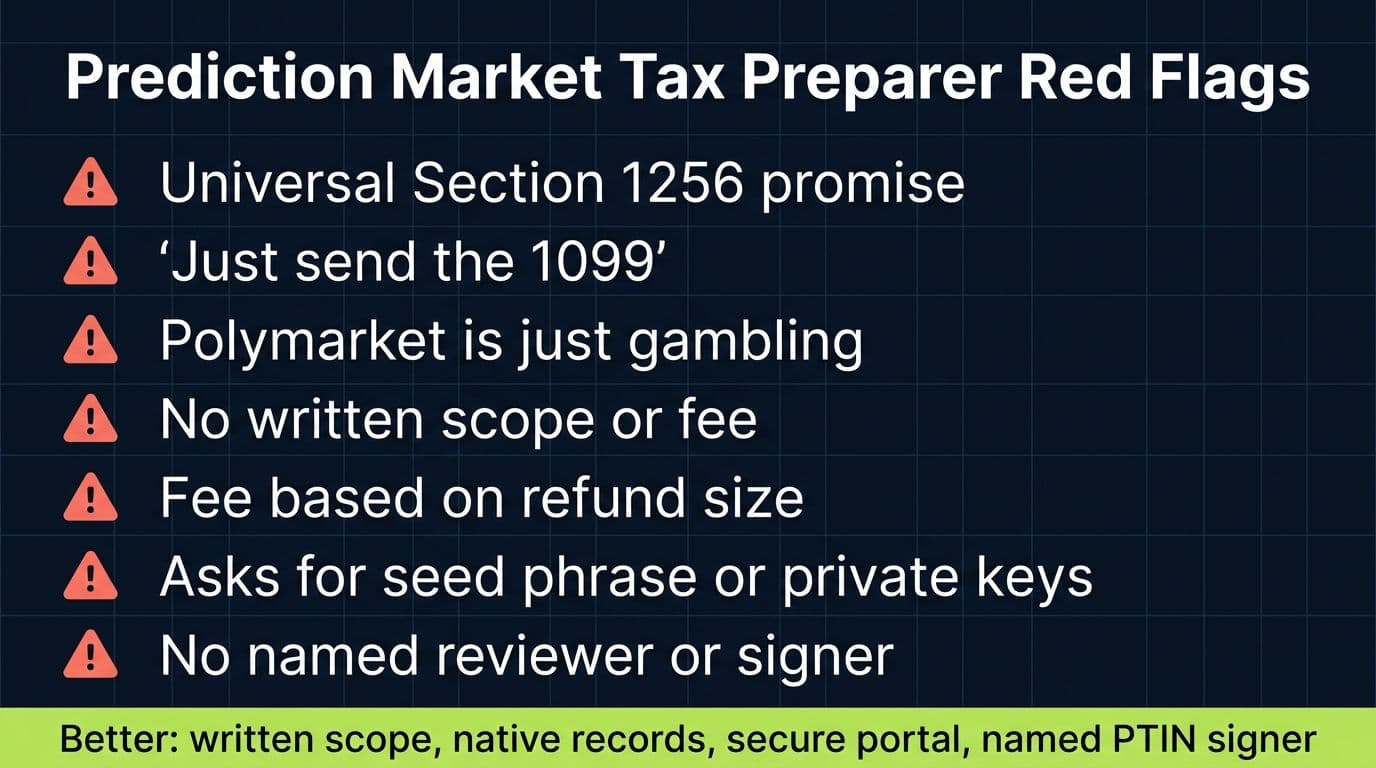
Prediction market tax preparer red flags
| Red flag | Why it matters | Better answer |
|---|---|---|
| "All Kalshi trades are automatically Section 1256" | Venue status alone may not settle product classification | "We test the specific contract and document the position" |
| "Just send the 1099" | Platform forms may omit trading P&L or underlying detail | "Send native exports, P&L, statements, and related wallet records" |
| "Polymarket is just gambling" | Ignores product, jurisdiction, settlement, and crypto facts | "We separate the product and analyze the facts" |
| No written scope or fee | Creates surprise charges and missing work | Fixed or hourly terms with inclusions and exclusions |
| Refund-percentage pricing | It is an IRS-recognized warning sign | Fee based on scope and work, not refund size |
| Seed phrase or private-key request | It is unnecessary and unsafe | Public addresses and exports through a secure portal |
| No named reviewer or signer | Accountability is unclear | Named preparer, reviewer, and PTIN on the return |
Notice what the better answers have in common. They do not promise a result before reviewing the records. They describe a process you can verify.
How do you compare two prediction market CPA proposals?
Compare two proposals by normalizing their scope, scoring the seven factors, and calculating the likely total cost after exclusions.
Here is a simple example.
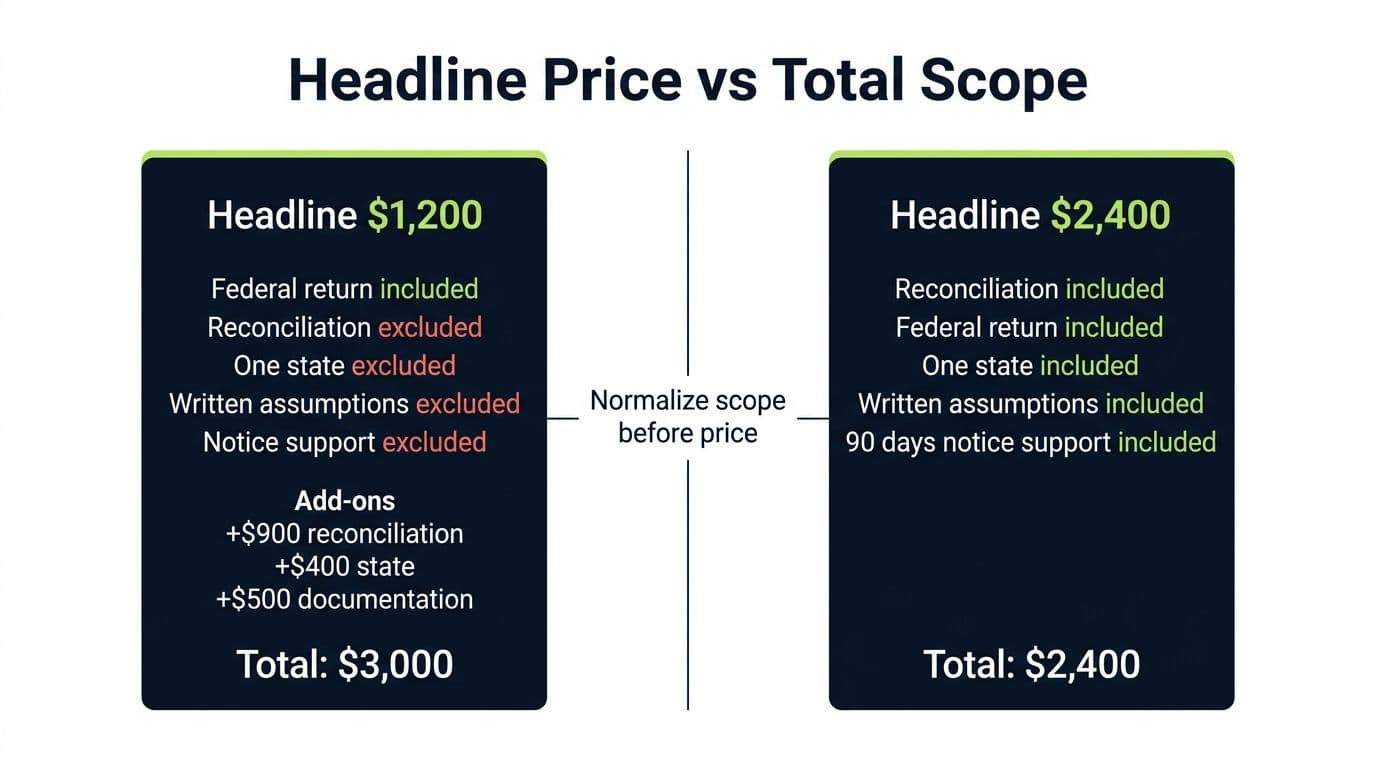
Firm A quotes $1,200. The proposal includes federal return preparation, but it excludes trade reconciliation, a state return, written treatment documentation, and notice support.
Firm B quotes $2,400. The proposal includes platform reconciliation, a written assumptions log, the federal return, one state return, a named CPA reviewer, and 90 days of notice support.
The $1,200 quote is cheaper only if you already have a clean, supportable ledger and do not need the excluded work. If reconciliation later costs $900, the state return costs $400, and treatment documentation costs $500, Firm A reaches $3,000. Firm B may be the lower total cost despite the higher headline fee.
Worked proposal comparison
| Item | Firm A | Firm B |
|---|---|---|
| Headline quote | $1,200 | $2,400 |
| Reconciliation | Excluded | Included |
| Federal return | Included | Included |
| One state return | Excluded | Included |
| Written assumptions | Excluded | Included |
| Notice support | Excluded | 90 days included |
| Illustrative total after Firm A add-ons | $3,000 | $2,400 |
This example is not a market price claim. It shows why scope must be made comparable before price can be useful.
If you are ready to compare your actual situation with a written scope, you can book a prediction market tax call. Bring the scorecard and use it on us.
When do you need a specialist instead of a general CPA?
You need a specialist when product classification, record reconciliation, crypto settlement, volume, entities, or controversy create work a general preparer cannot confidently document.
Some traders do not need a full specialist engagement. One platform, a small number of trades, complete records, and no wallet funding may be manageable for a general CPA who knows when to obtain a focused review.
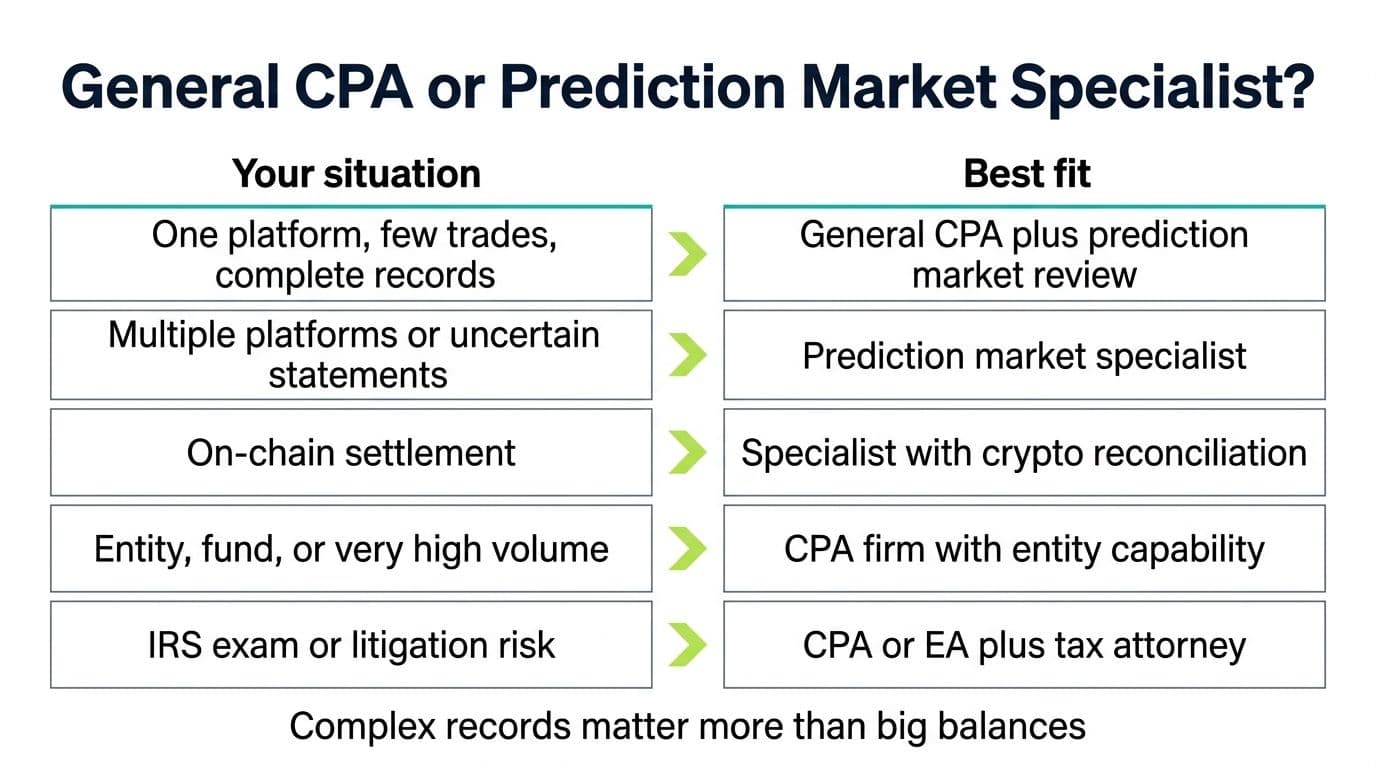
When a prediction market specialist is likely needed
| Situation | Likely path |
|---|---|
| One platform, few trades, complete records, no crypto funding | General CPA with a prediction market review may be enough |
| Multiple platforms or uncertain statements | Prediction market specialist |
| Polymarket or other on-chain settlement | Specialist with crypto reconciliation capability |
| Entity, fund, market making, automation, or very high volume | CPA firm with accounting, entity, and subledger capability |
| IRS examination, litigation risk, or privilege concern | CPA or EA plus tax attorney as needed |
The trigger is not only the amount won or lost. A modest account with damaged records and several wallets may need more specialist work than a larger account with one complete export.
What should you bring to the first call?
Bring a platform inventory, approximate fill count, tax years, wallet addresses, available exports, statements, tax forms, prior returns, entity documents, states, notices, deadlines, and the outcome you need.
You do not need to finish reconciliation before the call. You do need to make the scope visible.
Prepare this short intake packet:
- Every platform and product used, including closed accounts
- Approximate fills or transactions by platform and year
- Public wallet addresses connected to funding or settlement
- Native CSV exports, account statements, profit and loss reports, and tax forms
- Deposit, withdrawal, transfer, fee, and settlement records
- Prior federal and state returns that include related activity
- Entity formation documents and returns, if an entity was involved
- Any IRS or state notices, deadlines, and prior correspondence
- A list of missing files, inaccessible accounts, and known data problems
- Your goal, such as filing the current year, correcting prior years, or responding to a notice
Never send a seed phrase, private key, password, or unrestricted exchange credential. Public wallet addresses and read-only records are enough for legitimate tax work. Use the firm's secure portal, not ordinary email, for sensitive files.
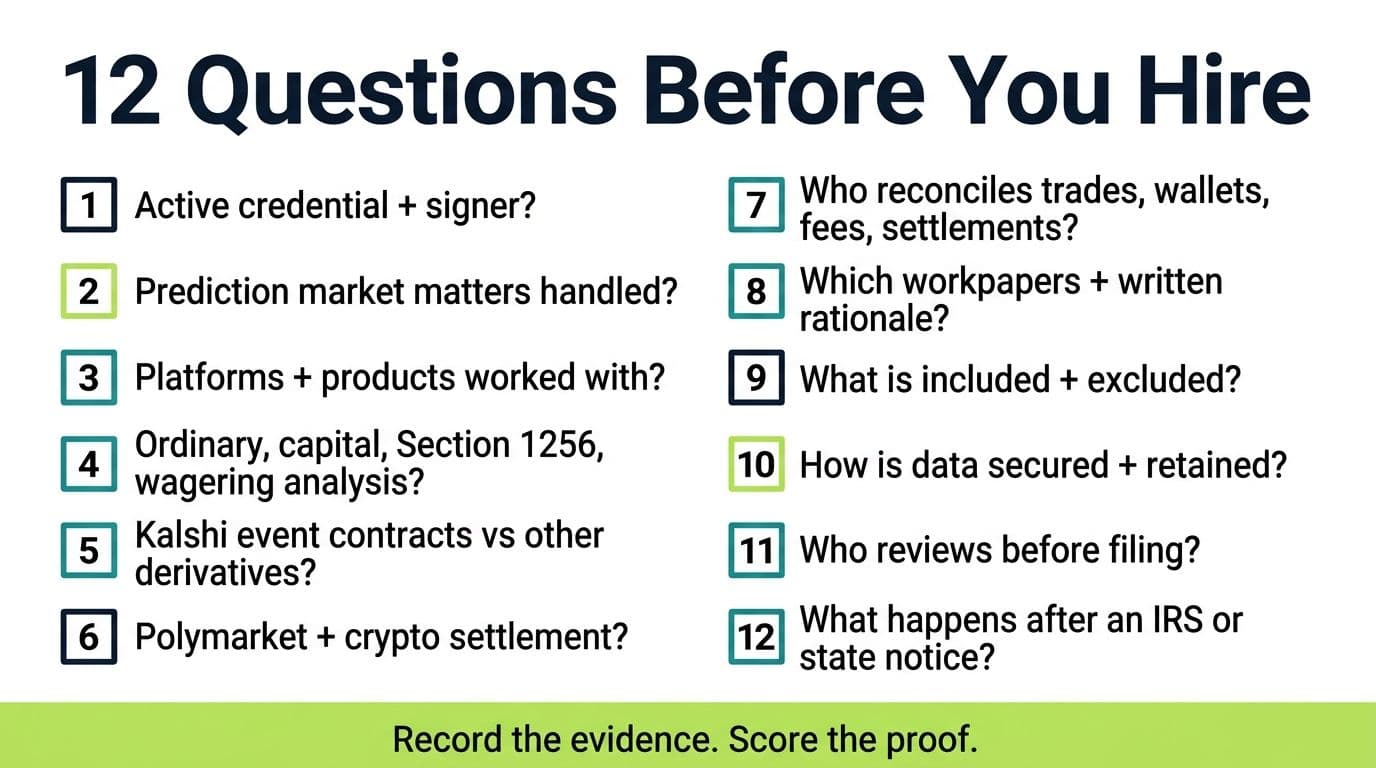
What are the 12 questions to ask before hiring a prediction market CPA?
Ask these 12 questions in order, record the answers, and score each candidate on proof rather than confidence.
- Is your CPA or EA credential active, and who will sign my return?
- How many prediction market matters have you handled?
- Which platforms and event-contract products have you worked with?
- How do you analyze ordinary, capital, Section 1256, and wagering treatment?
- How do you distinguish Kalshi event contracts from other derivatives?
- How do you handle Polymarket and crypto settlement?
- Who reconciles my trades, wallets, fees, and settlements?
- What workpapers and written rationale will I receive?
- What is included and excluded from the quote?
- How do you secure and retain my data?
- Who reviews the return before filing?
- What happens if the IRS or a state sends a notice?
The best candidates will not answer every question with a sales pitch. They will ask follow-up questions, identify missing facts, and tell you where the answer depends on the product or scope.
Which sources should a prediction market CPA know?
A qualified prediction market CPA should know where to verify preparer rules, federal investment guidance, digital-asset treatment, event-contract product details, and platform documentation.
Sources reviewed for this guide:
- IRS: Choosing a tax professional
- IRS: Understanding tax return preparer credentials and qualifications
- IRS: What taxpayers should know when choosing a tax professional
- IRS Publication 550
- IRS digital-assets guidance
- CFTC event-contract product listings
- Kalshi tax documentation
Use this list as an interview tool. A professional does not need to quote every page from memory, but they should know which authority or first-party record answers which question.
Compare Your Prediction Market Tax Scope
Bring your platform list, tax years, wallet activity, and open questions. We will help you identify the work required and put the scope in writing before you decide.
Book a Prediction Market Tax CallFree 15 minute call. No commitment.
Frequently Asked Questions
How do I find a CPA who understands prediction markets?
Start with licensed CPAs or enrolled agents who specifically mention event contracts, Kalshi, Polymarket, or prediction market reconciliation. Verify the credential and PTIN, then ask the candidate to explain competing tax treatments and their data workflow. A strong answer should connect product facts, platform records, written assumptions, and return forms without promising one result for every contract.
Do I need a CPA for Kalshi taxes?
Not every Kalshi user needs a specialist. A general preparer may be enough when activity is limited, records are complete, and the treatment is not material or disputed. Consider a prediction market CPA when you have high volume, multiple products, unclear statements, several platforms, an entity, prior-year problems, or a tax position that needs documented analysis.
What should I ask a Polymarket tax accountant?
Ask whether they separate Polymarket.com from Polymarket US, how they analyze the specific product, and how they reconcile USDC funding, wallet transfers, fees, and settlements. They should explain the possible tax treatment without defaulting to one label. Also ask which workpapers you receive and how digital-asset disposals map to Form 8949 and Schedule D.
Is a CPA or enrolled agent better for prediction market taxes?
Neither credential is automatically better. CPAs often fit return preparation, accounting, entity, and planning work. Enrolled agents specialize in federal tax and have unlimited IRS representation rights. For prediction market taxes, direct product experience, reconciliation capability, written scope, and a clear review process matter more than the initials alone. Verify both the credential and the specialist experience.
How can I verify a CPA or EA credential?
Verify a CPA through the applicable state board of accountancy and review any public disciplinary history. Verify an enrolled agent through the IRS tools or directory, and confirm that any paid preparer has a current PTIN. Ask who will sign the return. Credential checks establish authorization and accountability, but they do not prove event-contract or wallet-reconciliation experience.
Should a prediction market CPA reconcile my trades?
Yes, either the CPA or a clearly identified in-house reconciliation team should connect platform exports, positions, fees, deposits, withdrawals, wallets, and settlements to a supportable ledger. Confirm whether that work is included in the quote. A preparer who accepts a summary number or tax form without testing it may miss omissions, duplicates, transfers, or product-level differences.
Is it a red flag if a CPA guarantees Section 1256 treatment?
Yes. A blanket guarantee is a serious warning sign because event-contract treatment depends on the product, venue, taxpayer facts, and current authority. A qualified professional should discuss Section 1256 alongside capital, ordinary, and wagering possibilities, identify which facts matter, and document the selected position. Confidence is useful, but certainty without product-level analysis is not.
When should I hire a tax attorney instead of a CPA?
Consider a tax attorney when the matter involves litigation, potential criminal exposure, privilege-sensitive communications, a serious dispute, or a novel position with substantial legal risk. Routine preparation and reconciliation usually do not require an attorney. For an IRS examination or notice, a CPA or enrolled agent may handle the tax work while coordinating with counsel when legal risk justifies it.