“This guide has been reviewed for accuracy by Leanne Grant, Enrolled Agent, specializing in cryptocurrency tax compliance.”
, Leanne Grant, EA, Reviewer
If you searched "TokenTax review" hoping for a straight answer from someone who does not earn a commission on your click, you found it.
Most TokenTax reviews are written by affiliates or by competing software companies. The affiliates say it is great and drop a referral link. The competitors say it is overpriced and pitch their own tool at the bottom.
Neither of them has filed a tax return with the output.
I have. In my practice we review returns built on every major crypto tax platform, TokenTax included. I have seen its reports sail through complex filings, and I have seen a six-figure phantom gain hiding in an unreconciled draft that was one click away from being filed.
This review covers what TokenTax actually is, what each plan costs in 2026, where the software shines, where the service arm earns its fee, and where you still need a CPA who works for you and nobody else.
The 30-Second Verdict
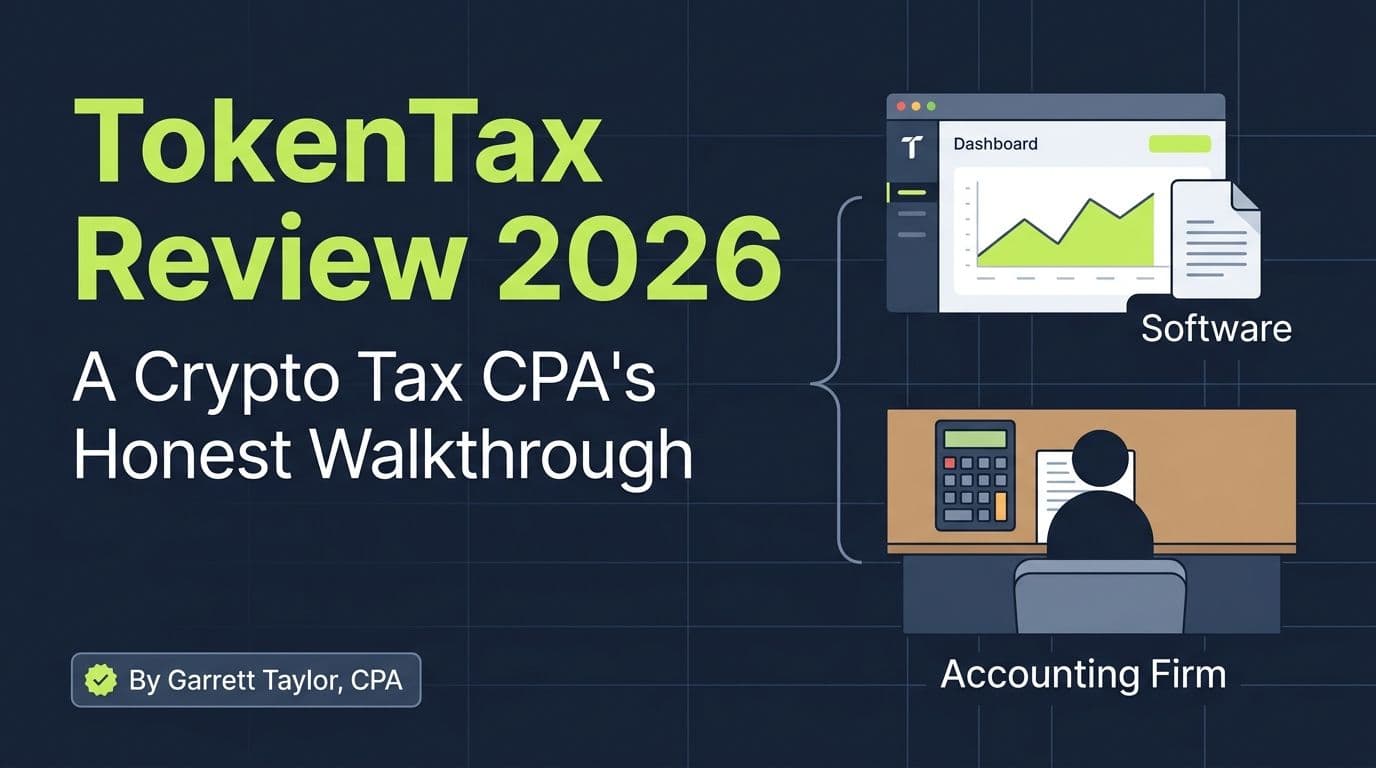
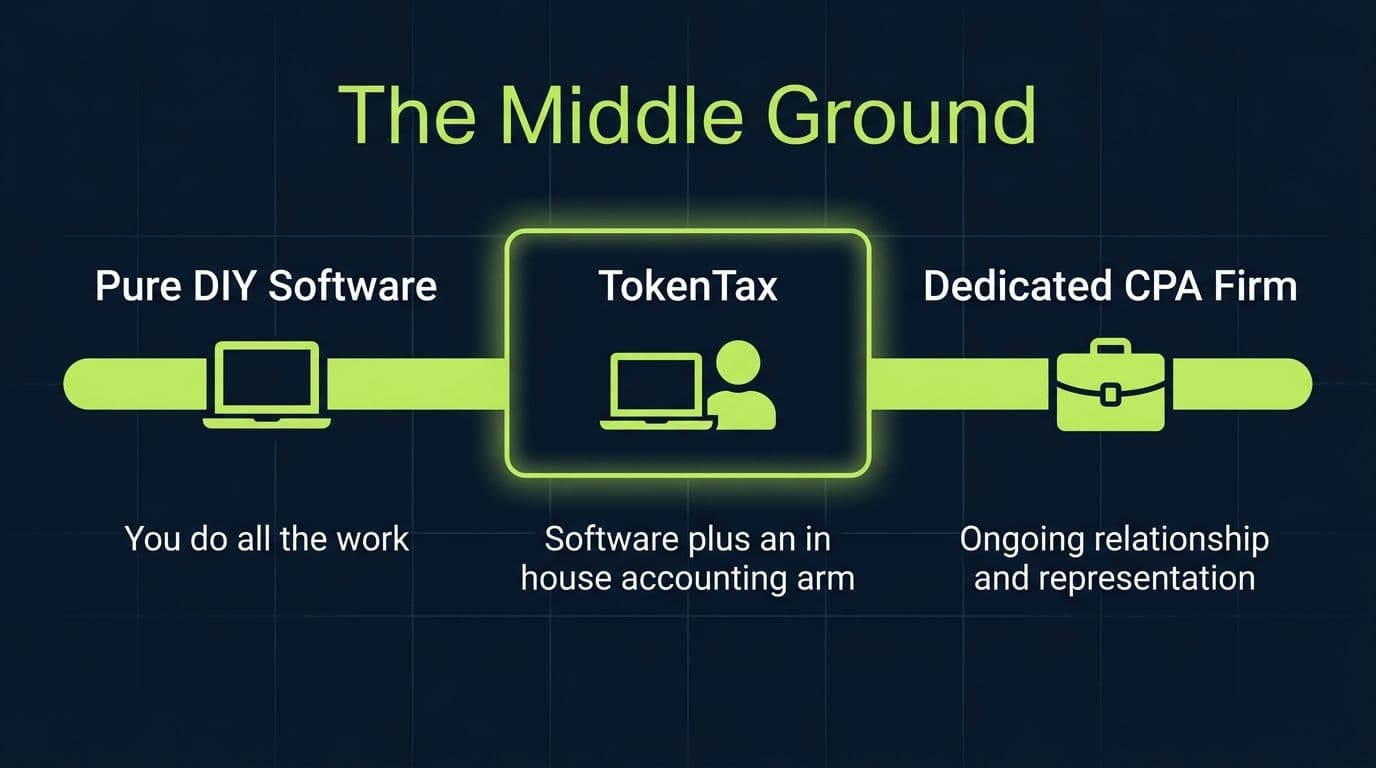
TokenTax is a capable crypto tax platform with something no major competitor offers: a real, in-house accounting team that can take the work off your hands entirely. TokenTax describes itself as a full-service accounting firm as well as a software platform, and that is an accurate description, not marketing fluff.
The software alone is solid but not the category leader. The service arm is the actual product.
My honest rating: 7/10 as pure DIY software. 8/10 as a done-for-you pipeline if your situation fits their process and your budget clears $3,499. The $1,999 Pro tier is the one I would skip; I will show you why in the pricing section.
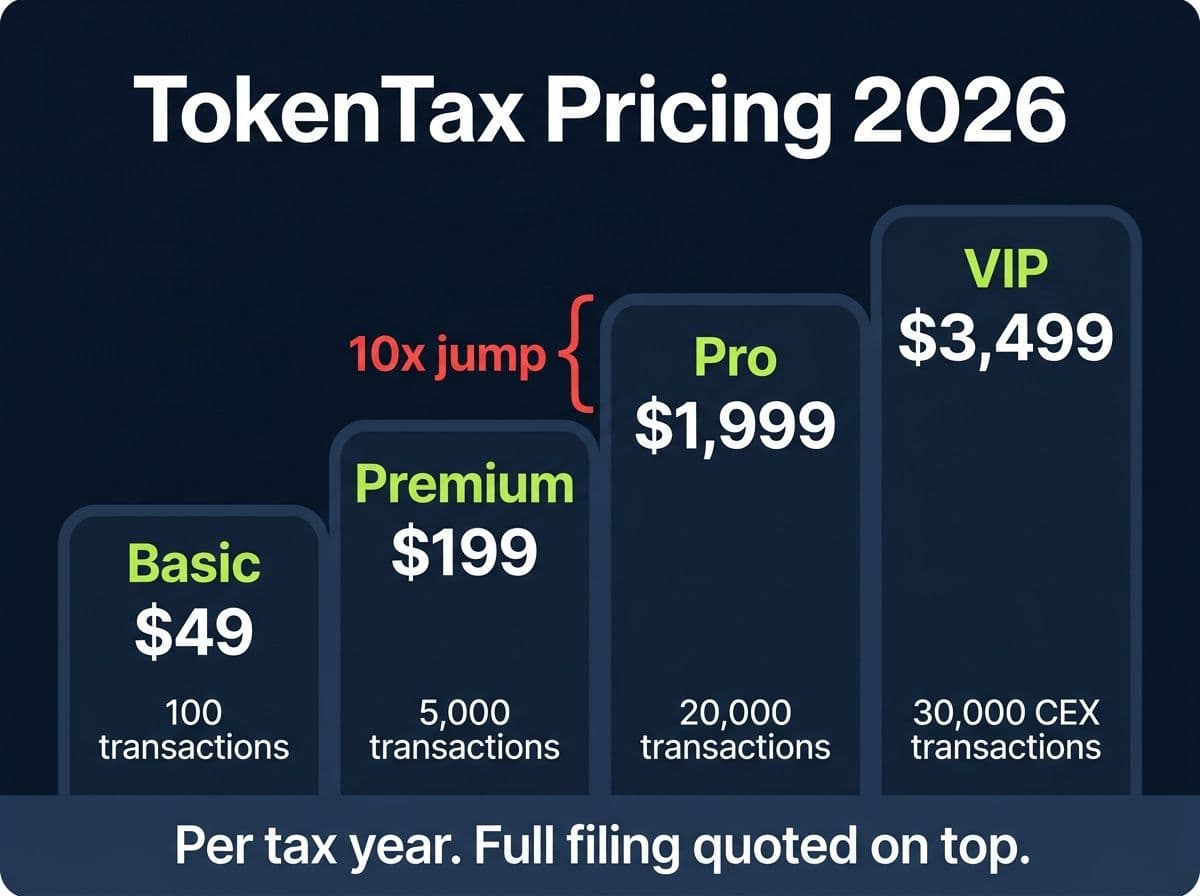
$49 to $3,499
TokenTax's published price range per tax year in 2026, from the Basic software tier to the VIP reconciliation plan. Full filing is an additional add-on quoted on top.
What TokenTax Actually Is (Software Plus a Firm)
Here is the thing most reviews get wrong: they grade TokenTax as if it were just another Koinly competitor. It is not, and grading it that way misses the point of the product.
TokenTax has two layers:
Layer one: the calculator. Connect exchanges by API, import wallets, generate Form 8949, income reports, and an audit trail report. This is the same job Koinly, CoinTracker, and CoinLedger do, and at the Basic and Premium tiers TokenTax competes on their turf at similar prices.
Layer two: the accounting arm. TokenTax employs an in-house team of CPAs and EAs. At the VIP tier, a reconciliation specialist works your data by hand: missing cost basis, dead exchanges, cross-chain messes, ICO and OTC history. Add the full filing package and their team prepares and files your complete tax return, not just the crypto forms.
That second layer is why TokenTax exists in a different lane. Every other major platform tells you to export your report and find your own accountant when things get ugly. TokenTax raises its hand and says: we are the accountant.
Whether that is the right accountant for you is a separate question, and I will answer it honestly further down.
How TokenTax Works, Step by Step
The DIY flow will feel familiar if you have used any crypto tax platform:
- Pick a plan and create an account. There is no free tier, so this is where you commit. Choose based on transaction count and whether you have margin or futures activity.
- Connect your data. API connections for centralized exchanges, wallet address imports for on-chain activity, and CSV uploads for anything else. Premium and above add manual import templates for ICO and OTC history that predates clean exports.
- Review and fix. TokenTax flags missing cost basis and suspicious entries. This is the step people skip and the step that decides whether your return is right. Expect to spend real time here if you have transfers between your own wallets.
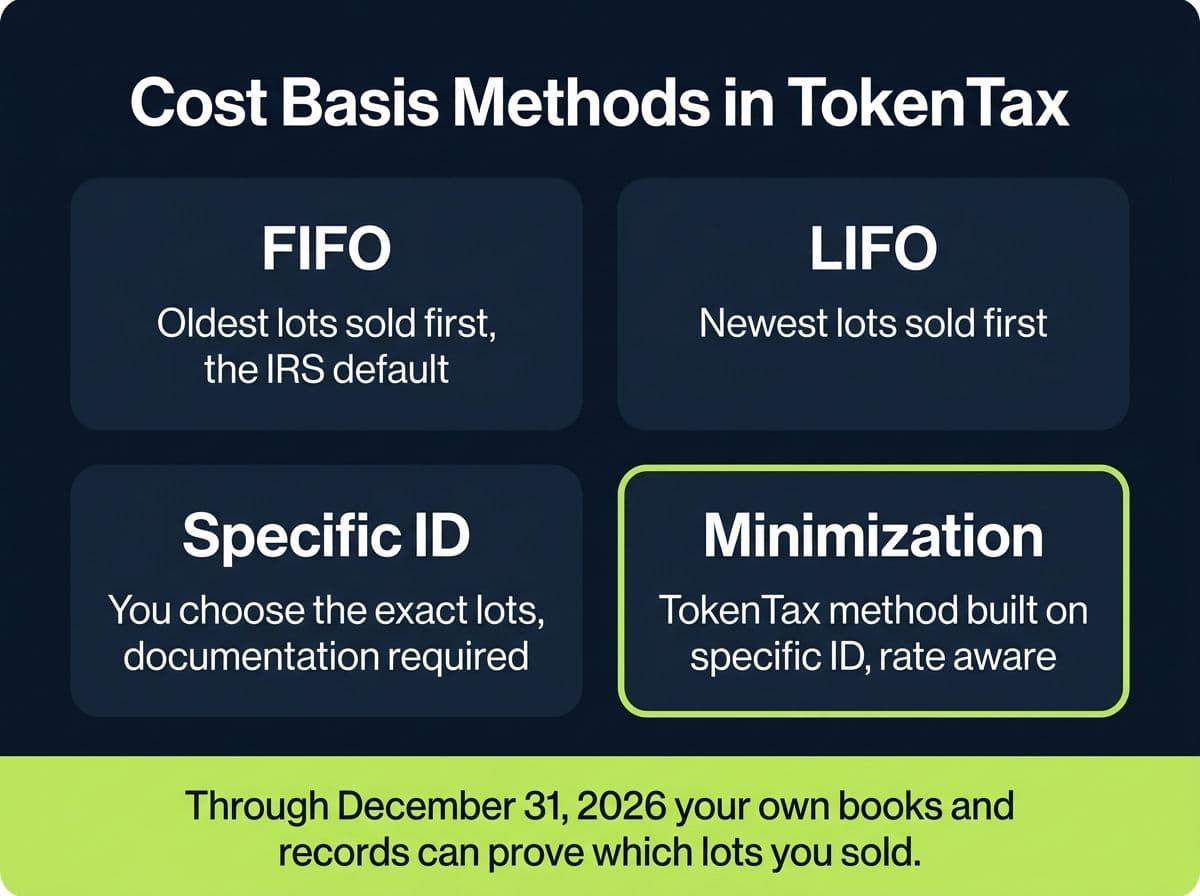
- Choose your accounting method. FIFO, LIFO, specific identification, or Minimization. You can preview your liability under each before committing, which is genuinely useful for year-end planning.
- Generate your forms. Form 8949, income report, audit trail report, and international equivalents. Export to TurboTax, hand the package to your accountant, or buy the full filing add-on and let TokenTax's team take it from there.
The VIP flow is different: you fill out a reconciliation questionnaire, upload everything, and an assigned specialist works your file, coming back to you with questions about ICOs, missing wallets, and ambiguous DeFi transactions. You get two 30-minute consultations with a tax professional to spend along the way. It is a managed process with a queue, not an instant product, and during filing season the calendar reflects that.
Who TokenTax Is (Actually) Best For
Based on what we see across client returns, three profiles get real value here:
The Delegator With a Messy History
You have five years of trades across exchanges that no longer exist, a DeFi phase you regret, and zero interest in categorizing 8,000 transactions yourself. You want to hand someone a pile of CSVs and wallet addresses and get a finished return back.
Why TokenTax works here: This is exactly what the VIP tier plus full filing was built for. The reconciliation questionnaire, the assigned specialist, and the two 30-minute expert consultations form a genuine done-for-you pipeline.
The High-Volume CEX Trader Who Wants One Vendor
You run thousands of trades a year on centralized exchanges, you may have margin or futures activity, and you want software, forms, FBAR, and a human safety net from a single company.
Why TokenTax works here: Margin and options profit-and-loss calculations arrive at the Pro tier, FBAR support is included there, and the audit trail report gives your filing a defensible paper spine.
The Premium-Tier Pragmatist
You have a few thousand transactions, mostly centralized exchanges, some DeFi. You are comfortable doing your own cleanup and just need accurate forms.
Why TokenTax works here: At $199 for up to 5,000 transactions, Premium is priced in line with Koinly and CoinTracker equivalents, and it includes the tax loss harvesting dashboard, Ethereum gas fee reports, and manual imports for ICO and OTC trades.
Pro Tip
If you want a free tier to test-drive, TokenTax does not have one; Koinly and CoinTracker both let you preview your data before paying. And if you are a DeFi-native trader on L2s and Solana who wants clean automatic categorization, the pure software platforms have invested more in that plumbing. Start with our [best crypto tax software](/blog/best-crypto-tax-software-2026) roundup if you are still comparing.
TokenTax Pricing in 2026: What Each Plan Actually Includes
These are the published prices on tokentax.co as of July 2026. Note that every plan is priced per tax year, so catching up on three unfiled years means three plan purchases (TokenTax offers 10% off multi-year purchases).
TokenTax Pricing Tiers (2026)
| Plan | Price per tax year | Transaction limit | Stand-out inclusions | FBAR |
|---|---|---|---|---|
| Basic | $49 | 100 | Every centralized exchange, Form 8949, income report, audit trail, TurboTax integration | Paid add-on |
| Premium | $199 | 5,000 | Adds tax loss harvesting dashboard, ICO/OTC manual imports, Ethereum gas fee report | Paid add-on |
| Pro | $1,999 | 20,000 | Adds margin and options PnL calculations, automatic CSV imports | Included |
| VIP | $3,499 | 30,000 CEX | Advanced reconciliation, two 30-minute expert consultations, review of IRS inquiries, priority support | Included |
| Enterprise | Custom | Custom | Businesses, high-net-worth, large unsupported transaction volumes | Custom |
Full filing is an add-on, not a tier. With it, TokenTax's team files your complete return for you. It is only available to customers who already purchased a crypto tax plan, and the site notes it may require extra fees with completion dates that vary. Get the total quoted in writing before you commit.
The $1,800 Gap Nobody Talks About
Look at the ladder again. Premium covers 5,000 transactions for $199. The next rung, Pro, costs $1,999. That is a 10x price jump to move from 5,000 to 20,000 transactions and unlock margin calculations.
For comparison, Koinly's top standard tier handles 10,000+ transactions for a few hundred dollars, and CoinTracker's Ultra plan runs $499. If you have 6,000 simple spot transactions and no margin activity, paying $1,999 for software alone is hard to justify. At that spend you are in the price range where an independent crypto CPA reviews your whole situation, not just your transaction count. Our guide to what a crypto tax CPA costs puts real numbers on that comparison.
Where the math flips back: if you genuinely trade margin and futures at volume, Pro's PnL engine and included FBAR support do work you would otherwise pay a professional hourly rates to reconstruct. The tier is mispriced for volume alone but fairly priced for complexity.
Pro Tip
**No free plan.** TokenTax is the only major platform without a free preview tier. You pay before you see how well your data imports. If your history is exotic, ask their sales chat directly whether your platforms are supported before buying, or choose the plan you can afford to write off as a test.
Cost Basis Methods: FIFO, LIFO, Specific ID, and Minimization
TokenTax supports FIFO, LIFO, and specific identification, plus average cost basis for UK and Canada filers. It also offers its own method called Minimization, which is built on specific identification and selects lots to reduce your current-year liability, factoring in your tax rate.
Minimization is TokenTax's answer to the HIFO setting you see in other platforms, and used correctly it does the same job with more nuance: it can prefer a slightly lower basis lot when the long-term rate beats the short-term saving.
Two compliance points most reviews skip:
First, specific identification has documentation rules. Under Treasury Regulation 1.1012-1, lots must be adequately identified no later than the time of sale. Software that retroactively rearranges lots at tax time is exactly what this rule exists to police.
Second, there is a live IRS relief window that makes your own records decisive. Under Notice 2026-20, through December 31, 2026 you can make an adequate specific identification using your own books and records, because most brokers still cannot accept lot-level instructions. That makes the report your software produces, with its lot selections documented, part of your legal proof. Run Minimization, then export and keep the audit trail report the same day you sell, not in April.
Since January 1, 2025, basis also has to be tracked wallet by wallet, and any pre-2025 holdings should have been allocated under Revenue Procedure 2024-28. TokenTax handles per-wallet tracking, but the allocation memo for your old universal-pool basis is on you (or your accountant) to have in the file. Our crypto cost basis methods guide walks through the whole framework.
The Part No Software Fixes: A Worked Example
Here is the honest section, and it applies to TokenTax, Koinly, CoinTracker, and every other platform equally. The first draft any crypto tax software produces is a hypothesis, not a tax return.
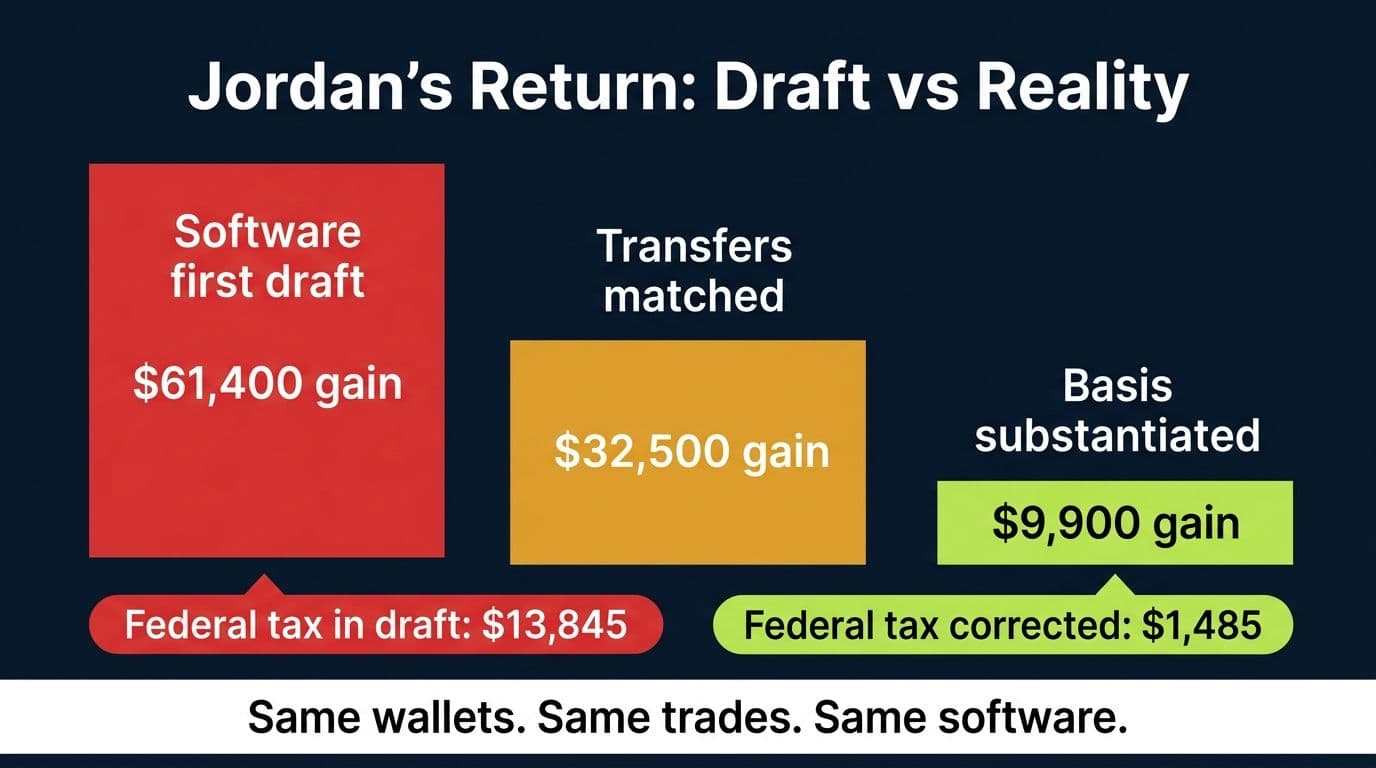
Meet Jordan. Tax year 2025, filed in spring 2026. Coinbase, Kraken, and a MetaMask wallet. Jordan connected everything by API, and the software's first draft showed $61,400 in capital gains.
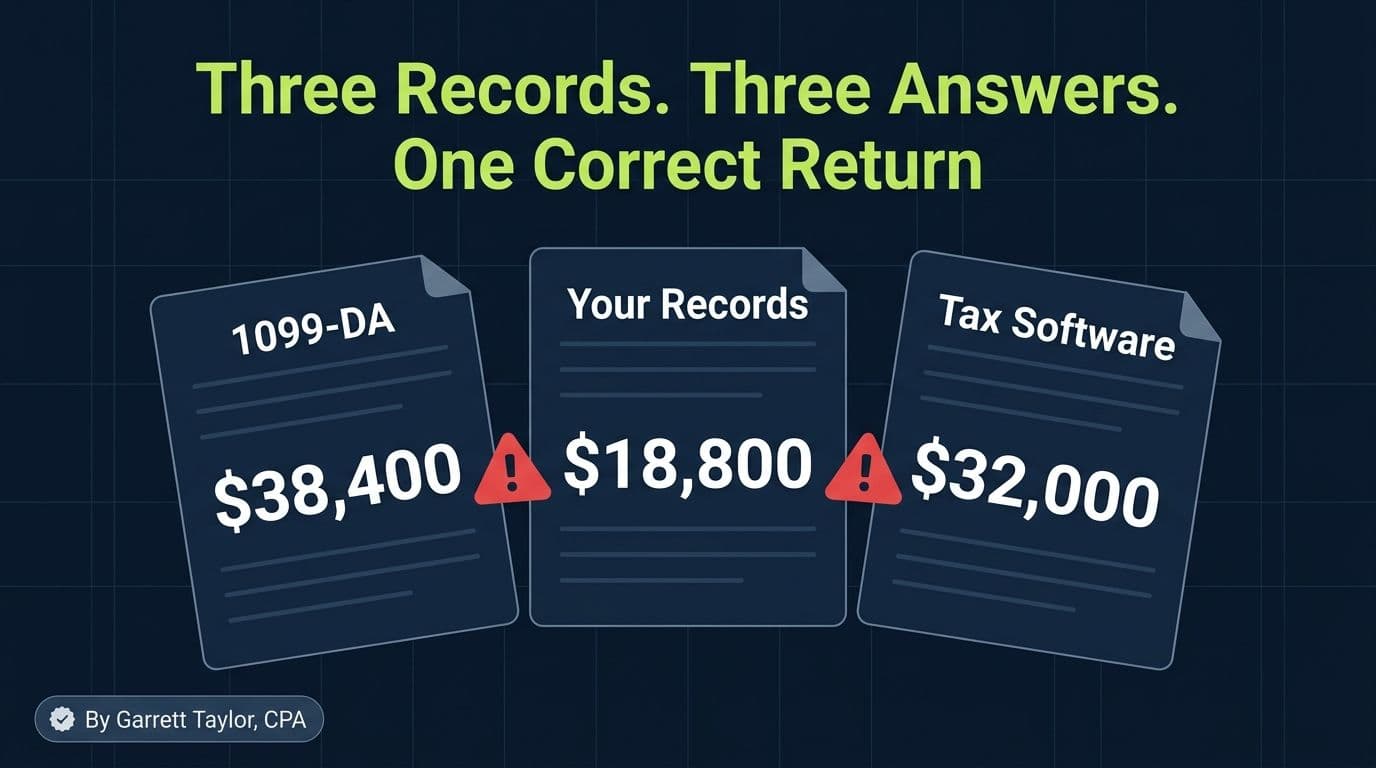
Jordan's Coinbase Form 1099-DA told a different story: $84,000 in proceeds, with cost basis blank on more than a third of it, because the coins had been transferred in from cold storage and Coinbase never knew what Jordan paid.
Our review found two problems:
Problem 1: phantom transfer gains. Two wallet-to-Coinbase transfers never got linked to their withdrawal legs. The software treated the deposits as brand-new coins with zero basis, then recorded their sale at full proceeds. That fabricated $28,900 of short-term gain on coins Jordan had owned for years. Matching the transfers erased it: draft drops to $32,500.
Problem 2: blank-basis lots. The BTC sold from those cold-storage transfers had a documented basis of $22,600, built from 2021 and 2022 purchase records and Jordan's Rev. Proc. 2024-28 allocation memo. The draft carried $0 and, with acquisition dates unknown, treated the gain as short-term. Substantiating basis and dates dropped the draft to $9,900, nearly all long-term.
The tax difference: the first draft priced out around $13,845 in federal tax. The corrected return: $1,485. Same wallets, same trades, same software.
Our reconciliation fee was $1,800. The correction was worth $12,360. No plan tier at any price fixes this automatically, because the software can only compute what the data feed shows it. TokenTax's VIP specialists do this kind of reconciliation for their clients; an independent CPA does it with the added duty of loyalty to you alone. Someone has to do it.
If your broker form and your records disagree right now, our 1099-DA reconciliation guide walks through all five mismatch types and the exact fix for each.
Why This Matters More in 2026 Than Ever
Jordan's story is not a corner case anymore. Starting with tax year 2025, every US crypto broker issues Form 1099-DA reporting your gross proceeds directly to the IRS, and the IRS matching computers compare those proceeds against your return automatically.
That changes the stakes of a sloppy software draft in two directions:
- Underreport proceeds (because an account never got imported) and the matching system flags you for a CP2000 notice proposing tax on the full unmatched amount, with no basis credit
- Overreport gains (because of phantom transfers and blank basis) and you simply overpay, and nobody at the IRS will ever call to give the money back
The IRS knows broker forms and taxpayer records will disagree during this transition. Notice 2026-20 says explicitly that broker-reported basis and acquisition dates may not match your books and records for 2026 transactions, and the regulations anticipate you completing the picture with your own documentation. The form controls the proceeds conversation. Your records control the gain conversation. Software is how you assemble those records; it is not a substitute for checking them.
TokenTax's audit trail report is a real asset here, and its reconciliation arm exists precisely because this work is hard. Just do not confuse buying the software with having done the reconciliation.
Get a Second Set of Eyes Before You File
Send us your TokenTax report (or any software's output) and your 1099-DA forms. We'll find the phantom gains, substantiate your basis, and tell you exactly what you owe. 15-minute call, no commitment.
Book Your Free ReviewFree 15 minute call. No commitment.
DeFi and NFT Handling: The Honest Assessment
TokenTax advertises DeFi and NFT support across its plans, with margin and futures support arriving at Pro. Here is the practical picture from returns we have reviewed:
What works well:
- Centralized exchange coverage is genuinely strong, and the audit trail report is one of the better substantiation documents in the industry
- Ethereum mainnet activity, staking income reports, and gas fee reporting (Premium and up) are solid
- Manual imports for ICO and OTC trades (Premium and up) cover history that most competitors make painful
Where you will do manual work:
- Liquidity pool entries and exits, bridging, and newer L2 ecosystems still need review-and-recategorize passes, the same as on every platform
- Solana and long-tail chain coverage lags the Ethereum ecosystem
- Complex positions (perps, leveraged loops, exotic yield) will not categorize themselves on any software, TokenTax included
The structural difference: when the software hits its limit, TokenTax's answer is "upgrade to VIP and our humans will reconcile it." Koinly's and CoinTracker's answer is "export it and find a professional." One of those answers costs $3,499 and keeps you in-house; whether that is a feature or a lock-in depends on your situation.
TokenTax vs Koinly vs CoinTracker: The Short Version
TokenTax vs Koinly vs CoinTracker (2026)
| Feature | TokenTax | Koinly | CoinTracker |
|---|---|---|---|
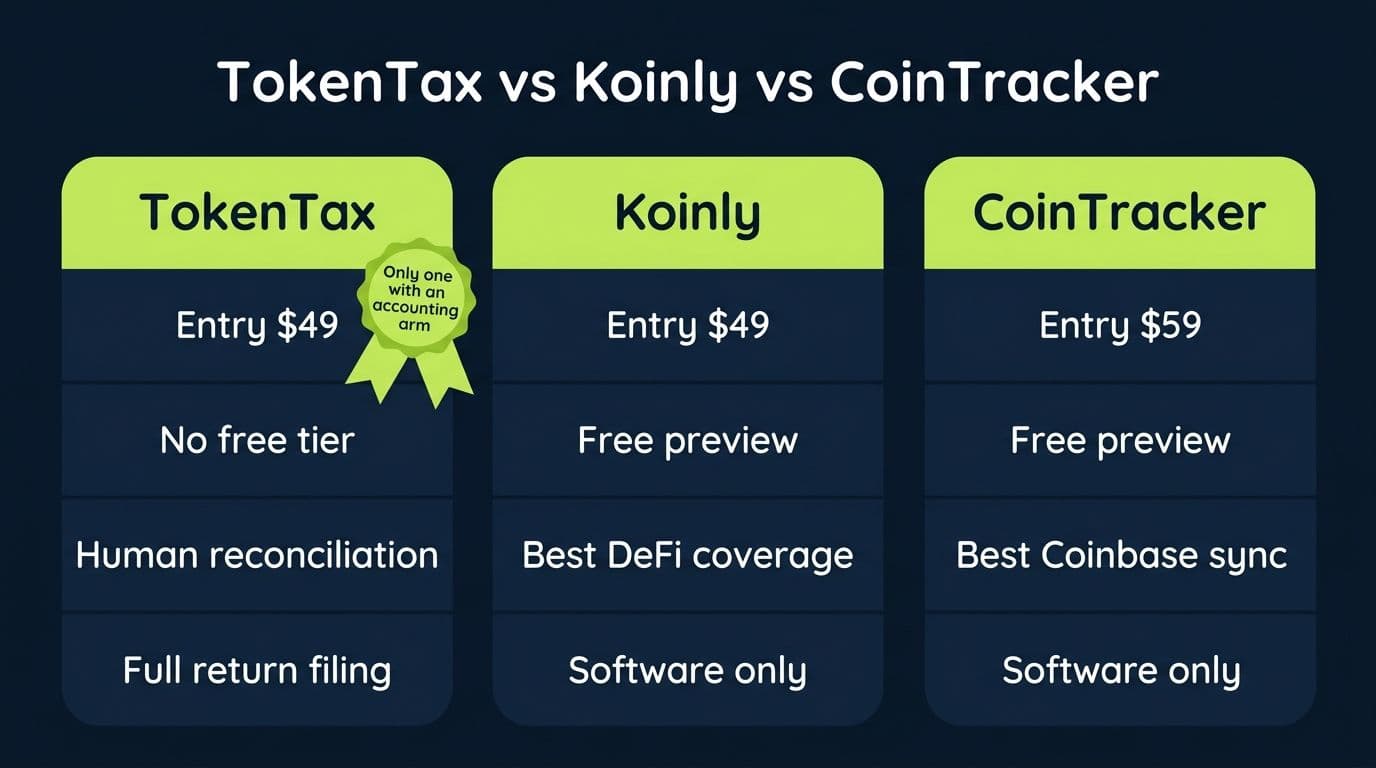
| Entry price (paid) | $49/tax year | $49/tax year | $59/year |
| Free preview tier | No | Yes | Yes (25 txns) |
| Mid-tier value | $199 for 5,000 txns | Similar price, similar range | $149 for 1,000 txns |
| High-volume price | $1,999 (20,000 txns) | Few hundred dollars | $499 (10,000+ txns) |
| Cost basis methods | FIFO, LIFO, Spec ID, Minimization | FIFO, LIFO, HIFO, Spec ID | FIFO, LIFO, HIFO, Spec ID |
| DeFi/L2 auto-categorization | Fair | Better | Fair |
| Margin/futures PnL | Yes (Pro+) | Partial | Limited |
| In-house human reconciliation | Yes (VIP) | No | No |
| Full return filing | Yes (add-on) | No | No |
| Best for | Delegators, messy histories, one-vendor filers | Broad DIY coverage | Coinbase-centric portfolios |
The bottom line: as pure software, Koinly and CoinTracker match or beat TokenTax at most volume levels, and both let you try before you buy. The moment you want a human to take over, TokenTax is the only one of the three with a real answer, and that is worth something. Our full reviews: Koinly guide and CoinTracker review.
Other TokenTax alternatives worth a look: CoinLedger if you want the cheapest competent report for a simple CEX portfolio, and CoinTracking if you are a high-frequency trader who wants granular control and does not mind a dated interface. Every one of them, TokenTax included, produces a draft that deserves the reconciliation treatment Jordan's return got above.
Is TokenTax Legit? (The Question Everyone Asks)
Yes. TokenTax is a legitimate, established company, founded in 2017, operating as both a software platform and an accounting practice with CPAs and EAs on staff. It is not a scam, and the service arm does real professional work.
Legitimacy and fit are different questions. The honest drawbacks:
- No free tier, so you commit money before seeing your import quality
- The Pro price cliff, a 10x jump that punishes volume without complexity
- Per-tax-year pricing, which compounds quickly for multi-year cleanups
- Assembly-line service. VIP is a process with a queue, questionnaires, and completion dates that vary. During peak season, that queue matters
- Review of IRS inquiries is not representation. VIP includes a review of IRS letters, which is useful triage. It is not the same as a credentialed professional of your choosing representing you before the IRS under a power of attorney
None of these are disqualifying. All of them belong in your decision.
Where a CPA Still Matters (Even If You Buy VIP)
I run a crypto tax practice, so discount this section however you like. But here is the distinction, stated as neutrally as I can:
TokenTax's service arm is transactional. You buy a plan for a tax year, their team reconciles and files that year, and the engagement ends. For many people, that is exactly the right product.
A dedicated CPA relationship is continuous. The same professional who filed your return answers the IRS letter eighteen months later, plans your disposals before year-end instead of scoring them afterward, coordinates your crypto with your equity comp, your business entity, and your state moves, and owes fiduciary-grade loyalty to you rather than to a software funnel.
Practical rules of thumb we give people who ask:
- Under $50K portfolio, simple CEX trades: Basic or Premium software (TokenTax or a competitor) is genuinely all you need
- Messy multi-year history, want it gone: TokenTax VIP plus full filing is a legitimate option; get the all-in quote in writing and compare it against an independent CPA's fixed-fee quote for the same scope, they often land within a few hundred dollars of each other
- Six figures in crypto, ongoing trading, other complexity: you want a standing relationship, contemporaneous lot documentation, and proactive planning. Software is your data pipeline, not your advisor
- Already received an IRS notice: go straight to a professional who can represent you. Do not route a live notice through a software queue
Our guide on how to choose a crypto tax CPA covers the vetting questions, including the ones that expose preparers who quietly outsource the crypto work.
Action Steps: What to Do Next
If you are evaluating TokenTax:
- Count your transactions and check for margin activity; that alone tells you the tier
- Confirm your exchanges and chains are supported before paying, since there is no free preview
- If you are considering VIP or full filing, ask for the total all-in price and expected completion date in writing
- Compare that quote against one independent crypto CPA's fixed-fee quote for identical scope
If you already use TokenTax:
- Run your report, then reconcile it against every 1099-DA before filing, line by line
- Check transfers between your own wallets and exchanges are matched, not showing as buys or sells
- If you use Minimization or specific ID, export and save the lot-level audit trail contemporaneously; that is your Notice 2026-20 documentation
- Keep your Rev. Proc. 2024-28 allocation memo with your tax file if you held crypto before 2025
If you want a professional in your corner:
Book a free Tax Health Check. Bring your TokenTax output and your broker forms, and we will tell you whether your draft is filing-ready or hiding phantom gains.
Free Crypto Tax Health Check
15 minutes with a crypto CPA. We'll review your software output, your 1099-DAs, and your basis documentation, and give you a straight answer on what to fix before you file.
Book Your Free CallFree 15 minute call. No commitment.
Frequently Asked Questions
Is TokenTax legit?
Yes. TokenTax is an established company, founded in 2017, that operates as both a crypto tax software platform and a full-service accounting firm with in-house CPAs and EAs. It is a legitimate business doing real professional work. Whether its pricing and service model fit your situation is a separate question: it has no free tier, its Pro tier carries a steep price jump, and its full filing service is transactional rather than an ongoing advisory relationship.
How much does TokenTax cost in 2026?
Published plans run $49 (Basic, 100 transactions), $199 (Premium, 5,000 transactions), $1,999 (Pro, 20,000 transactions plus margin and options support), and $3,499 (VIP, 30,000 centralized exchange transactions with human reconciliation and two expert consultations) per tax year. Full return filing is an additional add-on quoted on top, enterprise pricing is custom, and multi-year purchases get 10% off.
Does TokenTax have a free plan?
No. TokenTax is the only major crypto tax platform without a free preview tier. Koinly and CoinTracker both let you import data and preview results before paying; with TokenTax you buy a plan first. If your transaction history involves unusual platforms, confirm support with their team before purchasing.
What are the drawbacks of TokenTax?
The main ones: no free tier to test import quality, a 10x price jump from the $199 Premium tier to the $1,999 Pro tier, per-tax-year pricing that compounds for multi-year cleanups, a managed-queue service model whose completion dates vary in peak season, and the fact that its review of IRS inquiries is triage rather than formal representation before the IRS.
Is TokenTax worth it for the VIP plan?
If you have a genuinely messy multi-year history and want a done-for-you outcome, VIP at $3,499 plus the full filing add-on is a legitimate option. Get the all-in quote in writing, including extra fees and expected completion date, then compare it against a fixed-fee quote from an independent crypto CPA for identical scope. The two often land surprisingly close, and the independent option comes with a continuing relationship.
What cost basis methods does TokenTax support?
FIFO, LIFO, and specific identification, plus average cost basis for UK and Canada filers. TokenTax also offers its proprietary Minimization method, which is built on specific identification and selects lots to reduce your current-year tax, factoring in your tax rate. If you use Minimization or specific ID, export and keep the lot-level audit trail at the time you sell to satisfy the documentation rules.
How does TokenTax handle specific identification under Notice 2026-20?
Under IRS Notice 2026-20, through December 31, 2026 taxpayers can make an adequate specific identification of which broker-held units they sold using their own books and records, because most brokers still cannot accept lot-level instructions. A TokenTax report with documented lot selections, exported contemporaneously, is exactly the kind of books-and-records evidence that relief contemplates. After the relief period ends, identification standards tighten, so build the habit now.
Is TokenTax better than Koinly?
As pure software, Koinly generally offers better value at high transaction volumes and stronger automatic DeFi categorization across L2 chains, plus a free preview tier. TokenTax's advantage is structural: an in-house team of CPAs and EAs who can reconcile your data and file your entire return. If you want software only, Koinly usually wins on price. If you want to delegate everything to one vendor, TokenTax is the only one of the two with that product.
Does TokenTax handle DeFi and NFTs?
Yes, with the usual industry caveats. Centralized exchange and Ethereum mainnet coverage is solid, and Premium and higher tiers add Ethereum gas fee reports and manual imports for ICO and OTC history. Liquidity pools, bridges, Solana, and newer chains still need manual review, the same as on every platform. The VIP tier answers hard cases with human reconciliation rather than better automation.
Does TokenTax file your tax return for you?
It can. The full filing add-on, available only to customers who purchased a crypto tax plan, has TokenTax's in-house team prepare and file your complete return, not just the crypto forms. The site notes it may require extra fees and completion dates vary, so get the total cost and timeline in writing before committing.
Will TokenTax reconcile my 1099-DA forms?
The software generates reports you can compare against your broker-issued 1099-DA forms, and the VIP tier's human reconciliation covers mismatches, missing cost basis, and messy data. Reconciliation is not optional in 2026: the IRS matches 1099-DA proceeds against returns by computer, and unmatched or blank-basis amounts are how phantom gains and CP2000 notices happen. Whoever does it, someone must tie every form to your return before filing.
Should I use TokenTax or hire my own CPA?
For simple portfolios under about $50K on major exchanges, the Basic or Premium software tiers are all most people need. For messy histories you want to hand off once, TokenTax VIP with full filing competes directly with an independent CPA on price. For six-figure portfolios, ongoing trading, entity questions, or anything involving an IRS notice, a standing relationship with your own crypto CPA gives you planning before year-end and representation if the IRS calls, which no per-tax-year software package replaces.