Update | September 15, 2026
The CLARITY Act failed in the Senate on September 15, 2026. A procedural vote to advance H.R. 3633 fell short 49 to 50, well below the 60 votes needed. Every Democrat present voted no, joined by four Republicans: Susan Collins, Josh Hawley, Jerry Moran, and Thom Tillis. Lead sponsor Senator Cynthia Lummis said before the vote that if cloture failed, "it's over." The bill is effectively dead for 2026, with the lame duck session or the next Congress as the only realistic paths forward. None of this changes your taxes: crypto is still property, every sale and swap is still taxable, and 1099-DA reporting continues on schedule. The guidance below still applies exactly as written.
“This guide has been reviewed for accuracy by Leanne Grant, Enrolled Agent, specializing in cryptocurrency tax compliance and IRS representation.”
, Reviewed by Leanne Grant, EA
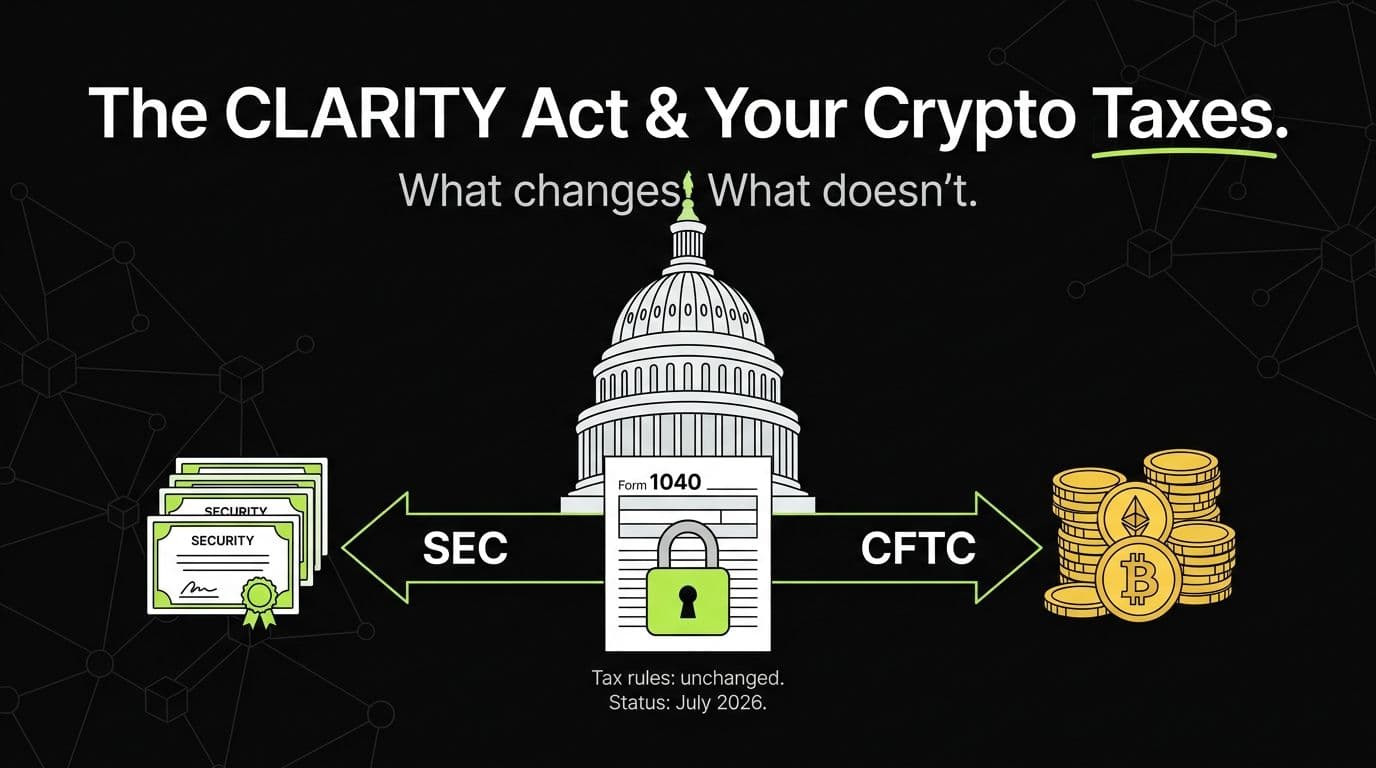
Quick answer: the CLARITY Act (the Digital Asset Market Clarity Act, H.R. 3633) decides which regulator oversees crypto markets, the SEC or the CFTC. It is not a tax bill. As of July 2026 it has passed the House but not the Senate, and even if it becomes law, the IRS will still tax your crypto as property. The tax changes people expect from it live in separate bills.
You've probably seen the headlines. "CLARITY Act could transform crypto." "Senate showdown over landmark crypto bill." And if you hold crypto, you've probably wondered the same thing our clients ask us every week:
"Does this change my taxes?"
Short answer: not directly. Longer answer: it changes some things that eventually touch your taxes, and almost nobody is explaining which is which.
That's what this guide does. We'll walk you through what the CLARITY Act actually says, exactly where it stands in Congress as of July 2026, what it does NOT change about your tax return (this part matters most), and the second-order tax effects that sophisticated traders should be watching right now.
We'll also untangle the three bills everyone mixes up: CLARITY, the GENIUS Act, and the Lummis crypto tax bill. Only one of them would actually change the numbers on your return.
Let's get into it.
What Is the CLARITY Act? (The Plain English Version)
The CLARITY Act, formally the Digital Asset Market Clarity Act of 2025 (H.R. 3633), is a bill that answers one question the U.S. government has dodged for over a decade:
Who regulates crypto: the SEC or the CFTC?
That sounds like inside baseball. It isn't. That single unanswered question is why exchanges got sued, why tokens got delisted, why projects moved to Singapore and Dubai, and why your favorite protocol's legal team is bigger than its dev team.
Here's the deal. Under current law, the SEC and CFTC have spent years fighting over the same assets. The SEC argued most tokens were unregistered securities. The CFTC called bitcoin and ether commodities. Courts split. Companies guessed. Enforcement filled the gap where rules should have been.
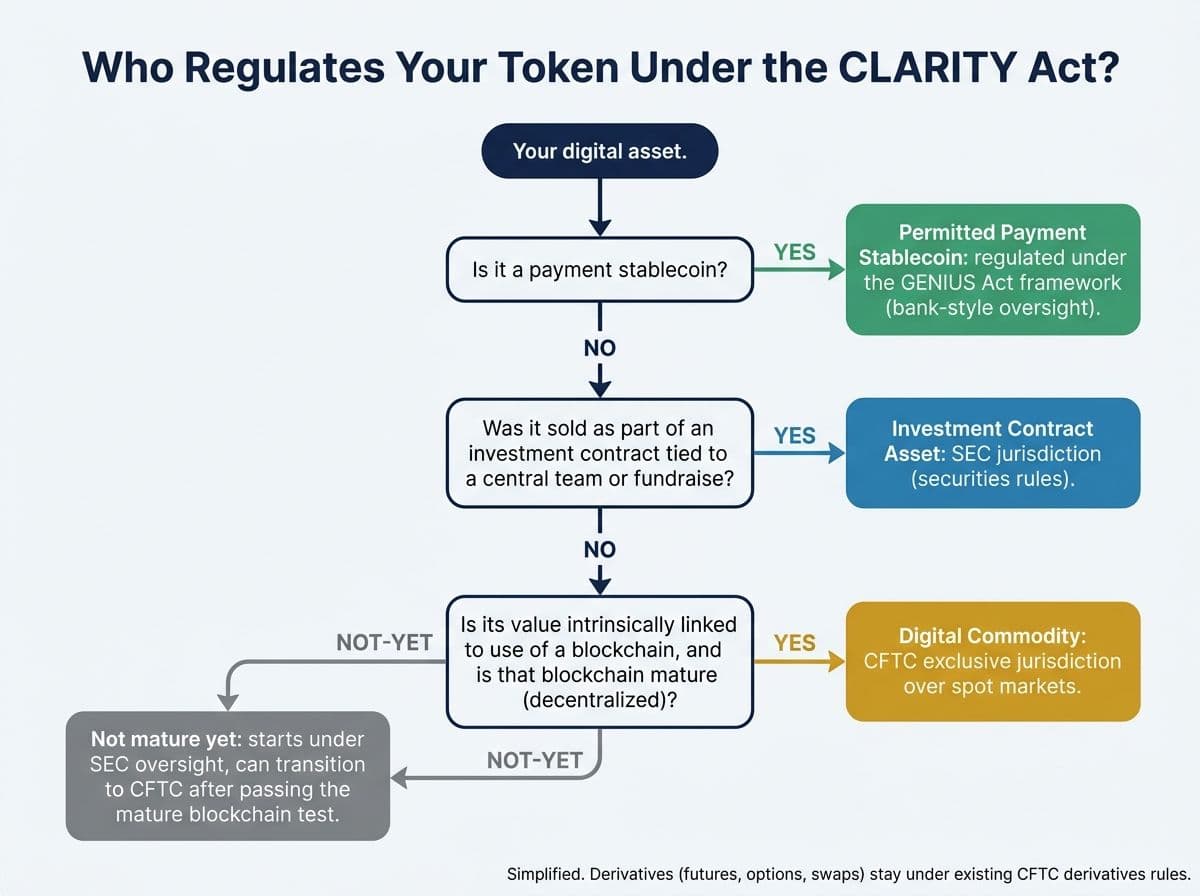
The CLARITY Act replaces that guessing game with a statutory sorting system. It puts every digital asset into one of three buckets:
The CLARITY Act's Three Buckets
| Bucket | What it means | Who regulates it |
|---|---|---|
| Digital commodity | A token whose value is intrinsically linked to the use of a blockchain (think BTC, and ETH once "mature") | CFTC gets exclusive jurisdiction over spot markets |
| Investment contract asset | A token sold as part of an investment contract, tied to a central team or a fundraise | SEC, under securities rules |
| Permitted payment stablecoin | Dollar-pegged stablecoins from approved issuers | Bank-style oversight under the GENIUS Act framework |
The bill grew out of FIT21, the crypto market structure bill that passed the House in May 2024 and died in the Senate. House Financial Services Chairman French Hill reintroduced the framework as H.R. 3633 in May 2025.
Pro Tip
Notice what's missing from those three buckets: anything about taxes. The word to lock in here is "market structure." The CLARITY Act is about who supervises trading venues, brokers, and dealers. The Internal Revenue Code is a different book on a different shelf, and this bill barely touches it.
Action step: when you read any CLARITY headline, ask one question first: "Is this about regulation or taxation?" For this bill, the answer is regulation, essentially every time.
Where the CLARITY Act Stands Right Now (July 2026 Update)
This is the section that goes stale fastest, so we'll date-stamp everything.
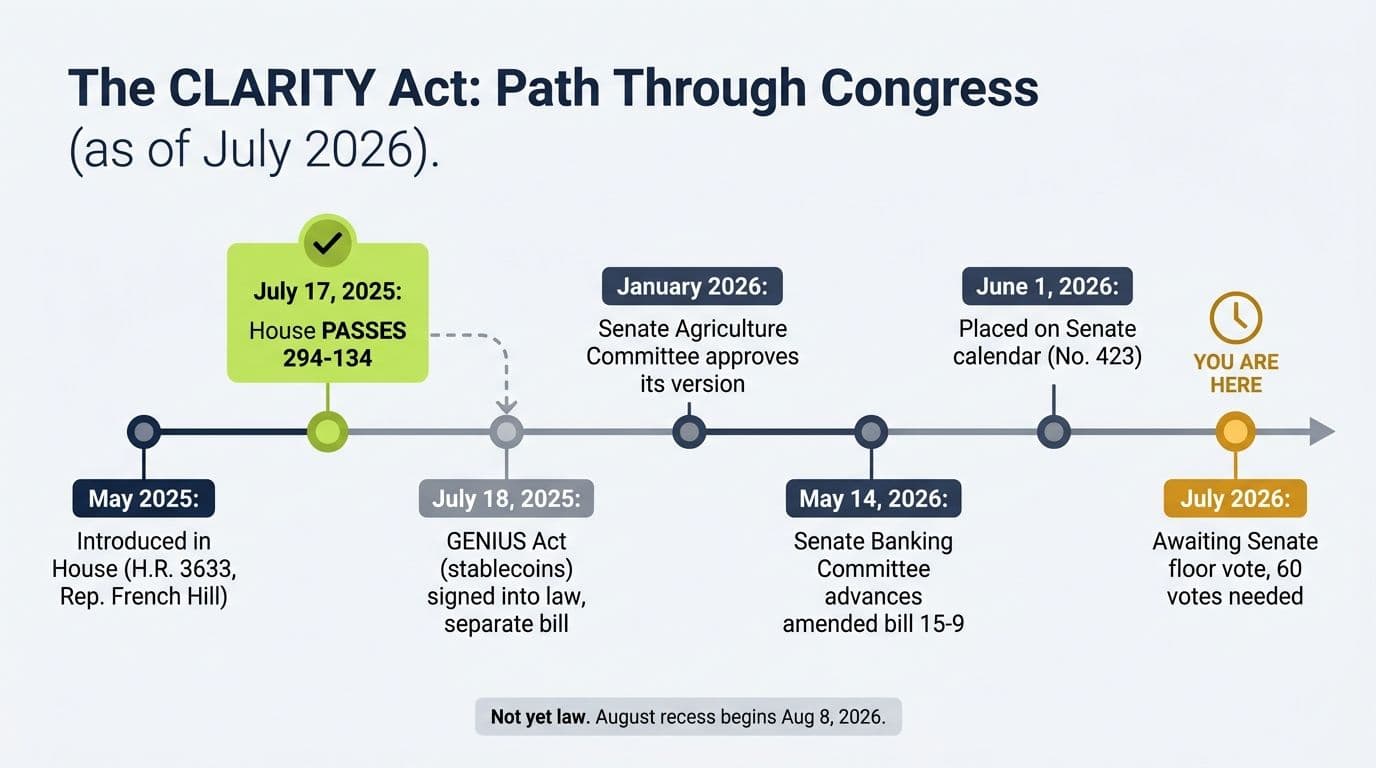
As of July 21, 2026, the CLARITY Act is not law. Here's the full timeline:
- May 2025: Rep. French Hill introduces H.R. 3633 in the House.
- July 17, 2025: The House passes the CLARITY Act 294-134, with 78 Democrats joining nearly all Republicans. It was the headline bill of Washington's "Crypto Week."
- July 18, 2025: President Trump signs the GENIUS Act (stablecoins) into law. Different bill, same week, which is exactly why people conflate the two.
- January 2026: The Senate Agriculture Committee (which oversees the CFTC) approves its digital commodities version.
- May 14, 2026: The Senate Banking Committee advances an amended version of the CLARITY Act 15-9, with every Republican and two Democrats voting yes.
- June 1, 2026: The bill is placed on the Senate Legislative Calendar (Calendar No. 423), making it eligible for a floor vote.
- July 2026: A floor vote is expected in the weeks of July 20 or July 27, before the Senate's August recess begins on August 8. President Trump has publicly pushed for passage before the recess.
294-134
The bipartisan House vote passing the CLARITY Act on July 17, 2025. It still needs 60 votes in the Senate.
So why isn't it law yet?
The 60-vote problem. The bill needs 60 Senate votes to overcome a filibuster, which means at least seven Democrats. Three sticking points keep surfacing in reporting on the negotiations:
- Stablecoin yield. The bill restricts platforms from paying rewards on stablecoin balances, with carve-outs still being fought over.
- Ethics provisions. Several Democrats want restrictions on government officials profiting from crypto while in office.
- Law enforcement concerns. Agencies have raised questions about how the framework affects criminal investigations.
If the Senate misses the pre-recess window, the bill slides into the midterm election season, where big legislation goes to stall. That's why industry watchers are treating early August 2026 as the real deadline.
Pro Tip
Be careful with any article that says the CLARITY Act "passed" without specifying the chamber. It passed the HOUSE in July 2025. As of July 2026 it has not passed the Senate and has not been signed into law. We've already seen clients arrive with tax plans built on provisions that don't legally exist yet.
Action step: before acting on anything CLARITY-related, confirm two things: has it passed the Senate, and has the President signed it? Until both are yes, nothing in the bill is law.
What the CLARITY Act Actually Does
Now let's open the hood. You need to understand five mechanisms, because the tax conversation later depends on them.
1. It hands the CFTC the spot market
Today, the CFTC can police fraud and manipulation in crypto spot markets, but it can't register or supervise the exchanges where you actually trade. The CLARITY Act closes that gap by giving the CFTC exclusive jurisdiction over digital commodity spot markets, including exchanges, brokers, and dealers.
The SEC keeps jurisdiction over investment contract assets (tokens sold as part of a fundraise or tied to a central team) plus anti-fraud authority over transactions on SEC-registered platforms. And tokenized securities don't escape securities law just by living on-chain: a tokenized share of stock is still a share of stock.
2. What counts as a digital commodity?
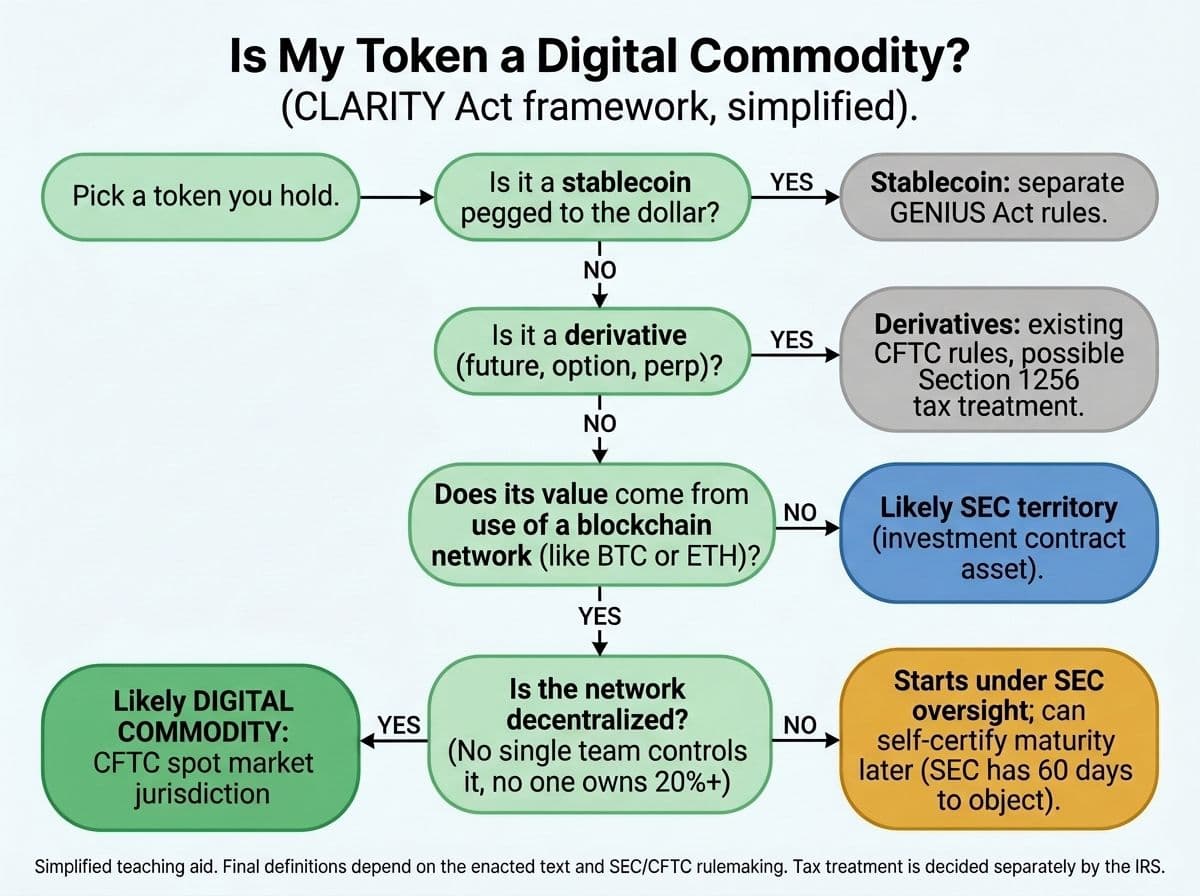
A digital commodity is, roughly, a digital asset whose value is intrinsically linked to the use of a blockchain system. Bitcoin is the obvious example. The category specifically excludes securities, stablecoins, and derivatives (futures, options, and swaps stay under existing derivatives rules, and that exclusion matters later when we talk Section 1256).
3. The mature blockchain test
This is the bill's most talked-about mechanism. A token can start life under SEC oversight (because it was sold in a fundraise by a central team) and then graduate to CFTC oversight once its blockchain becomes "mature," meaning sufficiently decentralized. Under the House-passed framework, the criteria include things like open, programmatic operation and no single person or team controlling the network or holding an outsized share (the House version drew the line around 20 percent).
The process runs on self-certification: a project certifies maturity to the SEC, there's a rebuttable presumption it qualifies, and the SEC has 60 days to push back. If the SEC rejects a certification, the project waits 90 days before trying again.
4. Fundraising and DeFi carve-outs
The House bill creates a new fundraising exemption that lets projects raise up to $75 million per year selling digital commodities, with disclosure requirements attached. It also draws a line between code and commerce: developers, validators, and other infrastructure operators who never take custody of customer funds get safe harbors instead of being regulated like asset managers.
5. Self-custody and consumer protections
The House-passed version affirms the right of individuals to hold digital assets in self-hosted wallets. On the consumer side, exchanges and brokers face segregation-of-funds requirements, disclosure obligations, and Bank Secrecy Act compliance (KYC, AML monitoring, suspicious activity reporting).
Action step: figure out which bucket your major holdings would likely land in. BTC is the clean digital commodity case. Large-cap, decentralized L1s are strong candidates to certify maturity. Small-cap tokens with active founding teams and treasury allocations are the ones most likely to stay in SEC territory. This sorting exercise becomes relevant to tax strategy in the next two sections.
The Part Everyone Gets Wrong: The CLARITY Act Is Not a Tax Bill
Here's where we put on the CPA hat, because this is the single most misunderstood point in crypto right now.
Regulatory classification and tax classification are two different systems, run by two different agencies, under two different bodies of law.
The SEC and CFTC enforce market rules. The IRS enforces the Internal Revenue Code. And the IRS made its position clear back in Notice 2014-21: cryptocurrency is property for federal tax purposes. Not currency. Not a security. Not a commodity. Property.
That classification does not change when the CLARITY Act passes. The IRS does not automatically follow the SEC's or CFTC's labels, and nothing in H.R. 3633 amends the tax code's treatment of your trades.
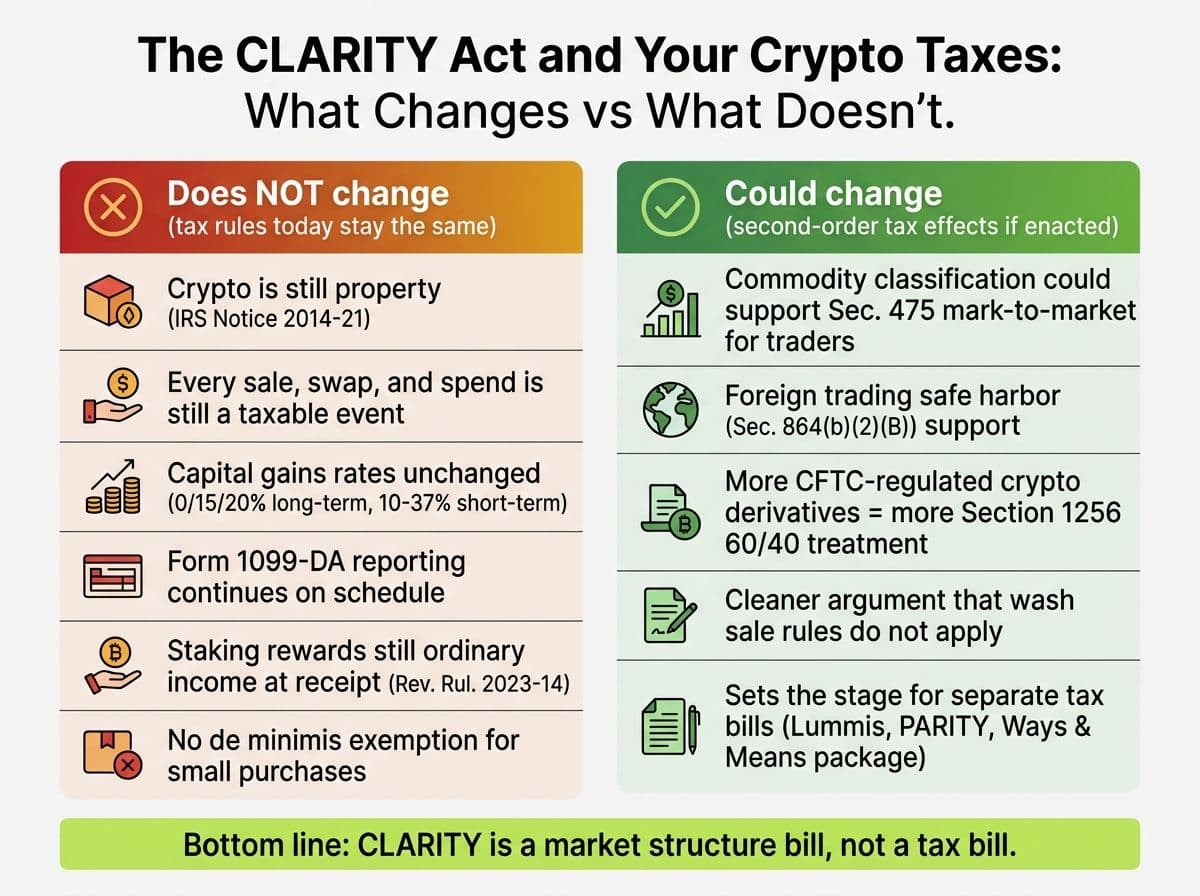
So let's be painfully specific. If the CLARITY Act becomes law, all of the following stay exactly the same:
- Crypto is still property. Every sale, swap, and purchase with crypto is still a disposal that goes on Form 8949 and Schedule D.
- Capital gains rates are unchanged. Short-term gains still hit ordinary rates of 10 to 37 percent. Long-term gains still land at 0, 15, or 20 percent, plus the 3.8 percent net investment income tax for higher earners.
- Crypto-to-crypto trades are still taxable. Swapping ETH for SOL was taxable before CLARITY and is taxable after.
- Staking rewards are still ordinary income at receipt under Revenue Ruling 2023-14. CLARITY does not touch this.
- Form 1099-DA keeps rolling out on schedule. Brokers began reporting gross proceeds for 2025 transactions (those forms landed in early 2026), and cost basis reporting starts with covered assets acquired on or after January 1, 2026. That timeline comes from IRS final regulations, not from CLARITY, and it does not pause while the Senate debates.
- Per-wallet basis tracking under Revenue Procedure 2024-28 still applies. No relief in this bill.
- There is still no de minimis exemption. Buying a sandwich with bitcoin still technically triggers a capital gain calculation.
Let's make it concrete.
Imagine Sarah swaps 2 ETH for SOL in October 2026. She bought the ETH at $2,100 each and it's worth $3,400 each at the swap. Whether or not the CLARITY Act passed the Senate that summer, Sarah has a $2,600 capital gain ($6,800 value received minus $4,200 basis), reportable on Form 8949. If she held over a year, it's long-term. Nothing about the Senate vote changes a single number in that calculation.
Pro Tip
The early-2026 wave of 1099-DA forms is the tax event that actually matters this year, and it has nothing to do with CLARITY. Most of those forms show gross proceeds with blank or zero cost basis, because basis reporting only covers assets acquired in a broker account on or after January 1, 2026. To the IRS matching computer, a blank-basis sale looks like 100 percent gain. If your reconciliation is sloppy, you will look like you made money you never made. Fix your transaction history before the IRS fixes it for you.
Related reading: what to do when your 1099-DA arrives and full 2026 crypto tax rules.
Action step: file your 2026 return under current law: property treatment, Form 8949, ordinary income for staking and mining. Do not let a pending bill change how you file. Pending is not passed.
The Real Tax Effects: What the CLARITY Act Could Actually Change
Now for the part the law firm memos cover in dense footnotes and the crypto blogs skip entirely.
The CLARITY Act doesn't amend the tax code, but tax law doesn't operate in a vacuum. Several provisions of the Internal Revenue Code turn on whether an asset is a "commodity" or a "security." When Congress declares that a class of digital assets sits under exclusive CFTC jurisdiction, that declaration becomes evidence in those tax arguments.
Here's the honest, second-order analysis.
Trader tax status and the Section 475 mark-to-market question
This is the one with the most money attached for active traders.
Section 475 of the tax code lets dealers and traders in securities and commodities elect mark-to-market accounting. A valid 475 election converts capital gains and losses to ordinary, which does three big things:
- Kills the $3,000 capital loss limitation. Ordinary losses deduct in full against other income.
- Exempts you from wash sale rules.
- May unlock the 20 percent qualified business income (QBI) deduction on trading income, subject to thresholds.
Here's the problem today: spot crypto is property, not a security or commodity in the tax code's eyes, so crypto traders generally cannot make a 475 election on spot holdings. A trader can still qualify for trader tax status (which unlocks business expense deductions), but the mark-to-market layer is off the table.
Enter the CLARITY Act. If digital commodities sit under exclusive CFTC jurisdiction by statute, the argument that they're "commodities" for Section 475 purposes gets meaningfully stronger. Tax practitioners at major firms have flagged exactly this. But two honest caveats:
- The IRS is not required to defer to the CFTC. Whether the Service accepts CFTC jurisdiction as controlling for tax classification is untested. Expect guidance fights.
- Section 475 also requires the specific commodity to be "actively traded" on an "established financial market." That's a token-by-token test. As of mid-2026, CME lists regulated futures on nine cryptocurrencies: bitcoin, ether, solana, XRP, cardano, chainlink, stellar, avalanche, and sui (the last two added in late May 2026). Those majors have a strong active-trading argument. Your favorite micro-cap does not.
Worked example. Marcus is a full-time crypto trader with 4,000 trades a year. In a bad year he loses $180,000. Under current law those are capital losses: he offsets any capital gains, deducts $3,000 against ordinary income, and carries the rest forward, possibly for decades. If digital commodities become 475-eligible and Marcus has a valid election in place, that $180,000 is an ordinary loss, fully deductible against his other income in the year it happens. At a 35 percent marginal rate, the timing difference alone is worth over $60,000 in current-year tax.
Pro Tip
Section 475 elections are due by the original due date of the prior year's return (April 15 for individuals, March 15 for existing partnerships and S corps) and generally can't be made retroactively. If commodity classification firms up, the traders who win will be the ones who already talked to a CPA about entity structure and election timing. This is a conversation to have before the law changes, not after.
Related reading: do you qualify for trader tax status? Talk to a crypto CPA.
The foreign trading safe harbor (Section 864(b)(2)(B))
This one matters for offshore funds and non-U.S. investors, and it's quietly one of the biggest institutional stakes in the bill.
Section 864(b)(2)(B) lets non-U.S. persons trade commodities through U.S. brokers or managers without being treated as engaged in a U.S. trade or business (which would drag them into net-basis U.S. taxation). The catch: the commodities must be "of a kind customarily dealt in on an organized exchange."
The IRS has historically read "of a kind" broadly. So if the CLARITY Act's grant of CFTC spot-market jurisdiction is respected for tax purposes, the safe harbor would likely cover trading in digital commodities as a class, including tokens that don't themselves trade on a CFTC-regulated exchange.
Translation: offshore capital gets a much cleaner legal path to trade U.S. crypto markets through U.S. managers. That's a liquidity story for the market and a structuring opportunity for funds, and it's a big part of why institutional players are lobbying hard for this bill.
Section 1256 and regulated crypto derivatives
Here's a subtlety most coverage misses: the CLARITY Act excludes derivatives from the digital commodity definition. Futures, options, and swaps on crypto stay under existing CFTC derivatives rules.
Why does that matter for taxes? Because Section 1256 contracts (regulated futures contracts traded on a qualified exchange) already get the best deal in the tax code:
- 60/40 treatment: 60 percent of gains taxed as long-term, 40 percent short-term, regardless of holding period
- Annual mark-to-market on Form 6781 (no lot tracking)
- No wash sale rules
CME bitcoin and ether futures already qualify today. The CLARITY Act's real effect here is indirect: by giving the CFTC a full spot-market regime, it accelerates the buildout of regulated U.S. crypto derivatives markets. More CFTC-regulated venues and more listed contracts mean more instruments that qualify for Section 1256 treatment.
Run the numbers. A trader with a $100,000 gain on offshore perps held under a year pays short-term rates: at 35 percent, that's $35,000. The same $100,000 gain in CME-regulated futures under Section 1256 splits 60/40: $60,000 at the 20 percent long-term rate ($12,000) plus $40,000 at 35 percent ($14,000) equals $26,000. Same profit, $9,000 less tax, purely because of which venue and instrument produced it.
Related reading: how crypto perpetual futures are taxed and Section 1256 contracts explained.
Wash sale rules: the classification question with real money attached
The wash sale rule (Section 1091) disallows a loss when you sell a security and buy it back within 30 days. Note the word: security.
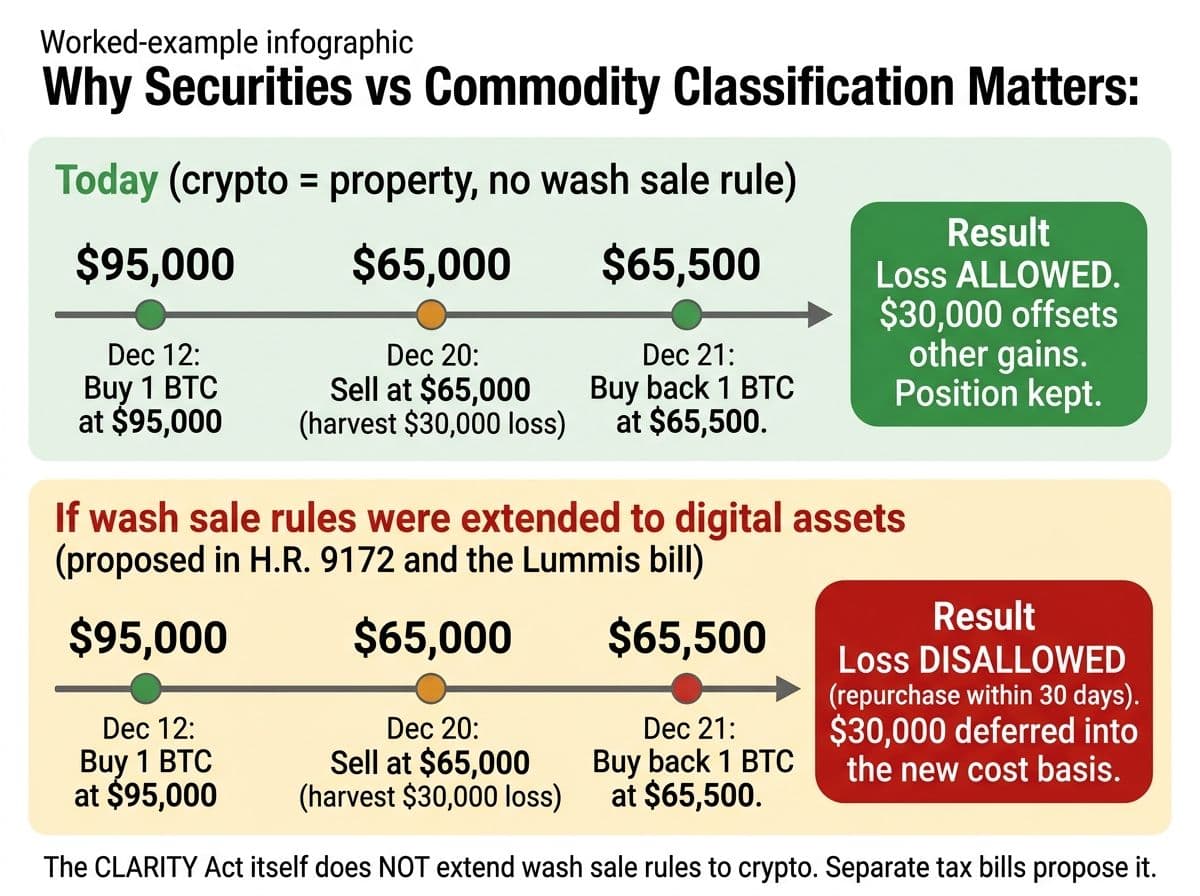
Because the IRS treats crypto as property, wash sale rules do not currently apply to crypto. You can sell bitcoin at a loss on Tuesday, buy it back Wednesday morning, and keep the loss. It's the single most powerful legal tax play in crypto.
Here's how the CLARITY Act cuts, and it may surprise you: it arguably protects that loophole for digital commodities. A statute declaring BTC-style assets to be commodities under CFTC jurisdiction makes it even harder to argue they're "securities" for Section 1091. Assets classified as investment contract assets under SEC jurisdiction sit closer to the securities line, though tax treatment would still follow the Code, not the SEC's label.
But don't get comfortable. Congress knows the loophole exists, and separate bills would close it directly: the Lummis tax bill proposes extending wash sale rules to digital assets, and H.R. 9172 in the House Ways and Means package (more on it below) does the same. When one of those passes, the play dies on that bill's effective date, regardless of what CLARITY says.
Worked example. You bought 1 BTC at $95,000. In December it trades at $65,000. You sell, harvest the $30,000 loss against your other gains, and rebuy the next morning at $65,500. Under current law: loss allowed, position kept, roughly $4,500 saved at a 15 percent long-term rate (more against short-term gains). Under a wash-sale extension: loss disallowed and deferred into your new basis. Same trade, wildly different outcome, decided entirely by which bill passes.
Related reading: crypto wash sale rules in 2026.
Broker definitions and information reporting
The tax code's broker reporting regime (the one that produces Form 1099-DA) was built by the 2021 infrastructure law and IRS final regulations, and it runs on its own track. But market structure and tax reporting feed each other. A CLARITY-driven registration regime creates a clean roster of CFTC-registered digital commodity brokers and dealers, which makes the IRS's matching job easier and widens the net of platforms that clearly owe customers (and the IRS) a 1099-DA.
The practical takeaway isn't that reporting rules change. It's that the era of invisible crypto activity is ending from two directions at once: tax regulations already in force, and market structure rules about to be.
Staking, DeFi, and the classification ripple
Nothing in the CLARITY Act changes Revenue Ruling 2023-14: staking rewards are ordinary income at fair market value when you gain control of them.
What CLARITY does do is define, for regulatory purposes, when DeFi protocols and infrastructure operators (validators, node runners, self-custody wallet developers) are NOT treated as intermediaries. That regulatory breathing room matters for the industry's plumbing, and it sharpens a tax question Congress is now taking seriously in separate bills: should someone who earns rewards for securing a network be taxed like they received a paycheck, or like they created property? The Lummis bill and the Ways and Means package both propose moving staking and mining toward taxation at sale rather than at receipt. CLARITY sets the vocabulary; the tax bills would change the answer.
Related reading: how staking rewards are taxed today and DeFi tax rules in 2026.
State-level effects
State tax generally piggybacks on federal classification, so property treatment flows through to state returns today and keeps flowing through after CLARITY. The state action to watch is indirect: a federal market structure law gives states a template for their own money transmission and digital asset statutes, and states with income taxes will inherit whatever Congress eventually does on wash sales, de minimis exemptions, and staking timing. If you're planning a move to a zero-income-tax state before a big disposal, that math is unchanged by this bill.
Action steps for this section:
- If you trade at volume, get evaluated for trader tax status now and map out what a 475 election would look like if commodity classification firms up.
- If you trade derivatives, compare your venue: regulated 1256 contracts can beat offshore perps after tax even at identical gross returns.
- If you're sitting on unrealized losses, understand the wash sale window may not stay open. Harvesting under current law is legal today.
- If you're a non-U.S. person or run offshore capital, watch the 864(b) analysis closely. The safe harbor question is worth real structuring money.
CLARITY Act vs GENIUS Act vs the Lummis Tax Bill
Three bills, one giant ball of confusion. Clients send us headlines about all three as if they're the same thing. They are not, and the differences decide whether your taxes change.
CLARITY Act vs GENIUS Act vs Lummis Tax Bill (as of July 2026)
| CLARITY Act | GENIUS Act | Lummis Tax Bill | |
|---|---|---|---|
| Full name | Digital Asset Market Clarity Act (H.R. 3633) | Guiding and Establishing National Innovation for U.S. Stablecoins Act | Digital asset tax legislation (Sen. Cynthia Lummis) |
| What it covers | Market structure: SEC vs CFTC jurisdiction, exchange and broker registration, mature blockchain test | Stablecoins: who can issue them, 1:1 reserves, redemption rights, oversight | Taxes: how crypto gains and income are taxed |
| Status (July 2026) | Passed House 294-134 (July 17, 2025); cleared Senate Banking May 14, 2026; awaiting Senate floor vote | LAW. Signed July 18, 2025. Agencies missed the July 2026 rulemaking deadline; full effect by January 18, 2027 or 120 days after final rules | Introduced July 2025; in committee; de minimis push renewed March 2026 |
| Changes your taxes? | Not directly. Second-order effects on 475, 864(b), 1256, wash sale arguments | No. Regulatory only (stablecoin trades remain taxable property disposals) | Yes: $300 de minimis exemption, staking/mining taxed at sale, wash sale extension |
| Who should care most | Exchanges, token projects, active traders, funds | Stablecoin issuers, fintechs, payment companies | Every single crypto taxpayer |
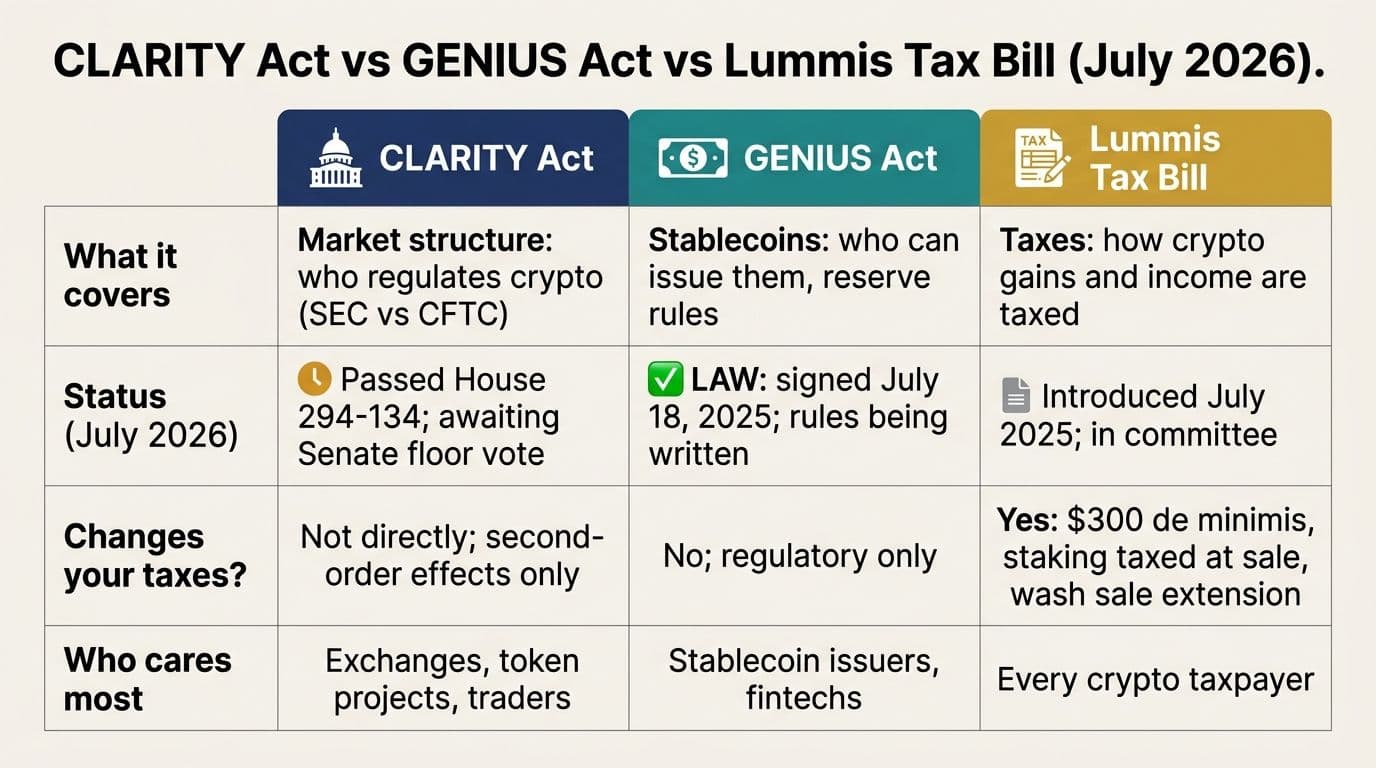
Three things worth underlining.
The GENIUS Act is already law, signed July 18, 2025, one day after CLARITY passed the House. That's why the two are permanently glued together in people's memories. But GENIUS is stablecoin plumbing. And no, it did not make stablecoin transactions tax-free: converting crypto to USDC is still a taxable disposal, and spending a stablecoin that has drifted from your cost basis still technically creates gain or loss.
The Lummis bill is the one that would show up on your Form 1040. Senator Lummis introduced standalone digital asset tax legislation in July 2025 proposing, among other things: a $300 per-transaction de minimis exemption for personal purchases (capped at $5,000 of exempted gains per year, and notably NOT covering conversions to cash or stablecoins), taxing staking and mining rewards when sold instead of when received, and extending wash sale rules to digital assets. As of July 2026 it remains in committee, with the de minimis concept under review by both the Senate Finance Committee and House Ways and Means.
The sequencing matters. Washington's working assumption, echoed by tax policy watchers all year, is that market structure goes first and tax reform follows. A Senate CLARITY passage this summer is probably the starting gun for serious crypto tax legislation, not the end of the story.
Example of what the Lummis bill would actually fix: you buy a $6 coffee with bitcoin you acquired years ago at a fraction of the price. Under current law, that purchase is a property disposal: you're supposed to compute the gain on $6 of bitcoin (maybe $4.75 of it is gain) and report it. Multiply by every small purchase all year. Under the Lummis de minimis rule, purchases with gains under $300 simply wouldn't be reportable, up to the annual cap. That single change is what would make crypto usable as actual money.
The Other Crypto Tax Bills to Watch in 2026
Here's the part of the landscape that almost no consumer-facing coverage has caught up with. While everyone watches the CLARITY floor vote, the actual crypto tax reform pipeline filled up in May and June 2026.
The PARITY Act (introduced May 19, 2026)
The bipartisan Digital Asset Protection, Accountability, Regulation, Innovation, Taxation and Yields Act (yes, they tortured the acronym) was introduced in the House on May 19, 2026. It attacks the exact questions CLARITY leaves dangling:
- A statutory trading safe harbor for digital assets (the 864(b) fix, done directly instead of by inference)
- Extending the mark-to-market election to dealers and traders in "actively traded digital assets" (the Section 475 fix, done directly)
If PARITY passes, traders stop needing the "does the IRS respect CFTC jurisdiction?" argument entirely. The answer gets written into the Code.
The Ways and Means package (June 9, 2026)
On June 9, 2026, the House Ways and Means Committee unveiled a coordinated set of digital asset tax bills ahead of a legislative hearing. This is the most concrete crypto tax activity Congress has ever produced, so here's the whole slate:
The June 2026 Ways and Means Digital Asset Tax Bills
| Bill | What it would do |
|---|---|
| H.R. 9178 (Less Tax Paperwork for Digital Asset Owners Act) | Exclude gain/loss on network fees and on regulated U.S. dollar stablecoins; create a simplified accounting election |
| H.R. 9175 (Tax Clarity for Mining and Staking Act) | Confirm newly minted tokens are ordinary income but allow an election to treat them like self-created property (deferring tax toward sale) |
| H.R. 9173 (Charitable Deductions for Digital Asset Donations Act) | Drop the qualified appraisal requirement for donated digital assets with reliable market prices |
| H.R. 9176 (PAR Act) | Extend the foreign trading safe harbor and securities-lending-style nonrecognition to digital assets; allow dealer/trader mark-to-market |
| H.R. 9174 (Digital Assets Voluntary Disclosure Program Act) | Create a one-time voluntary disclosure program with reduced penalties for taxpayers with past crypto noncompliance |
| H.R. 9172 (Applying Existing Tax Anti-Abuse Rules to Digital Assets Act) | Extend wash sale and constructive sale rules to digital assets |
Notice the trade embedded in that package: taxpayers get de minimis-style relief, staking timing fixes, easier donations, and an amnesty program. The government gets the wash sale loophole closed. That's the shape of the eventual deal.
Pro Tip
All six of these are proposals as of July 2026. None has passed either chamber. We include them because they tell you exactly where the puck is going: less paperwork for small transactions, staking taxed closer to sale, and the end of loss harvesting with instant buybacks. Plan with that direction in mind, but file under the law that exists.
And the IRS keeps moving regardless
While Congress debates, the enforcement machinery already in motion keeps running: 1099-DA gross proceeds reporting live now, basis reporting for covered assets acquired from January 1, 2026, per-wallet basis tracking under Revenue Procedure 2024-28, and the digital asset question staring at you from the top of Form 1040. None of it waits for a market structure vote.
Related reading: cost basis methods and the per-wallet rules.
What Happens Next: Three Scenarios
Nobody can tell you how the Senate votes. But we can tell you what each outcome means for your taxes, which is the part you can actually plan around.
Scenario 1: CLARITY passes before the August 2026 recess. The Senate version differs from the House bill, so the chambers reconcile, the President signs (he has publicly pushed for it), and then the real work starts: SEC and CFTC rulemaking, registration windows, and phased effective dates that play out over one to two years. Your 2026 return is still filed under property rules. The tax action shifts to the follow-on bills (PARITY, Ways and Means, Lummis), which suddenly have momentum.
Scenario 2: it slips past the recess. The bill lands in midterm season, where controversial floor time evaporates. Regulatory limbo continues, enforcement-by-lawsuit continues, and the tax bills likely stall too, since leadership has signaled market structure goes first. Your filing obligations: unchanged.
Scenario 3: it fails outright. The status quo hardens: SEC/CFTC turf ambiguity, offshore migration, and a tax code that keeps treating crypto as property with no de minimis relief. Also unchanged for your return.
Catch the pattern? In all three scenarios, your 2026 tax return looks the same. The scenarios differ in what you should be planning for 2027 and beyond, not in what you file next April.
“Clients keep asking me to plan around the CLARITY Act. I tell them the same thing every time: plan around the 1099-DA sitting in your mailbox, because that one is real, and the IRS computer reads it whether or not the Senate ever votes.”
, Garrett Taylor, CPA
What You Should Do Now (Whether or Not It Passes)
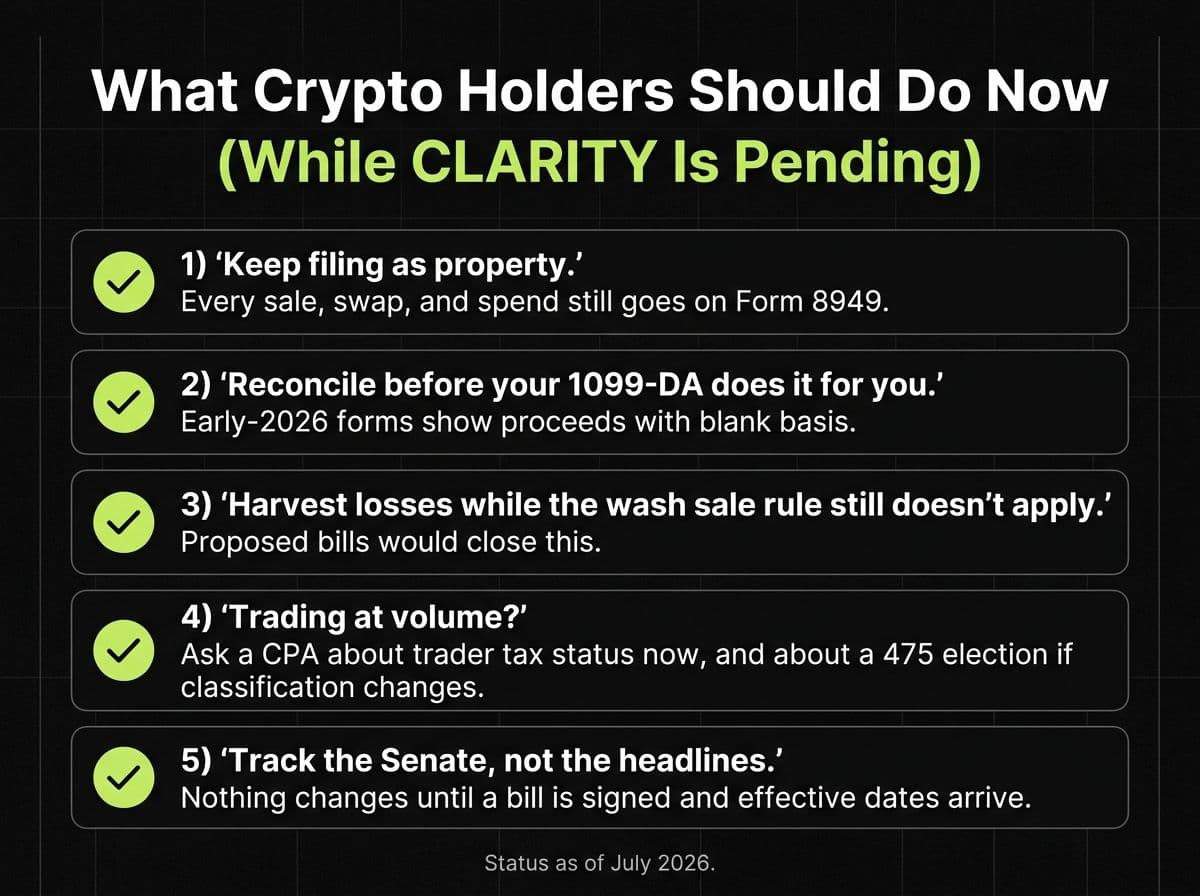
Here's your five-step playbook while Congress finishes the job.
1. Keep filing as property. Every disposal on Form 8949, staking and mining as ordinary income, the digital asset question answered honestly. Pending legislation is not a filing position.
2. Reconcile before your 1099-DA does it for you. Early-2026 forms mostly report proceeds with blank basis. Build your complete transaction history now, across every exchange and wallet, so the IRS matching program sees your real gain instead of assuming it's all gain. If your records are a mess, that's a solvable problem, but it's solvable faster before a notice arrives.
3. Harvest losses while the window is open. Wash sale rules still don't apply to crypto as of July 2026. Both the Lummis bill and H.R. 9172 would close that window. Losses you harvest legally today don't get retroactively disallowed by a future bill under any current proposal.
4. If you trade at volume, get ahead of the 475 question. Trader tax status evaluations, entity structure, and election timing all take lead time. The traders who benefit from commodity classification will be the ones whose paperwork was ready.
5. Track the Senate, not the headlines. The only two events that change anything are a Senate passage plus presidential signature (market structure) and a tax bill actually moving through Ways and Means or Senate Finance (your return). Everything else is noise.
Get Ahead of the Rule Changes
Whether the CLARITY Act passes next week or never, your 1099-DA, your loss harvesting window, and your trader tax status questions are live right now. Talk through your situation with a CPA who works in crypto every day.
Book a callFree 15 minute call. No commitment.
FAQ: The CLARITY Act and Crypto Taxes
This article is for educational purposes and is not tax, legal, or investment advice. Legislative status is described as of July 21, 2026 and will change. Talk to a licensed professional about your specific situation.
Frequently Asked Questions
What is the CLARITY Act in simple terms?
The CLARITY Act (Digital Asset Market Clarity Act, H.R. 3633) is a bill that decides which federal agency regulates crypto. It sorts digital assets into three buckets: digital commodities regulated by the CFTC, investment contract assets regulated by the SEC, and payment stablecoins covered by the GENIUS Act. It is a market structure bill, not a tax bill.
Did the CLARITY Act pass? Is it law in 2026?
No. The House passed it 294-134 on July 17, 2025, but the Senate failed to advance it on September 15, 2026, when a cloture vote fell short 49 to 50 (60 votes were needed). The bill is effectively dead for 2026. The realistic paths forward are the lame duck session after the November election or reintroduction in the next Congress.
Does the CLARITY Act change how crypto is taxed?
No, not directly. The IRS treats crypto as property under Notice 2014-21, and the CLARITY Act does not amend the tax code. Every sale, swap, and purchase with crypto remains a taxable event. Its tax effects are indirect, mainly by strengthening arguments that digital commodities qualify as commodities under certain tax code provisions like Section 475.
Does the CLARITY Act affect Form 1099-DA?
No. Form 1099-DA comes from the 2021 infrastructure law and IRS final regulations, on a separate track. Brokers reported gross proceeds for 2025 transactions on forms issued in early 2026, and cost basis reporting applies to covered assets acquired on or after January 1, 2026. That schedule continues regardless of the CLARITY Act.
Will the CLARITY Act lower my capital gains taxes on crypto?
No. Capital gains rates and the property classification are set by the Internal Revenue Code, which the CLARITY Act does not change. Bills that would actually change crypto tax outcomes include the Lummis tax bill and the House Ways and Means digital asset package introduced in June 2026.
What is the difference between the CLARITY Act and the GENIUS Act?
The GENIUS Act covers stablecoins and was signed into law on July 18, 2025. The CLARITY Act covers overall market structure (SEC vs CFTC jurisdiction) and is still pending in the Senate as of July 2026. Neither one changes how the IRS taxes crypto.
What is a digital commodity under the CLARITY Act?
A digital asset whose value is intrinsically linked to the use of a blockchain system, like bitcoin. The category excludes securities, stablecoins, and derivatives. Digital commodities would fall under exclusive CFTC jurisdiction for spot market trading.
What is the mature blockchain test?
The CLARITY Act's mechanism for deciding when a token can move from SEC to CFTC oversight. A project self-certifies to the SEC that its blockchain is decentralized: operating programmatically with no person or team in unilateral control or holding an outsized share. The SEC has 60 days to challenge a certification.
Does the CLARITY Act apply wash sale rules to crypto?
No. Wash sale rules still do not apply to crypto as of July 2026, and the CLARITY Act arguably reinforces that for digital commodities by classifying them as commodities rather than securities. Separate proposals, including the Lummis tax bill and H.R. 9172, would extend wash sale rules to digital assets.
Would the CLARITY Act change how staking rewards are taxed?
No. Staking rewards remain ordinary income at fair market value when received, under Revenue Ruling 2023-14. Separate bills, including the Lummis bill and H.R. 9175, propose taxing staking and mining rewards when sold instead of when received, but none has passed as of July 2026.
When would the CLARITY Act take effect if it passes?
Not immediately. The House and Senate versions would need to be reconciled and signed, then the SEC and CFTC would write implementing rules, with registration windows and phased effective dates expected to run one to two years after enactment. Tax filing obligations would be unchanged throughout.
Is there a crypto tax bill in Congress right now?
Yes, several. Senator Lummis's digital asset tax bill has been pending since July 2025. The bipartisan PARITY Act was introduced May 19, 2026. And the House Ways and Means Committee unveiled a six-bill digital asset tax package on June 9, 2026. None has become law as of July 2026.